OpenAI and Oracle turn cloud commitments into a faster enterprise path for models and Codex
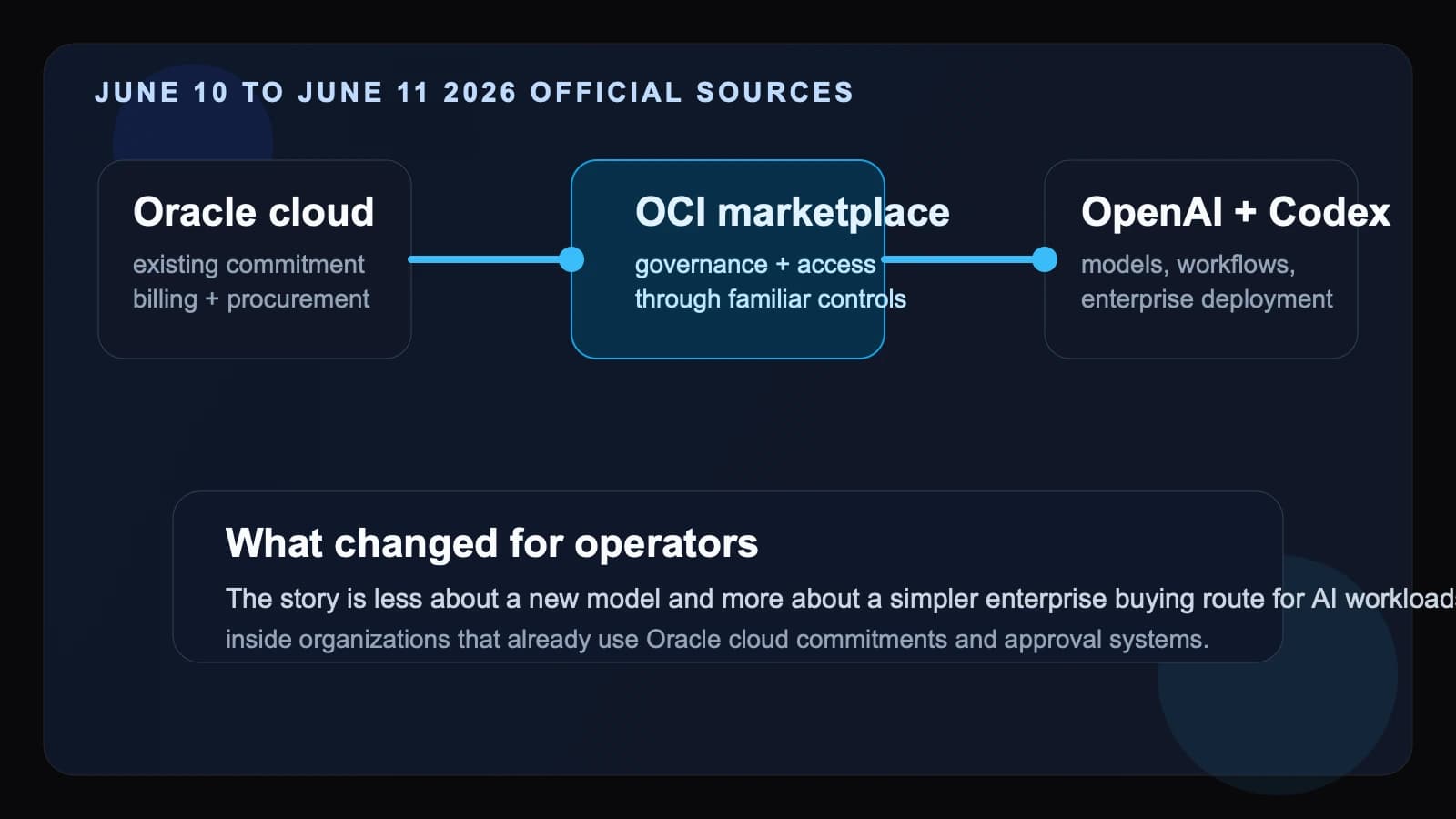
OpenAI said on June 10, 2026 that Oracle Cloud Infrastructure customers will soon be able to apply eligible Oracle Universal Credits toward OpenAI frontier models and Codex through OCI. Oracle reinforced the same message in an Oracle Marketplace post published on June 11, 2026, framing the move as a way to simplify procurement, align AI adoption with existing governance, and reduce operational friction. The practical shift is not that OpenAI released a new model. It is that one more enterprise bottleneck, buying and approving AI access inside an established cloud commitment, is being turned into a product surface.
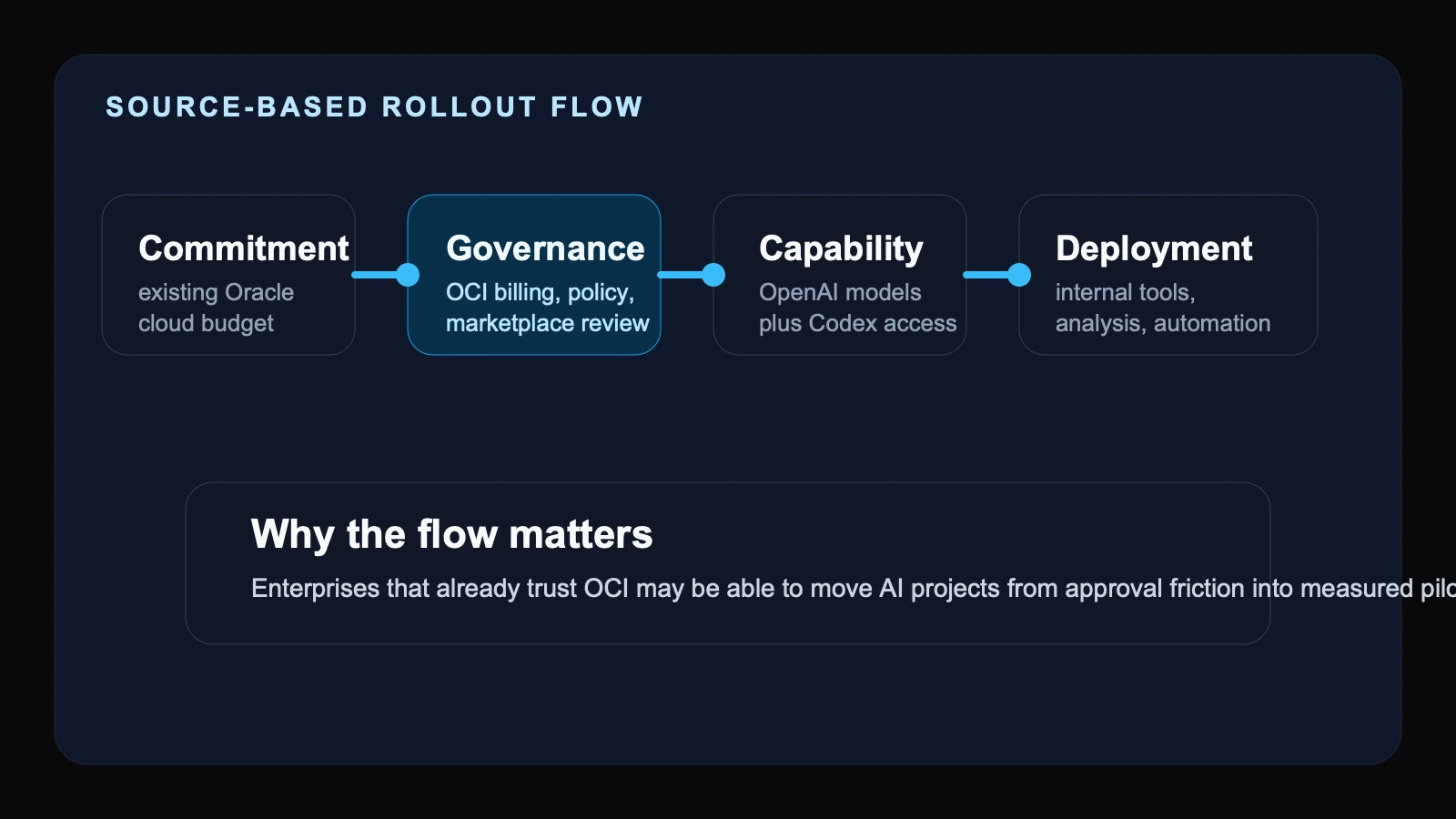
That matters because many AI rollouts do not stall on prompt quality alone. They stall when security, finance, procurement, and platform teams have to create a separate vendor path for experimentation, usage tracking, and policy review. If OpenAI models and Codex can be purchased through an existing Oracle relationship, some enterprises will be able to move from pilot discussion to production planning faster.
What changed
The official OpenAI announcement is narrow but important. OpenAI says Oracle customers will be able to use eligible Oracle Universal Credits for OpenAI models and Codex through OCI, and that availability will begin in the coming weeks rather than immediately on June 10. Oracle's June 11 Marketplace post adds the operator-facing detail: OpenAI frontier models and Codex via API will soon be purchasable through OCI Marketplace under existing billing and procurement processes.
| Confirmed June 10 to June 11 detail | Primary source | Why it matters in practice |
|---|---|---|
| Eligible Oracle Universal Credits will be usable for OpenAI models and Codex through OCI. | OpenAI announcement, June 10, 2026 | AI access can fit into an already approved cloud spending structure instead of a new buying path. |
| Availability starts in the coming weeks, not immediately. | OpenAI announcement, June 10, 2026 | Teams should treat this as an announced route, not a fully live global rollout. |
| Oracle says OpenAI frontier models and Codex via API will soon be purchasable through OCI Marketplace. | Oracle Marketplace post, June 11, 2026 | Billing, procurement, and marketplace controls become part of the launch story. |
| Oracle says the route is meant to simplify procurement and align AI adoption with governance frameworks. | Oracle Marketplace post, June 11, 2026 | The announcement is as much about enterprise process fit as raw model access. |
| Oracle says availability and eligibility may vary. | Oracle Marketplace FAQ, June 11, 2026 | Regional, contractual, or account-level constraints may still slow broad rollout. |
The Oracle post is especially revealing because it explains the sales logic in plain language. Oracle says customers want a streamlined way to adopt AI without adding operational friction, and that buying OpenAI through OCI helps organizations align AI deployment with cloud strategy, governance frameworks, and existing operational processes. That is procurement language, but procurement language often determines which AI tools actually get deployed.
Why it matters
For marketing, growth, analytics, and digital operations teams, this is really a workflow availability story. OpenAI's June 10 post says teams can use the models to build AI applications, analyze complex information, automate workflows, and create customer and employee experiences. If those capabilities become easier to buy inside OCI, the internal question changes from "Can we justify another AI vendor path?" to "Which production workflows are worth formalizing first?"
That makes the announcement relevant well beyond engineering. Codex already moved toward cross-functional work in OpenAI's June 2 product expansion, where the company positioned it for analytics, creative, sales, and operations work. The Oracle route adds a different layer: distribution into enterprises that prefer to govern AI adoption through familiar cloud, billing, and approval systems.
There is also a budget discipline angle. Teams evaluating AI-powered reporting, content operations, internal tools, or campaign automation still need to compare cost, workflow speed, and review overhead. That is where practical tools like the Marketing ROI Calculator, Digital Marketing Budget Planner, and GEO Visibility Checklist are more useful than generic excitement. Access is only valuable when it improves a measurable operating loop.
Who is affected
The most affected groups are the ones that already have Oracle-centered infrastructure or procurement processes and want AI adoption without adding a new approval maze.
- Enterprise platform and procurement teams deciding whether AI spend should live inside an existing OCI commitment.
- Marketing operations and analytics teams that want governed access to model-backed reporting, scenario analysis, and internal tools.
- Software and automation teams evaluating Codex where vendor onboarding speed matters almost as much as model capability.
- Security and governance teams that prefer cloud marketplace controls, known billing paths, and contract alignment over fragmented pilot sprawl.
- Agency, consulting, and digital business leaders who need to know whether a client with Oracle spend now has a simpler path into OpenAI-backed workflows.
What to do next
Use the June 10 to June 11 announcement as a planning trigger, not as proof that every buying and access detail is already settled.
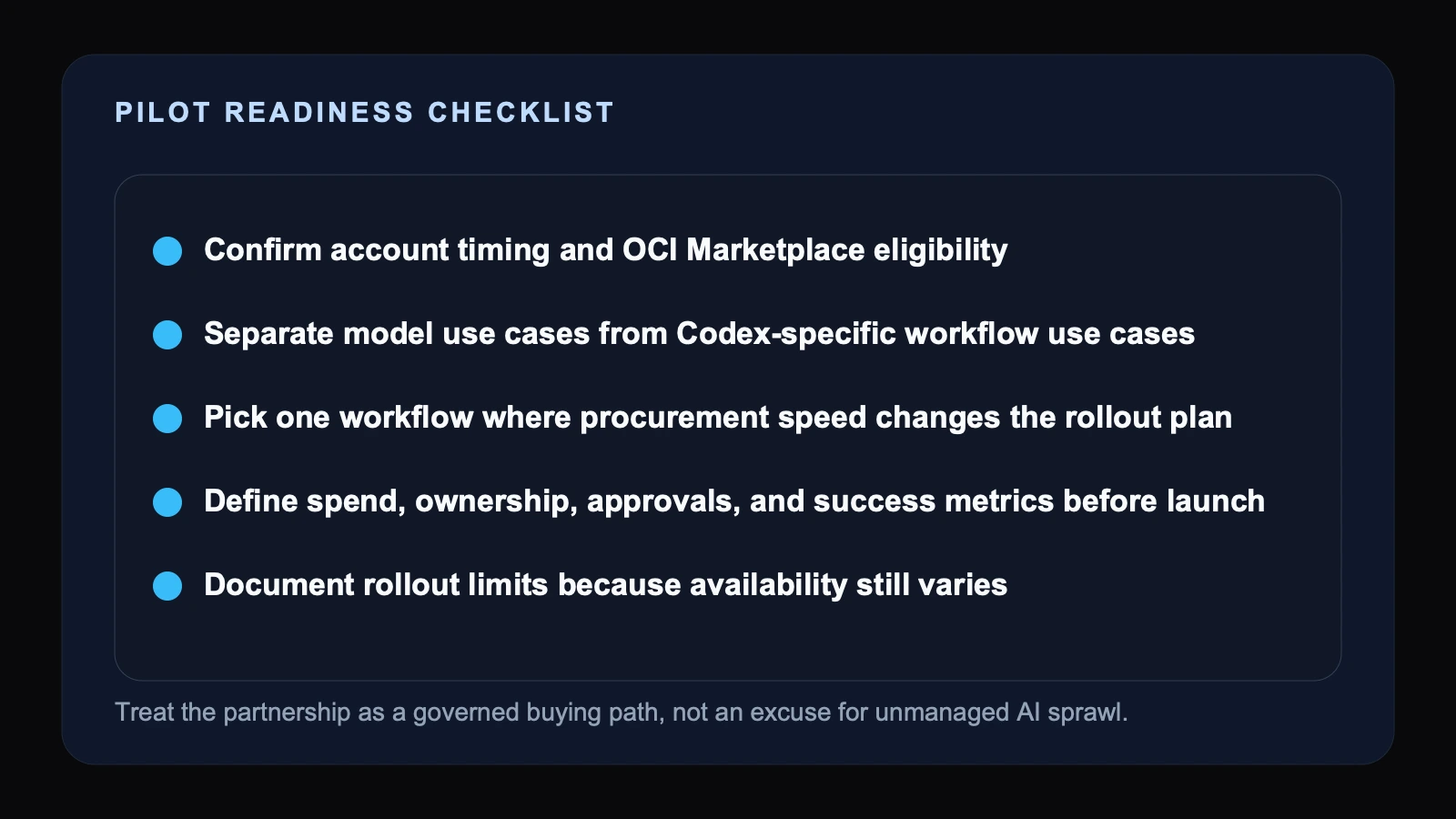
- Ask your Oracle account team which OCI Marketplace access path, eligibility rules, and timing apply to your account, because both OpenAI and Oracle say rollout starts in the coming weeks rather than immediately.
- Separate use cases into two buckets: model access for business workflows and Codex access for build, debugging, or internal tool work.
- Choose one workflow where faster procurement would change behavior, such as campaign reporting, internal microsite generation, data analysis, or support automation.
- Define approval, budget, and measurement rules before rollout so AI access does not become another unmanaged software line item.
- Tie any pilot to a concrete business question, then compare cost and speed against the current process instead of assuming that easier buying equals better outcomes.
What remains uncertain
The biggest limit is timing. OpenAI says availability will begin in the coming weeks, and Oracle says availability and eligibility may vary. That means no serious team should assume universal access, consistent pricing mechanics, or identical regional readiness on June 13, 2026.
There is also a scope question. Oracle's post says OpenAI frontier models and Codex via API will soon be purchasable through OCI Marketplace, but it does not publish a full public matrix of every service configuration, entitlement path, or implementation pattern. OpenAI similarly describes the route in broad terms and tells customers to contact their Oracle sales representative for timing and availability. In other words, the announcement confirms the direction, but not every operational detail.
The useful conclusion is narrower than the hype and stronger than a shrug. On June 10 and June 11, 2026, OpenAI and Oracle made AI procurement more actionable for enterprises that already live inside OCI commitments. The winners will probably be the teams that treat this as a governance and workflow acceleration story, not just a cloud-partnership headline.