Pinterest turns Amazon creator tagging into a native affiliate discovery path
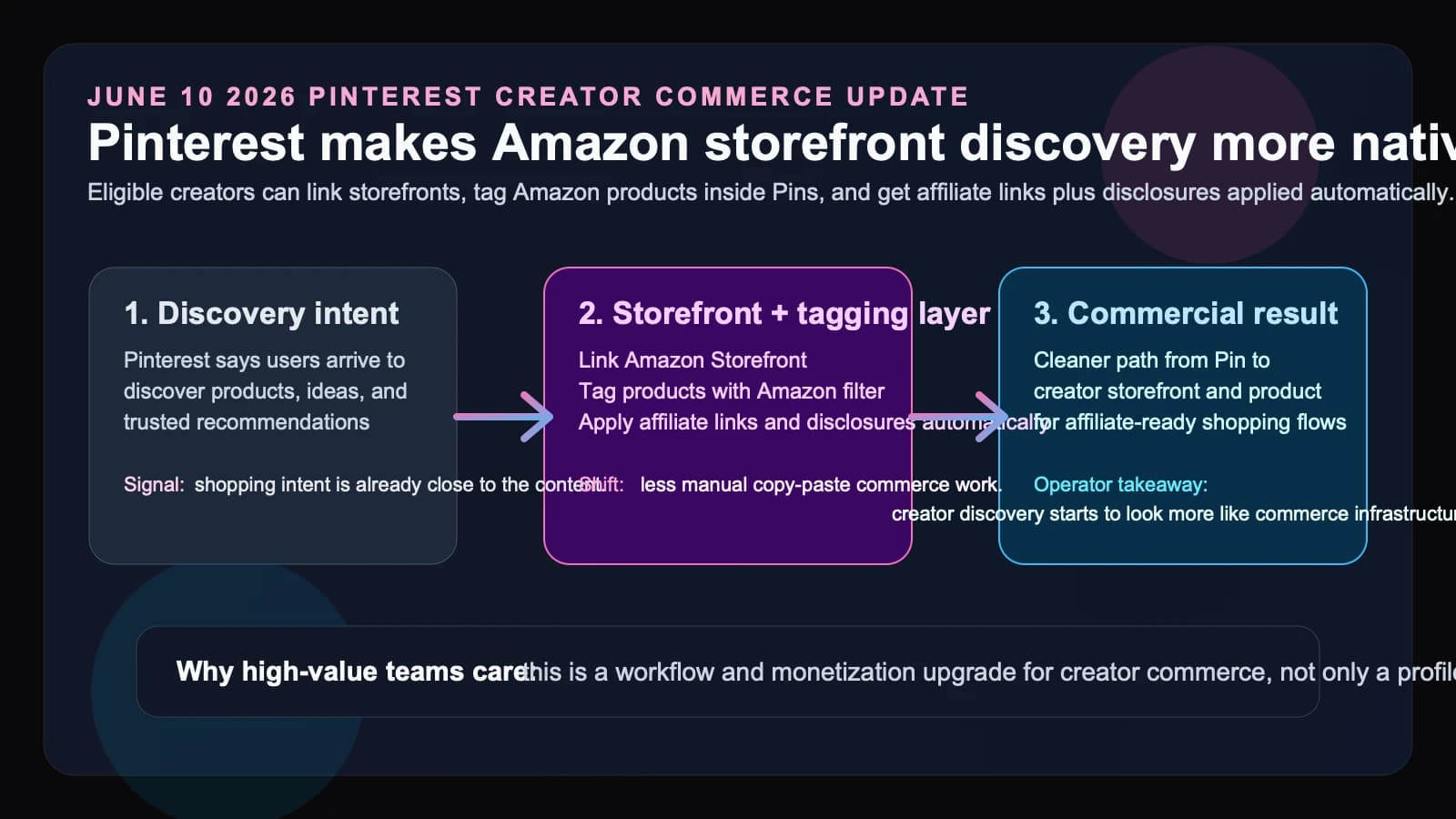
Pinterest said on June 10, 2026 that it is rolling out Amazon Storefront linking for creators, adding a more native path from product inspiration to affiliate-tagged purchase. The practical change is not just another social-commerce integration. According to Pinterest's official business help documentation, eligible creators can now link an Amazon Storefront to a Pinterest business account, tag Amazon products inside Pins, and have affiliate links plus disclosures applied automatically. For operators who manage creator programs, affiliate commerce, or discovery-led retail growth, that removes several manual steps that used to sit between content and conversion.
An official Pinterest executive post on LinkedIn published June 10, 2026 adds the commercial framing. Pinterest said more than 50% of its users come to the platform to shop and that people search Pinterest more than 80 billion times per month. If those figures hold, the Amazon connection matters because it gives creators a cleaner way to monetize high-intent discovery instead of sending users through more brittle affiliate workflows.
What changed
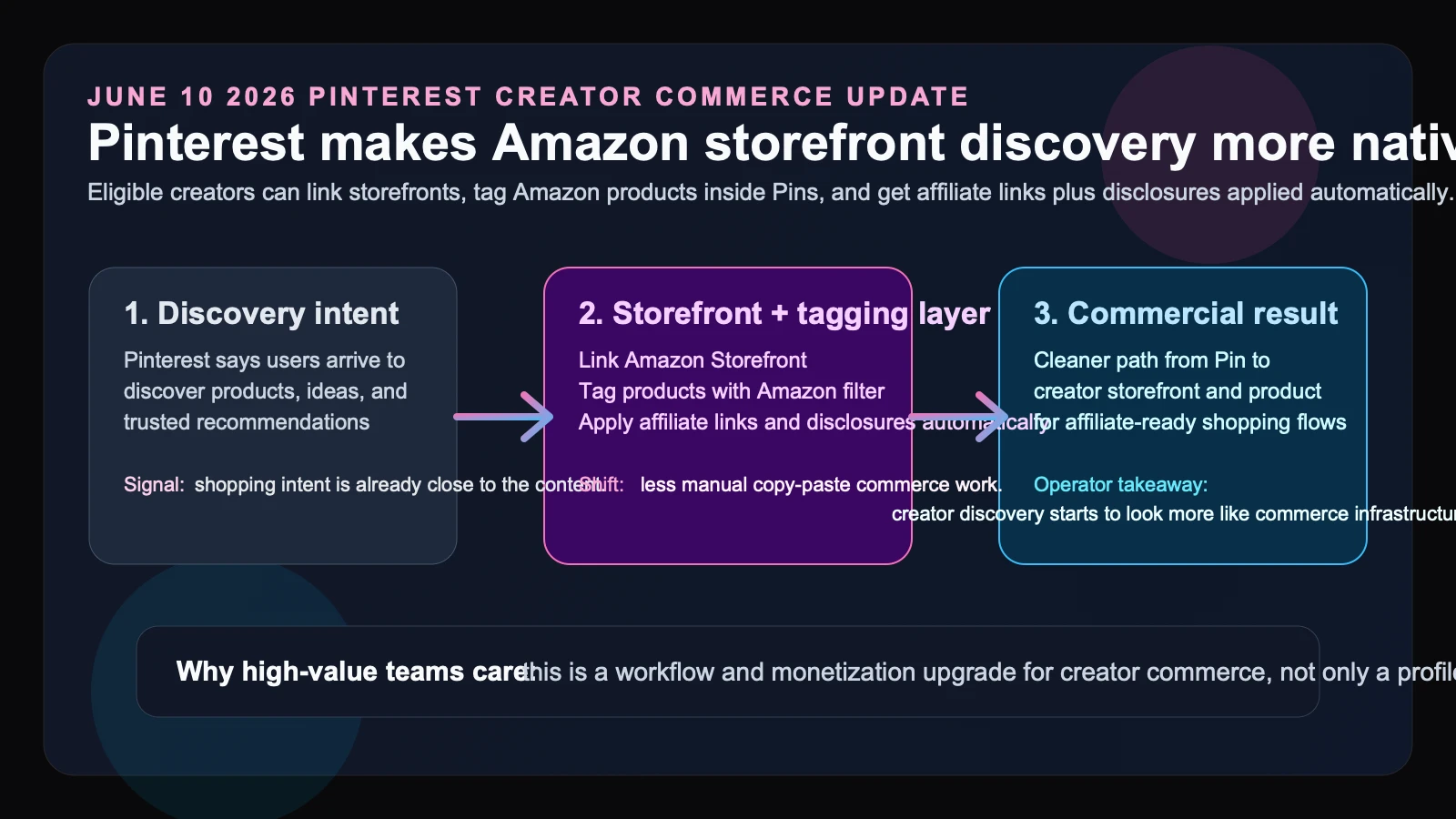
The official newsroom announcement says Pinterest has started rolling out Amazon Storefront linking for creators globally on June 10, 2026. Pinterest describes the move as a way to help users discover trusted product recommendations. The help documentation is more operationally specific. It says connecting Amazon and Pinterest is only available to eligible creators, and that creators who link an Amazon Storefront can surface that storefront on their Pinterest profile, use an Amazon filter when tagging products, and receive automatically applied affiliate links and affiliate-link disclosures.
Pinterest also published eligibility details that matter to teams planning creator programs. In the same help article, Pinterest says creators need a Pinterest business account, participation in the Amazon Influencer Program, and an Amazon Storefront that complies with Amazon policies. The documentation also says that if a creator has multiple storefront accounts, such as a U.S. and a Canadian one, Pinterest will automatically select the account that matches the Pinterest account's location.
| Confirmed June 2026 detail | Primary source | Why it matters |
|---|---|---|
| Pinterest rolled out Amazon Storefront linking for creators on June 10, 2026. | Pinterest Newsroom announcement | The story is a live platform change, not a speculative roadmap note. |
| Eligible creators can link an Amazon Storefront to a Pinterest business account. | Pinterest Business Help | The feature is account-linked infrastructure, not only a one-off campaign integration. |
| Tagged Amazon products receive affiliate links automatically, with disclosures added automatically. | Pinterest Business Help | This reduces manual affiliate-link work and lowers execution friction for creators and partner teams. |
| Creators must use a Pinterest business account and participate in the Amazon Influencer Program. | Pinterest Business Help and Amazon Influencer Program | Eligibility and policy compliance remain part of the operating model. |
| Pinterest said more than 50% of users come to the platform to shop, with over 80 billion monthly searches. | Official Pinterest executive social post | The integration is being aimed at a high-intent discovery surface, not passive feed traffic alone. |
Why it matters
The bigger point is workflow compression. Affiliate commerce on content platforms often breaks because too many steps stay manual: joining the right program, creating compliant links, inserting disclosures, tagging the right products, and making the creator profile itself feel commerce-ready. Pinterest's June 10 release tries to bundle several of those steps together inside a platform that already sits close to planning, wish-listing, and shopping intent.
That matters for marketers in retail, home, beauty, fashion, electronics, gifting, and lifestyle categories across the United States, Canada, the United Kingdom, Australia, and Europe. Creator-led discovery is useful only if the path from content to transaction is clear enough to scale. By tying Amazon Storefront identity, product tagging, affiliate monetization, and profile-level discovery together, Pinterest is making its creator surface look a bit more like commerce infrastructure and a bit less like a top-of-funnel inspiration layer.
There is also a measurement angle. Teams using the Marketing ROI Calculator and Digital Marketing Budget Planner should read this as another sign that content, affiliate media, and retail discovery are converging. If a creator Pin can lead more directly into tagged products and a recognized storefront, the right benchmark is not only engagement. It is incremental commerce efficiency, assisted discovery value, and whether Pinterest-originated creator activity earns more repeat budget than other affiliate or social channels.
Who is affected
The first group is creators already using Amazon storefronts who want a more stable way to monetize Pinterest-native content instead of relying on patched-together link workflows.
The second group is brand and affiliate teams that manage creator partnerships and need cleaner operational rules around tagging, compliance, and storefront attribution.
The third group is ecommerce and growth teams trying to understand how discovery surfaces are changing as platforms turn content closer to point-of-purchase media. That overlaps with the same discipline behind Slogan.website's GEO Visibility Checklist and the guide to tracking brand mentions and visibility: the value comes from making your products, claims, and commercial pathways easier for both people and systems to recognize.
What to do next
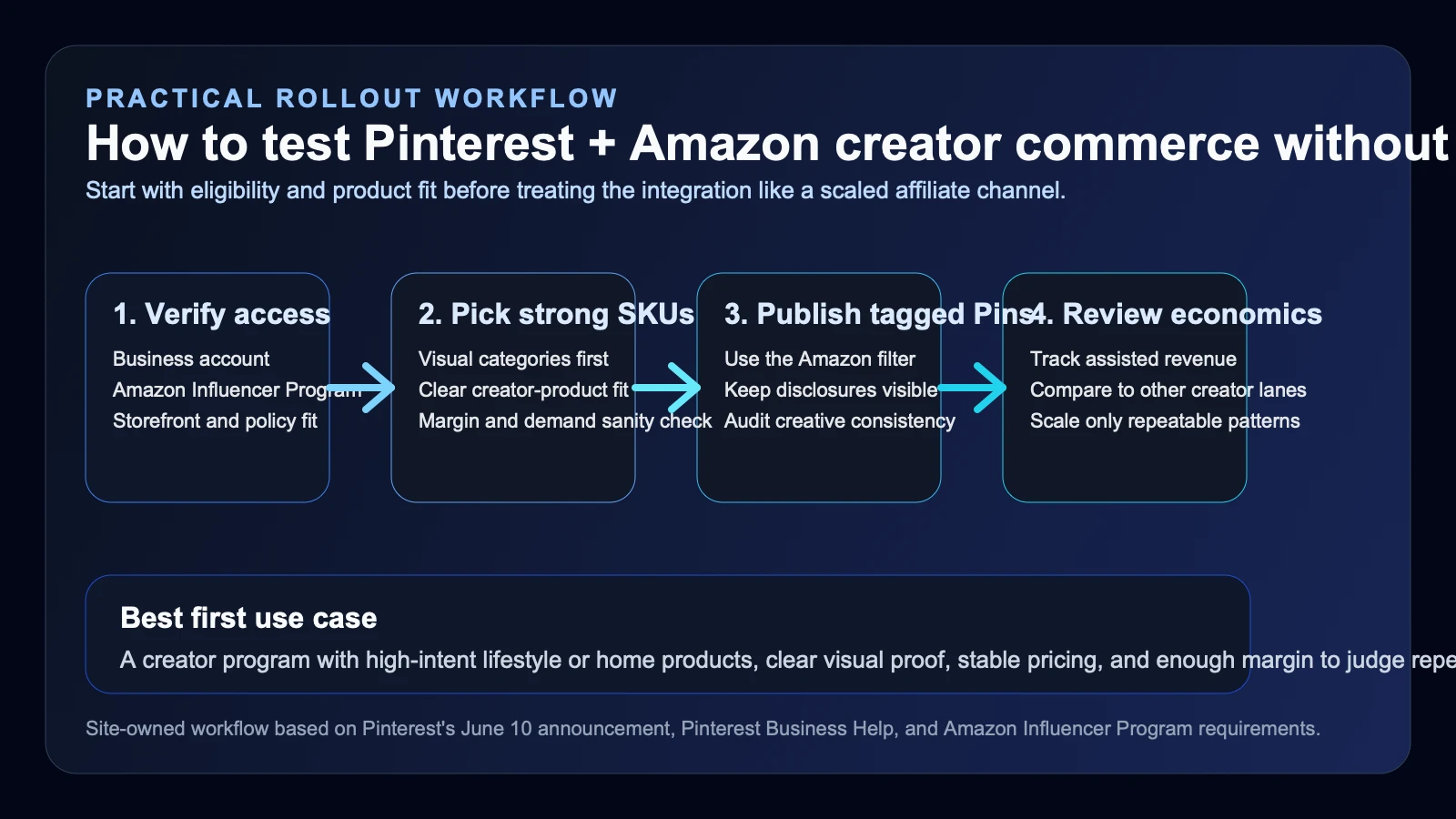
Treat the June 10 Pinterest update as an operational audit, not as a blanket reason to flood the platform with affiliate Pins.
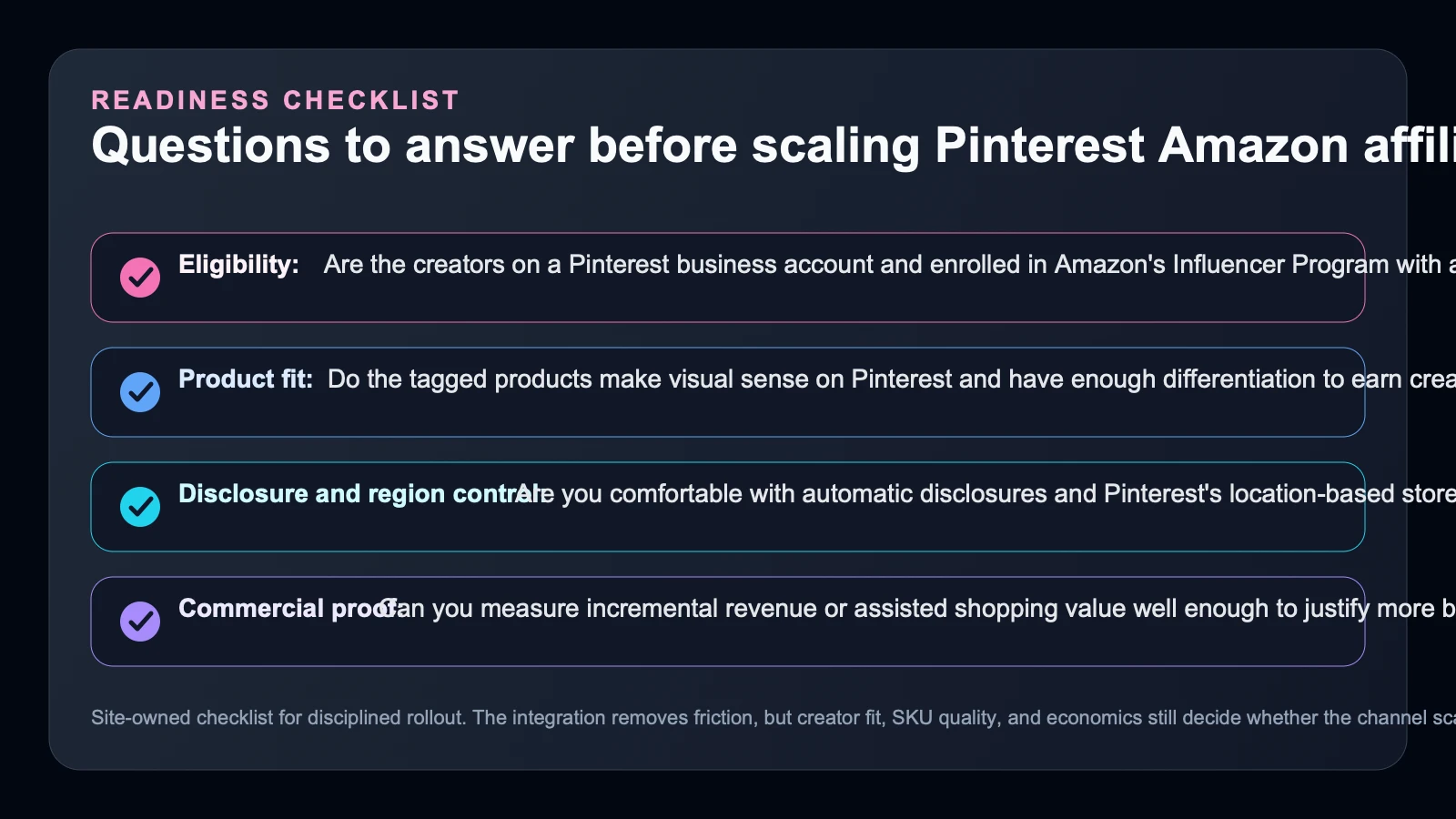
- Confirm whether your creator roster is actually eligible for the Pinterest + Amazon Storefront path, including Pinterest business account requirements and Amazon Influencer Program participation.
- Review which SKUs are strong enough for visual discovery so creators are not tagging commodity products with weak differentiation.
- Standardize storefront, disclosure, and product-tagging rules before you scale outreach, especially if creators operate across multiple regional Amazon accounts.
- Model the channel economics with the Digital Marketing Budget Planner and compare expected margin discipline with the Marketing ROI Calculator.
- Use Pinterest creator commerce as part of a broader discoverability system by aligning product pages, proof points, and public brand facts with your answer-engine and search visibility work.
What remains uncertain
Important limits remain visible as of June 14, 2026. Pinterest's public materials do not spell out detailed performance reporting fields, do not publish revenue-share economics, and do not explain how broadly the rollout is distributed across all creator segments on day one beyond saying it is available to eligible creators. The location-based storefront matching rule in the help documentation is also useful but restrictive, especially for teams that operate across multiple Amazon regions and want tighter account selection control.
There is another caution for operators. Pinterest's own framing is intentionally friction-reduction oriented. That does not guarantee strong results for every product category or creator fit. Teams should still test landing-page quality, creator trust, average order value, and repeatability before shifting meaningful budget. The strongest reading of the June 10 release is narrower: Pinterest is making affiliate-ready creator discovery more native, and that makes the channel more serious for teams that already know how to manage creator commerce with discipline.