Pinterest commits $4 billion to AWS to speed up AI visual search and shopping discovery
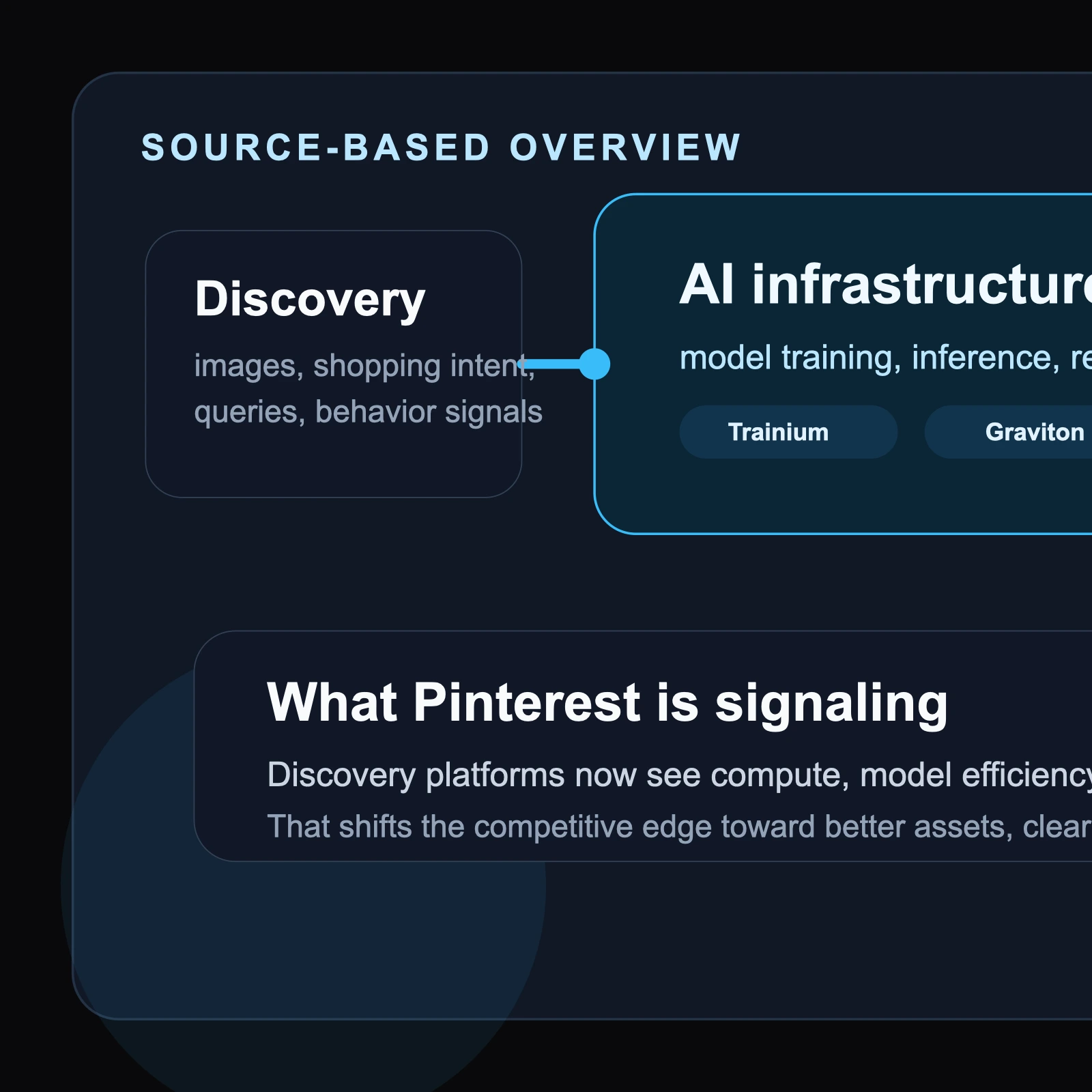
Pinterest used an official June 4, 2026 newsroom announcement to disclose a much bigger infrastructure move than a normal cloud-renewal headline. The company said it plans a $4 billion commitment to Amazon Web Services through 2031, calling it the largest infrastructure commitment in Pinterest's history, and tied the deal directly to faster AI work across visual search, shopping discovery, model training, inference, and platform modernization.
That matters because Pinterest is not positioning AI as a side assistant. It is treating AI infrastructure as the engine behind visual discovery, recommendation quality, and advertiser performance. In Pinterest's own May 4, 2026 Q1 earnings release, CEO Bill Ready said the company reached 631 million monthly active users, grew revenue 18% year over year to $1.008 billion, and was seeing momentum from visual search experiences and its AI-powered ads platform. Read together, the story is straightforward: Pinterest is spending infrastructure money now because it sees visual discovery and AI relevance as the monetization layer it needs to scale next.
What changed
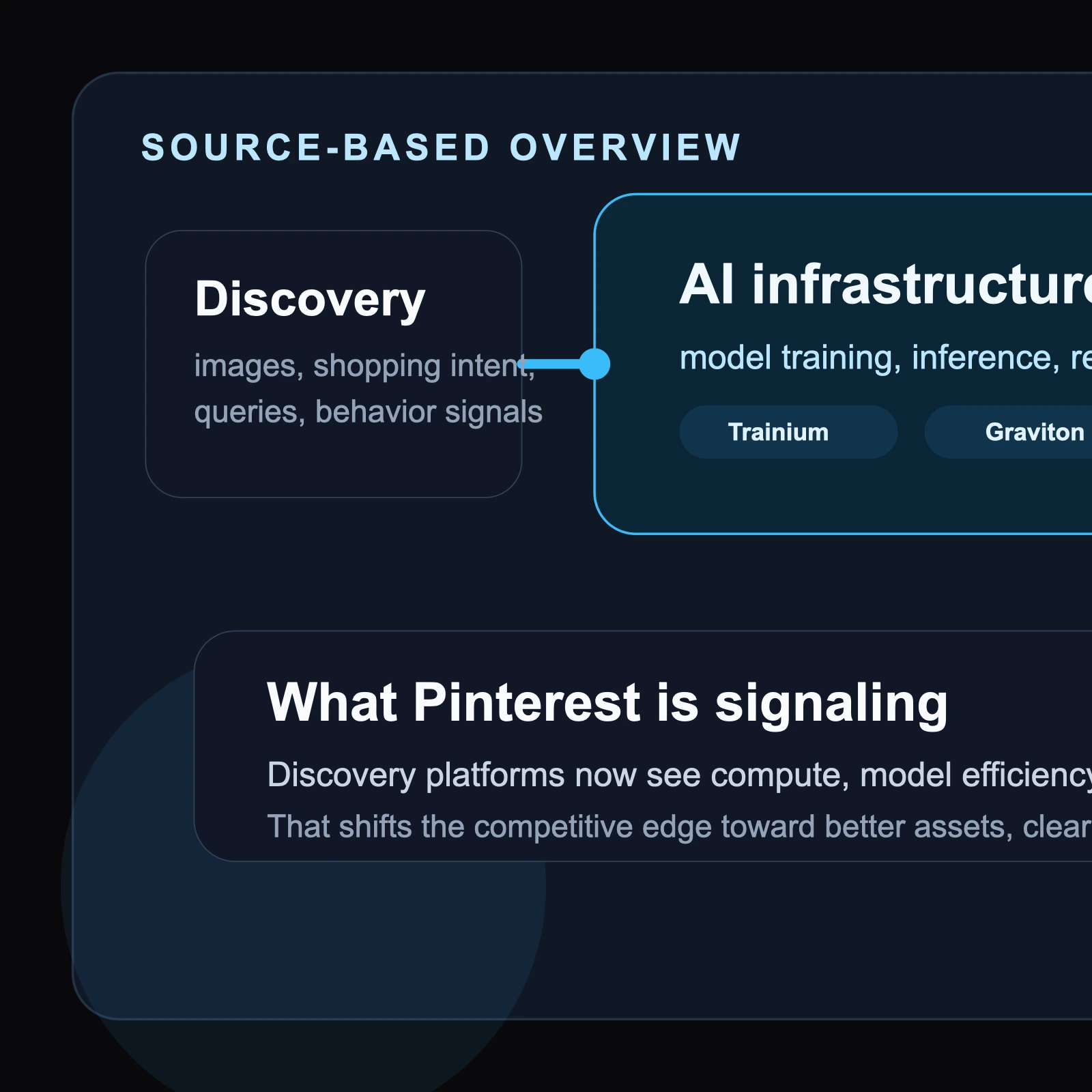
Pinterest's June 4 announcement is specific about what the new commitment covers. The company says the AWS expansion is meant to accelerate its AI roadmap, make search and shopping experiences more responsive, and modernize the infrastructure behind its global discovery platform. Pinterest also says the deeper agreement supports AI model training, inference, and broader platform infrastructure, not just storage or commodity compute.
The technical details are unusually concrete for a newsroom post. Pinterest says it plans to use AWS Trainium to host and run large language models and vision-language models that power personalized visual search and AI-assisted discovery. It also says Graviton already powers roughly one-third of its compute infrastructure and that it plans to expand that footprint. Pinterest also says it will keep moving from more traditional EC2-based environments toward a Kubernetes-based architecture on Amazon EKS to improve developer velocity, reliability, and infrastructure efficiency.
The company also used the June 4 post to frame the consumer product side more clearly. Pinterest says it has moved from older embedding-based retrieval toward transformer-based generative systems, continues adapting open-source AI alongside proprietary vision models, and recently launched Pinterest Assistant for multi-turn conversational discovery.
| Confirmed point | Official source | Why operators should care |
|---|---|---|
| Pinterest plans a $4 billion AWS cloud-services commitment through 2031. | Pinterest newsroom announcement, June 4, 2026 | This is a long-horizon infrastructure bet, not a short-term product experiment. |
| The company tied the agreement to AI model training, inference, and platform modernization. | Pinterest newsroom announcement, June 4, 2026 | Pinterest is explicitly connecting discovery quality to compute architecture. |
| Pinterest says AWS Trainium will help run large language and vision-language models. | Pinterest newsroom announcement, June 4, 2026 | Model cost and inference efficiency are becoming part of the discovery strategy. |
| Graviton already powers roughly one-third of Pinterest's compute infrastructure. | Pinterest newsroom announcement, June 4, 2026 | The stack is already materially migrated, so this is an expansion of a working pattern. |
| Pinterest reported 631 million monthly active users and $1.008 billion in Q1 2026 revenue. | Pinterest Q1 2026 earnings release, May 4, 2026 | The infrastructure bet is being made against a large, growing commercial surface. |
Why it matters
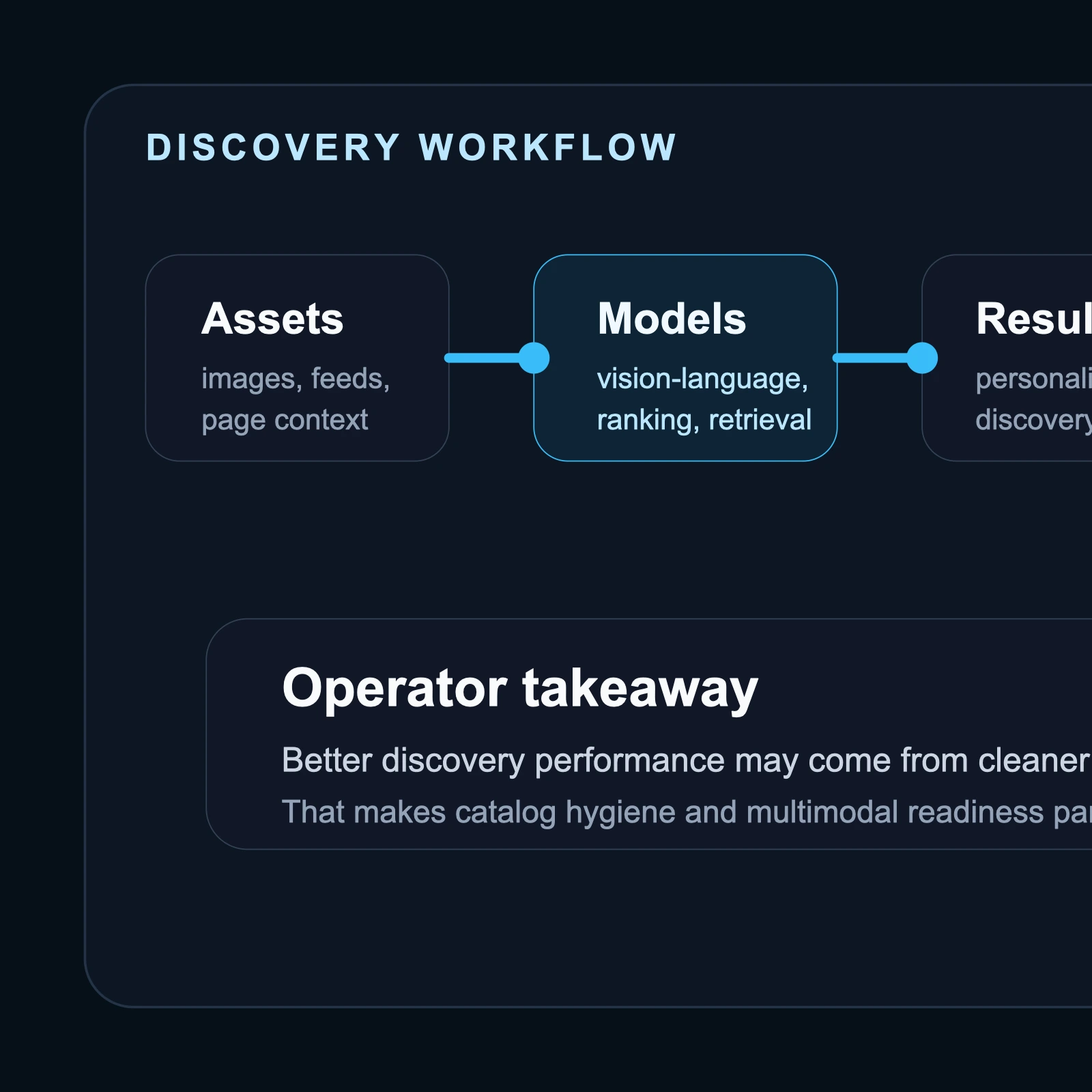
For marketers and ecommerce operators, the real signal is not "Pinterest picked a cloud vendor." The signal is that a major discovery platform is investing heavily so its AI systems can rank, personalize, and operationalize visual intent faster. If that works, it improves how products, publishers, creators, and brands are surfaced before a user ever reaches a classic search-results page.
That has two direct implications. First, discovery quality on Pinterest may become more dependent on structured product data, clearer imagery, stronger taxonomy, and content that machine-learning systems can interpret cleanly. Second, advertisers should expect more of Pinterest's performance story to be tied to AI-mediated relevance rather than manual segmentation alone.
This is also relevant beyond Pinterest itself. Teams already using tools like the GEO Visibility Checklist or guidance on tracking brand mentions and visibility should treat visual-discovery platforms as part of the same broader answer-engine shift. Discovery is becoming multimodal: text, images, shopping signals, and conversational intent are blending together.
Who is affected
The clearest winners, if Pinterest executes well, are retail brands, marketplace sellers, publishers with visual how-to content, creator-led commerce teams, and agencies managing upper-funnel product discovery. This is especially relevant in the United States, Canada, the United Kingdom, Australia, and Europe, where Pinterest already matters for home, fashion, beauty, gifting, and seasonal planning.
It also matters for internal growth and product teams. If Pinterest can reduce model cost while improving relevance, smaller brands may see a platform where visual assets, catalog quality, and creative taxonomy matter more than brute-force media spend. Teams using the Digital Marketing Budget Planner or Marketing ROI Calculator should be thinking about how much budget belongs in feed quality and discovery readiness, not only in campaign amplification.
What to do next
Use this as a workflow prompt, not as a reason to chase hype:
- Audit whether your Pinterest-facing product images, titles, taxonomy, and landing pages are machine-readable and visually consistent.
- Review whether your discovery content is built for multimodal retrieval, not only for classic web SEO.
- Track which product or editorial surfaces already attract high-intent image-led discovery and treat those as candidates for deeper optimization.
- Compare Pinterest discovery performance with the AI visibility checks you already run in /tools/geo-visibility-checklist.
- Revisit budget assumptions so infrastructure-like work such as catalog cleanup, image quality, and metadata hygiene is not treated as optional.
What remains uncertain
Pinterest's announcement is still a company-framed roadmap statement, so the exact pace of user-facing impact remains unclear. The June 4 post does not quantify expected latency gains, conversion lift, advertiser ROI improvement, or rollout timing for specific new experiences. It also does not say how much of the $4 billion commitment will map directly to new AI workloads versus broader platform needs.
There is also an execution risk. Big infrastructure commitments do not automatically translate into better discovery for every advertiser or publisher. Teams should watch for follow-on evidence such as changes in shopping performance, advertiser tools, or recommendation quality before assuming that the spend itself guarantees better outcomes.
Still, the signal is hard to ignore. Pinterest is telling the market that AI discovery quality now depends on serious infrastructure depth, hardware optionality, and model efficiency. For brands that rely on visual discovery, that means the next competitive edge may come less from posting more content and more from making assets, taxonomy, and discovery surfaces easier for AI systems to understand and rank.