Pinterest gives SMB marketers a cleaner growth loop with Performance+ acquisition and one-click Shopify shopping
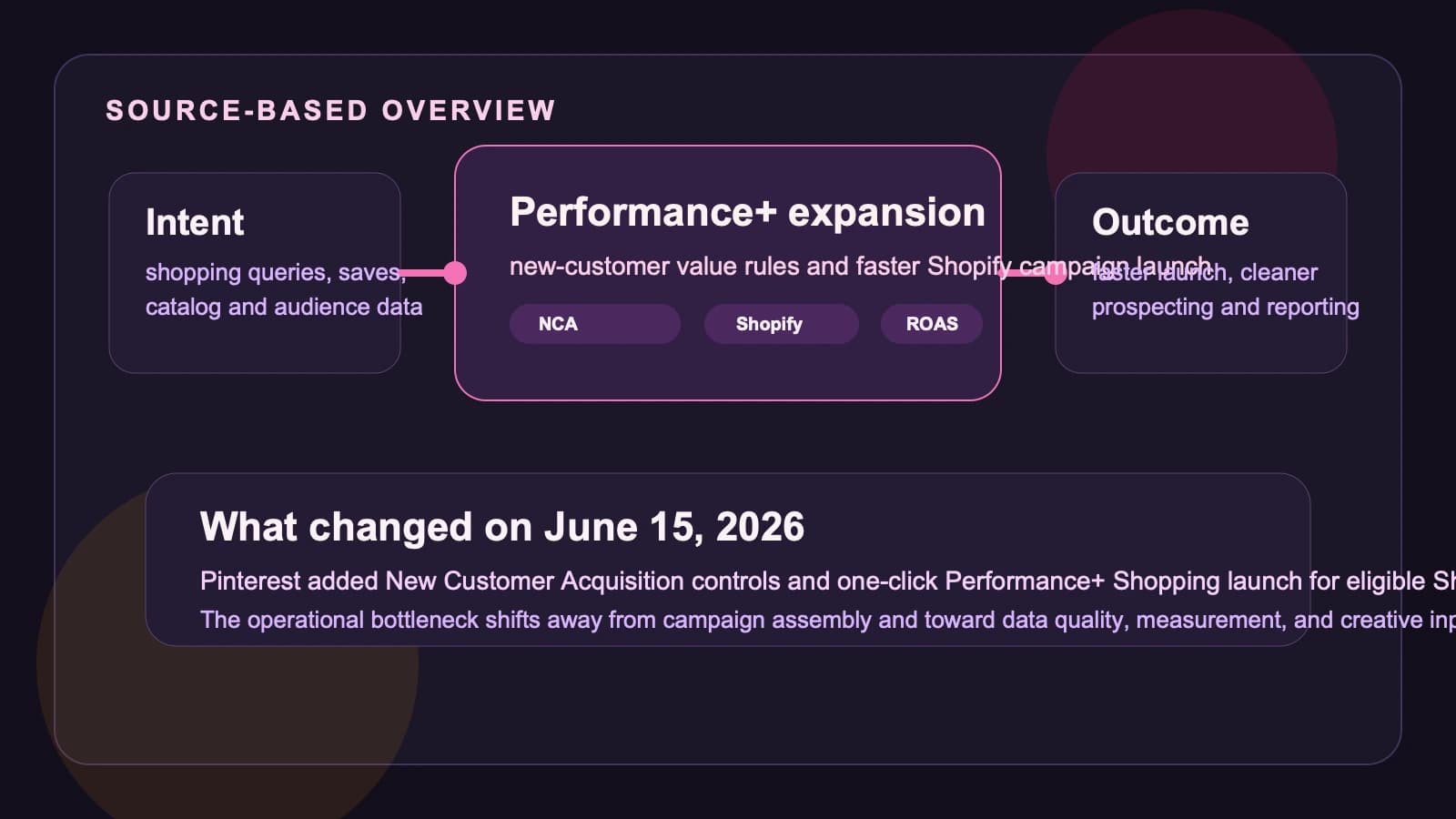
Pinterest said on June 15, 2026 that it is expanding Performance+ for small and mid-sized businesses with two practical changes: New Customer Acquisition (NCA) controls inside Performance+ campaigns, and 1-Click Pinterest Performance+ Shopping for eligible Shopify merchants. For lean teams, that means faster launch and clearer new-buyer prioritization.
What changed
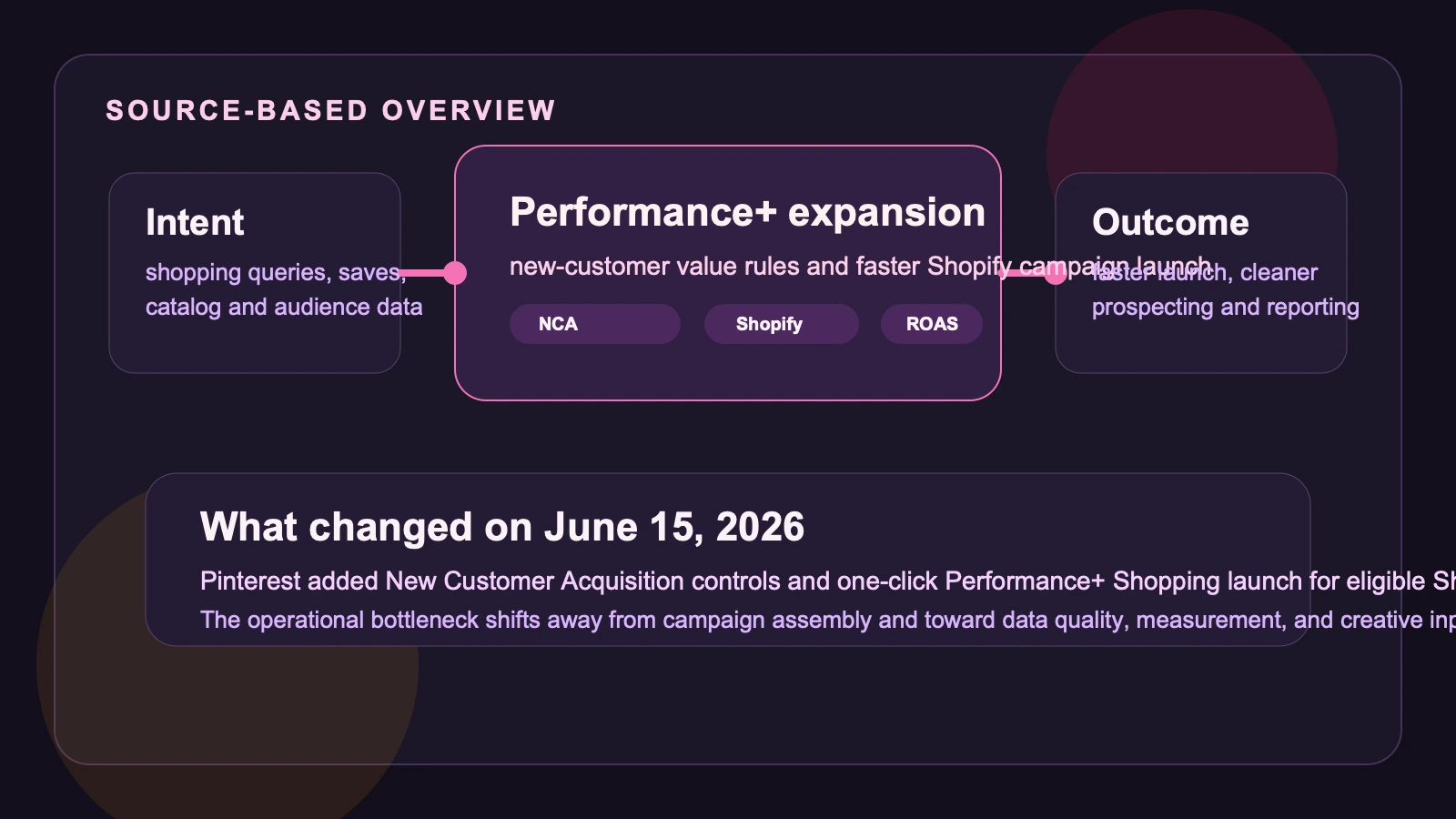
The official June 15 Pinterest Business post says the company is adding two specific workflow upgrades rather than a vague AI refresh. First, Pinterest launched Performance+ New Customer Acquisition, which lets advertisers upload or define their existing customer base, assign higher value to new buyers through value rules, and let delivery prioritize people most likely to convert as net-new customers. Pinterest says advertisers using NCA in early testing saw a 64% average increase in new-customer conversions.
Second, Pinterest says eligible Shopify merchants can now launch a Performance+ Shopping campaign directly from the Shopify integration, with best-practice setup enabled by default and ready in a single click.
Pinterest's own Performance+ help documentation adds the more durable mechanics behind the announcement. The help page says Performance+ is available across Consideration, Conversion, and Catalog sales objectives, uses 50% fewer inputs than standard setup, simplifies targeting, defaults to automatic bidding, and expands reporting across Ads Reporting, Insights, Custom Reports, and the Ads API.
| Confirmed change | Primary source | Why it matters |
|---|---|---|
| Pinterest added New Customer Acquisition controls to Performance+ campaigns on June 15, 2026. | Pinterest Business post | SMBs can tell the system to value net-new buyers more explicitly instead of optimizing around blended conversion volume alone. |
| Eligible Shopify merchants can launch Performance+ Shopping directly from the Shopify integration in one click. | Pinterest Business post | Campaign launch time drops, which is useful for small teams that do not want to hand-build shopping structures inside Ads Manager. |
| Performance+ campaigns use 50% fewer inputs and are available for consideration, conversion, and catalog sales objectives. | Pinterest Business help | The simplified setup is not only a blog claim; it is built into the current product workflow. |
| Performance+ reporting still breaks results down by geography, device, placement, age, and ad group for analysis. | Pinterest Business help | Teams keep some diagnostic visibility even while delivery stays automated. |
| Pinterest says Performance+ campaigns outperformed traditional campaigns in nearly 80% of A/B tests. | Pinterest Performance+ page | The company is positioning Performance+ as the default operating mode, not a niche beta option. |
Why it matters
For high-value English-speaking markets in the United States, Canada, the United Kingdom, Australia, and Europe, the real significance is workflow compression. Smaller ecommerce and growth teams often lose time building the campaign, deciding how hard to push prospecting, and cleaning up weak reporting after launch. Pinterest is trying to reduce all three.
The NCA change matters because many automated systems optimize toward whatever is easiest to convert. That can hide whether a campaign is actually expanding the customer base or just re-harvesting people already close to buying. Pinterest's June 15 post makes a narrower promise: advertisers can define existing customers, apply value rules that favor new ones, and let the system rebalance delivery accordingly.
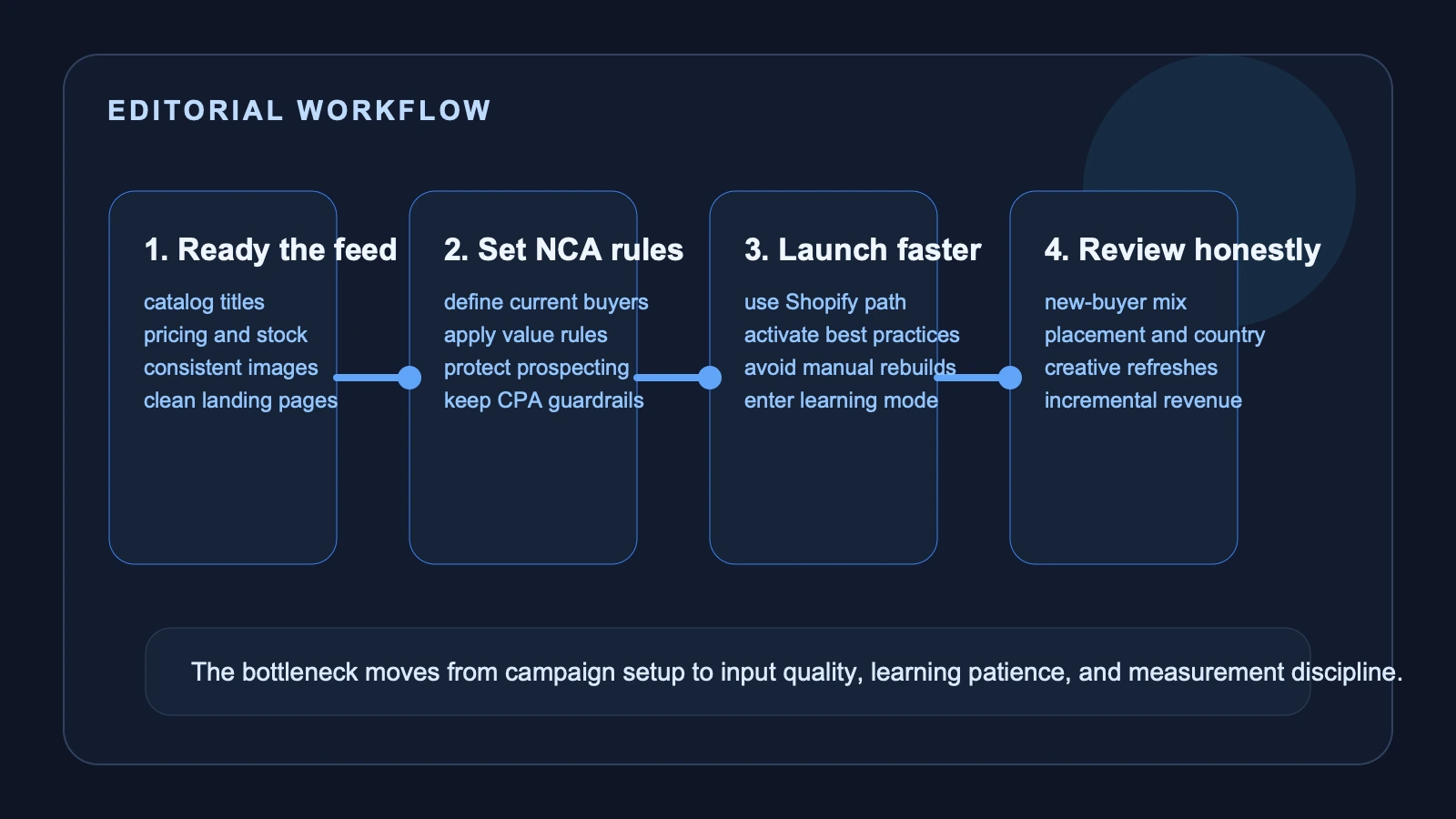
The Shopify tie-in matters because setup friction still kills adoption for many SMB teams. If the launch path is fast enough, operators can spend more time on feed quality, creative inputs, landing pages, and measurement hygiene. That connects directly to Slogan.website's Digital Marketing Budget Planner, Marketing ROI Calculator, and the GEO Visibility Checklist.
Who is affected
The first affected group is Shopify-based ecommerce brands that already use Pinterest for shopping discovery or seasonal demand capture. The second is agencies and fractional marketers running smaller multi-account portfolios, where repeated manual setup becomes expensive fast. The third is in-house performance teams that care less about vanity ROAS and more about acceptable new-customer cost.
What to do next
Use this checklist before shifting budget or assuming the one-click setup will solve weak performance by itself:
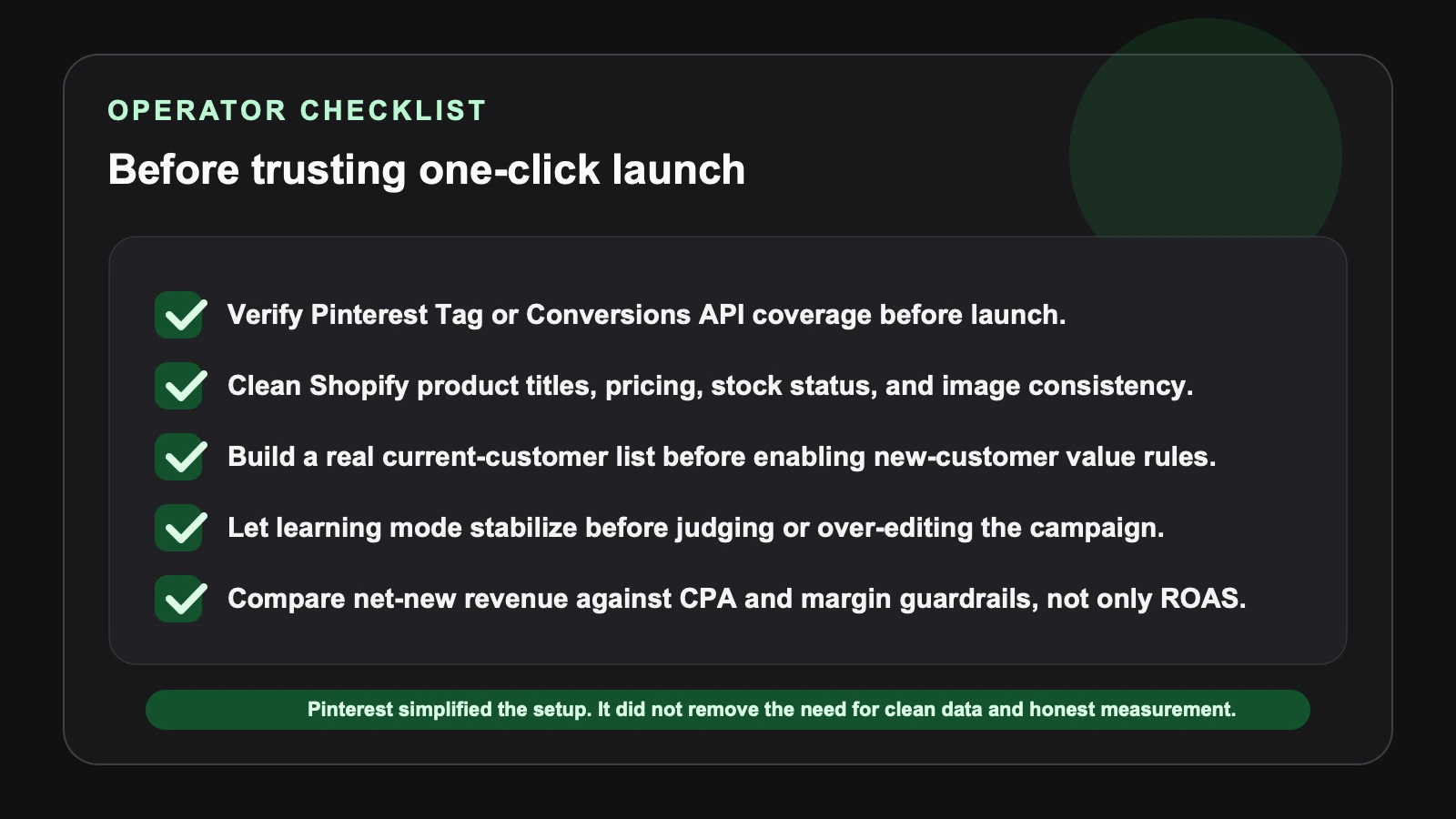
- Confirm your Pinterest tag and/or Conversions API setup before launch. Pinterest's help documentation explicitly recommends accurate conversion tracking and sufficient budget for Performance+ tests.
- Clean the Shopify catalog first: titles, images, pricing, availability, and landing-page continuity need to be reliable before one-click launch becomes useful.
- Define your current-customer segment carefully if you plan to use NCA, so the value rule is based on a real exclusion or prioritization logic.
- Plan for creative refreshes instead of constant mid-flight tweaks. Pinterest says learning mode can take about two weeks on average in its official help page.
- Model the acceptable acquisition ceiling before launch with the Marketing ROI Calculator and scenario budgets in the Digital Marketing Budget Planner.
- Track whether gains are coming from true net-new buyers, broader cheap reach, or catalog cleanup that would have improved results anyway.
What remains uncertain
Pinterest's public materials still leave several gaps. The June 15 announcement says the one-click Shopify path is available for eligible merchants, but it does not fully define every eligibility edge case in the article itself. The company also cites early testing gains for NCA and broader Performance+ benchmarks, but those are still Pinterest-framed results.
There is also a control tradeoff. The Performance+ help page makes clear that simplified targeting and automated delivery are part of the product design, so teams that want fine-grained manual control may find the system narrower than traditional setups.
The best reading on June 19, 2026 is practical, not promotional. Pinterest has made it easier to launch shopping campaigns and bias automation toward new-customer growth, especially for Shopify-centered teams. That is meaningful. But the real winners will still be the teams with clean feeds, trustworthy measurement, realistic CPA guardrails, and enough discipline to separate automation convenience from actual incremental growth.