Pinterest turns high-intent planning data into a CTV buying workflow with tvScientific
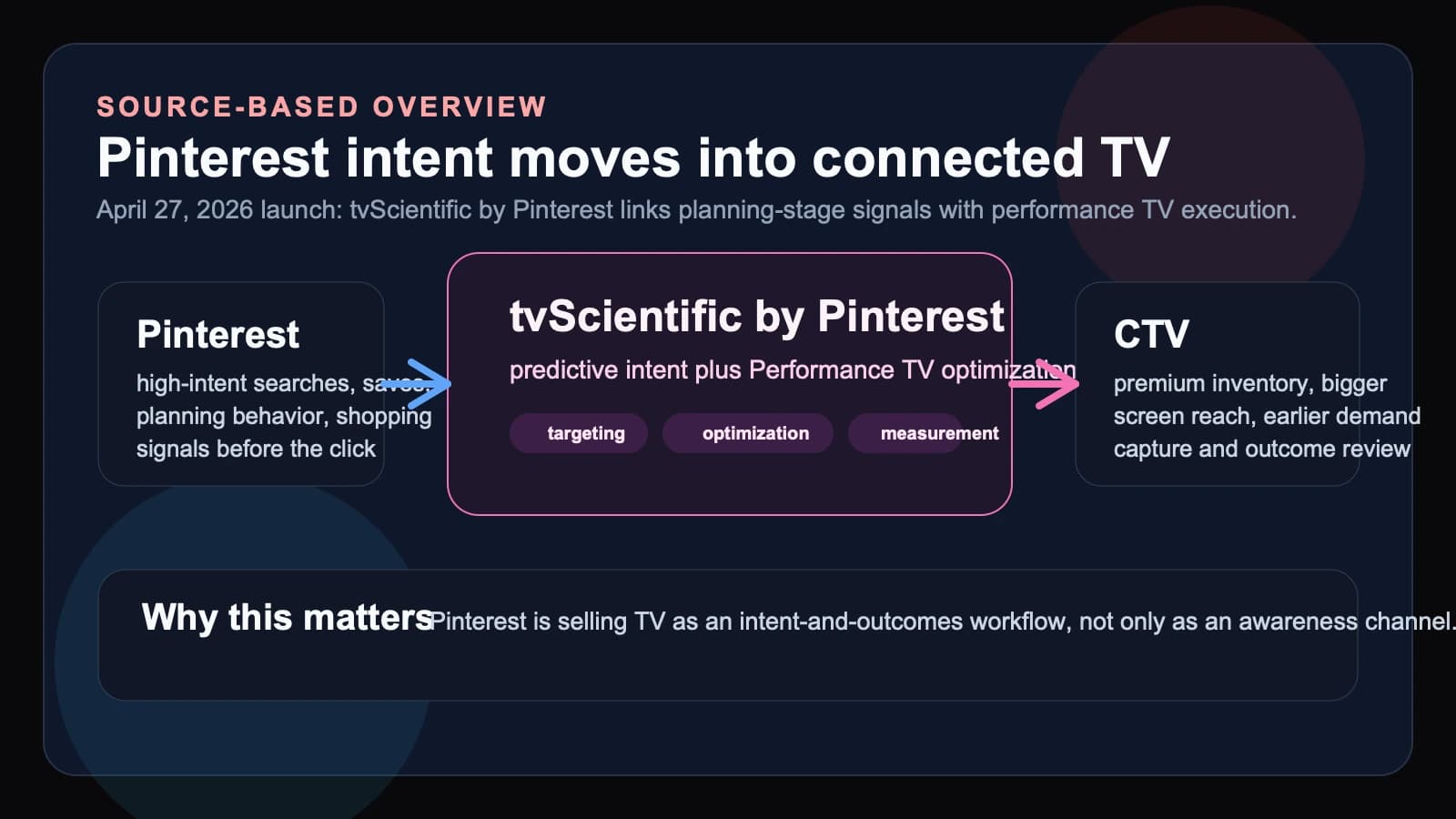
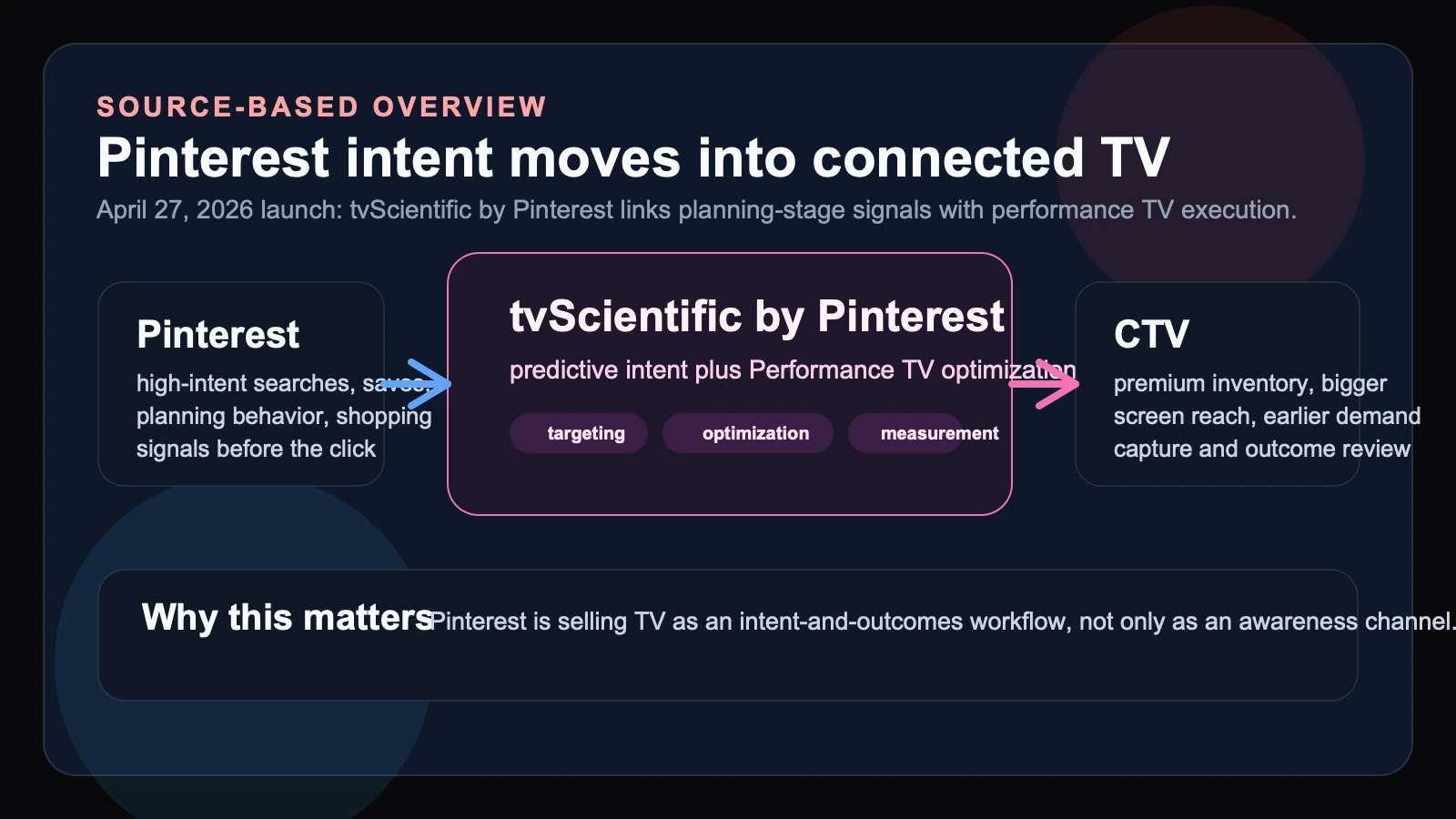
Pinterest said on April 27, 2026 that it launched tvScientific by Pinterest, describing it as the first ad platform to give advertisers direct access to Pinterest's high-intent audiences for connected TV campaigns. That is the headline. The more useful operator reading is that Pinterest is trying to move its planning-stage intent data out of the Pinterest app and into a more measurable, performance-oriented TV workflow.
The official launch announcement says advertisers can use Pinterest audiences across premium CTV inventory and that, when tvScientific AI is enriched with Pinterest intent signals, campaigns have seen an average 27% increase in outcomes per $100 spent and a 65% increase in purchases. Pinterest's own tvScientific by Pinterest overview adds the product framing: combine predictive intent signals with a Performance TV platform to reach customers earlier, optimize toward business outcomes, and understand TV impact with more clarity. For marketers, agencies, and growth teams, that is a workflow change, not just another channel partnership.
What changed
Pinterest's April 27 release ties three ideas together that are usually separated in media plans: discovery intent, TV inventory, and performance measurement. In the official announcement, Pinterest says advertisers can now activate Pinterest audiences on connected TV through tvScientific. On the tvScientific by Pinterest site, the company says the system is built to help marketers reach high-intent customers earlier, optimize toward purchases, installs, subscriptions, and incremental growth, and prove TV's contribution across the funnel and wider media mix.
That matters because Pinterest's audience data is not being framed as simple retargeting. The company's own positioning is about getting in front of people earlier in their shopping journey, when they are planning rather than only converting. That is a different promise from many CTV stories, which usually lean on broad household reach or post-purchase data.
| Confirmed April 27, 2026 detail | Primary source | Why it matters |
|---|---|---|
| Pinterest introduced tvScientific by Pinterest as a direct way to use Pinterest audiences for connected TV campaigns. | Pinterest Newsroom | Planning-stage Pinterest signals can now influence off-platform CTV buying. |
| Pinterest says it is the first ad platform to offer direct access to Pinterest's high-intent audiences for CTV. | Pinterest Newsroom | The company is trying to differentiate with audience quality, not just inventory access. |
| Pinterest says tvScientific AI enriched with Pinterest signals has driven an average 27% increase in outcomes per $100 spent and 65% more purchases. | Pinterest Newsroom | Pinterest is attaching concrete performance claims to the launch, not only branding language. |
| tvScientific by Pinterest says it combines predictive intent signals with a Performance TV platform. | tvScientific by Pinterest | The operational pitch is intent plus optimization, not TV placement alone. |
| The platform says it is designed to optimize toward purchases, installs, subscriptions, and incremental growth while improving measurement clarity. | tvScientific by Pinterest | CTV is being positioned as measurable growth infrastructure, not just upper-funnel awareness. |
Why it matters
The strategic shift is that Pinterest wants to become more useful before the click, not only after it. Search teams, ecommerce operators, and agencies already know Pinterest traffic can signal future shopping demand. What changes here is the buying surface. Instead of waiting for that intent to stay inside Pins or onsite commerce flows, Pinterest is now offering a path to use it on the biggest screen in the house.
For brands in retail, home, beauty, apparel, travel, fintech, and app growth, that creates a new media-mix question. If Pinterest signals really capture earlier-stage commercial intent, connected TV can become more than a reach play. It can become a way to introduce products before search volume peaks or before performance channels get more expensive. That fits the same planning discipline behind Slogan.website's Digital Marketing Budget Planner, Marketing ROI Calculator, and GEO Visibility Checklist: the value of a new channel depends on whether it improves timing, measurability, and downstream economics.
This also matters because TV is usually hard to compare with search, social, and retail media on the same decision sheet. Pinterest and tvScientific are explicitly trying to narrow that gap by talking about outcomes, attribution, and incremental growth instead of only impressions or completion rates. Even if a team never buys this product, the product language itself is a signal: premium video inventory is being sold more like a performance system.
Who is affected
The first group is performance marketers and media teams that already use Pinterest for discovery or catalog demand and want a stronger off-platform growth path. The second is agencies that need a reason to defend CTV budget with more than brand-lift language. The third is ecommerce and retail-media operators trying to connect inspiration, search behavior, and purchase outcomes across channels instead of treating them as separate silos.
International teams should care too, even when public materials do not spell out every rollout detail by country. Slogan.website targets operators in the United States, Canada, the United Kingdom, Australia, and Europe, and the broader signal travels well: audience quality and planning intent are becoming more portable across media surfaces. That changes how teams should think about budget sequencing, creative adaptation, and measurement ownership.
What to do next
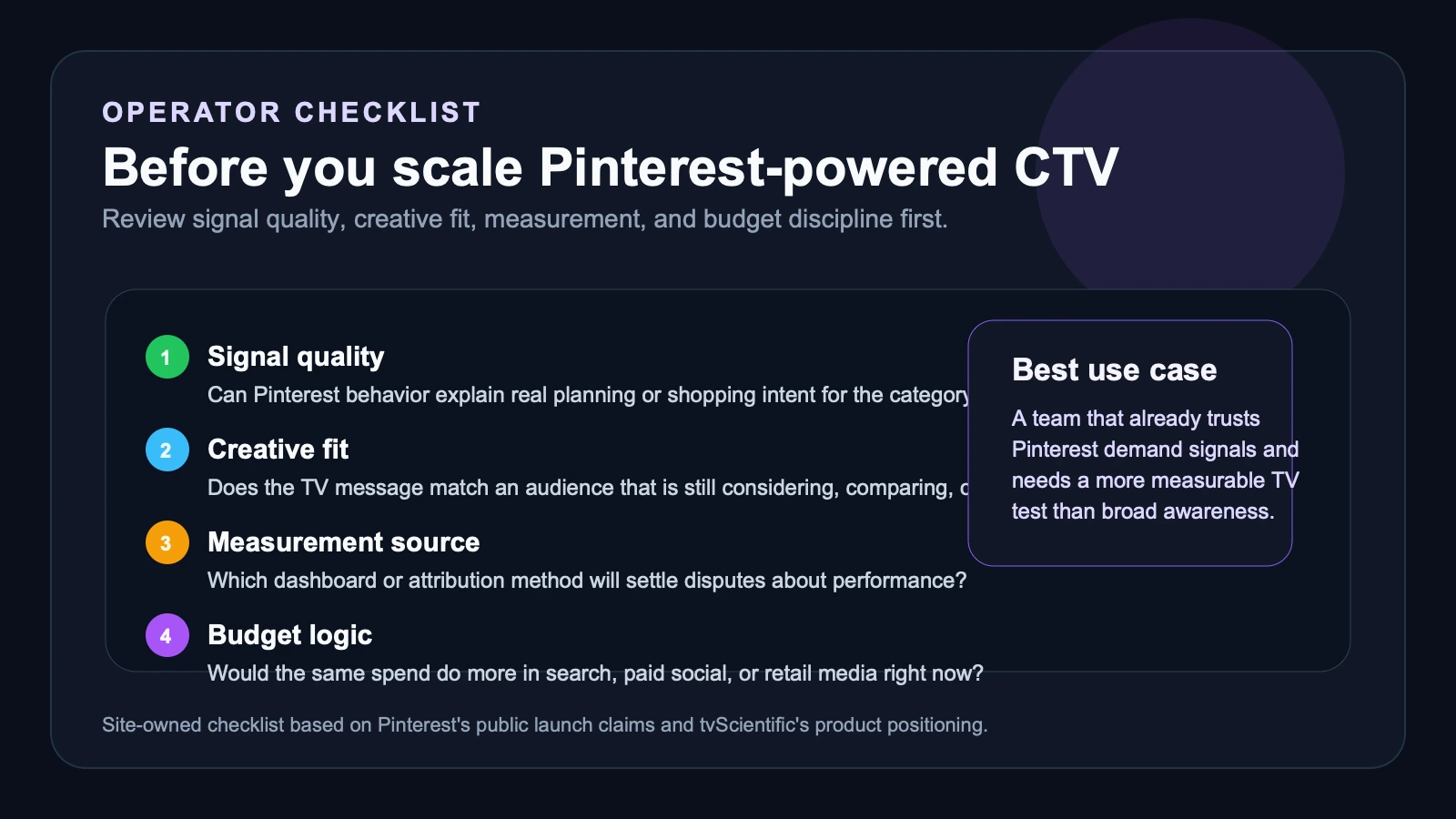
Treat the launch as a planning prompt before you treat it as a budget command.
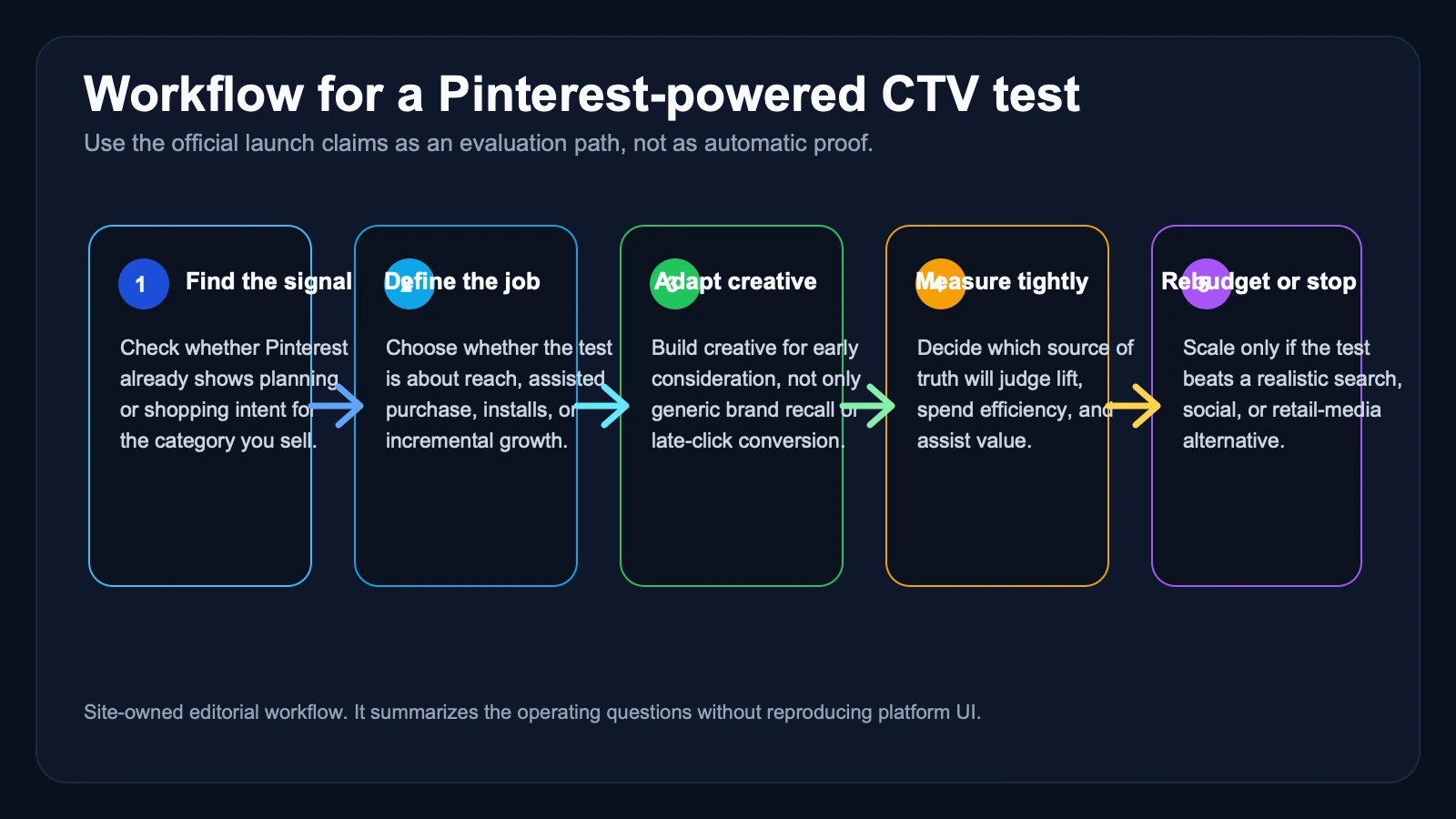
- Map where Pinterest already contributes in your funnel: discovery, saves, product interest, or assisted purchase behavior.
- Separate awareness goals from measurable outcome goals before testing any CTV expansion.
- Ask whether your current CTV stack can prove incrementality clearly enough to compare against search, paid social, or retail media.
- Pressure-test creative fit. Intent-rich CTV works only if the message matches a planning-stage audience instead of generic TV storytelling.
- Model conservative and upside scenarios in the Digital Marketing Budget Planner, then compare expected payback in the Marketing ROI Calculator.
- Connect the test to owned-content quality and discoverability work, especially if your brand already relies on visual search, shopping content, or AI-assisted discovery surfaces.
What remains uncertain
Pinterest's public materials still leave several important questions open as of June 15, 2026. The company has shared performance claims, but not a broad public breakdown by vertical, market, or advertiser maturity. It also has not publicly detailed exactly how every team should interpret attribution or incrementality when CTV, retail media, and search all influence the same purchase path.
There is also an operational caution. Pinterest's own positioning depends on the idea that its audience signals reflect earlier shopping intent. That can be powerful, but it also means bad creative, weak product-market fit, or fuzzy measurement can waste money faster than a slower-moving awareness buy. The strongest conclusion today is narrower and more useful: Pinterest has turned intent-rich connected TV into a more serious buying conversation, and smart teams should evaluate it with the same rigor they apply to search, social, and commerce media.