Salesforce turns Agentforce Commerce into a product-feed path for ChatGPT and Google AI Mode
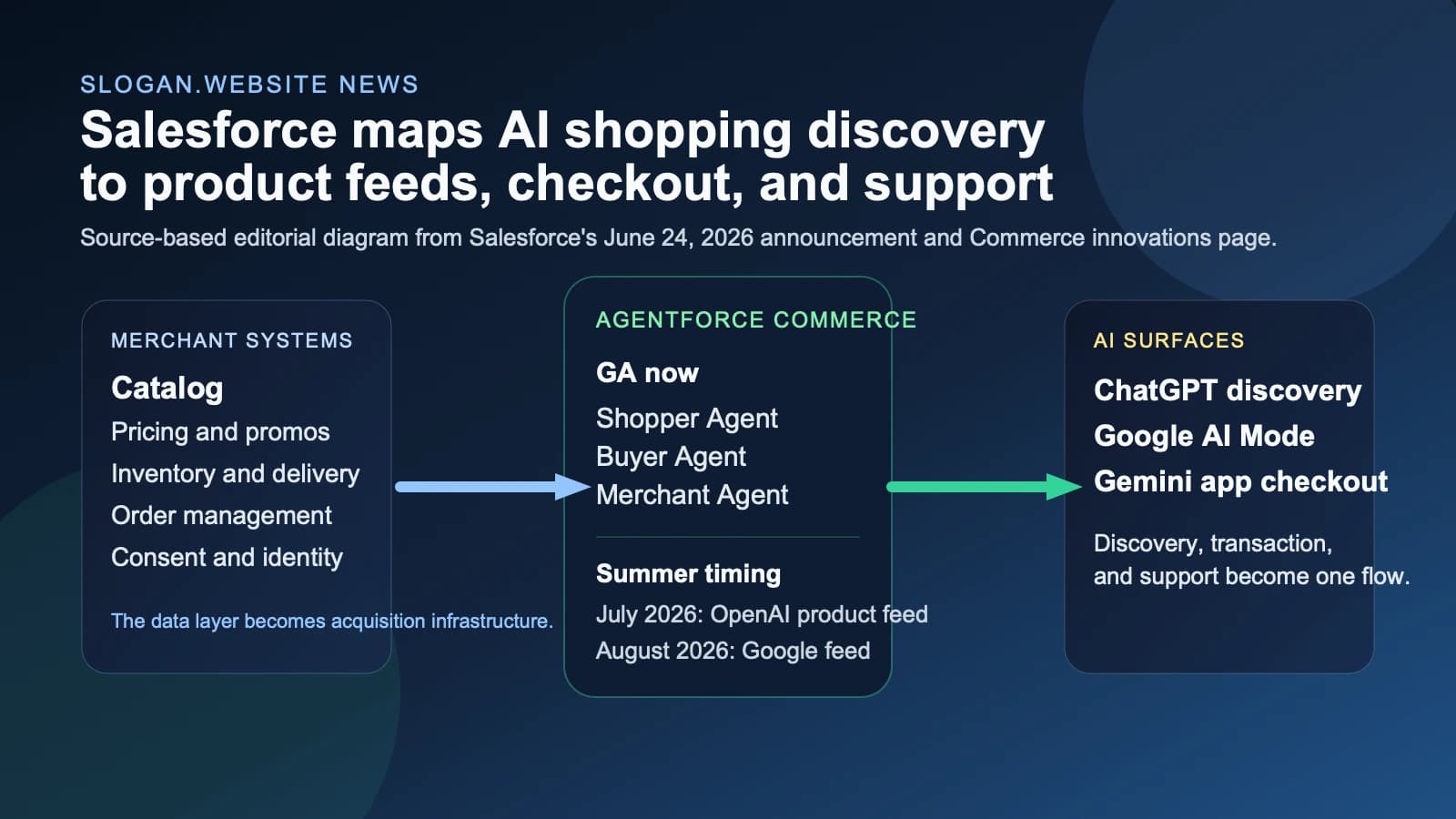
Salesforce used its June 24, 2026 Agentforce Commerce announcement to make one practical point clear: AI shopping discovery is moving beyond your own site, and merchants need a controlled way to surface products inside assistants customers already use. Salesforce said Shopper Agent, Buyer Agent, and Merchant Agent are generally available now, while native distribution paths to ChatGPT, Google Search including AI Mode, and the Gemini app are arriving through the platform's product-feed and checkout rails this summer. Read with Salesforce's live Commerce innovations page, the message is simple: if AI assistants become shopping entry points, catalog structure, order data, consent, and fulfillment logic become customer-acquisition infrastructure.
That matters because many teams still treat answer engines as a visibility problem only. Salesforce is framing them as a transaction path too.
What changed
| Confirmed June 24, 2026 point | Official source | Why it matters |
|---|---|---|
| Salesforce said Shopper Agent, Buyer Agent, and Merchant Agent are generally available now. | Salesforce announcement | Merchants can plan around live agent roles, not only pilots or roadmap language. |
| Salesforce said native integration into ChatGPT is arriving this summer. | Salesforce announcement and Commerce innovations | Product discovery inside consumer AI assistants is becoming a feed-and-operations problem, not only an SEO problem. |
| The innovations page says OpenAI Product Feed Integration is GA in July 2026. | Commerce innovations | Merchants get a concrete timing signal for ChatGPT catalog distribution planning. |
| The innovations page says Google Feed and Checkout Integration is GA in August 2026 for Google Search AI Mode and the Gemini app. | Commerce innovations | Google's AI shopping surfaces are being treated as an end-to-end commerce channel, not just a referral source. |
| Salesforce says Agentic Commerce Search uses real and simulated shopper data and has delivered a 13% conversion increase and 17% add-to-cart increase. | Commerce innovations | The company is tying the AI-discovery story to measurable on-site commerce outcomes, not only to chatbot novelty. |
The key detail is the separation between what is live now and what arrives next. In the announcement, Salesforce said the three agent roles are generally available now. On the innovations page, it then attached more precise dates to the distribution layer: OpenAI Product Feed Integration is marked GA July '26, while Google Feed and Checkout Integration is marked GA August '26. Salesforce also says those Google capabilities connect products to discovery and checkout across AI Mode in Google Search and the Gemini app.
That is a shift from "be visible in AI answers" to "be purchasable through AI surfaces." The announcement says agentic commerce is already reshaping the customer journey, while the innovations page says Google integration can enable end-to-end purchasing with payments, compliance, and order management on existing commerce rails.
Why it matters
For marketers, ecommerce leaders, and growth operators, the practical implication is that GEO and shopping-feed work are converging. If ChatGPT and Google AI Mode become more important product-discovery interfaces, then structured catalog data, inventory accuracy, shipping logic, taxonomy, product content, and post-purchase operations influence visibility and conversion together.
That is why this story connects naturally to Slogan's GEO Visibility Checklist and GEO guide. Teams preparing for AI discovery need more than citations and clean copy. They need machine-readable product data, trustworthy fulfillment details, and clear consent and measurement design. Salesforce reinforced that stack in the same release by listing Unified Consent and out-of-the-box commerce-plus-marketing journeys as GA July '26 items on the innovations page.
Who is affected
The nearest audience is enterprise and mid-market merchants that already depend on structured catalogs, CRM, and order management across multiple regions. Agencies managing ecommerce stacks for those merchants are next, especially if clients are already asking about ChatGPT product discovery or AI Mode traffic quality. Marketing ops and lifecycle teams are also exposed because the same release ties commerce data more closely to consent, messaging, and post-order journeys.
What to do next
Treat this as a readiness exercise.
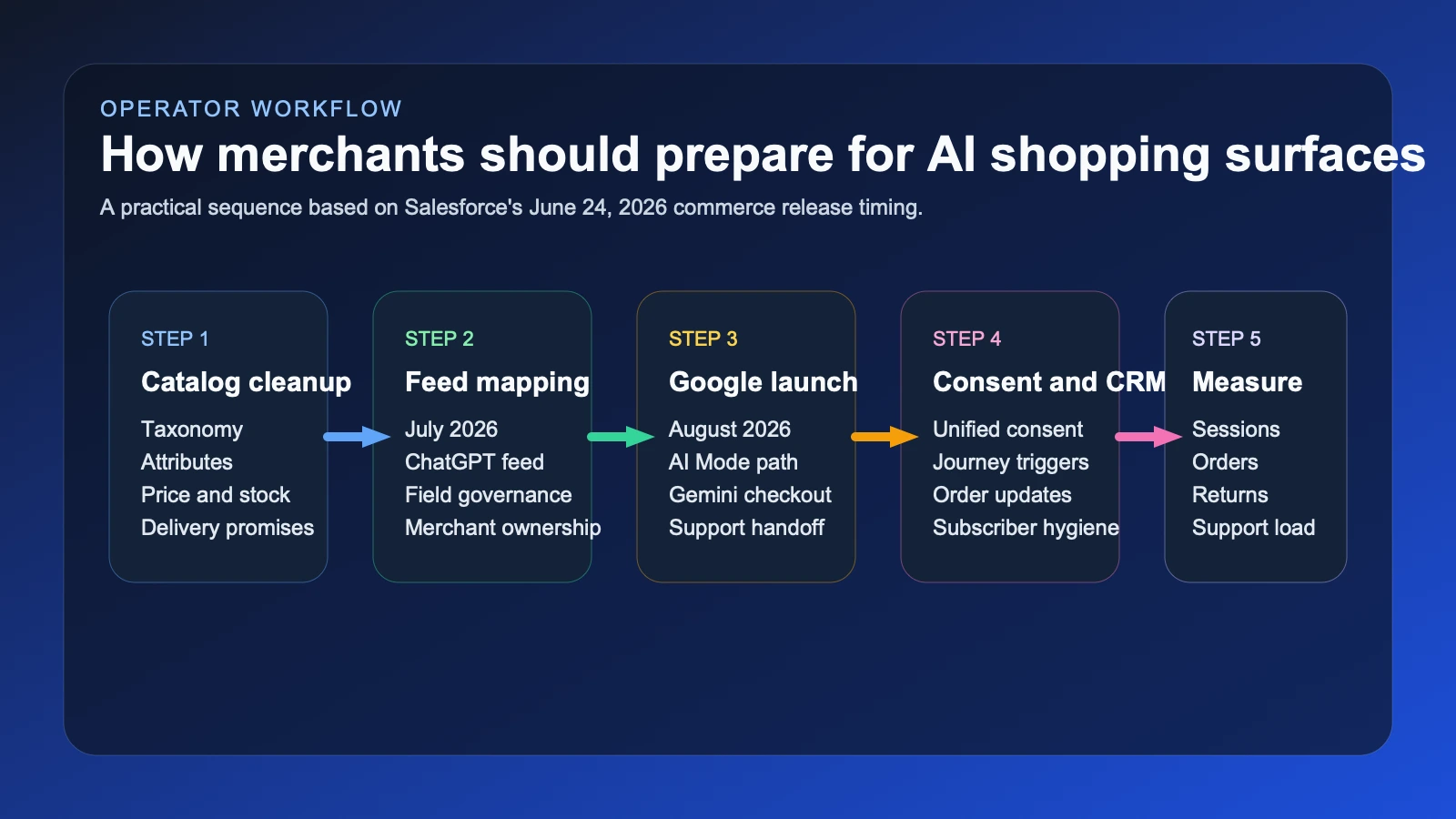
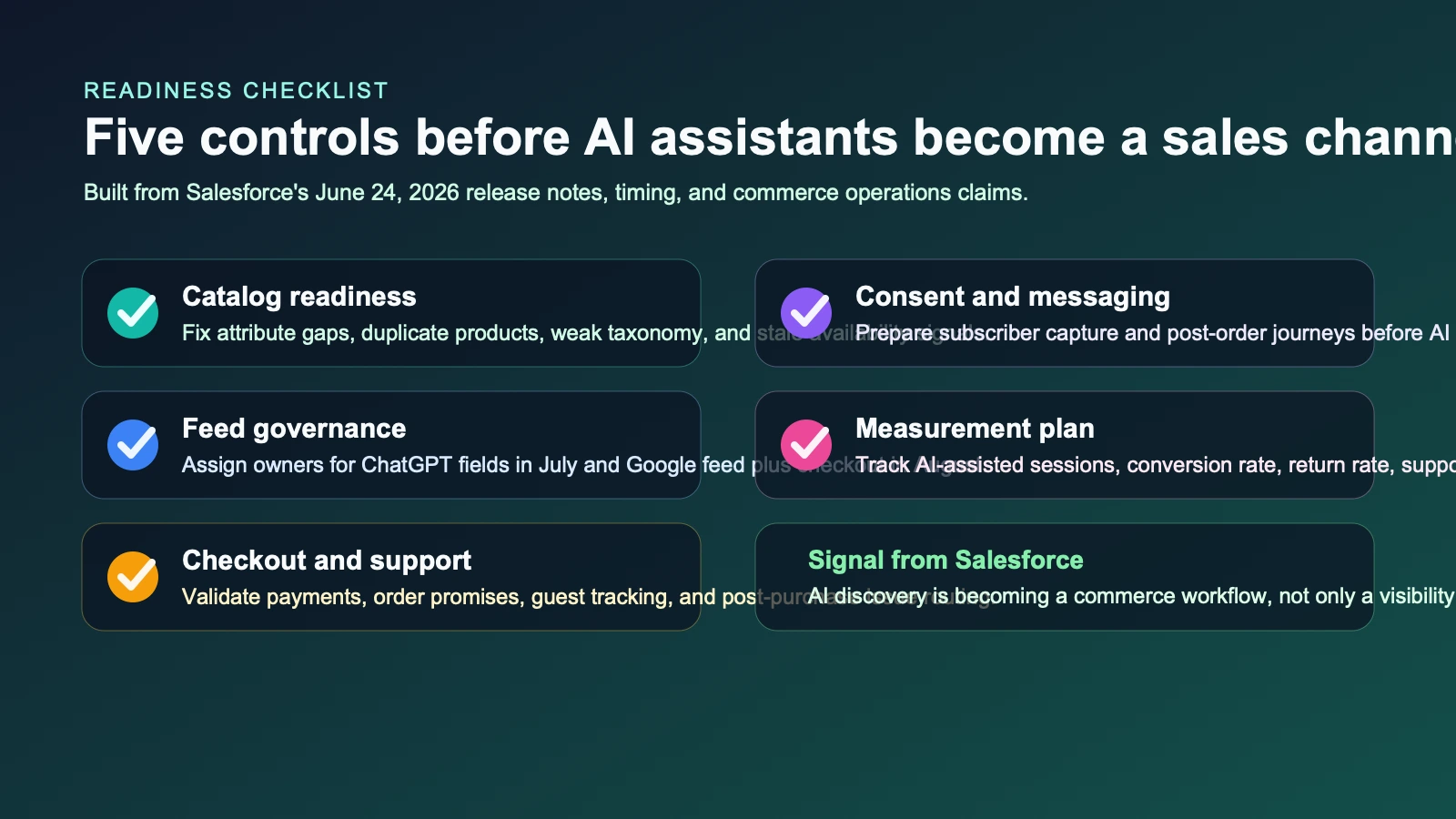
- Audit your catalog fields, taxonomy, stock signals, pricing logic, and delivery promises before worrying about assistant placement.
- Separate GA now features from GA July '26 and GA August '26 distribution features so internal expectations stay realistic.
- Review how your team will attribute AI-assisted discovery. Use the Marketing ROI Calculator and Digital Marketing Budget Planner to model whether AI-originated traffic or purchases justify new implementation work.
- Decide who owns feed governance across merchandising, growth, engineering, and support once AI surfaces can trigger real purchases.
- Build a small measurement plan for citation rate, assisted sessions, conversion quality, return rate, support contacts, and post-purchase friction.
What remains uncertain
The official sources still leave important unknowns. Salesforce has published availability targets, but it has not publicly shown broad merchant performance benchmarks for ChatGPT or Google AI Mode shopping flows yet. The announcement's statistics about AI-influenced sales and conversion lift are vendor framing, not neutral market audits.
There is also a workflow question the launch does not answer completely: how much control merchants will have over surfacing, ranking, brand presentation, and exception handling once product discovery shifts into third-party AI interfaces. Teams already tracking brand mentions and visibility through a disciplined workflow, such as the one outlined in Slogan's visibility tracking guide, will have an advantage.
The useful conclusion on June 25, 2026 is that Salesforce has turned AI shopping visibility into a more operational category. If ChatGPT and Google AI surfaces become real buying paths, the winners will be the teams whose catalog, consent, checkout, and measurement layers are already clean enough to let those paths work.