Salesforce turns agentic marketing into a managed operating system at Connections 2026
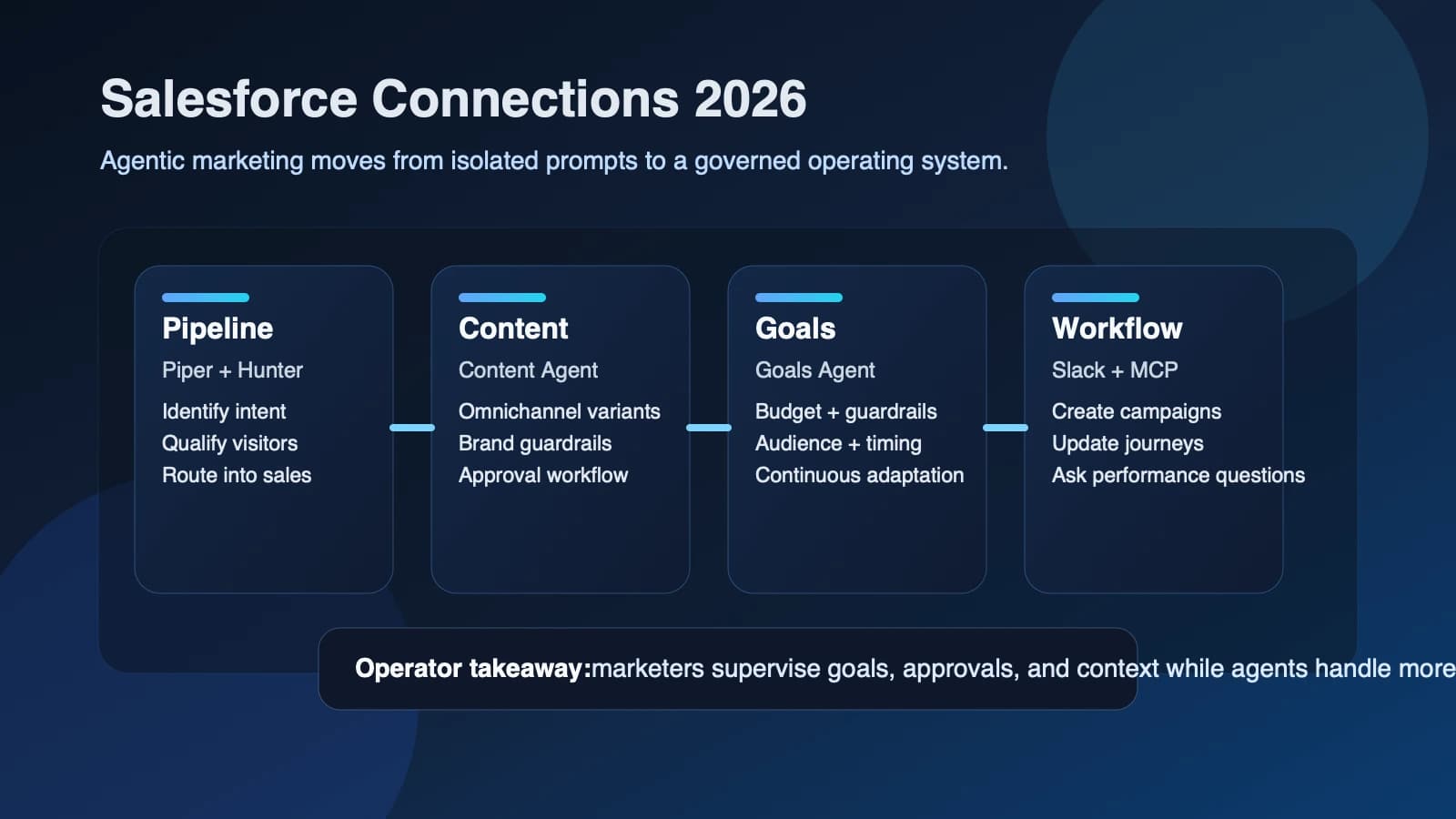
Salesforce used Connections on June 3, 2026 to pitch a sharper version of agentic marketing: not just AI that drafts copy, but agents that help build pipeline, generate approved campaign assets, run campaigns against goals, and expose campaign actions through Slack using Model Context Protocol tools. Read together with Salesforce's Connections guide published on May 26, 2026 and the live Connections event page, the message is practical. Salesforce wants marketers to manage governed AI workers inside their existing operating system, not bounce between separate copilots, dashboards, and content handoffs.
That matters for high-value teams in the United States, Canada, the United Kingdom, Australia, and Europe because customer journeys are already shifting toward real-time, cross-channel interactions. The vendor claim is big, but the planning implication is simple: marketing automation is moving one layer up, from workflow automation to agent supervision.
What changed
| Confirmed June 3, 2026 point | Primary source | Why it matters |
|---|---|---|
| Salesforce said marketers now get agents that help build pipeline, create content, and run campaigns. | Salesforce announcement | The core story is broader than content generation. Salesforce is packaging several agent roles into one operating model. |
| Salesforce said Rawlings reports 75% faster campaign creation using Agentforce Marketing. | Salesforce announcement | The company is attaching an operator-speed claim to the launch, not only vision language. |
| Salesforce said campaign management in Slack using MCP is generally available in June 2026. | Salesforce announcement | Marketers can increasingly trigger segments, campaigns, and performance questions from a workflow surface they already use. |
| Salesforce said Agentforce Content Agent and Marketing Goals Agent are in pilot. | Salesforce announcement | Some of the most ambitious automation is still early, which affects rollout expectations and procurement timing. |
| Salesforce positioned Connections 2026 as a June 3-4 conference for agentic marketing with 280+ sessions and hands-on trainings. | Connections guide and Connections event page | This was not a stray product blog. It was the centerline message of Salesforce's current marketing conference. |
The structure of the launch is what stands out. In the June 3 announcement, Salesforce split the release into three job families: agents that help build pipeline, agents that create content at individual scale, and agents that turn business goals into autonomous campaigns. That frames marketing work less as campaign assembly and more as supervised execution across prospecting, production, orchestration, and optimization.
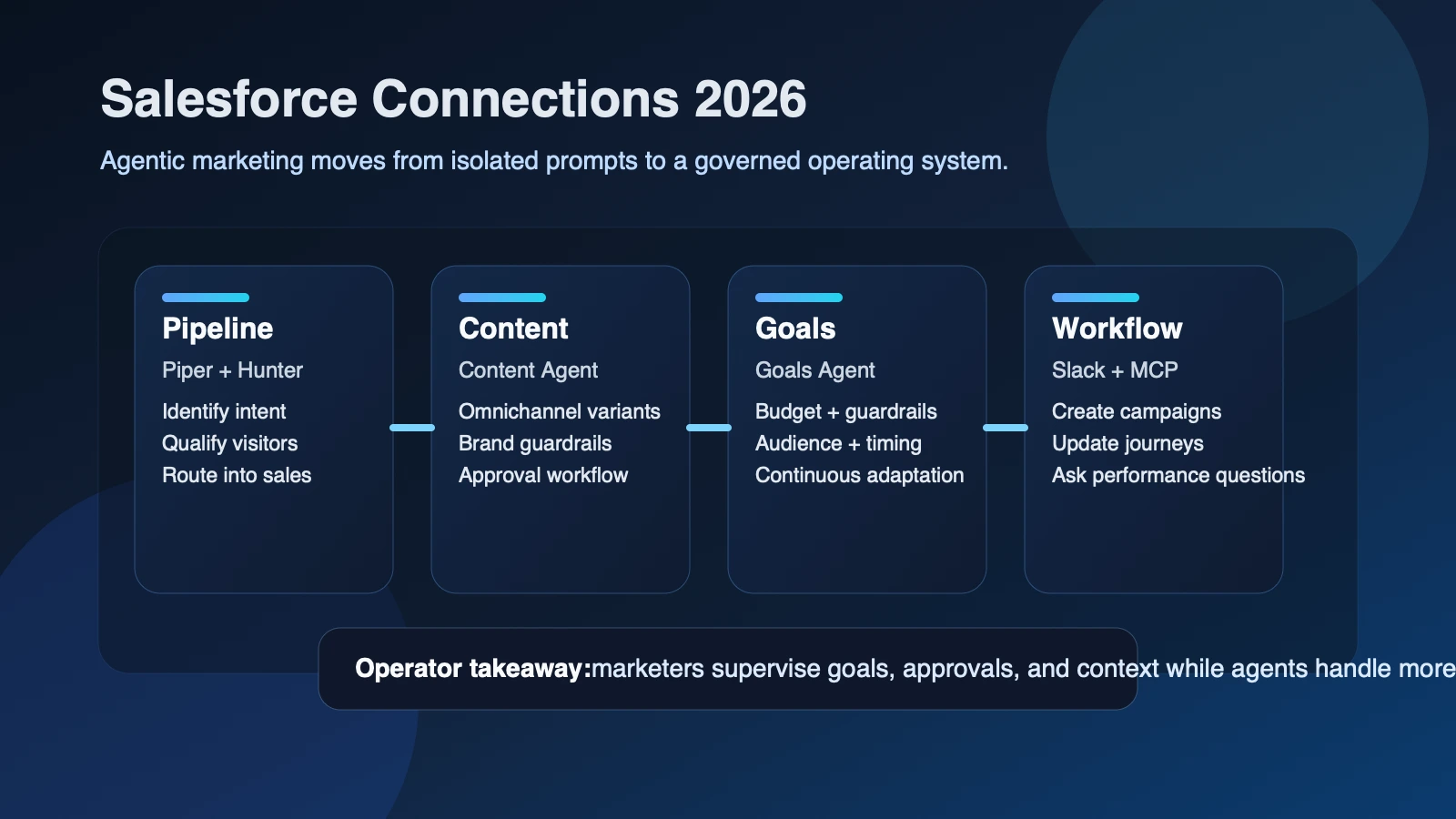
Two details deserve extra attention. First, Salesforce said marketers can use Slack-based MCP tools to request audience segments, create campaigns, update journeys, and ask performance questions from their existing workflow. Second, Salesforce tied the content layer to its pending Contentful acquisition announced earlier this week, arguing that content, approvals, and channel activation need to live in one governed system if agents are going to act safely at scale.
Why it matters
For operators, the practical shift is not that marketing suddenly becomes autonomous. It is that the control surface changes. Teams increasingly define goals, guardrails, approval rules, budgets, and escalation limits, then let agents handle more of the repetitive planning and execution inside those boundaries.
That creates three immediate pressures. One is data quality. Salesforce explicitly says shared customer and business context is what keeps agents from making disconnected decisions, such as promoting something a customer already bought. If your CRM, audience logic, and conversion events are messy, agent speed just multiplies bad decisions faster.
The second pressure is brand governance. The launch is built around approved content systems, templates, and review paths, which aligns with the broader problem many teams are trying to solve right now: producing more variants without turning channels into AI slop. That makes this story relevant to the kinds of operating checks already covered in Slogan's brand mention tracking guide and the GEO Visibility Checklist, where consistency and machine-readable clarity matter more than raw content volume.
The third pressure is workflow design. If Slack, campaign tooling, and agent actions start collapsing into one environment, marketing ops teams need stronger permissions, audit trails, and rollback discipline. The gain is speed. The risk is that too many teams treat conversational control as casual when it is really production infrastructure.
Who is affected
The closest-to-the-change teams are the ones already trying to run cross-channel growth with limited headcount and too many handoffs.
- Enterprise marketing teams that need to produce more content variations without losing review control.
- Marketing ops and RevOps teams that own segmentation, lifecycle journeys, campaign execution, and CRM hygiene.
- Demand generation teams that want pipeline creation to happen closer to real-time intent signals.
- Agencies and systems integrators that may need to support Slack-based campaign operations and supervised-agent workflows for clients.
- Finance and growth leaders who need a firmer model for how agentic marketing changes labor, media, and content economics.
What to do next
Treat the June 3 launch as an operating-model review, not just a platform headline.
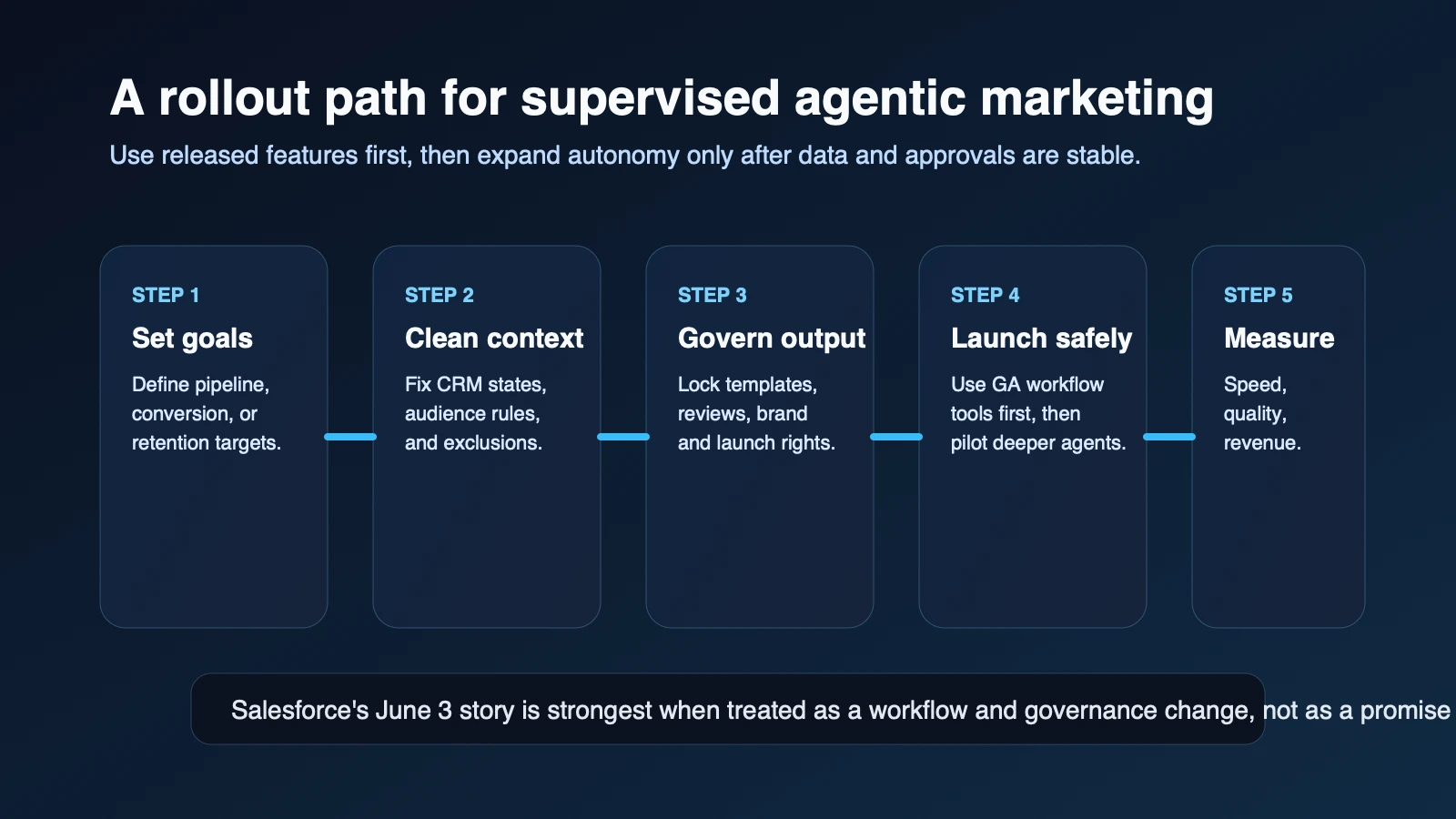
- Audit which campaign steps are still bottlenecked by manual handoffs: segmentation, approvals, localization, launch QA, performance triage, or reporting requests.
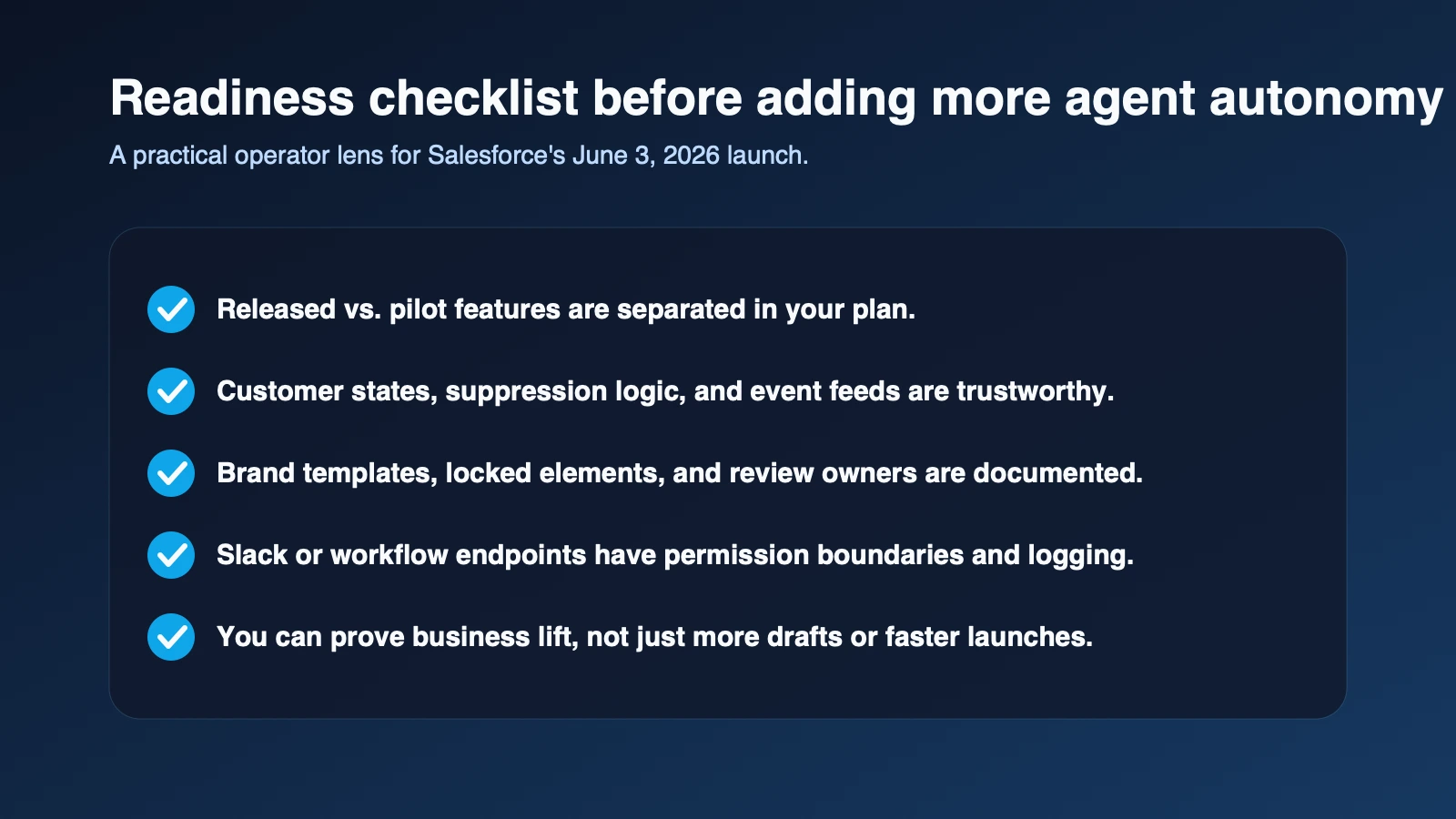
- Separate released features from pilots. Salesforce said Slack-based MCP campaign management is generally available in June 2026, while Content Agent and Marketing Goals Agent remain in pilot.
- Tighten data and offer hygiene before adding more autonomy. If lifecycle states, audience exclusions, and event feeds are unreliable, fix that first.
- Define a human-in-the-loop checklist for agent work: who approves copy, who approves budget changes, who can launch, and who can reverse a mistake.
- Rework your economics model with the Digital Marketing Budget Planner and Marketing ROI Calculator so you can measure whether automation is lowering execution cost or just increasing output.
What remains uncertain
Salesforce also left meaningful uncertainty in the open. The most ambitious campaign automation pieces are still in pilot, so broad availability and real-world operating limits are not fully proven yet. The same June 3 article also says some referenced features remain unreleased, which means buyers should not treat every keynote workflow as deployable today.
There is also a measurement gap. Salesforce can show operator anecdotes such as Rawlings' reported 75% faster campaign creation, but most teams still need their own evidence on conversion quality, approval burden, and downstream revenue impact. Faster content and faster launches do not automatically mean better business outcomes.
The real takeaway from June 3, 2026 is narrower and more useful. Salesforce is treating agentic marketing as a governed system of roles, context, approvals, and workflow endpoints, not as a single assistant. Teams that prepare the data, governance, and measurement layer now will be in a better position to use that model when the currently piloted features become broadly available.