Salesforce and Databricks turn agent governance into a cross-platform workflow
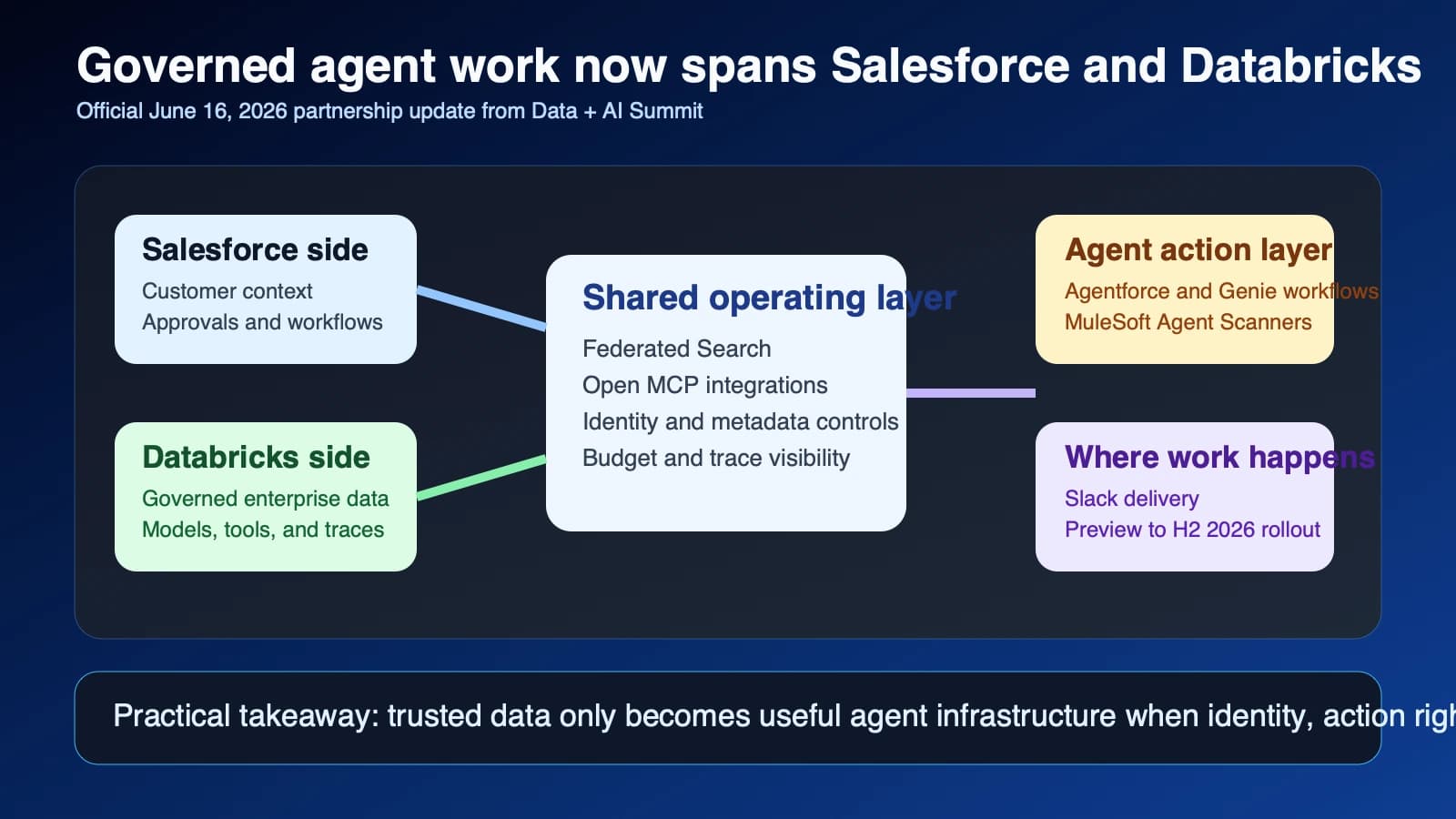
Salesforce used an official June 16, 2026 announcement from Data + AI Summit to make a more operational claim about enterprise AI agents. The company said its expanded Databricks partnership adds federated search, open MCP-driven integrations, MuleSoft Agent Scanners for Databricks, Slack integrations, and new governance features around identity, permissions, and metadata-aware access controls. For marketing, RevOps, analytics, and AI platform teams, the practical shift is not another generic "agents need data" statement. Salesforce is trying to connect trusted data, approval logic, and action paths across two major systems that often sit in different teams.
Databricks published complementary product details on June 16, 2026 and the same day, saying Unity AI Gateway now governs models, agents, MCP services, and tools in one place, while Genie One can bring governed data answers and actions into tools such as Slack and Microsoft Teams. Read together, the message is clear: enterprise agent adoption is moving away from isolated copilots and toward a governed context layer that can search, reason, and act across systems.
What changed
The June 16 Salesforce announcement is specific about where the partnership is expanding. Salesforce says the companies are adding governance enhancements to the existing Zero Copy relationship between Salesforce Data 360 and Databricks Unity Catalog, including Federated Authentication, planned identity mapping, governance interoperability, and metadata-aware access controls. The point is to reduce the repeated work of recreating permissions, policies, and identities across separate systems.
Salesforce also says new Federated Search capabilities let Agentforce search Databricks while Databricks users can search Salesforce, creating a bidirectional discovery layer. In the same post, Salesforce says MuleSoft Agent Scanners extend visibility into Agent Fabric, and that Databricks-powered insights plus security workflows are being brought directly into Slack.
Databricks fills in the governance side of that story. Its Unity AI Gateway update says the platform now aims to track AI spend, apply hard budget caps, route work across models intelligently, capture end-to-end traces, and govern runtime interactions across models, agents, MCP services, skills, and enterprise tools. Its Genie One launch post adds that governed answers and actions can now surface in Slack, Teams, mobile apps, and MCP-based assistant workflows.
| Confirmed June 16 signal | Primary source | Why operators should care |
|---|---|---|
| Salesforce and Databricks announced new federated search, MCP integrations, and Slack workflows. | Salesforce announcement | Agents are being positioned as cross-system workers, not single-app assistants. |
| Salesforce said new governance features include federated authentication and metadata-aware access controls. | Salesforce announcement | Identity and policy consistency are being treated as launch requirements, not cleanup tasks. |
| Databricks said Unity AI Gateway now governs models, agents, MCP services, and enterprise tools with tracing and spend controls. | Databricks Unity AI Gateway update | Budget control and auditability are becoming part of the agent operating model. |
| Databricks said Genie One can work through Slack, Teams, mobile apps, and MCP-based assistant experiences. | Databricks Genie One launch | Business users may get governed data action inside the tools where work already happens. |
| Salesforce said broader capabilities roll out in H2 2026 and beyond, with some pieces still in preview. | Salesforce availability notes | This is a real platform direction, but not every workflow is generally available today. |
Why it matters
This matters because many enterprise AI deployments still fail at the same handoff. Models can produce answers, but they often lack live business context, safe access boundaries, and approved action routes. Salesforce's own June 16 framing says the gap is between data and the permissions, approvals, and workflows required to use that data safely. Databricks is making the same case from the governance side by saying AI estates now need centralized controls across models, tools, MCP services, and agents.
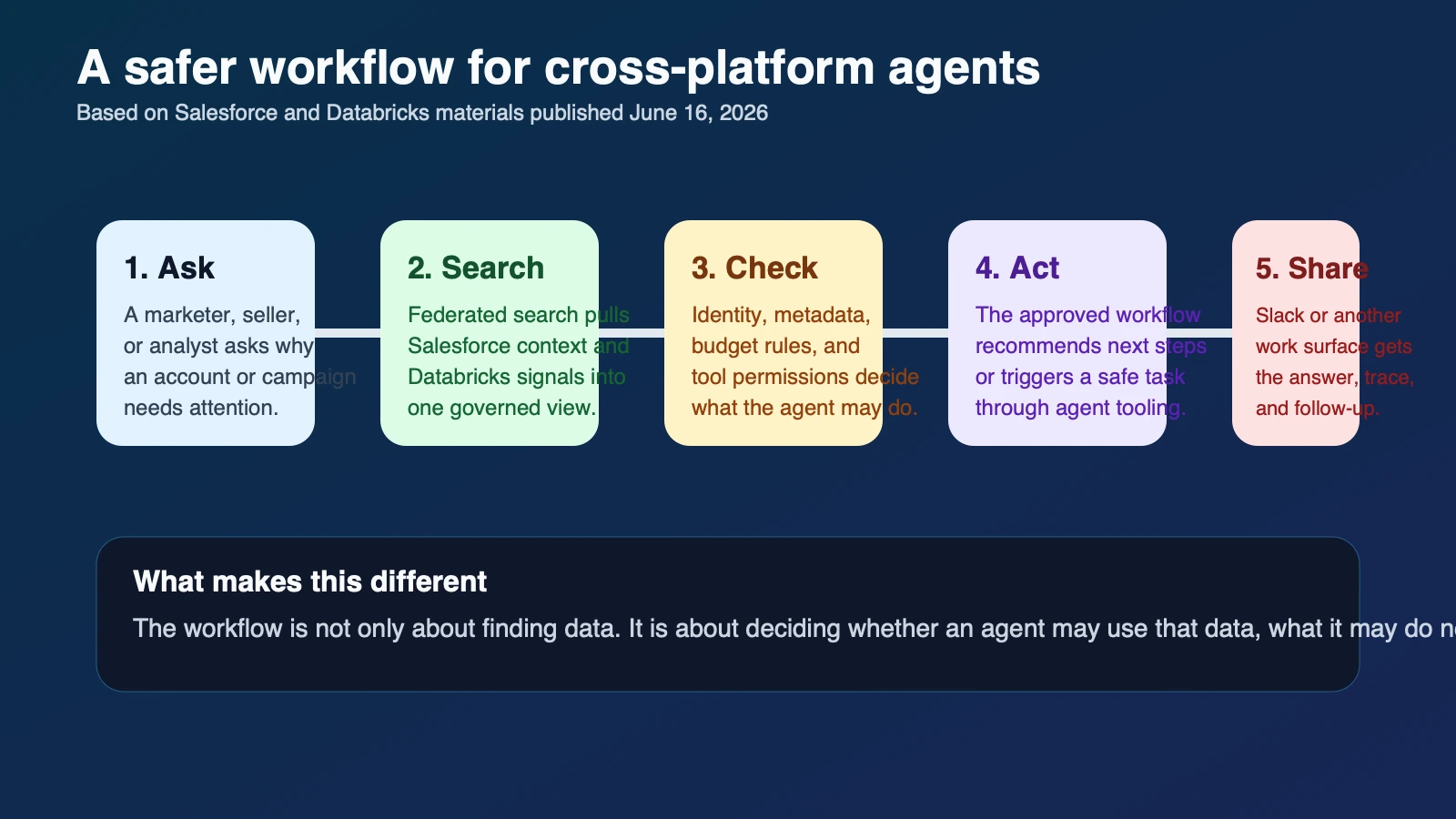
For marketing and revenue teams, this becomes practical very quickly. A marketer might want an agent to explain why pipeline from a named account is softening, compare CRM signals with product or usage data, and then trigger a follow-up workflow in a governed way. A lifecycle team might want Slack-delivered alerts grounded in customer data, but without exposing unrestricted access to every tool. A RevOps leader might want the same system to prove who had access, which data was used, and what action was taken.
That is why this story fits the same discipline behind the GEO Visibility Checklist, the Digital Marketing Budget Planner, and the guide to tracking brand mentions and visibility. In all three cases, the advantage comes from making context structured, reusable, and measurable before automation scales.
Who is affected
The clearest immediate audience is large organizations already running Salesforce, Databricks, Slack, or MuleSoft in the same stack. That includes enterprise marketing teams, revenue operations groups, customer success leaders, analytics teams, and internal AI platform owners across the United States, Canada, the United Kingdom, Australia, and Europe.
Agencies and systems integrators should also pay attention. If customer data, search, approvals, and agent actions start converging inside governed cross-platform workflows, service scopes will move beyond campaign execution or dashboarding alone. More engagements will include access design, policy mapping, action logging, and budget controls for agent usage.
What to do next
Use this short workflow before treating the June 16 announcement as deployable production magic:
- Map which questions your teams actually want agents to answer across Salesforce and Databricks, then separate read-only use cases from action-taking ones.
- Audit identities, permissions, and policy mismatches across CRM, data, Slack, and middleware systems before adding agent access on top.
- Decide where a governed conversational surface in Slack or Teams would reduce dashboard hopping without exposing unsafe actions.
- Add cost and logging requirements early, especially if your team expects model routing, MCP tool access, or multi-agent behavior.
- Benchmark whether the workflow would improve real operator speed, using planning tools like the Marketing ROI Calculator and the Digital Marketing Budget Planner.
What remains uncertain
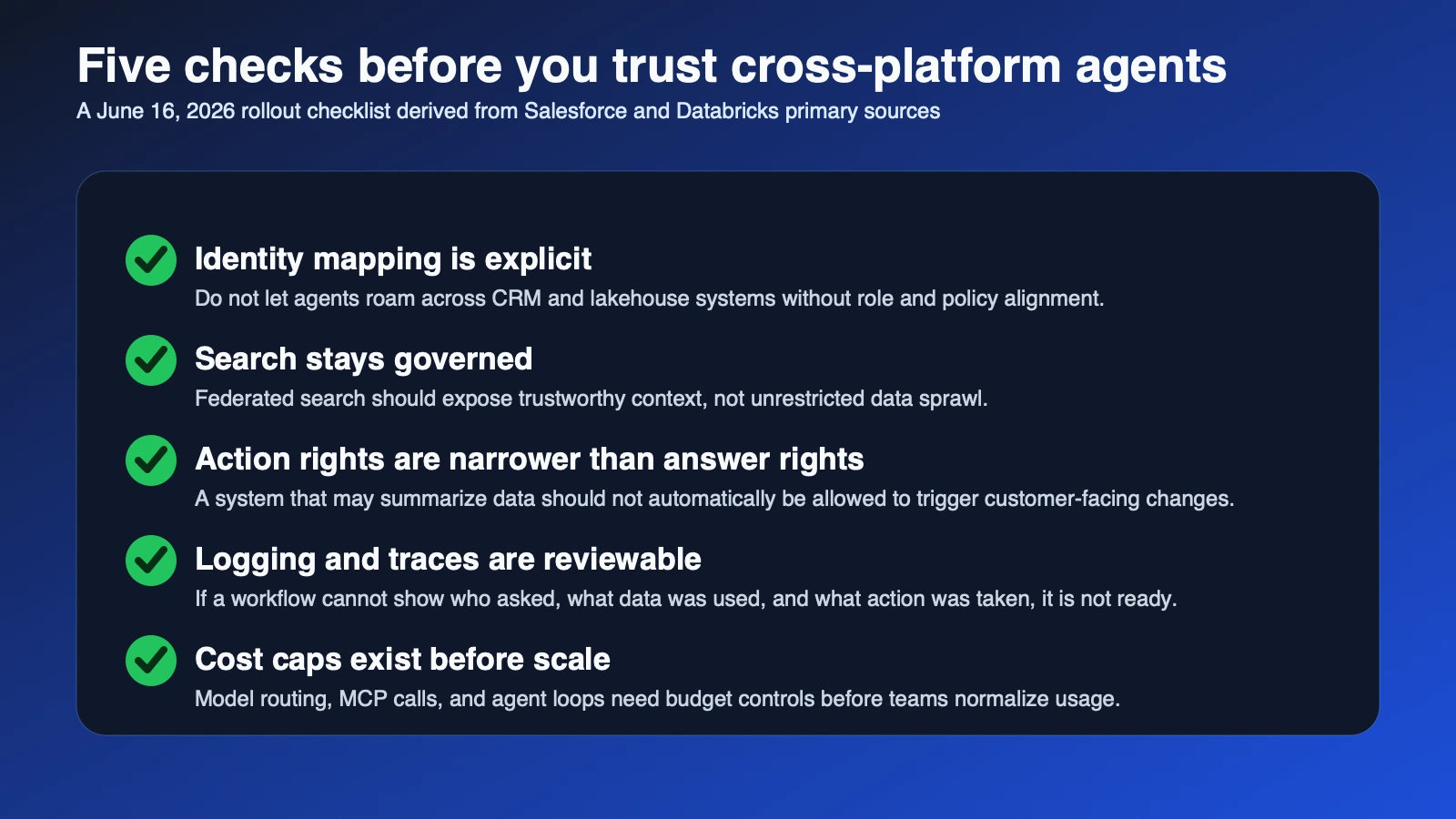
Important limits are still visible on June 16, 2026. Salesforce says the broader agentic search, open MCP-driven integrations, and related capabilities are rolling out in H2 2026 and beyond, while the Slack Genie App is still listed as public preview before planned GA later in H2 2026. Pricing, packaging, regional availability, and agreement-specific limits can still vary. Databricks also promotes some performance and governance gains from its own benchmarks and customer examples, which are useful signals but not substitutes for internal testing.
So the disciplined reading is narrower than the keynote energy. Salesforce and Databricks have made a stronger enterprise case that trusted data alone is not enough, and smart agent orchestration alone is not enough. The operating model that matters is the layer between them: governed context, searchable truth, explicit action rights, and traceable workflows. Teams that prepare those pieces now will be in a much better position when the H2 2026 rollout window turns more of this architecture into routine production work.