Semrush-backed AI brand model gives CMOs a clearer playbook for GEO and demand generation
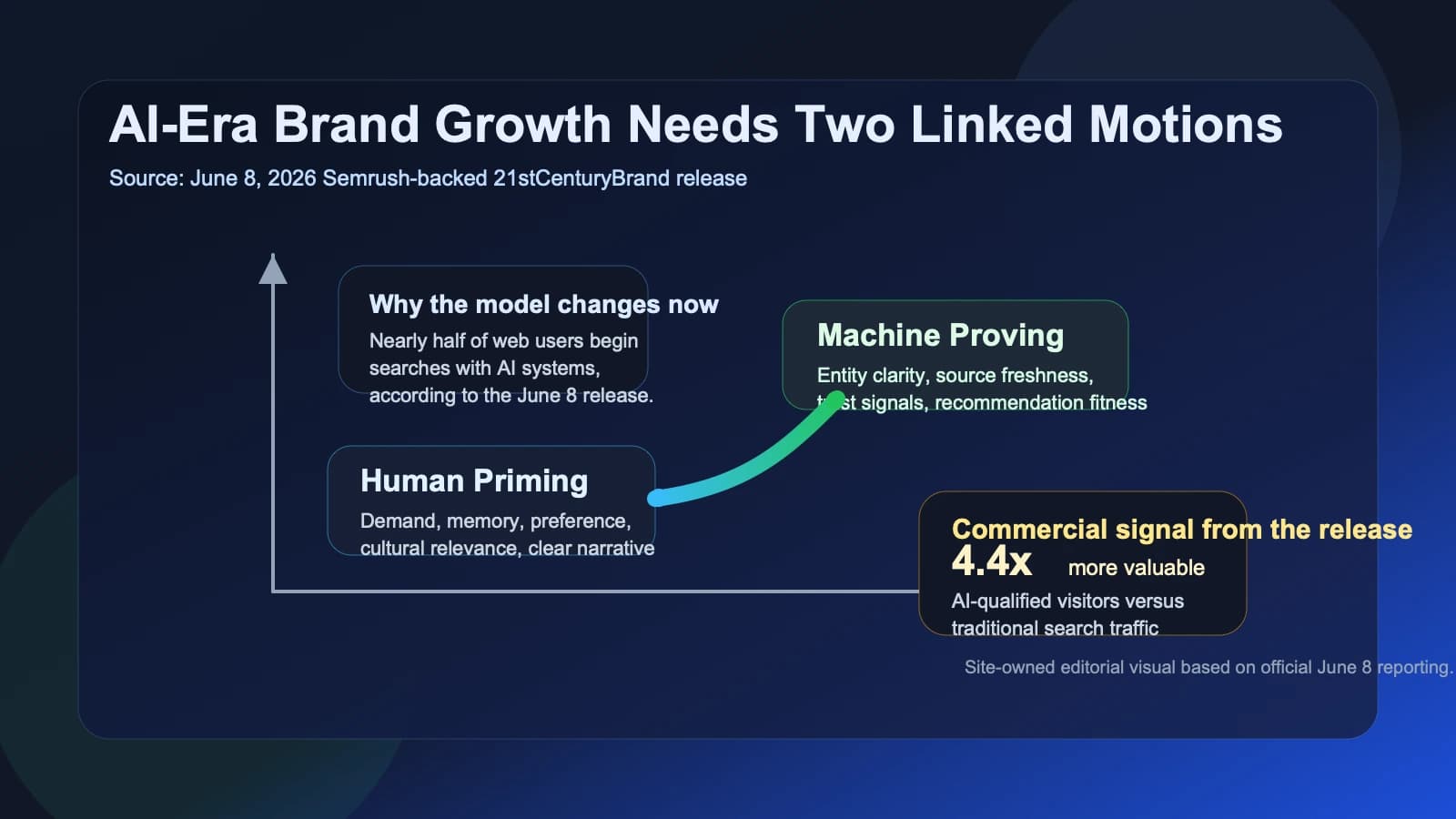
On June 8, 2026, 21stCenturyBrand said in a Semrush-backed release that marketers need a new go-to-market model built for both people and AI systems. The paper introduces a "Priming and Proving" framework and argues that AI-qualified visitors are already 4.4x more valuable than traditional search traffic, while nearly 50% of web users now begin searches with AI systems. For CMOs, SEO leaders, and growth teams, the practical shift is that brand demand, search visibility, and machine-readable trust can no longer be managed as separate programs.
The June 8 release says the framework is based on 18 months of research plus Semrush data spanning hundreds of millions of prompts across dozens of categories. It also arrives five days after Semrush's June 3, 2026 MCP connector launch for Perplexity and less than two weeks after its May 27, 2026 unified content optimization release. Read together, those official updates show a bigger pattern: Semrush is framing AI visibility as a demand, brand credibility, and commercial discovery problem, not a niche report.
What changed
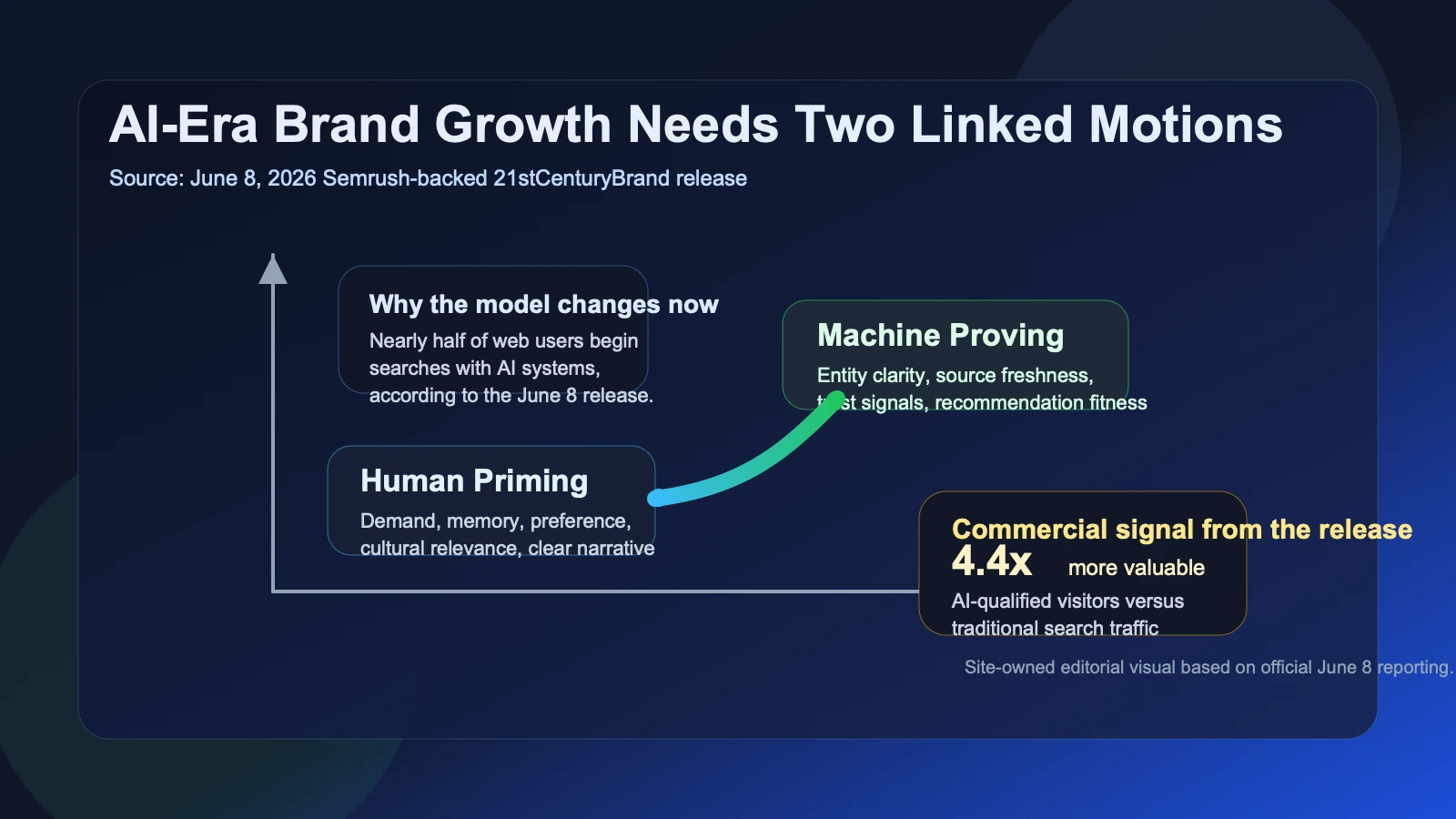
The June 8 release argues that the classic linear funnel is no longer an adequate planning model because AI systems increasingly mediate how brands are discovered, evaluated, and recommended. According to the announcement, the new framework splits the job into two connected motions: Priming, which builds human familiarity, relevance, and preference, and Proving, which helps AI systems find, understand, and trust the brand well enough to recommend it.
| Confirmed June 8 signal | Official source | Why it matters |
|---|---|---|
| Nearly 50% of web users now begin searches using AI systems. | Semrush-backed 21stCenturyBrand release, June 8, 2026 | Discovery behavior is fragmenting beyond classic search and direct navigation. |
| AI-qualified visitors are 4.4x more valuable than traditional search traffic. | Semrush-backed 21stCenturyBrand release, June 8, 2026 | AI visibility is increasingly tied to downstream commercial quality, not just impressions. |
| The framework is built on 18 months of research and Semrush data across hundreds of millions of prompts. | Semrush-backed 21stCenturyBrand release, June 8, 2026 | The model is being positioned as an evidence-led operating framework, not only brand theory. |
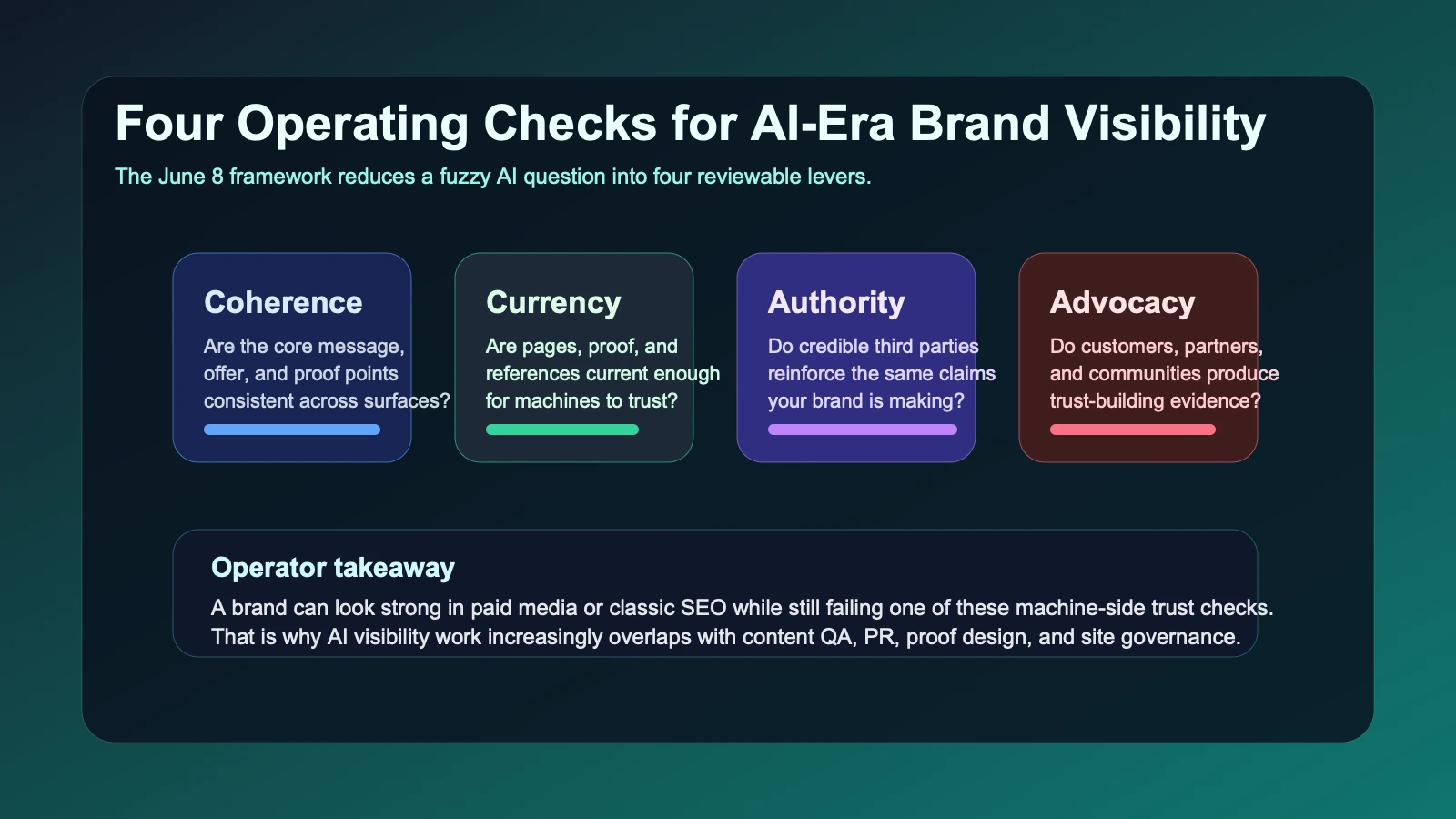
| The four highest-impact variables are Coherence, Currency, Authority, and Advocacy. | Semrush-backed 21stCenturyBrand release, June 8, 2026 | Teams get a more usable diagnostic than vague "optimize for AI" advice. |
| Semrush launched an MCP connector in Perplexity on June 3, 2026 and unified SEO plus AI content optimization on May 27, 2026. | Semrush newsroom product index and Semrush product news, May 27, 2026 | The research is landing alongside operational product moves, not in isolation. |
The release also uses brand examples to show that AI discovery is becoming measurable enough to influence planning. It says Lego reaches a monthly AI audience of 1.2 billion across 10,000 live topics, Notion receives 96,000 AI mentions per month with 140% mention growth over six months, and Shopify grew AI mentions 360% in six months.
Why it matters
This matters because many teams still separate brand marketing, SEO, PR, content operations, and AI visibility into different reporting lines. The June 8 release argues that this is now a structural weakness. If AI systems are evaluating entity clarity, third-party endorsement, source freshness, and customer proof in real time, disconnected brand programs create inconsistent signals at exactly the point where machine intermediaries are making recommendations.
That makes the story more relevant than a standard thought-leadership drop. Semrush has spent the last month shipping workflow infrastructure around AI visibility, and this release gives CMOs a strategic language for the same problem. The combination is useful for high-value markets such as the United States, Canada, the United Kingdom, Australia, and Europe, where enterprise buyers increasingly compare vendors through AI-assisted research before they ever click a landing page.
It also fits Slogan.website's internal tool layer. Teams already working through the GEO Visibility Checklist, the guide to generative engine optimization benefits, or the framework for tracking brand mentions and visibility should read this as confirmation that AI visibility is not a side channel. It is a cross-functional discipline that touches positioning, source quality, technical access, proof, and demand capture.
Who is affected
The first group is CMOs and VP-level growth leaders trying to connect brand spend with measurable pipeline in an AI-mediated discovery environment.
The second group is SEO, content, and digital PR teams. If their work is still measured only by rankings, traffic, and backlinks, they may be missing the interpretation layer that shapes shortlists and recommendations.
The third group is agencies and consulting firms selling GEO, AI search, or content modernization work. The June 8 release raises the bar: clients should expect a framework that links brand clarity, fresh evidence, authority building, and customer advocacy rather than a loose package of prompt tests.
What to do next
- Audit one priority brand or product line across the four levers: coherence, currency, authority, and advocacy.
- Compare what your homepage, solution pages, and third-party mentions say today versus what an AI system should reliably infer about your category, proof, and differentiation.
- Run the GEO Visibility Checklist on pages that drive pipeline, not just informational content.
- Use the Marketing ROI Calculator or the Digital Marketing Budget Planner to test whether stronger AI-qualified traffic would justify more spend on source quality, PR, or content operations.
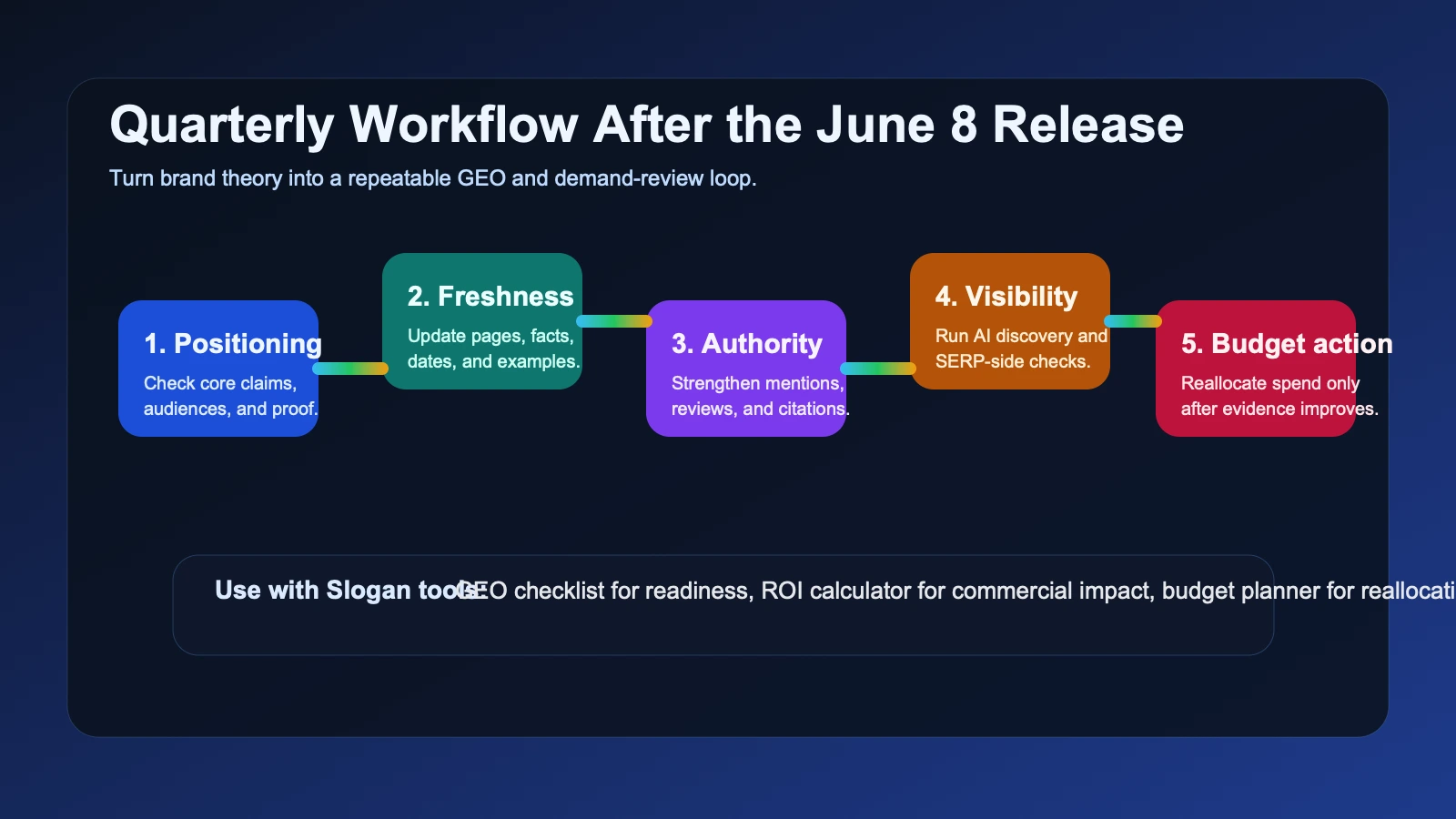
- Build one recurring workflow that connects brand messaging, source freshness, third-party proof, and AI visibility measurement before buying more tooling.
The key is to move from abstract AI awareness into an operating cadence that can actually be reviewed each quarter.
What remains uncertain
There are still real limits. The release does not publish the full methodology behind every benchmark, and the brand examples come from selected case studies rather than a neutral market average. The framework is best treated as a credible operator lens, not a complete forecasting model.
There is also a measurement gap. Even with Semrush expanding AI visibility products, most teams still do not have a clean system for connecting AI-driven discovery to influenced revenue or renewal. That is why the best response is not to chase a new vanity metric. It is to tighten source quality, unify brand claims, and make proof easier for both humans and AI systems to verify.
As of June 8, 2026, the strongest official signal is that AI-era brand growth is becoming less about publishing more and more about publishing cleaner, fresher, and more defensible evidence. Teams that keep treating GEO, SEO, PR, and brand strategy as separate tracks are likely to lose time before they lose visibility.