Semrush scales its AI Visibility Index to 126 million prompts and makes brand visibility a measurement problem
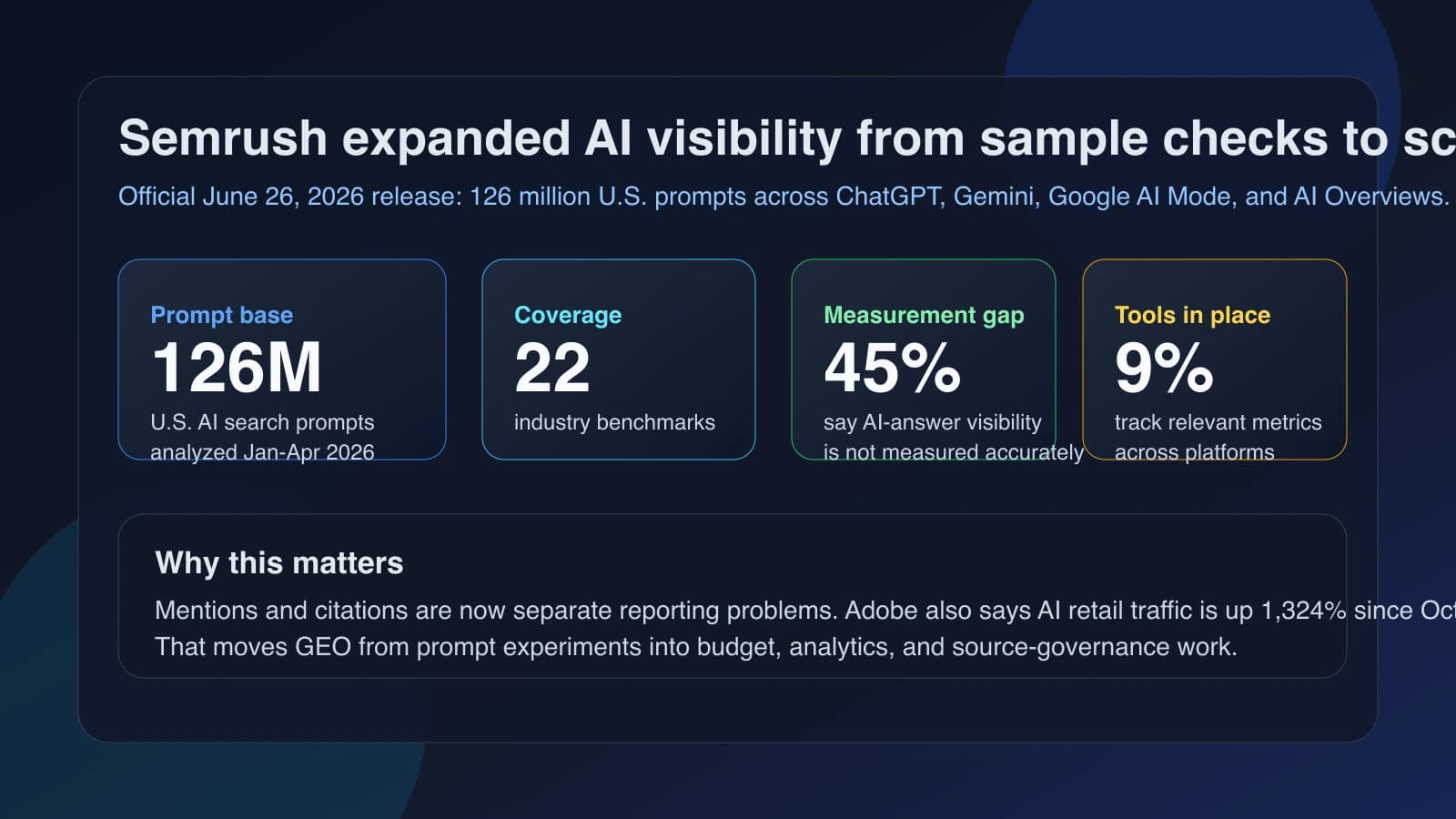
Semrush turned AI visibility from a niche GEO talking point into a larger measurement issue on June 26, 2026. The company said its 2026 AI Visibility Index now scales from an initial 2,500 prompts to 126 million U.S. AI search prompts analyzed from January through April 2026, with benchmarks across 22 industries. Read together with Adobe's June 17, 2026 business report, which says AI traffic to U.S. retail sites is up 1,324% since October 2024, the practical conclusion is not that marketers need another dashboard. It is that AI-era discovery now deserves the same planning discipline as paid search, analytics, and conversion infrastructure.
The timing matters for operators in the United States, Canada, the United Kingdom, Australia, and Europe because AI discovery is no longer a side-channel curiosity. It is increasingly part of how buyers compare vendors, research products, and decide which brand even makes the shortlist. If your team still treats AI visibility as a one-off prompt test, the data now looks behind the market.
What changed
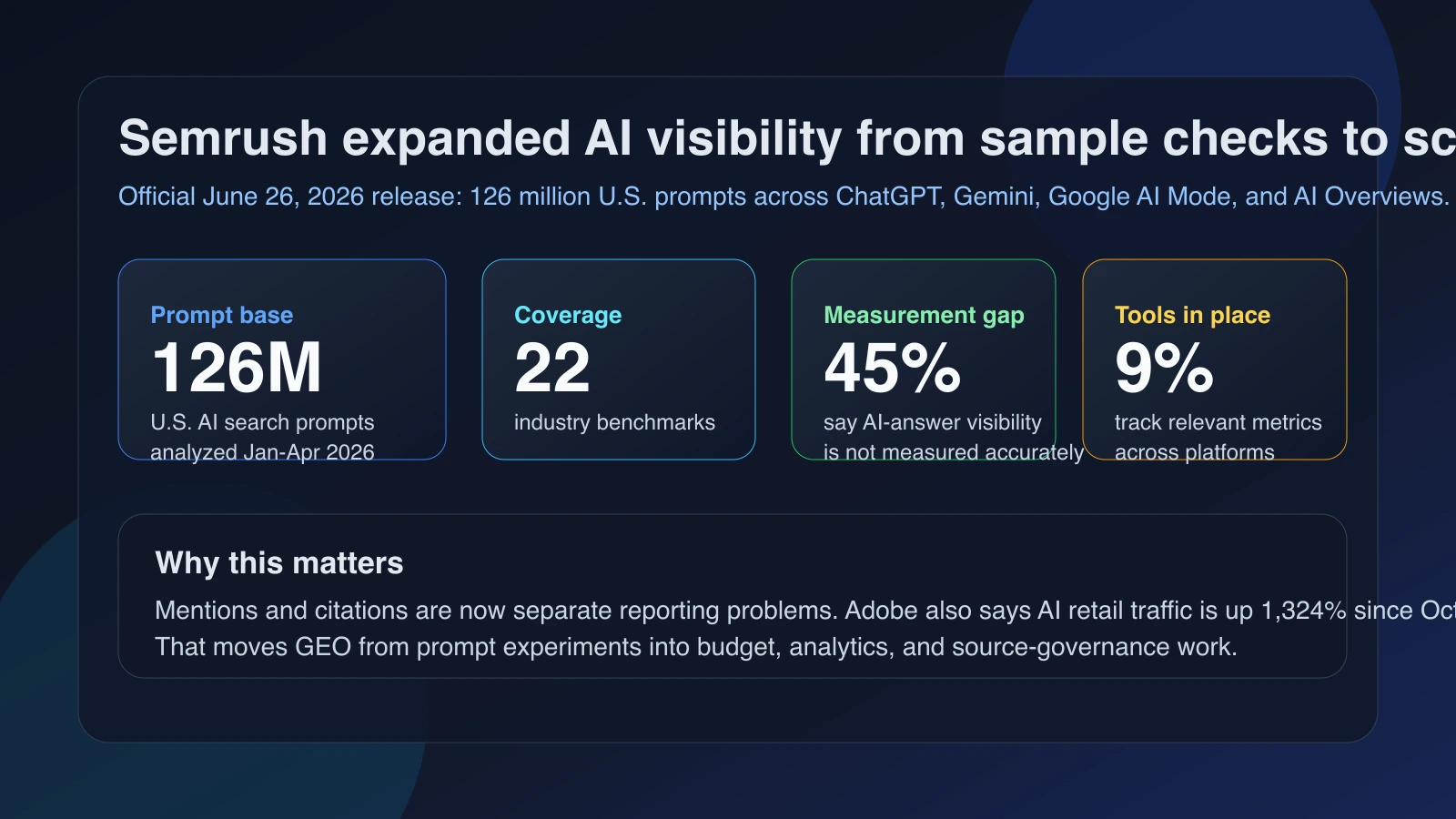
Semrush's official release says the new study measures how brands are mentioned, cited, and represented across major AI discovery environments, including ChatGPT, Gemini, Google AI Mode, and Google AI Overviews. The same release says 45% of marketing leaders cannot accurately measure brand visibility inside AI-generated answers, while only 9% have tools to track the relevant metrics across platforms. That framing is important because Semrush is not only selling visibility software. It is describing a market gap: brands are appearing inside AI systems before many teams have a stable reporting model for that exposure.
The methodology findings make the gap more concrete. Semrush says ChatGPT cites an average of 15 sources per response, while Gemini cites an average of 3 sources. It also says overlap between mentioned brands and cited domains on Gemini can be as low as 30%. In plain terms, being talked about in an AI answer and being used as the evidence behind that answer are not the same thing.
| Confirmed June 2026 finding | Primary source | Why it matters operationally |
|---|---|---|
| Semrush expanded the AI Visibility Index from 2,500 prompts to 126 million U.S. AI search prompts analyzed from January through April 2026. | Semrush release, June 26, 2026 | GEO is shifting from small-sample experimentation toward benchmarked measurement at much larger scale. |
| The study benchmarks 22 industries and compares performance across ChatGPT, Gemini, Google AI Mode, and Google AI Overviews. | Semrush release | Visibility strategy now needs platform-specific diagnosis instead of one blended AI score. |
| Semrush says 45% of marketing leaders cannot accurately measure AI-answer visibility, and only 9% have full cross-platform tooling. | Semrush release | The reporting stack is lagging the behavior shift, which raises planning and attribution risk. |
| ChatGPT cites an average of 15 sources per response, while Gemini cites an average of 3. | Semrush release | Brand evidence strategy should change by platform; citation behavior is not uniform. |
| Adobe says AI traffic to U.S. retail sites is up 1,324% since October 2024 and AI-referred retail traffic now converts 54% better than non-AI sources. | Adobe for Business report, June 17, 2026 | Discovery quality is now affecting commercial traffic, not only vanity visibility. |
Why it matters
This matters because AI discovery is becoming harder to dismiss as upper-funnel noise. Adobe's June 17 report says AI traffic to U.S. retail sites in May 2026 was not only up 1,324% since October 2024, but also converted 54% better than non-AI traffic sources. If those trends continue, then the question for growth teams changes from "Should we monitor AI visibility?" to "Which pages, entities, and external citations deserve the most attention first?"
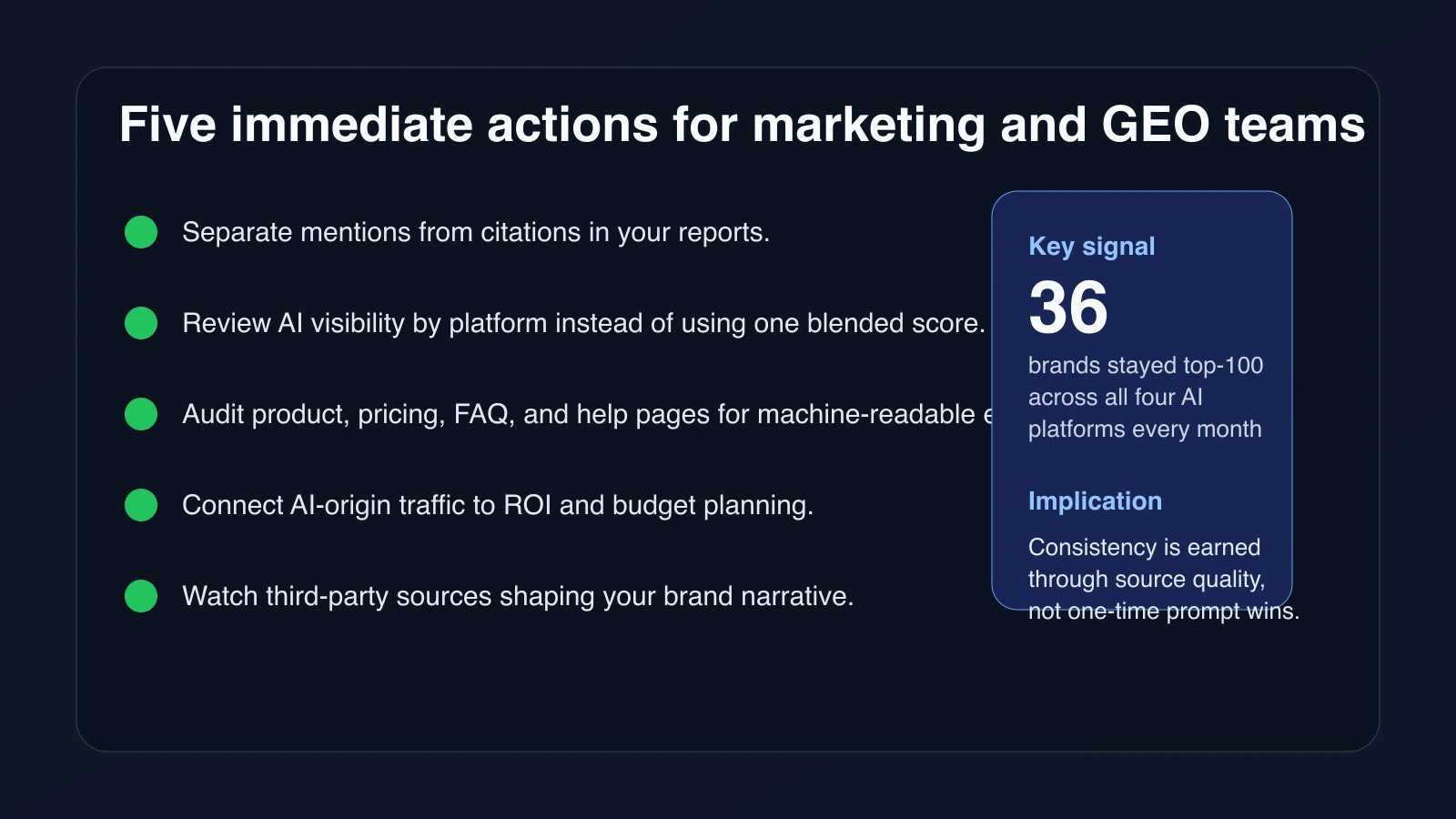
Semrush's own findings push in the same direction. The company says only 36 brands maintained top-100 visibility across all four platforms during every month of the study, and that organizations integrating SEO and AI visibility into one workflow were more likely to report AI-platform traffic or lead gains than teams managing them separately. That supports a tougher but more useful view of GEO: it is not a copywriting trick. It is a cross-functional operating model touching SEO, analytics, brand governance, content, PR, product facts, and source quality.
That is why this story connects naturally to Slogan.website's GEO Visibility Checklist, the guide to tracking brand mentions and visibility, the Marketing ROI Calculator, and the Digital Marketing Budget Planner. Once visibility starts affecting qualified discovery, the work belongs in budgeting and reporting, not only in editorial theory.
Who is affected
The first group is SEO, GEO, and content teams that need to decide whether their owned pages are earning citations or only contributing loose brand mentions through third-party sources.
The second group is demand-generation and paid-media leaders who increasingly need to explain performance in a world where discovery can start inside AI systems before the click lands on a site.
The third group is CMOs, RevOps, and digital strategy teams that need a cleaner way to connect AI-era visibility work with business outcomes instead of funding it as an isolated experiment.
What to do next
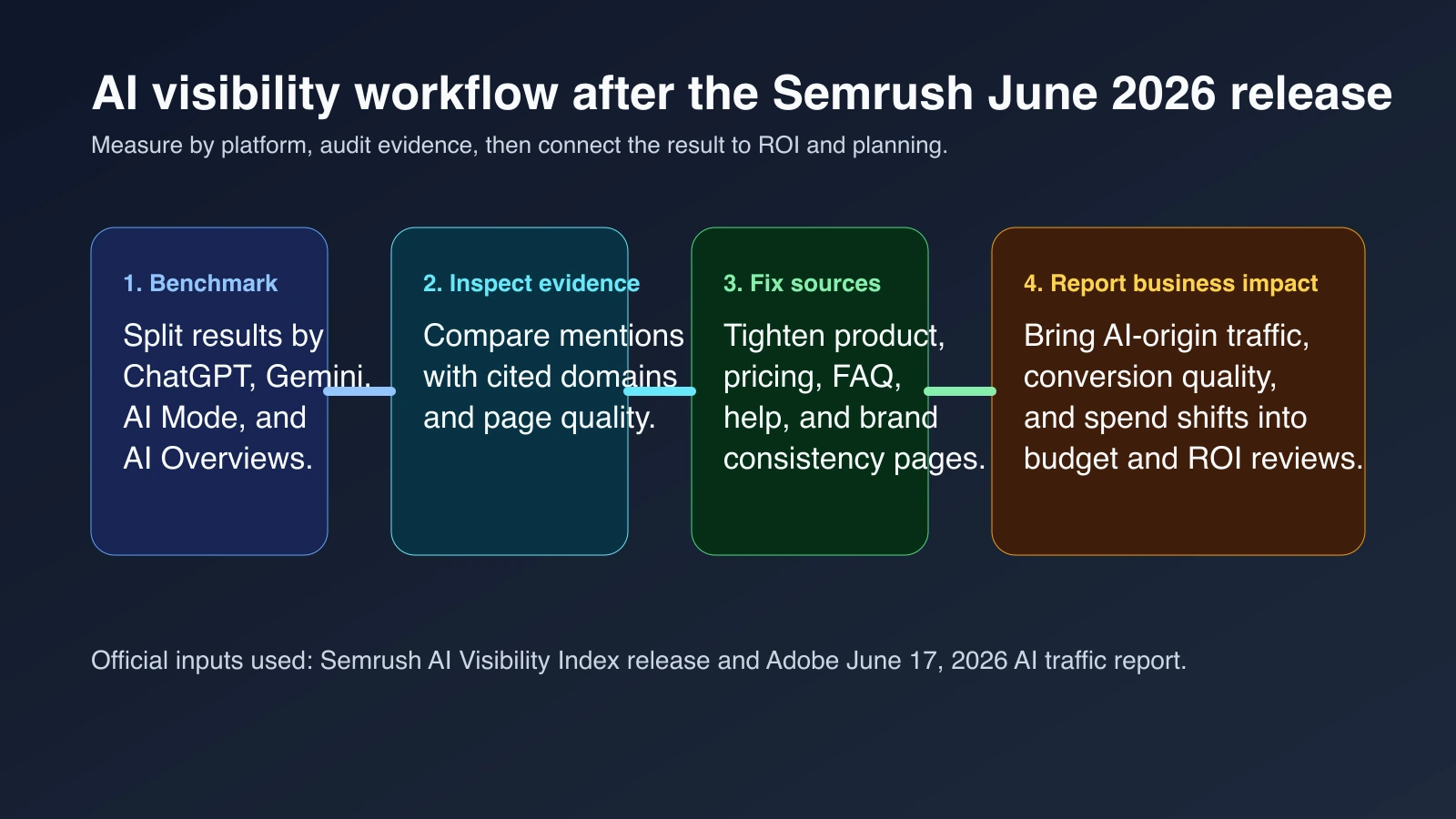
- Separate mentions from citations in your reporting, because the source proving the claim may not be your own domain.
- Review AI visibility platform by platform instead of merging ChatGPT, Gemini, Google AI Mode, and AI Overviews into one average.
- Audit the pages and documents that should anchor your brand narrative with the GEO Visibility Checklist, especially product detail, pricing, FAQ, help, and comparison pages.
- Model the commercial impact of stronger AI-origin traffic with the Marketing ROI Calculator and the Digital Marketing Budget Planner before treating the work as a soft brand project.
- Track whether independent publishers, communities, marketplaces, and reference pages are reinforcing or distorting the story AI systems tell about your brand.
What remains uncertain
There are still limits. Semrush's release is a company-issued study, not a neutral industry census, so teams should treat it as strong directional evidence rather than universal ground truth for every category. The same article says AI platforms show very different citation behavior, which implies that no single benchmark can fully predict results across industries, countries, or buyer journeys. Adobe's traffic findings are also strongest for the U.S. market, even if the operating lessons are useful more broadly.
So the durable takeaway on July 7, 2026 is narrower and more useful than "AI search changes everything." The clearer conclusion is that the measurement problem has matured. Brands that keep AI visibility in a side folder will struggle to explain what the machines are saying about them, where that evidence comes from, and whether the traffic it creates is worth more or less than the channels they already manage.