Semrush brings live search intelligence into Perplexity and makes GEO research more operational
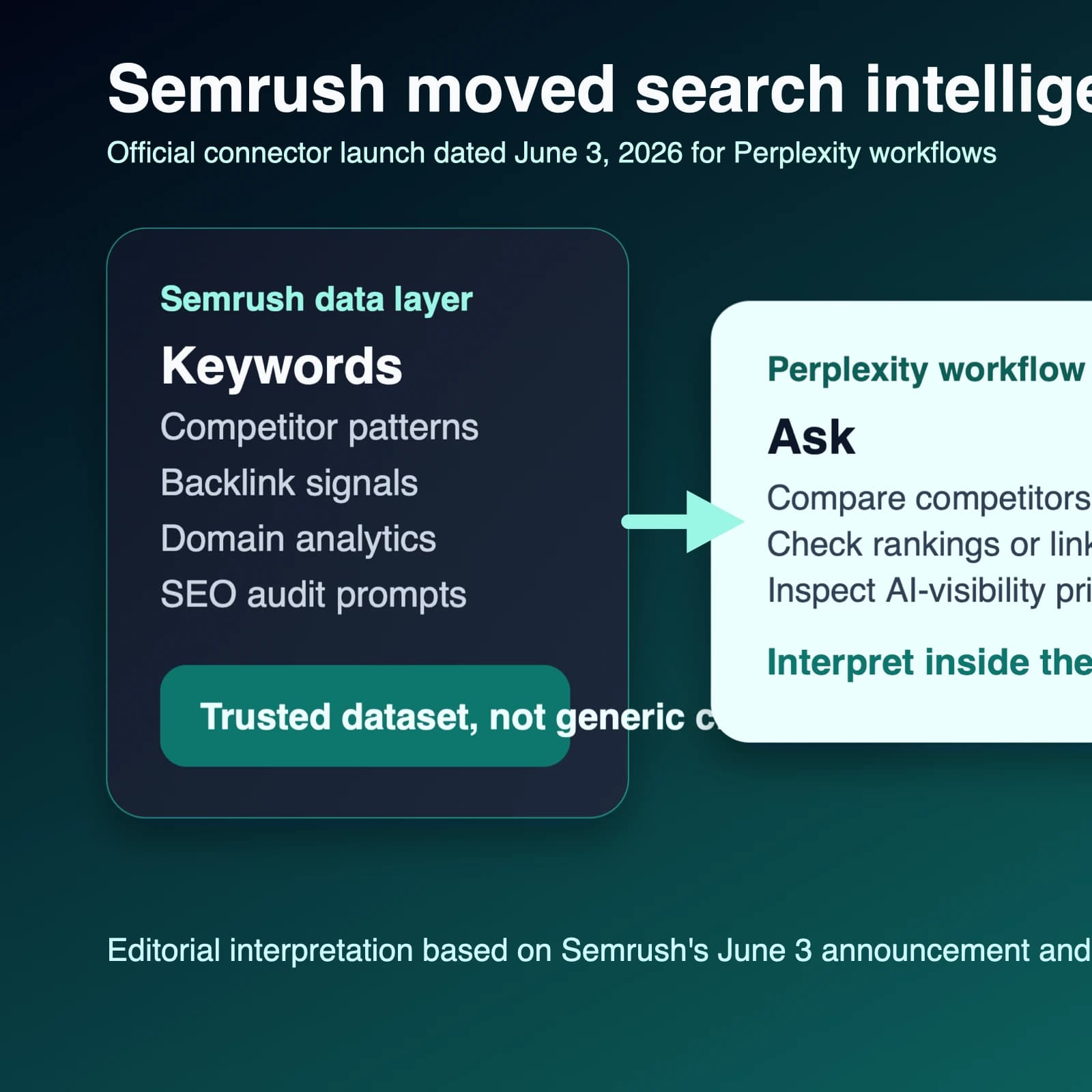
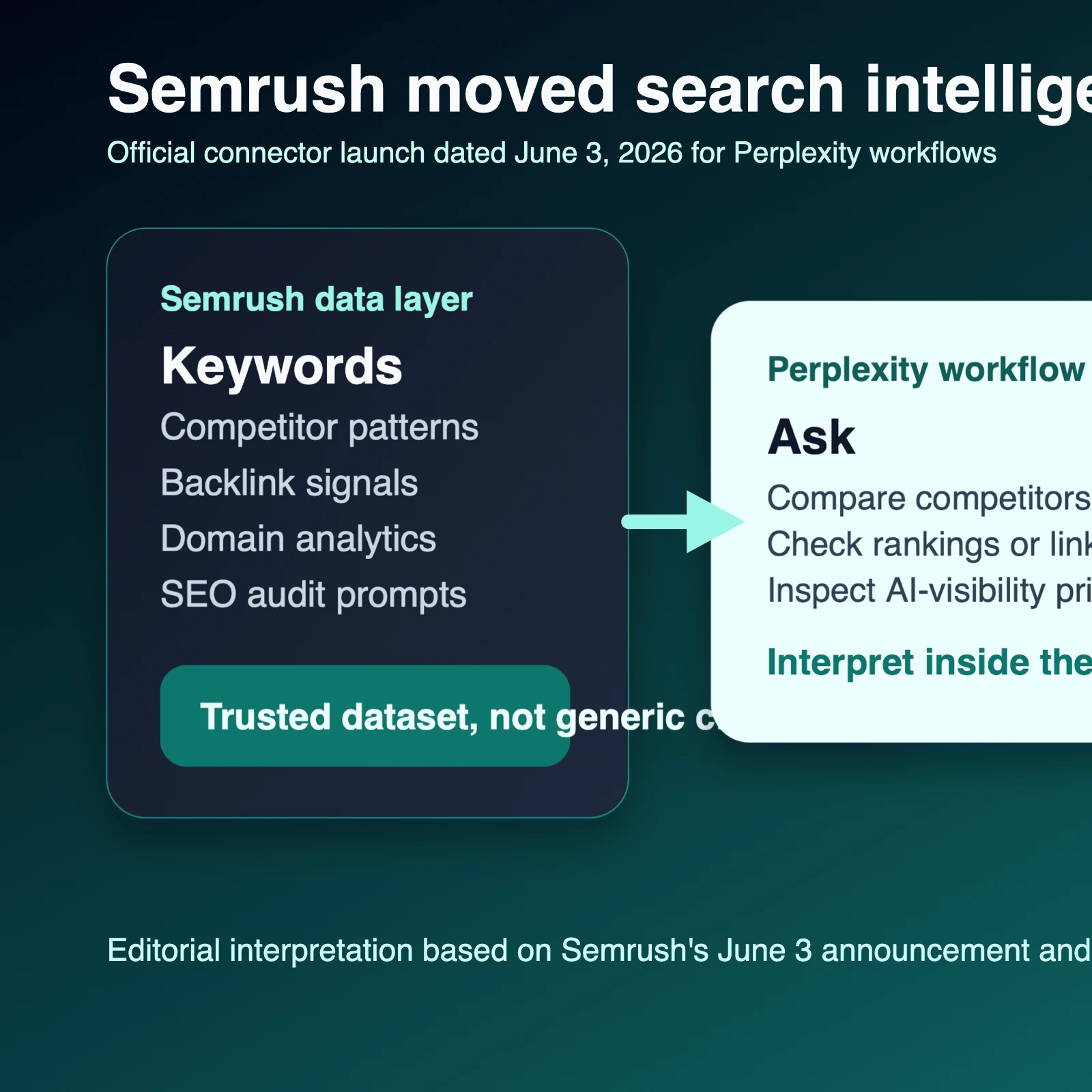
Semrush said on June 3, 2026 that it launched an official MCP connector inside Perplexity, giving Perplexity users access to Semrush search intelligence directly inside the AI search workflow. That matters because the job is no longer only "export data from an SEO tool, then interpret it elsewhere." According to Semrush, users can run keyword research, competitor analysis, SEO audits, and pull rankings, domain analytics, and backlink data from inside Perplexity.
For operators in the United States, Canada, the United Kingdom, Australia, and Europe, this is not just another AI integration headline. It is a workflow change for teams doing GEO, SEO, competitive research, content planning, and digital visibility reporting. If the place where people ask strategic questions now has direct access to visibility datasets, the speed and shape of decision-making can change.
What changed
| Confirmed June 3, 2026 change | Primary source | Why it matters |
|---|---|---|
| Semrush launched an MCP connector with Perplexity. | Semrush product news, June 3, 2026 | Semrush data can now travel into an AI-native search interface instead of staying locked in a separate dashboard. |
| Semrush says users can run keyword research, competitor analysis, and SEO audits inside Perplexity. | Semrush product news, June 3, 2026 | The question-to-analysis loop becomes shorter for search, content, and market teams. |
| Semrush says rankings, domain analytics, and backlink data can be pulled into the Perplexity workflow. | Semrush product news, June 3, 2026 | Research can stay grounded in live platform data instead of generic AI summaries. |
| The launch covers Perplexity's AI-native search experience, Comet browser, and Perplexity Computer workflows. | Semrush product news, June 3, 2026 | This is broader than a simple plugin for one prompt box. It points toward agent-assisted operating workflows. |
| Semrush documentation says Perplexity setup requires a paid Perplexity account and consumes Semrush API units from the user's Semrush subscription. | Semrush MCP documentation | Availability is real, but usage still depends on account tier, units, and connector access. |
The connector also sits inside a bigger Semrush push. Semrush's MCP documentation says the same server can be used across Claude, ChatGPT, Cursor, VS Code, Gemini, and Perplexity, with the MCP endpoint exposed at https://mcp.semrush.com/v1/mcp. That tells you the Perplexity release is not a one-off experiment. It is part of a larger attempt to make Semrush data travel natively into the places where AI-assisted work now happens.
Why it matters
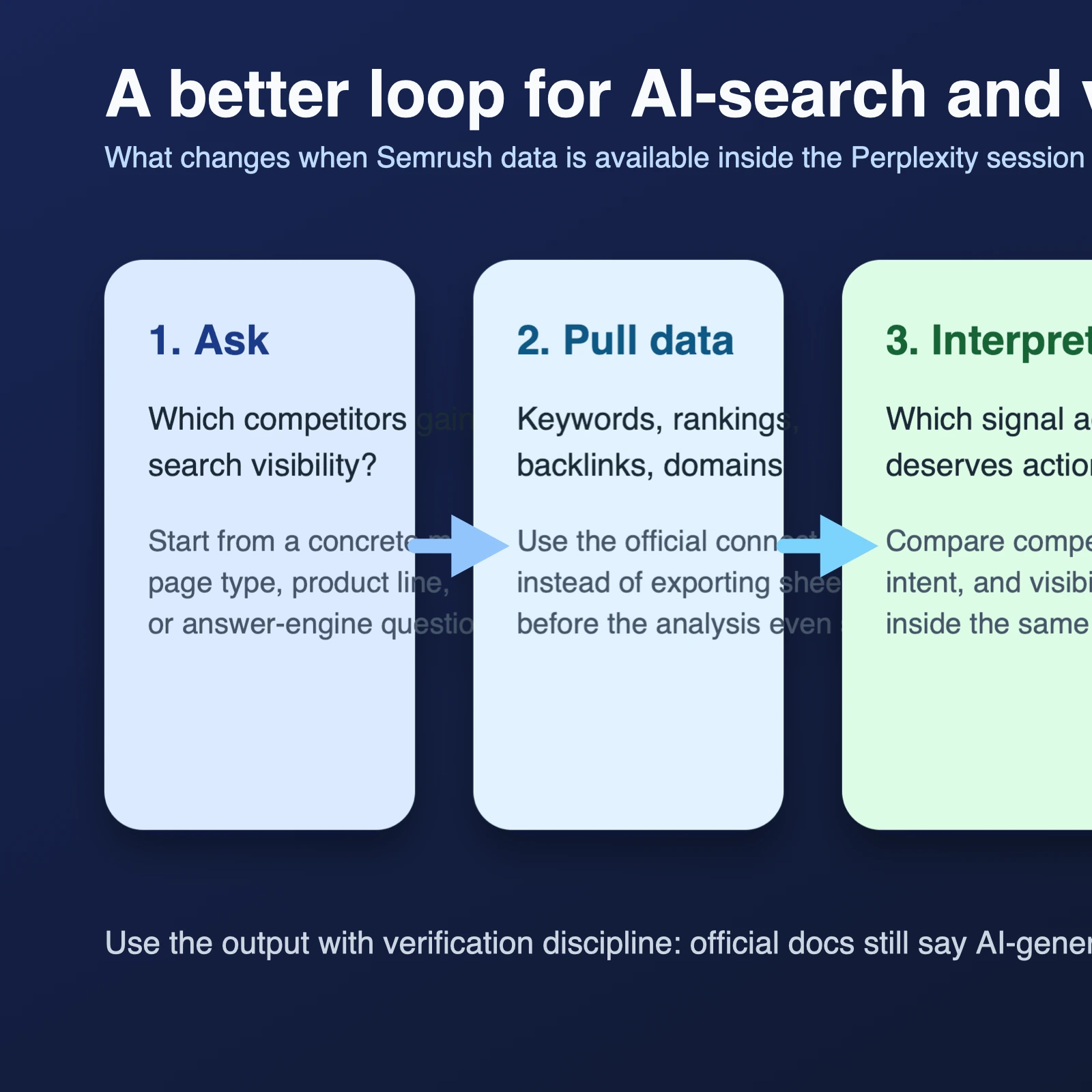
The practical value is not that marketers can "chat with SEO data." That framing is too shallow. The real shift is that visibility work, answer-engine research, and competitor analysis can happen in the same interface where a team is already planning actions. A strategist can ask about a competitor's ranking position, follow up with backlink or domain questions, compare implications, and then turn that into a next-step plan without switching between multiple tabs and exports.
That is especially relevant for teams already working through Slogan.website's GEO Visibility Checklist, the guide to tracking brand mentions and visibility, or the review of AI search analytics tools for marketing teams. Those resources assume the hard part is moving from signal to action fast enough to matter. Semrush is trying to reduce that friction.
The Perplexity angle matters too. Search behavior is fragmenting across classic search, answer engines, and AI-assisted browsing. If Perplexity becomes a place where operators both ask market questions and inspect live search-intelligence data, then the interface itself starts to matter strategically. Teams may spend less time treating AI search as a separate experimental layer and more time treating it as part of normal research operations.
Who is affected
The first group is in-house SEO and GEO teams that need faster competitive answers without relying on stale exports. The second is agencies that have to explain visibility movement across multiple clients and markets. The third is growth and content teams that want better evidence before changing a content brief, a landing page, or a budget assumption in the Marketing ROI Calculator or Digital Marketing Budget Planner. The fourth is founders and operators who already use Perplexity as a daily research surface.
This does not mean every team should abandon dashboards. It means the interface where questions get asked is becoming more powerful, and the teams that connect trusted data into that interface will usually work faster than teams that keep context fragmented.
What to do next
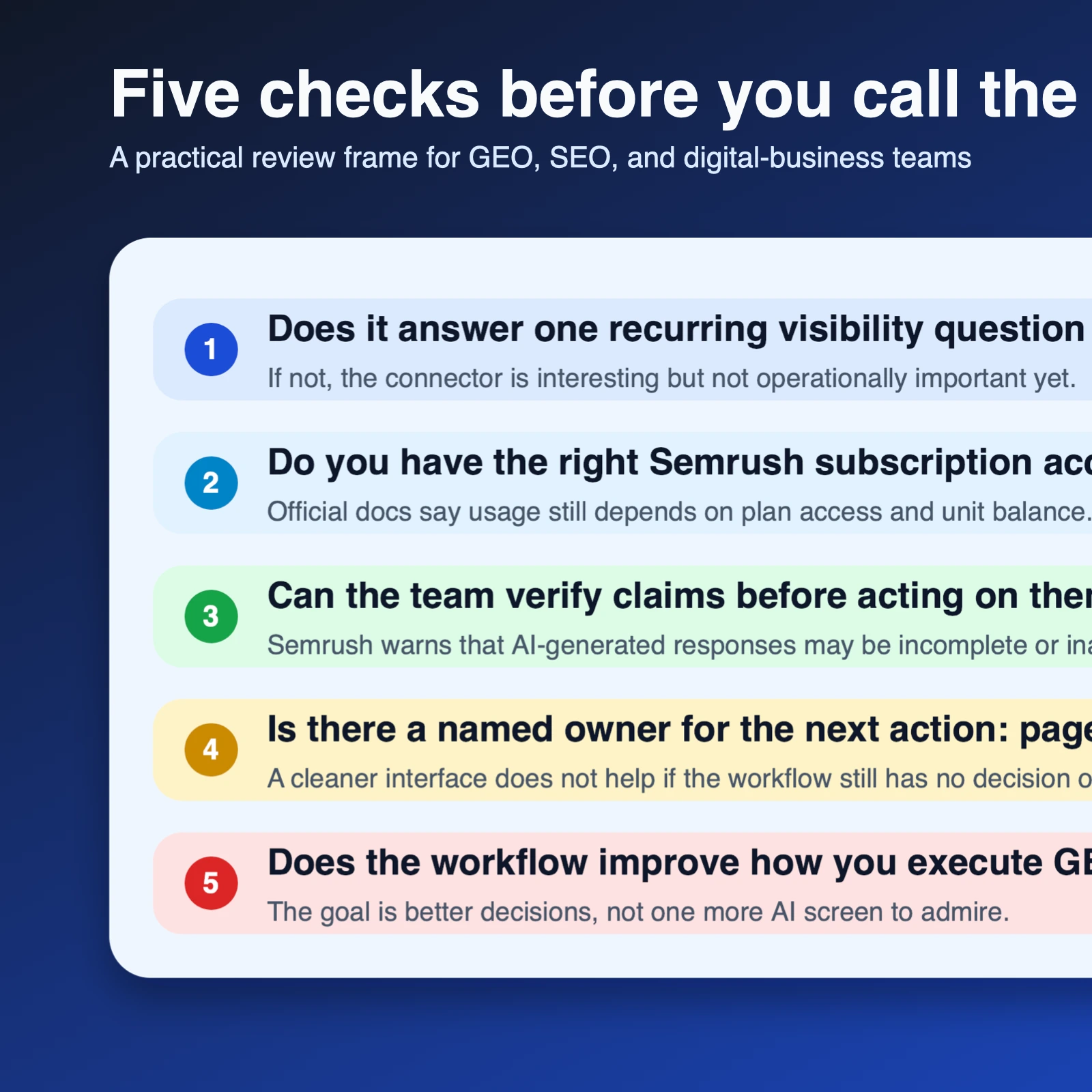
- Decide which visibility questions you ask repeatedly: competitor keywords, backlink gaps, ranking shifts, branded demand, or answer-engine exposure.
- If your team already pays for Semrush and Perplexity, test one real workflow end to end inside the connector instead of evaluating it only as a novelty demo.
- Keep prompts concrete. Ask for one market, one competitor set, or one audit question at a time so the AI output stays inspectable.
- Use the GEO Visibility Checklist to turn the answers into page, source, and crawlability fixes instead of stopping at analysis.
- Pressure-test any recommended move against your own analytics, business model, and budget assumptions before reallocating spend or rewriting core pages.
What remains uncertain
The public materials still leave gaps. Semrush says access in Perplexity Computer is available from June 3, 2026, subject to regional availability, but it does not publish a full market-by-market rollout matrix in the announcement. The Semrush documentation also makes clear that usage depends on Semrush subscription access and available API units.
There is also a reliability question built into the official docs. Semrush explicitly warns that AI-generated responses may be incomplete or inaccurate and should be verified before being used for decisions or publication. That is a sensible limitation, not a deal-breaker. It means the connector should be treated as an acceleration layer for analysis, not as a substitute for human review.
The useful takeaway on June 16, 2026 is straightforward. Semrush has moved trusted search-intelligence data closer to the AI interface where many teams already think, ask, and plan. For high-value marketing and digital-business teams, that makes GEO and search research more operational. The winners will be the teams that use the connector to reduce handoff time, tighten validation, and act on better visibility evidence, not the teams that treat it as one more AI integration headline.