Shopify turns Catalog and UCP into default infrastructure for agentic commerce
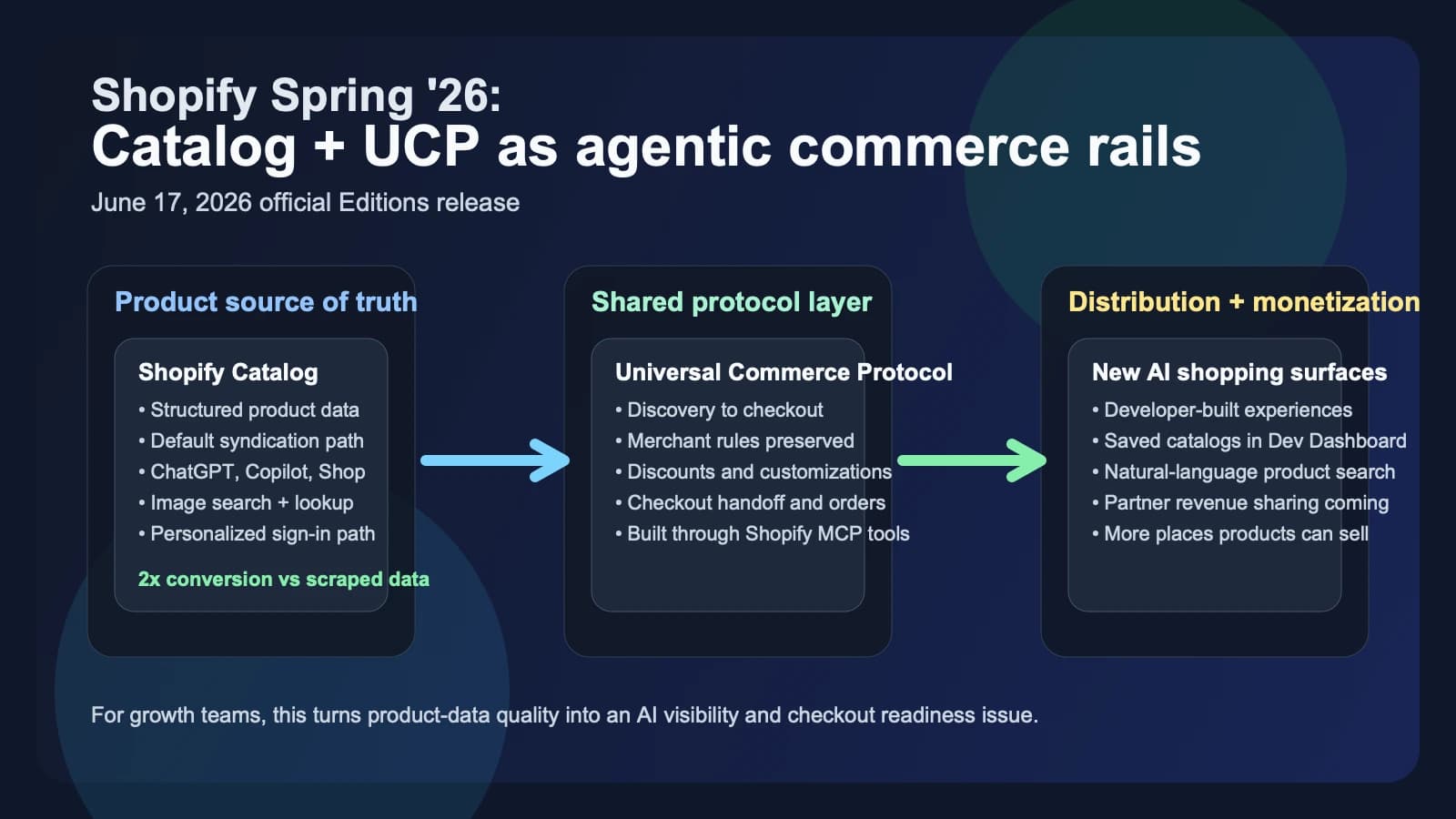
Shopify used its official Spring '26 Edition announcement on June 17, 2026 to make a sharper claim than a normal product roundup. The company says Shopify Catalog and the Universal Commerce Protocol (UCP) now function as default infrastructure for getting merchant products discovered, understood, and bought across AI-driven surfaces. For marketers, commerce operators, and product teams, the real change is not "Shopify shipped more features." It is that Shopify is trying to turn agentic commerce into a distribution system that starts with structured product data and ends with governed checkout behavior.
That matters because Shopify is bundling merchant defaults, developer tooling, and AI-channel management into one operating story. In the same June 17 merchant post, Shopify says Catalog distributes product details across ChatGPT, Copilot, Shop, and other surfaces without manual feeds for qualifying merchants, while UCP gives agents a common way to interact with merchant rules across the commerce journey. The companion developer post and Shopify agentic commerce docs make the second half of the strategy explicit: Shopify wants developers and partners building more agentic buying surfaces on top of that same layer.
What changed
The first change is that Shopify is treating Catalog as a default AI-distribution layer, not a side integration. Its Spring '26 Edition post says Catalog is a global structured dataset spanning billions of products, that it syndicates product details to AI surfaces such as ChatGPT and Copilot, and that AI searches powered by Shopify Catalog convert at 2x the rate of searches using scraped data.
The second change is the new developer surface around Catalog. Shopify says in the same June 17 post that the Catalog API now supports sign in with Shop for personalized results, adds image search and lookup capabilities, and will give developers and partners a way to earn revenue when Catalog-powered experiences drive sales. That is a meaningful shift from "merchants can be found" to "partners now have an incentive to build more places where discovery and buying happen."
The third change is that UCP is being positioned as the shared protocol for the whole buyer flow. Shopify says UCP, co-developed with Google, covers discovery through checkout and is enabled by default for Shopify merchants. Its agentic commerce documentation says Shopify's MCP tools now map the full sequence from product discovery to carts, checkout handoff, and order monitoring, while the Catalog quickstart shows developers creating custom catalogs, searching with natural language, and refining results with filters.
| Confirmed June 17 detail | Official source | Why it matters |
|---|---|---|
| Catalog and UCP are enabled by default for Shopify merchants. | Shopify Spring '26 merchant announcement | Merchants do not need to treat AI shopping as a separate experimental channel before basic eligibility exists. |
| Catalog syndicates product details to ChatGPT, Copilot, Shop, and other surfaces. | Shopify Spring '26 merchant announcement | Structured product data is becoming a multi-surface acquisition asset, not only an onsite merchandising asset. |
| Shopify says Catalog-powered AI searches convert at 2x the rate of scraped-data searches. | Shopify Spring '26 merchant announcement | Data quality is being framed as a conversion lever, not just a compliance or feed-management task. |
| The Catalog API now adds sign in with Shop, image search, and lookup, and Shopify says partner revenue sharing is coming for qualifying experiences. | Shopify Spring '26 merchant announcement | Developers get stronger reasons to build AI-native shopping experiences on Shopify rails. |
| Shopify's UCP docs cover discovery, cart building, checkout, and order monitoring through MCP tools. | Shopify agentic commerce docs | The protocol is being presented as an operating system for agent-assisted buying, not only a search endpoint. |
Why it matters
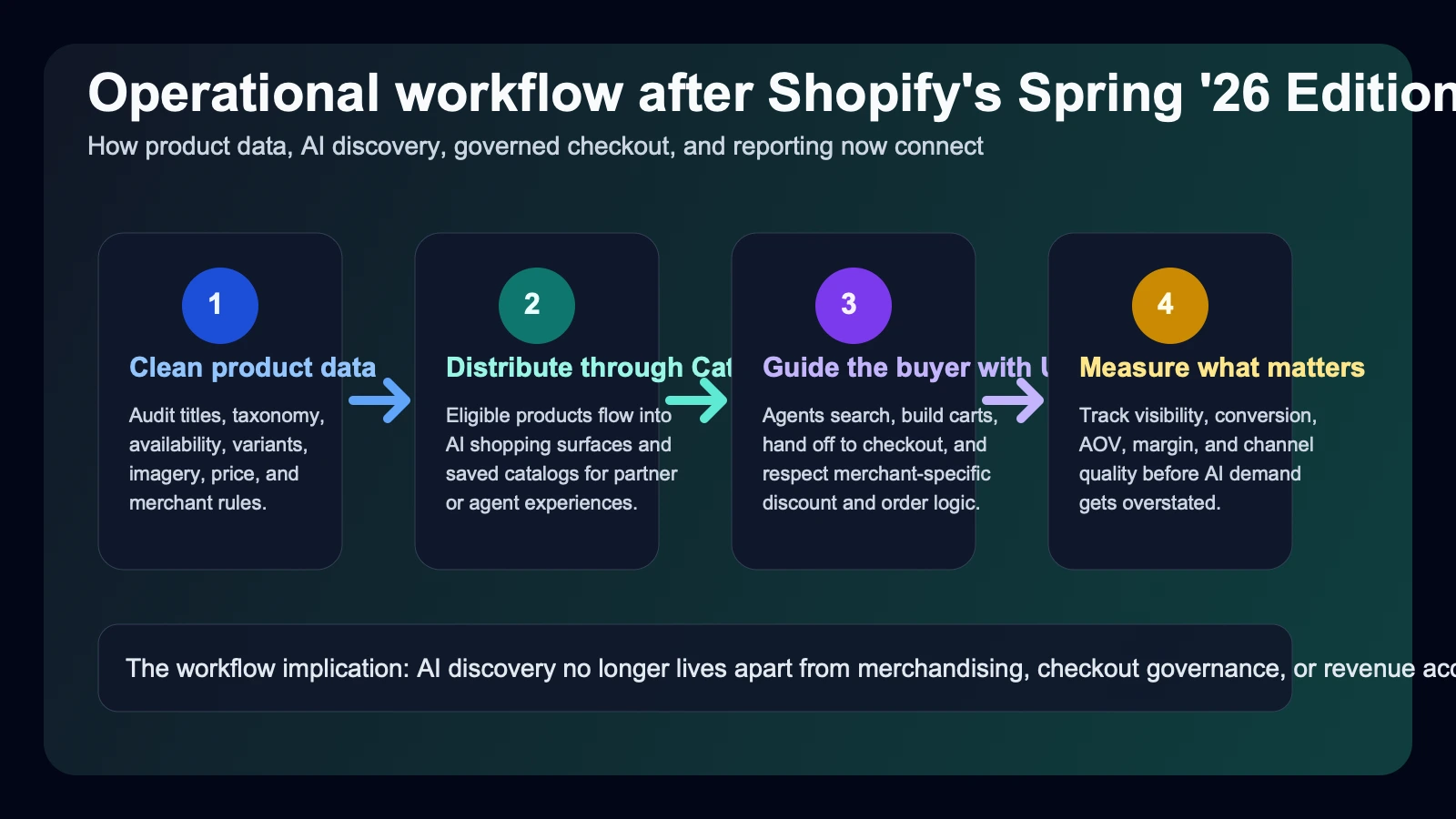
This release matters because it tightens the link between GEO, product data hygiene, and transaction readiness. If AI agents are increasingly responsible for discovery, recommendation, and pre-checkout comparison, then weak titles, missing attributes, poor inventory accuracy, and inconsistent pricing become visibility problems before they become conversion problems. That connects directly to Slogan.website's GEO Visibility Checklist, the guide to generative engine optimization benefits, and the workflow for tracking brand mentions and visibility.
It also matters because Shopify is reducing the gap between "channel strategy" and "platform architecture." The company is effectively saying that future shopping surfaces will be created by Shopify itself, by AI platforms, and by outside developers at the same time. If that is true, then merchants need one reliable product source of truth and one predictable way to carry checkout rules, discounts, and customizations forward. That is exactly the problem Shopify says Catalog and UCP are meant to solve in its merchant post.
For operators, the more important lesson is economic. A channel that sends higher-intent traffic is only useful if the catalog, pricing logic, and handoff flows remain current. That is why this announcement should sit next to your budget and measurement work, not outside it. If AI discovery starts expanding faster than your reporting discipline, teams can over-read reach and under-read margin, fulfillment, or assisted-conversion effects. The practical counterweight is to model expected upside and guardrails in tools like the Marketing ROI Calculator and Digital Marketing Budget Planner.
Who is affected
The first affected group is Shopify merchants that already sell into the United States and other high-value English-speaking markets where AI-assisted shopping behavior is moving fastest. The second is agencies and growth teams managing multiple catalogs and storefronts, because cleaner product structure now has clearer downstream value beyond SEO or paid feeds. The third is developers and partners who can use the Catalog quickstart and Dev Dashboard catalog tooling to build custom shopping agents, curated catalogs, or embedded commerce experiences. The fourth is analytics and operations teams that will need to separate channel novelty from real contribution.
What to do next
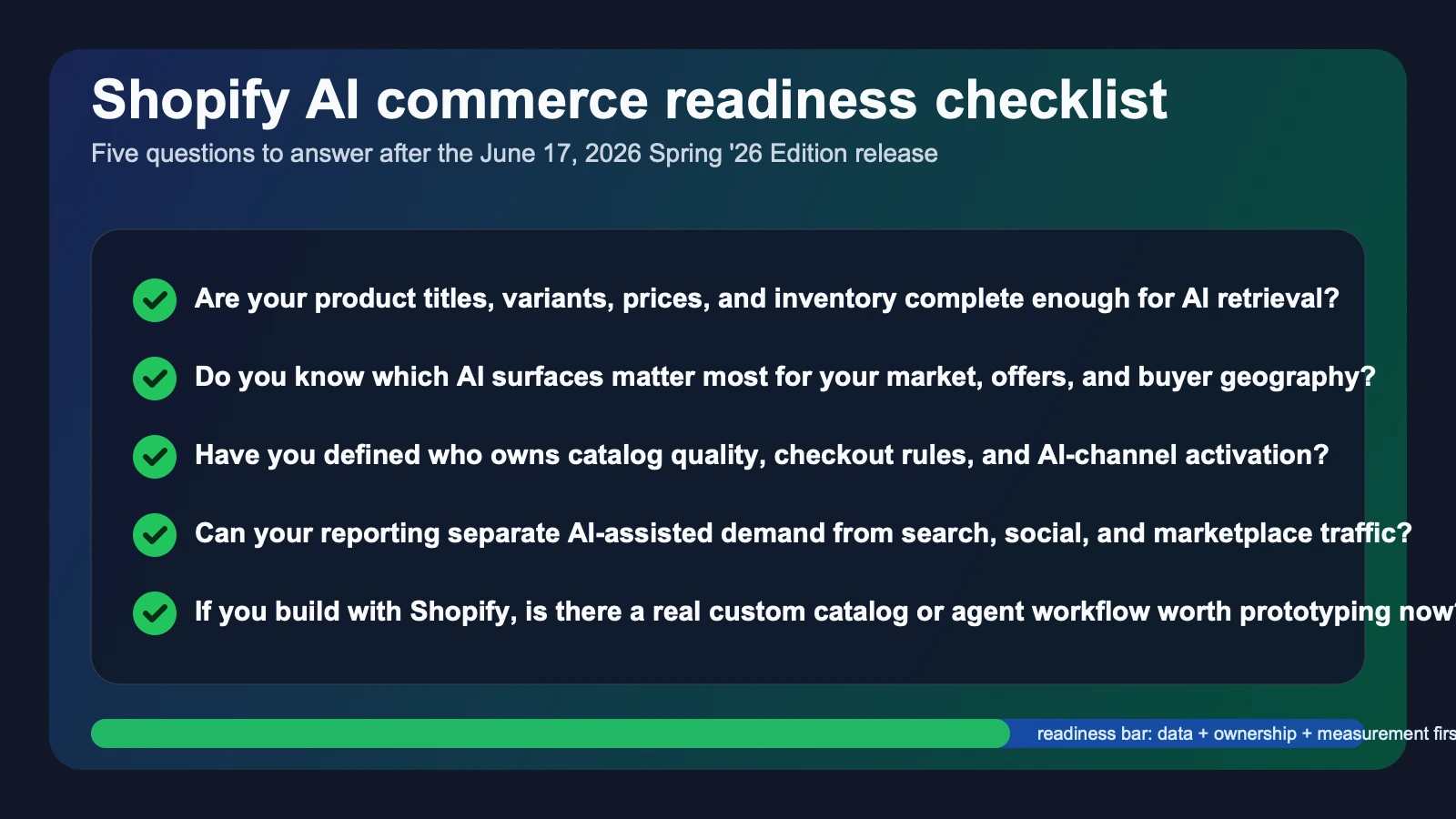
- Audit your product data now: titles, descriptions, categories, sizes, colors, price accuracy, and availability need to be complete enough for an agent to interpret without guesswork.
- Decide which catalog attributes are business-critical for AI discovery and assign ownership across merchandising, growth, and operations.
- Review where AI-driven demand should be measured separately from traditional organic search, marketplaces, and paid social.
- If you build on Shopify, test whether a custom catalog or agentic surface is worth prototyping through the Dev Dashboard and the Catalog developer flow.
- Use the GEO Visibility Checklist and your internal reporting stack to align visibility, conversion, and margin expectations before AI-assisted shopping traffic becomes material.
What remains uncertain
Important limits remain as of June 17, 2026. Shopify has described the new default posture, the expanded Catalog API, and the broader UCP workflow, but it has not published a single universal benchmark showing how these experiences perform across every vertical, region, or merchant size. The 2x conversion claim in the merchant announcement is useful directional evidence, but it is still Shopify's own framing of ecosystem performance.
There are also rollout and adoption questions. Shopify says developers and partners will soon be able to earn revenue when Catalog-powered experiences drive sales, but it has not publicly detailed the commercial terms in the announcement itself. Likewise, the agentic commerce docs and search tutorial make the build path clear, but they do not prove that every merchant should expect immediate traffic scale from every AI surface.
The solid conclusion is narrower and still important. On June 17, 2026, Shopify moved agentic commerce infrastructure closer to the default core of its platform. Teams that depend on product discovery should treat that as a signal to improve structured data, ownership, and measurement now, before AI shopping surfaces become too important to clean up later.