Snap turns AI campaign setup, creative production, and shopping into one advertiser workflow
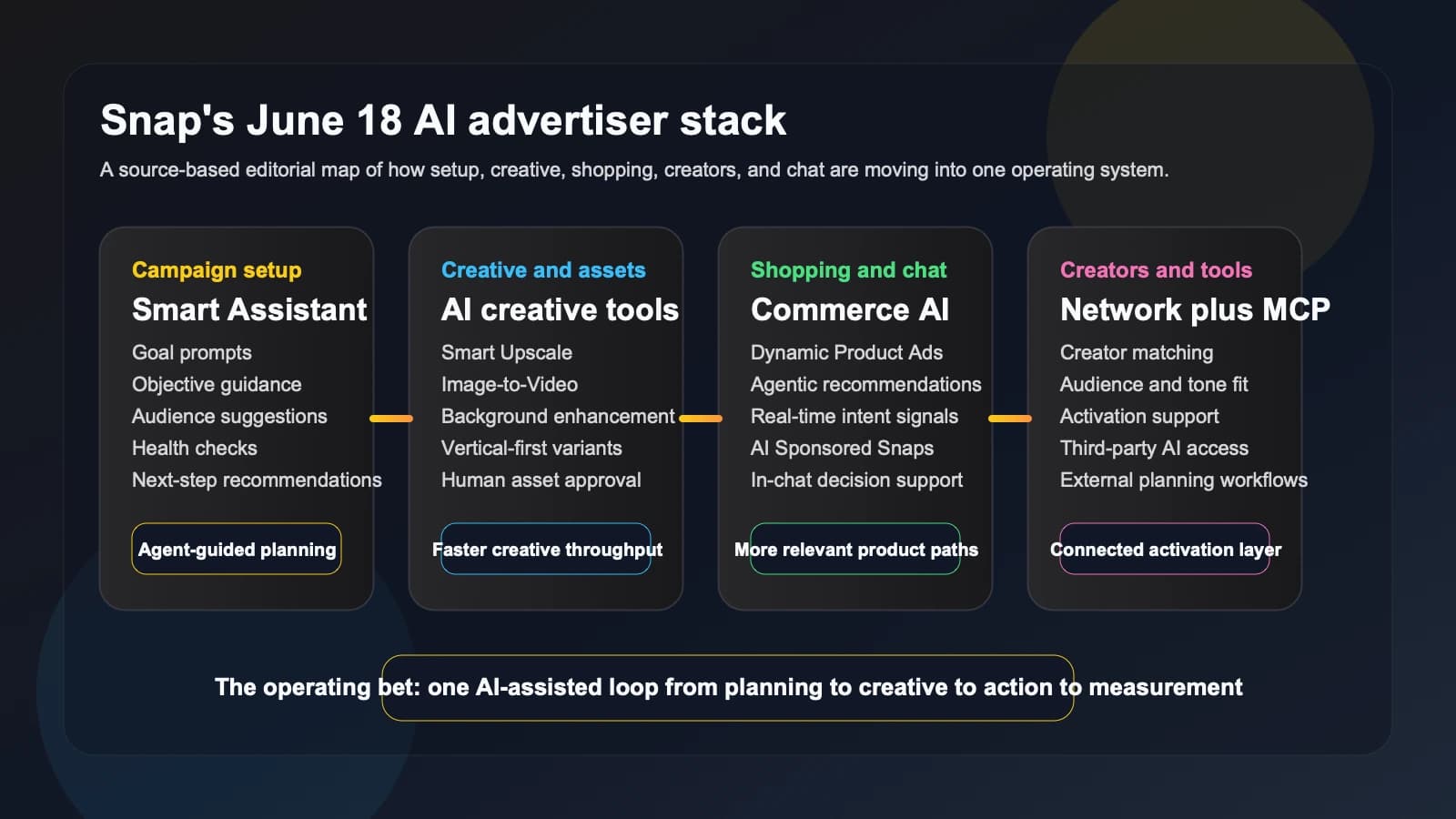
Snap said on June 18, 2026 that it is adding a new Snap Smart Assistant, opening an ads-focused Model Context Protocol (MCP) server to third-party AI agents, upgrading shopping recommendations and creative generation, and launching an AI-assisted creator-matching system called Snap Creator Network later this year. The practical read is more useful than the headline: Snap is trying to turn campaign planning, creative production, product selection, creator activation, and conversational commerce into one connected operating loop instead of a stack of separate ad tasks.
That matters because the company is not positioning AI as a side feature. In the same June 18 post, Snap says more than 950 million monthly active users come to Snapchat to communicate, discover, and share; it also says GenAI Lenses have generated nearly 38 billion impressions since Q4 2025. Read together with Snap's earlier May 20, 2026 Unified Attribution announcement, the message is clear: Snap wants advertisers to trust the platform not only for reach and creative novelty, but also for faster optimization and more defensible workflow decisions.
What changed
| Confirmed June 18 signal | Primary source | Why it matters in practice |
|---|---|---|
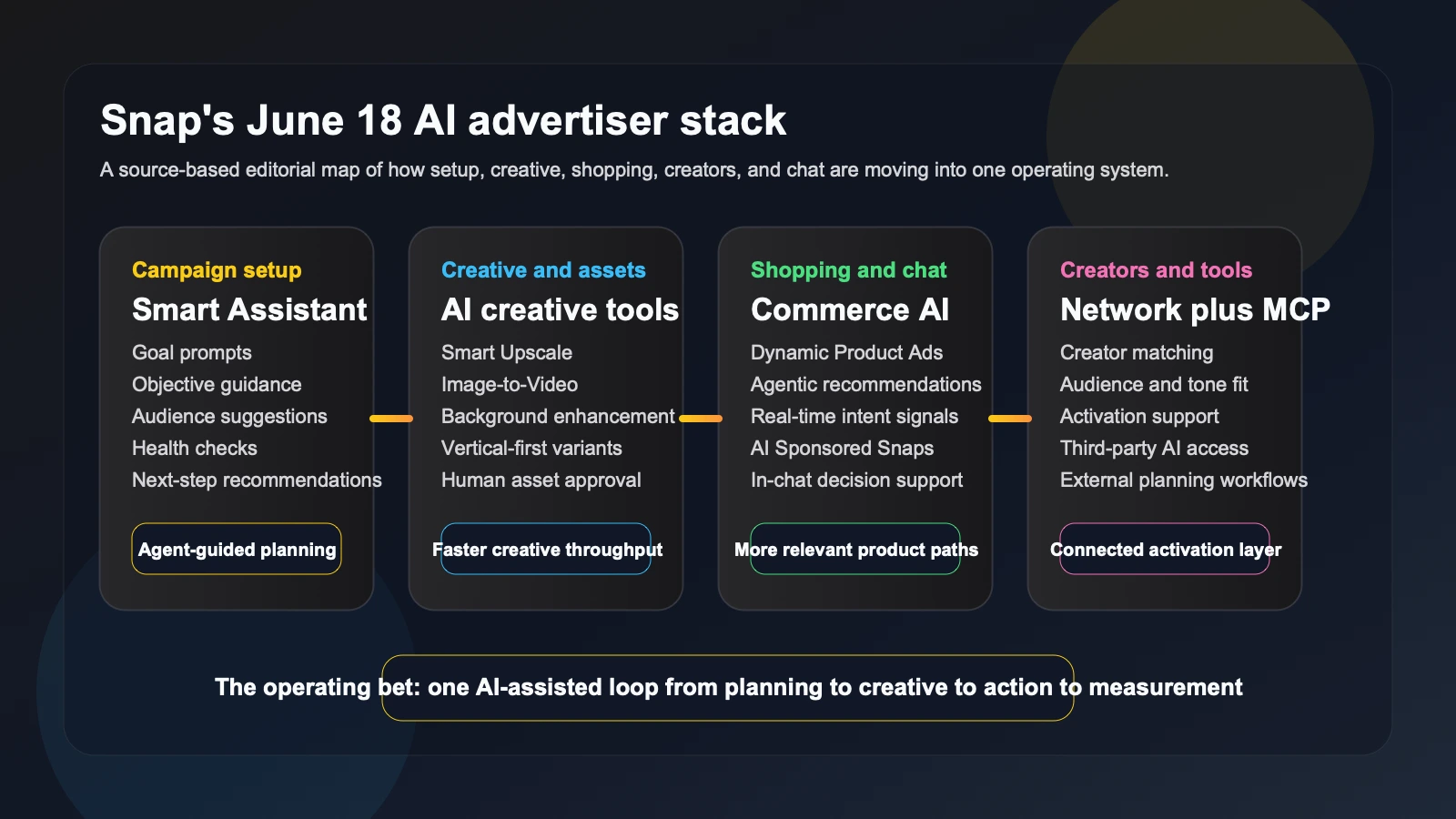
| Snap launched Smart Assistant to recommend objectives, audience strategy, and optimization settings from a plain-language goal. | Snapchat for Business, June 18, 2026 | Campaign setup moves closer to an agent-guided workflow instead of manual menu selection. |
| Snap opened an ads-focused MCP server to third-party AI agents. | Snapchat for Business, June 18, 2026 | Planning and optimization work can extend into external AI tools rather than staying trapped inside Ads Manager alone. |
| Dynamic Product Ads are being rebuilt with agentic recommendation models that use user behavior, product affinity, full-funnel signals, and real-time intent. | Snapchat for Business, June 18, 2026 | Shopping campaigns become more recommendation-driven and less dependent on static product rotation. |
| Smart Upscale, Image-to-Video, and Background Image Enhancement now help turn a single asset into multiple Snap-native creative variants. | Snapchat for Business, June 18, 2026 | Creative operations teams can produce more mobile-native variants without rebuilding every ad manually. |
| Snap Creator Network will launch later in 2026 to match advertisers with creators by audience, tone, category, and goals. | Snapchat for Business, June 18, 2026 | Creator discovery and activation may become faster and less spreadsheet-driven for brands and agencies. |
The June 18 release also ties together pieces that had previously looked separate. Snap's May 20 Unified Attribution post said the company is aligning Snapchat performance data more closely with Mobile Measurement Partners and letting app advertisers use real-time signals, including MMP conversions, to optimize spend inside Snap Ads Manager. That earlier measurement move now looks like part of the same system: Snap wants more of the decision loop to stay inside one AI-assisted environment, from setup through creative testing to outcome analysis.
Why it matters
The strategic shift is workflow compression. On many ad platforms, AI tools still feel fragmented: one assistant for setup, another for creative, another for reporting, another for creator sourcing. Snap is trying to package those jobs into a more continuous operating surface so lean teams do not have to hand-build every audience, asset variation, and shopping recommendation.
That is especially relevant for ecommerce brands, app-growth teams, agencies, and creator-led campaigns that need to move quickly but still justify spend. If Smart Assistant reduces setup friction, MCP extends planning into external AI systems, and recommendation models improve product relevance, Snap becomes more than a youth-reach channel. It becomes a candidate operating surface for performance and commerce workflows. Teams can evaluate that shift with the Marketing ROI Calculator, the Digital Marketing Budget Planner, and the GEO Visibility Checklist when comparing how different channels turn intent into measurable outcomes.
Who is affected
The first group is performance marketers running app, retail, or DTC acquisition programs that already care about automation but still need cleaner measurement and creative throughput. They should read this alongside Snap's existing Unified Attribution rollout, because setup automation matters more when reporting and optimization are moving in the same direction.
The second group is agencies and in-house media teams managing high-volume creative testing. If one product image can be transformed into multiple vertical, mobile-native variants with less manual production work, channel testing becomes faster but also easier to overproduce unless review standards stay disciplined. Brands leaning on creators or conversational commerce should also pay attention, because Snap is explicitly pushing AI Sponsored Snaps in Chat plus the future Creator Network.
What to do next
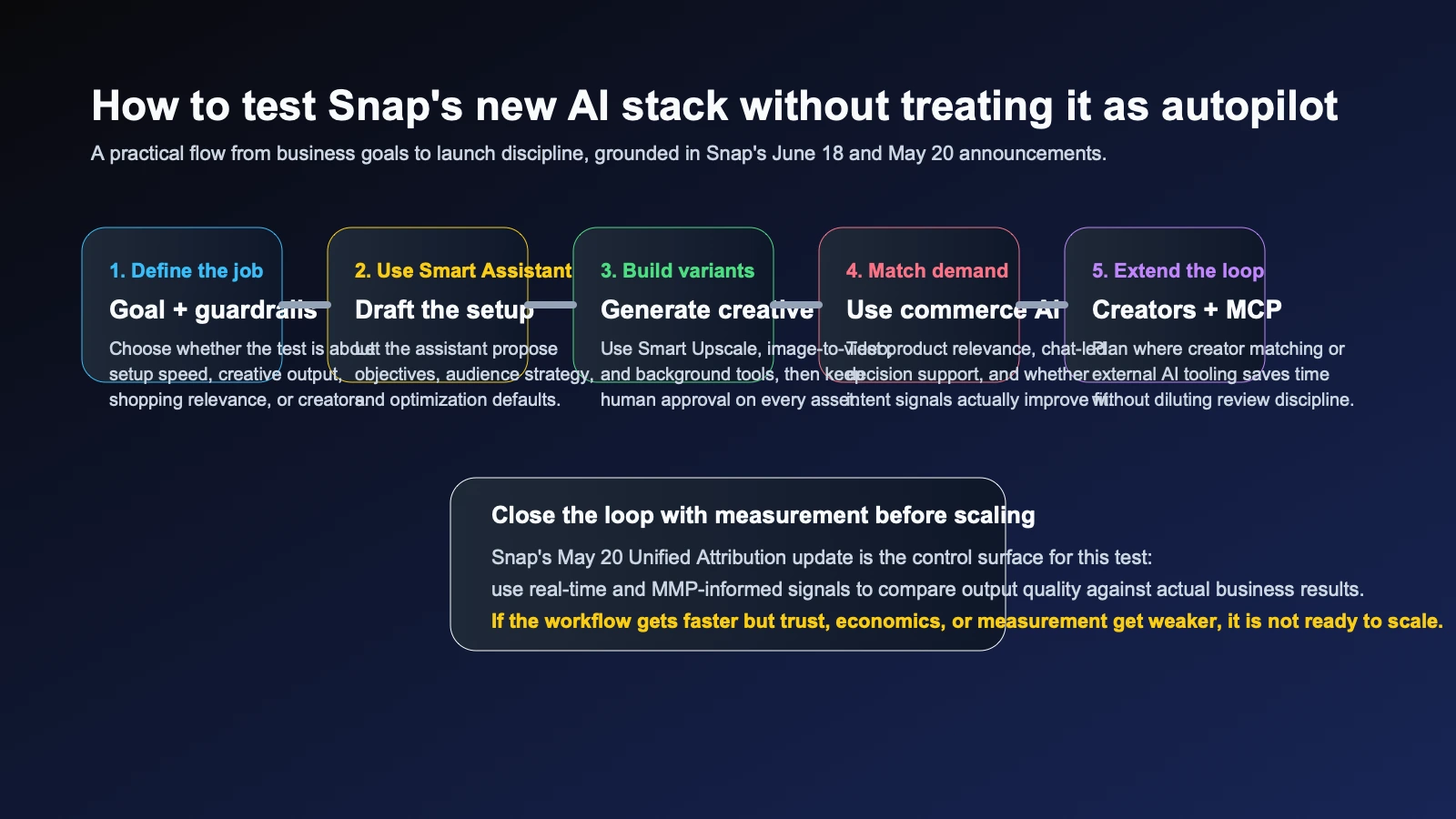
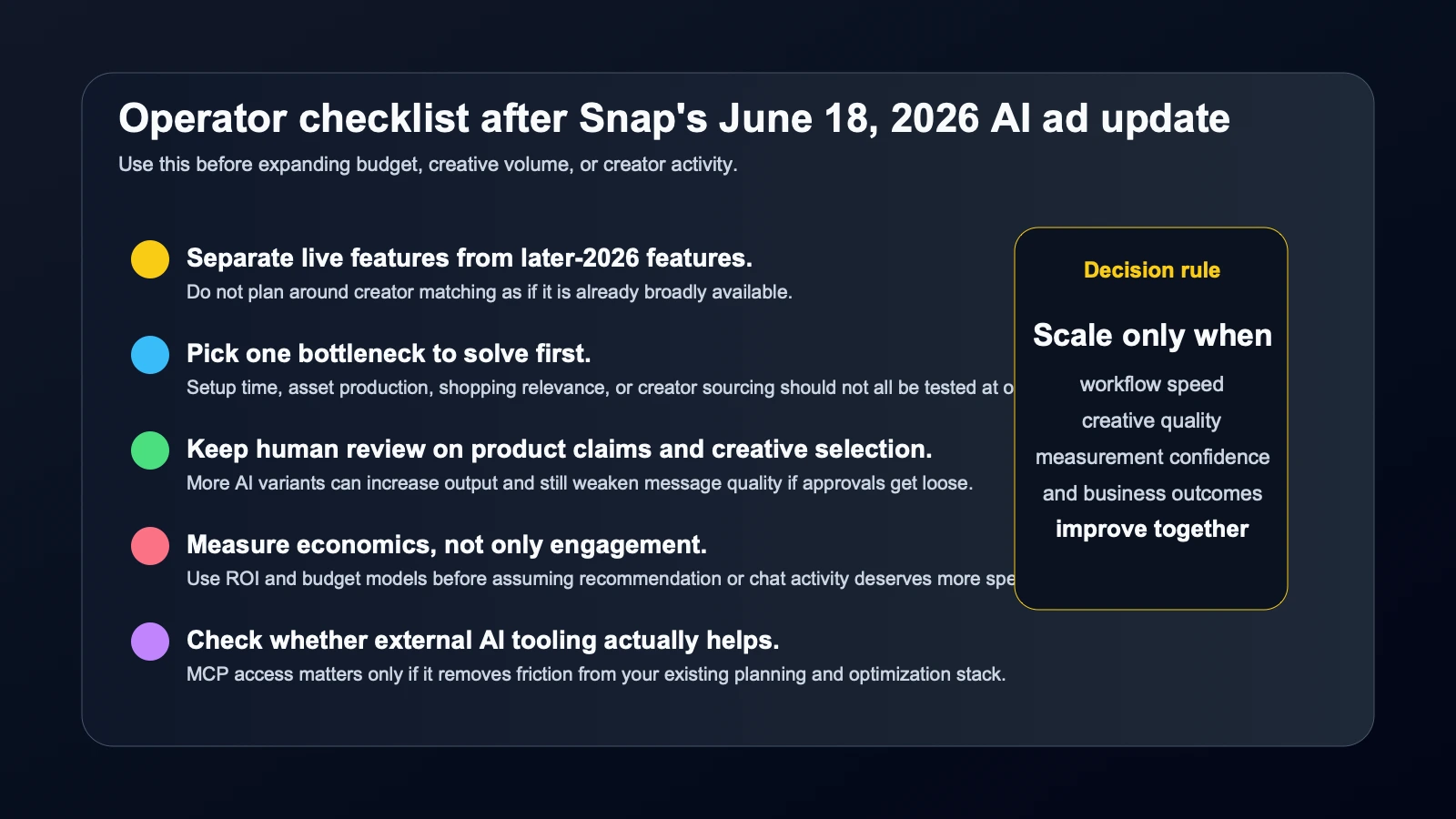
- Separate what is live now from what is still phased. Smart Assistant and the new creative stack are announced now, while Snap Creator Network is slated for later in 2026.
- Audit your current Snap workflow for the biggest friction point: setup, asset production, shopping relevance, creator sourcing, or measurement.
- Define where AI can safely assist and where human review still needs to stay strong, especially for offer accuracy, product suitability, and brand claims.
- Map Snap's AI stack against your current economics using the Marketing ROI Calculator and Digital Marketing Budget Planner before expanding spend.
- Track whether these AI-assisted experiences improve not only click volume, but also downstream trust and discoverability using the brand mentions visibility guide.
What remains uncertain
Important limits remain on June 18, 2026. Snap's post does not publish pricing changes, full regional rollout timing for each capability, or exact access conditions for every advertiser tier. It also does not show whether Smart Assistant recommendations consistently outperform experienced human operators across complex accounts.
There is also a governance question. Snap says advertisers remain in control of which AI creative tools they use and which generated assets they run, but a faster production loop can still create weaker creative if teams mistake velocity for strategy. The narrow conclusion is still strong: Snap is building a more connected AI advertising system, and serious teams should test it as workflow infrastructure, not as a reason to switch off judgment.