Spotify resets podcast reporting around 30-second plays and upgraded creator analytics

Spotify said on June 11, 2026 that podcast play counts will now reflect listens or views of at least 30 seconds, and that Spotify for Creators is getting a redesigned analytics experience with new audience, engagement, and episode-comparison tools. For podcast operators, advertisers, and media teams, the practical change is not a cosmetic dashboard refresh. Spotify is trying to make reported audience activity look more like intentional consumption and less like loose starts, while still keeping monetization logic on a separate standard.
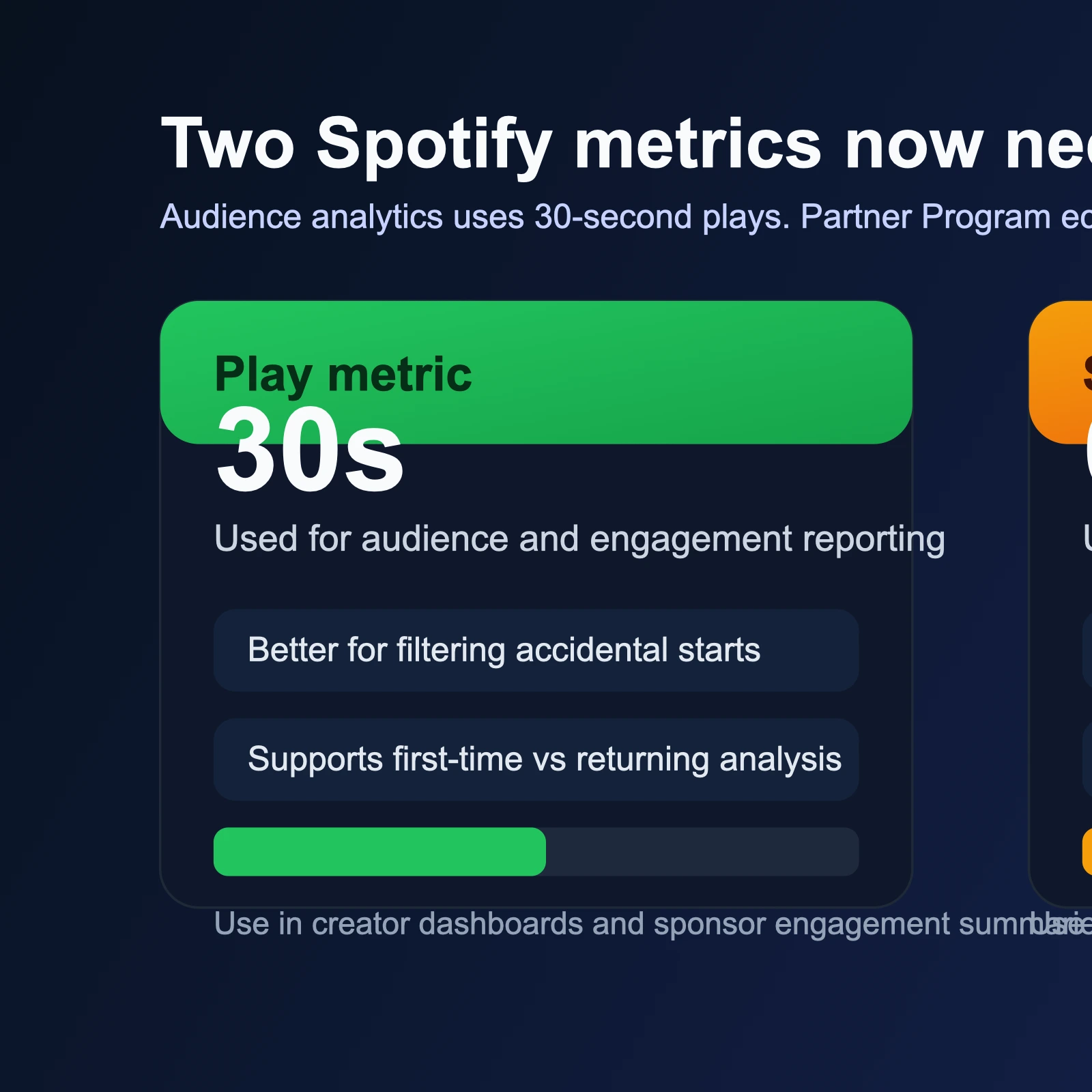
That second point matters. Spotify's own Spotify Partner Program documentation says a stream for eligibility and revenue is counted after 60 seconds or more of listening or viewing. So on June 11, 2026, Spotify effectively made its public-facing creator analytics more nuanced: plays now mean 30-second intentional consumption, while streams still govern monetization and partner-program economics. If you run a show, buy podcast ads, sponsor creator inventory, or benchmark podcast growth inside a broader digital-business stack, that distinction now needs to be explicit in your reporting.
What changed
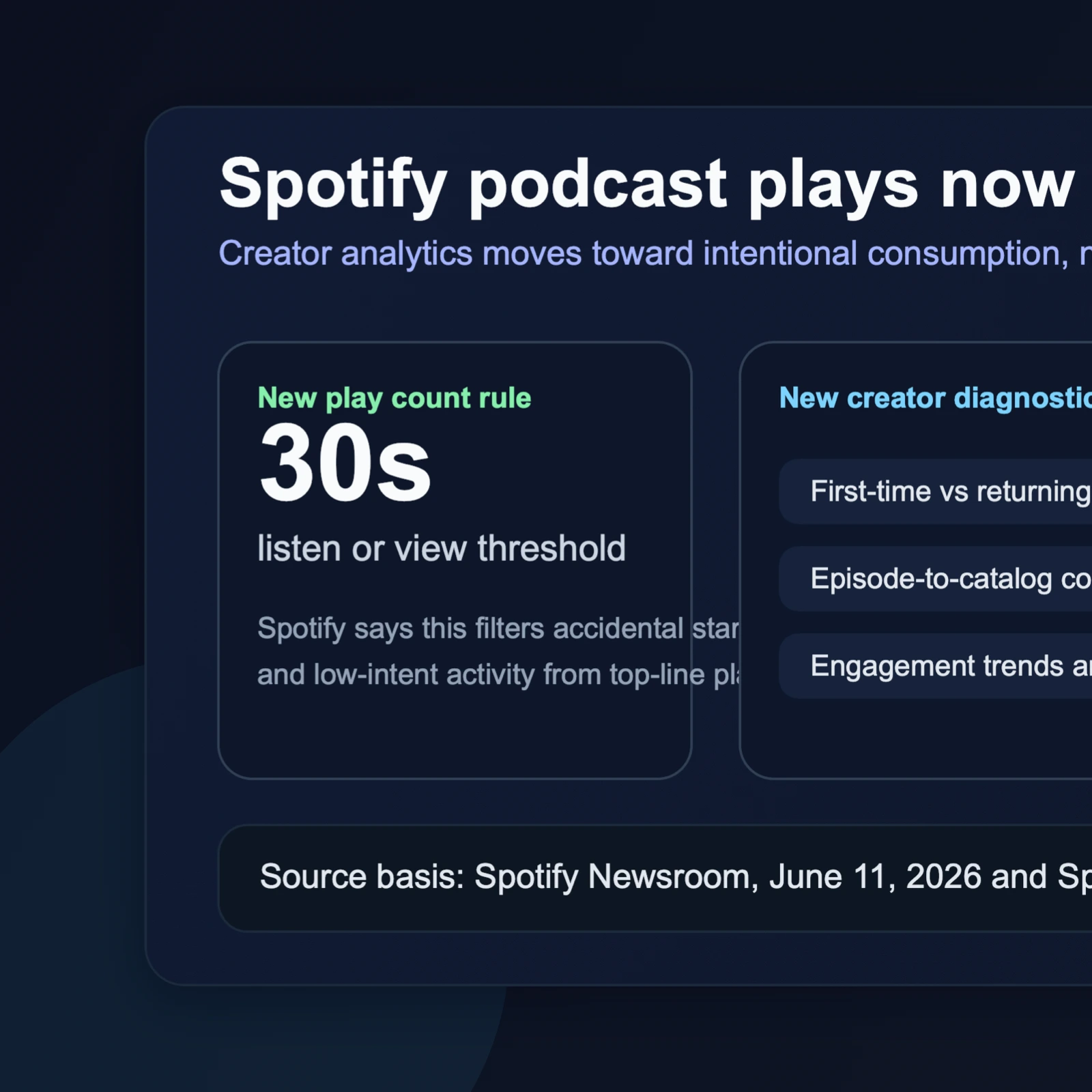
Spotify's official newsroom post says play counts now register only when an episode is watched or listened to for at least 30 seconds. The company says its audience-behavior data shows 30 seconds is a reliable signal of intentional consumption and filters out accidental starts and other low-intent activity. Spotify also says its work with the Alliance for Measurement in Podcasting helped inform the industry's newly announced Podcast Plays definition.
The same announcement adds several analytics changes inside Spotify for Creators: first-time versus returning audience views, episode performance comparisons against the rest of a show's catalog, a new engagement tab, a redesigned home screen, and expanded historical data. Those features change how a creator or operator can diagnose growth. Instead of asking only "How many starts did this episode get?" teams can ask whether the show is bringing in new audience, retaining returning listeners, and creating stronger engagement patterns over time.
The official support materials add a crucial operating nuance. Spotify's partner-program analytics article says plays are the primary metric for audience and engagement on Spotify, but the Spotify Partner Program uses streams of 60 seconds or more for eligibility and revenue consistency. That means creators and advertisers should not collapse all Spotify analytics into one number.
| Confirmed detail | Primary source | What it means in practice |
|---|---|---|
| Spotify now counts a podcast play after at least 30 seconds of listening or viewing. | Spotify Newsroom, June 11, 2026 | Low-intent starts should matter less in top-line creator reporting. |
| Spotify says the work helped inform AMP's newly announced Podcast Plays definition. | Spotify Newsroom, June 11, 2026 | Spotify is positioning its metric as closer to an industry standard, not just a house rule. |
| Spotify for Creators now shows first-time versus returning audience, engagement tools, and episode comparisons. | Spotify Newsroom, June 11, 2026 | Teams can separate acquisition, retention, and episode-level resonance more clearly. |
| Spotify Partner Program monetization still uses streams of 60 seconds or more. | Spotify Support and partner-program analytics docs | Audience reporting and monetization reporting are now related but not interchangeable. |
| Partner Program eligibility also depends on 2,000 consumption hours and 1,000 audience count in the last 30 days. | Spotify Support | Podcast operators should track growth health beyond one visible headline metric. |
Why it matters
Podcast reporting has been messy for years because different surfaces describe different kinds of attention. A download is not the same as an active listen. A video impression is not the same as a sustained audience moment. A monetizable stream is not the same as top-of-funnel discovery. Spotify's June 11 change does not solve all of that, but it does make one thing harder to ignore: teams need a cleaner hierarchy of metrics.
For creators, this can reduce false confidence. Episodes that rack up starts from feed curiosity but fail to hold listeners past half a minute should look weaker now than they did under looser counting. For advertisers and sponsors, the update makes it easier to ask better questions about whether a show is building real attention or simply generating shallow sampling. For agencies and in-house operators, it is another reminder to separate awareness metrics from revenue metrics before those numbers land in the same executive deck.
This is especially relevant for operators in the United States, Canada, the United Kingdom, Australia, and Europe, where podcast businesses increasingly sit inside broader media, CRM, and revenue systems. If you already use planning tools like the Marketing ROI Calculator or the Digital Marketing Budget Planner, Spotify's new setup is a good reason to model podcast performance with more than one layer: attention, retention, and monetization.
Who is affected
The first group is podcast creators and studios using Spotify for Creators as a primary dashboard. Their weekly and monthly performance reviews will now need better annotations so nobody compares pre-change and post-change counts as if they meant the same thing.
The second group is advertisers, sponsors, and agencies buying host-read or creator-led inventory. They should treat the new play metric as a stronger engagement proxy than a raw start count, but not as a replacement for outcome reporting, attribution, or revenue data.
The third group is operators building owned-media programs for brands, SaaS companies, publishers, and service businesses. For them, the story is about measurement discipline. Podcasting is becoming more measurable, but also more layered. That fits the same operating mindset behind our guide to tracking brand mentions and visibility: separate awareness, engagement, and business impact instead of pretending one metric explains all three.
What to do next
Use the change as a reporting cleanup opportunity, not just as a news item.
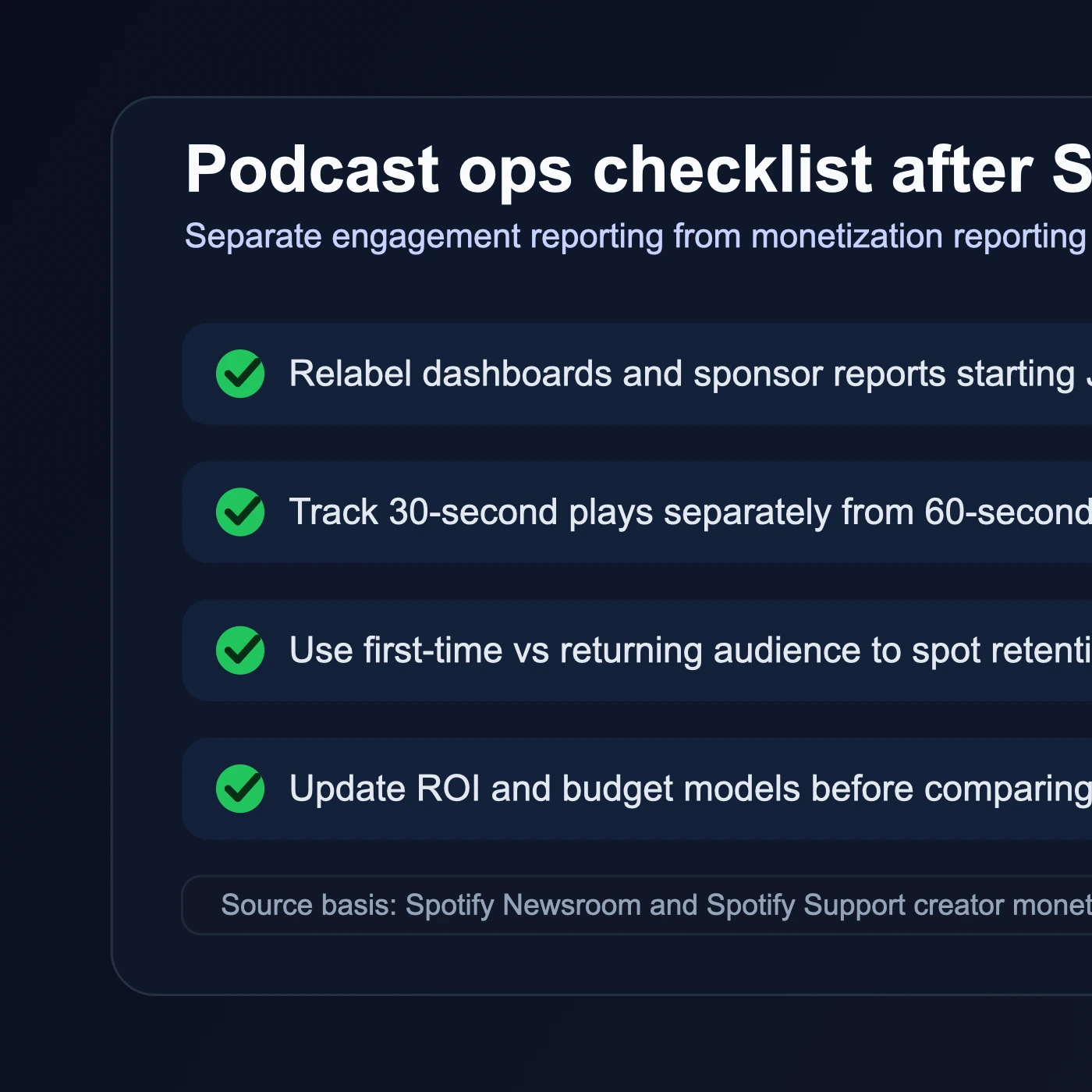
- Label the metric change in any internal dashboard, sponsor deck, or client recap that includes Spotify podcast performance after June 11, 2026.
- Separate plays, streams, and monetization outputs so growth, retention, and revenue are not mixed into one headline number.
- Review whether episodes with strong starts but weak returning-audience patterns still deserve the same promotion or paid support.
- Update sponsorship and media planning models in the Marketing ROI Calculator or Digital Marketing Budget Planner to reflect the difference between top-of-funnel attention and monetizable listening.
- Use the new first-time versus returning audience views to decide whether your show has an acquisition problem, a retention problem, or simply an inconsistent episode format.
What remains uncertain
Spotify has not published a detailed backfill methodology explaining how historical comparisons should be handled across the metric transition, and it has not quantified how many previously counted starts will now disappear under the 30-second threshold. It also has not said whether other major platforms will adopt the same reporting logic on the same timeline, even if the broader AMP direction points toward more standardization.
There is another practical uncertainty for operators: sponsor expectations often lag platform definitions. Some teams will continue using looser language like "plays," "listens," "views," and "downloads" interchangeably unless reporting owners force the distinction. That means the operational win here depends less on Spotify's announcement alone and more on whether creators, agencies, and buyers update their own scorecards.
The most defensible reading on June 11, 2026 is that Spotify is pushing podcast analytics toward a more intentional-consumption standard without fully collapsing engagement and monetization into one metric. That is a useful improvement, but only if teams treat it as a measurement model change and adjust their workflows accordingly.