Uber turns retail media into an API workflow for restaurants and brand teams
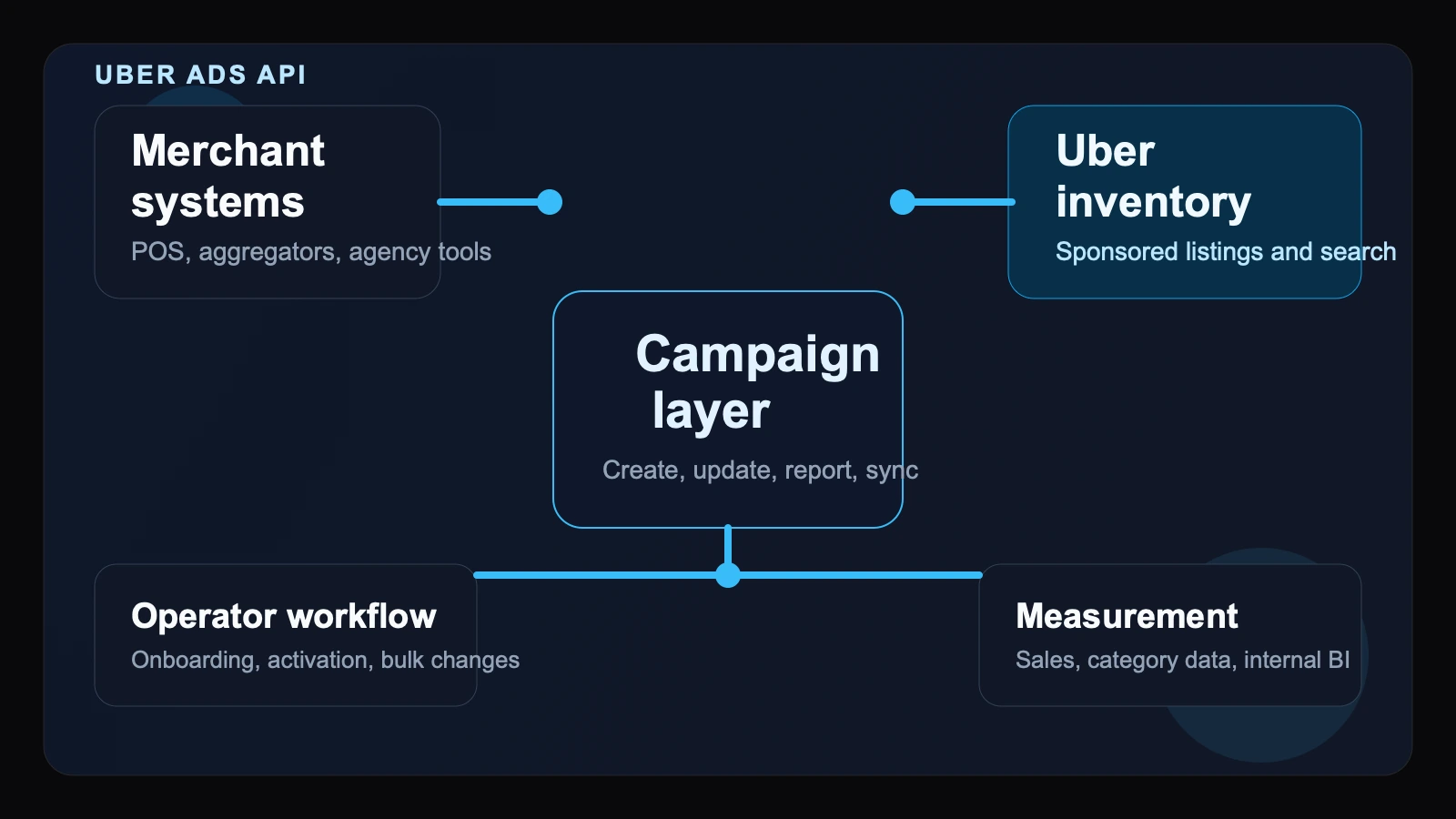
Uber said on May 26, 2026 that it launched Uber Ads APIs, opening campaign management and reporting to partners, restaurant platforms, agencies, and brands that want to run advertising without a separate Uber-only workflow. Read together with the live Uber Ads developer documentation, the broader Uber Advertising product page, and Uber's Q1 2026 results released on May 6, 2026, the change looks bigger than a developer convenience feature. Uber is trying to make retail media execution part of merchant operations software and brand reporting systems, not a side console managed by hand.
For operators in the United States first, and for agencies, software vendors, and enterprise teams in Canada, the United Kingdom, Australia, and Europe evaluating where restaurant and delivery media are going next, the practical shift is straightforward: ad buying on Uber can now move closer to the tools teams already use for onboarding merchants, adjusting campaigns, and reviewing performance.
What changed
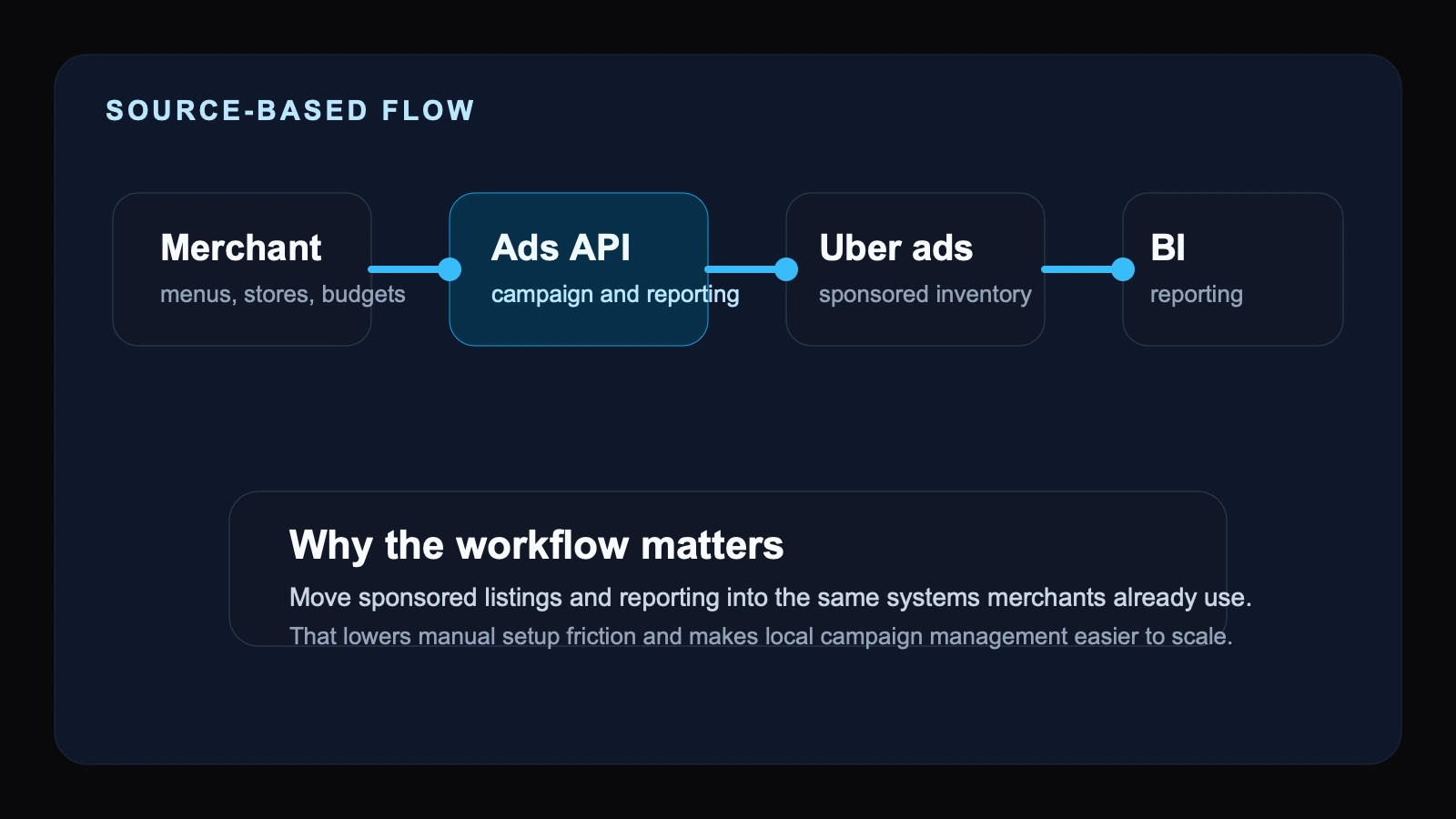
The core announcement is clear in Uber's May 26, 2026 product post. Uber said partners such as POS systems and aggregators can now manage advertising programmatically, while brands can access performance and sales data either through integrated platforms or direct API access. Uber specifically framed the launch around three operational gains: launching and updating campaigns more efficiently, reducing manual steps across platforms, and pulling performance data into internal systems for analysis.
The corresponding developer documentation shows the product is organized around Campaign Management, Reporting, and Product Catalog capabilities. In plain terms, that means a software platform or agency tool can create and update campaigns, retrieve analytics, and work with Uber's ad inventory and product information from one integration surface instead of asking users to jump between separate dashboards.
Uber also made the intended use cases explicit. In the same May 26 post, it says restaurant-focused partners can support onboarding, activation, and ongoing campaign management across many merchants, while CPG brands can use reporting APIs to access platform sales and category data for centralized analysis. That matters because it shifts Uber Ads from a managed-media add-on toward something closer to infrastructure.
Business context matters here. Uber's Q1 2026 results on May 6, 2026 show Delivery gross bookings reached $25.992 billion, up 23% year over year in constant currency, while Delivery revenue reached $5.068 billion, up 28% year over year in constant currency. Separately, Uber's advertising site says its ad business runs across a large mobility and delivery platform with first-party data, measurement, and ads-enabled countries already in market. The API launch plugs into a platform that already has scale.
| Confirmed point | Official source | Why operators should care |
|---|---|---|
| Uber launched Ads APIs on May 26, 2026 | Uber blog, May 26, 2026 | Advertising can move into merchant and agency workflows instead of staying in a separate console. |
| The API covers campaign management, reporting, and product catalog access | Uber Developers Ads API introduction | Integrators can build both execution and analytics layers on top of Uber's inventory. |
| Uber says POS systems and aggregators can manage campaigns programmatically on behalf of restaurants | Uber blog, May 26, 2026 | Multi-location restaurant growth can become easier to standardize and scale. |
| Brands can access sales and category data through reporting APIs | Uber blog, May 26, 2026 | Retail media reporting can feed internal BI and incrementality analysis faster. |
| Uber Delivery gross bookings reached $25.992 billion in Q1 2026 | Uber Q1 2026 results, May 6, 2026 | The API is being added to a scaled commerce surface, not a pilot side project. |
Why it matters
This matters because retail media often breaks down at the operations layer. Restaurant groups, franchise operators, agencies, and CPG teams may have budget, inventory, and performance data in one place but still need manual steps to activate campaigns across locations. Uber is saying that layer can now be automated.
That is important for software vendors too. If a POS platform, merchant-success platform, or restaurant operating system can surface Uber Ads directly inside the interface merchants already use, then ad activation becomes part of the same workflow as menu updates, promotions, and store operations. That is a different distribution model from asking every location operator to learn another ad product.
There is a measurement angle as well. Uber says brands can bring performance, sales, and category data into internal reporting systems through its APIs. For teams already using the Marketing ROI Calculator or the Digital Marketing Budget Planner, that means Uber media can be modeled more like a regular acquisition channel with clearer break-even logic instead of a black-box retail media spend.
The search and visibility angle is more indirect but still real. As platforms expose more commerce and ad signals programmatically, growth teams need better discipline around product data, offer structure, and category positioning. The same habits that help with AI visibility workflows and brand mention tracking also help when platform algorithms decide which merchants, items, or sponsored listings get surfaced.
Who is affected
The closest-to-the-change teams are the ones already coordinating campaigns across many stores, merchants, or product lines.
- POS providers and merchant platforms that want ad activation inside their existing restaurant software.
- Restaurant groups and franchise operators managing campaigns across many locations.
- Agencies that need repeatable sponsored listing workflows instead of account-by-account manual work.
- CPG and retail media teams that want Uber performance and sales data in their own BI environment.
- RevOps, analytics, and finance teams responsible for proving whether marketplace media is actually incremental.
What to do next
Use the API launch as an operating-model review rather than just a feature announcement.
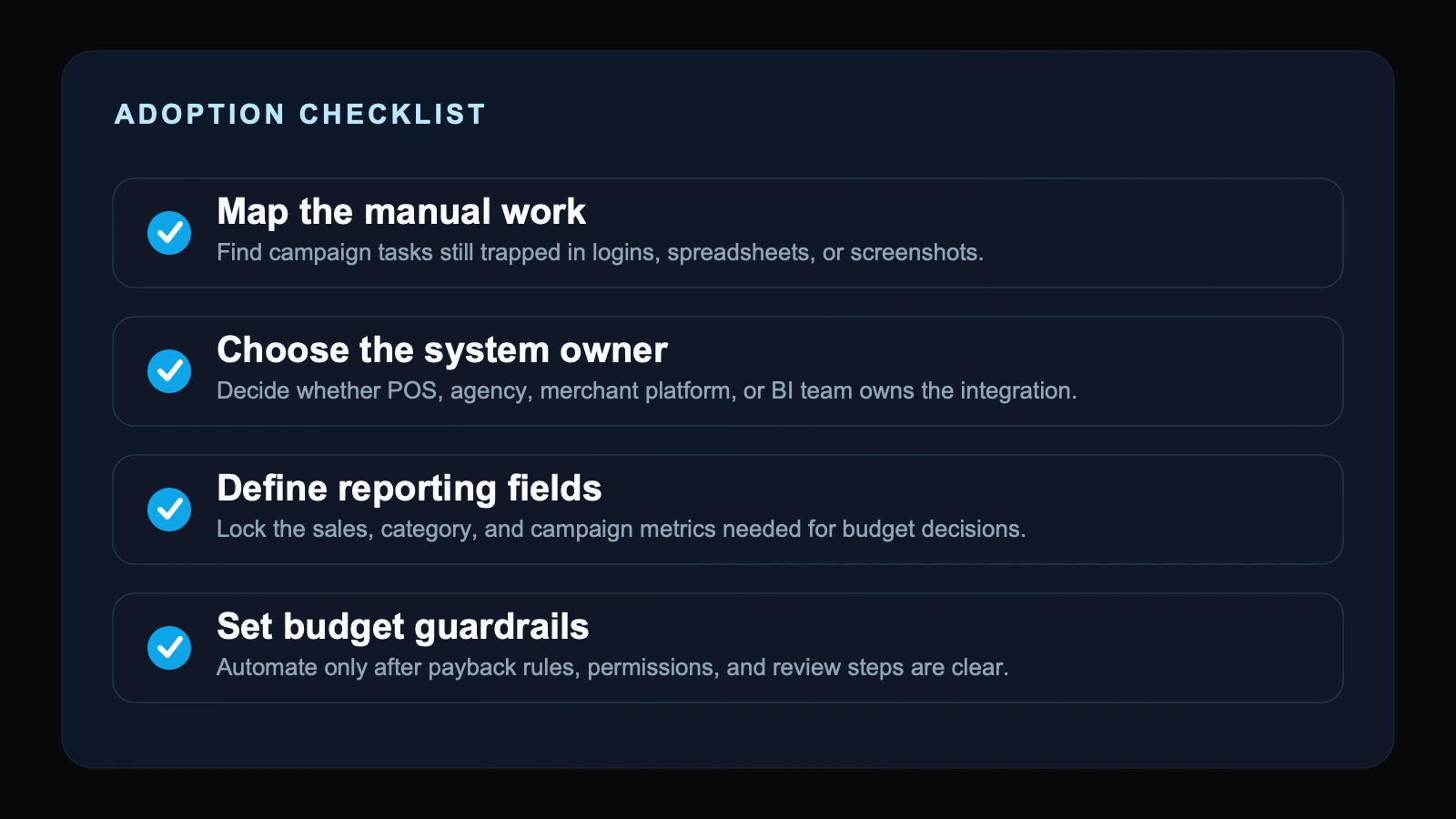
- Audit where Uber campaign setup, budget changes, and reporting still depend on spreadsheets, screenshots, or logins to separate tools.
- Check whether your restaurant platform, aggregator, or agency tool could support campaign creation and updates through the Uber Ads API docs.
- Define which reporting fields need to land in your internal dashboards before you increase spend.
- Rebuild channel assumptions in the Digital Marketing Budget Planner and validate payback thresholds in the Marketing ROI Calculator.
- Pair paid-media automation with a stronger organic and AI-surface visibility baseline using the GEO Visibility Checklist, especially if delivery apps are only one part of your demand mix.
What remains uncertain
Several details are still open. Uber's May 26 announcement does not publish broad adoption numbers, pricing details for API access, or a full market-by-market rollout table. The company also says reporting capabilities will continue expanding, which means today's API surface is an opening version rather than the final analytics contract.
There is also a governance question. Programmatic campaign creation helps scale, but it can also multiply mistakes if location data, merchant permissions, creative rules, or funding logic are messy upstream. Teams that automate the activation layer without tightening budget controls and reporting definitions could simply create faster confusion.
The practical takeaway on June 3, 2026 is that Uber wants retail media to behave more like embedded software infrastructure. For restaurant platforms, agencies, and brand teams, that makes this launch worth more than a passing developer note. It is a signal that marketplace advertising is moving closer to the systems that already run local growth, reporting, and digital operations.