Yext opens its agentic marketing stack to enterprise AI workflows with MCP and local visibility data
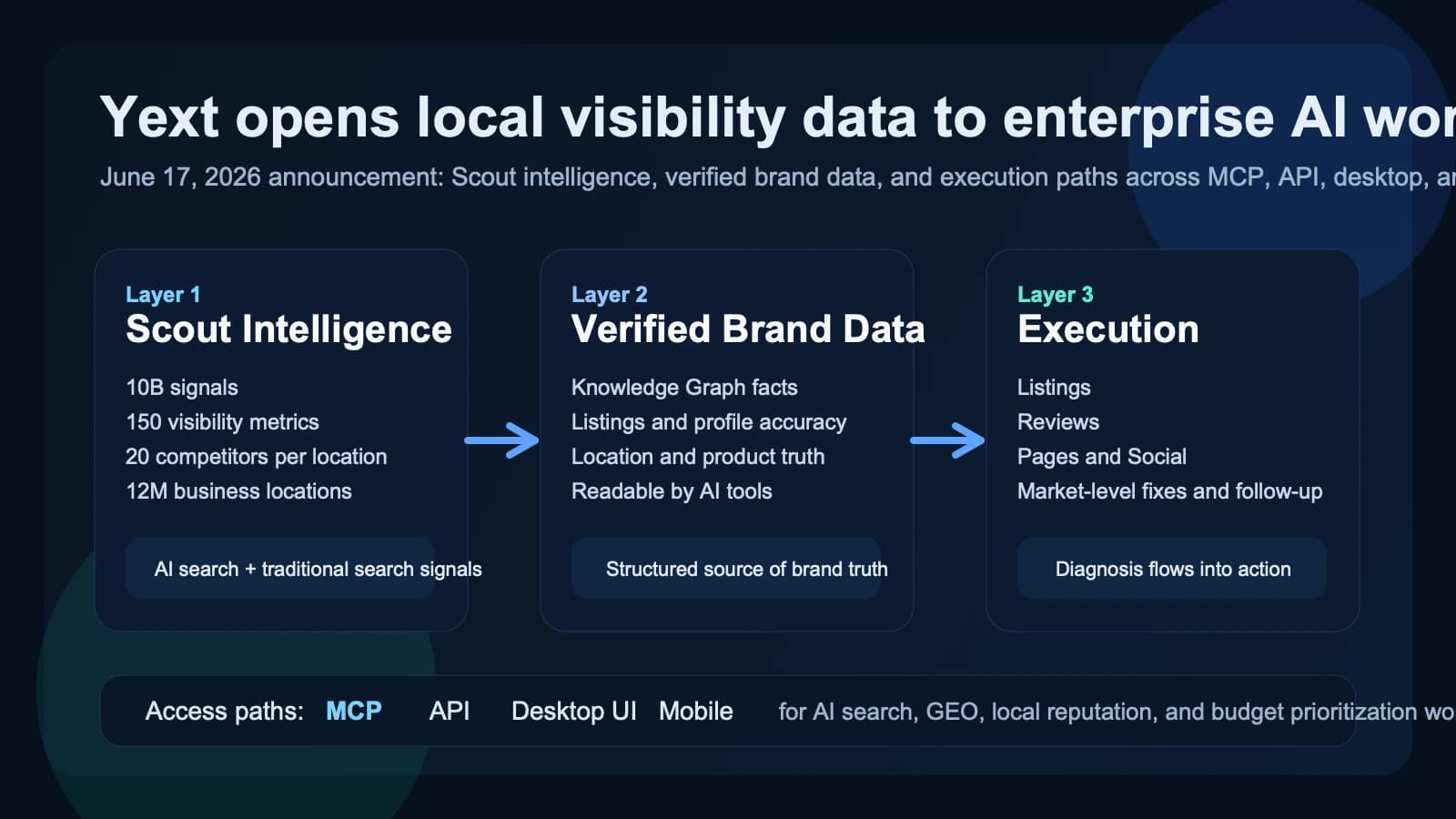
Yext said on June 17, 2026 that its full platform is now open to AI workflows through MCP, API, desktop, and mobile access. The direct claim is that brands can combine verified brand facts, Scout competitive intelligence, and execution workflows inside the AI tools they already use. For teams working on GEO and multi-location growth, the shift is simple: Yext wants visibility work to happen inside AI interfaces, not only dashboards.
This follows Yext's May 18, 2026 partner launch for Scout MCP and Scout API. The June 17 move extends that access model to enterprise brands and ties it to Scout, the Yext Knowledge Graph, and execution across Listings, Reviews, Pages, and Social.
What changed
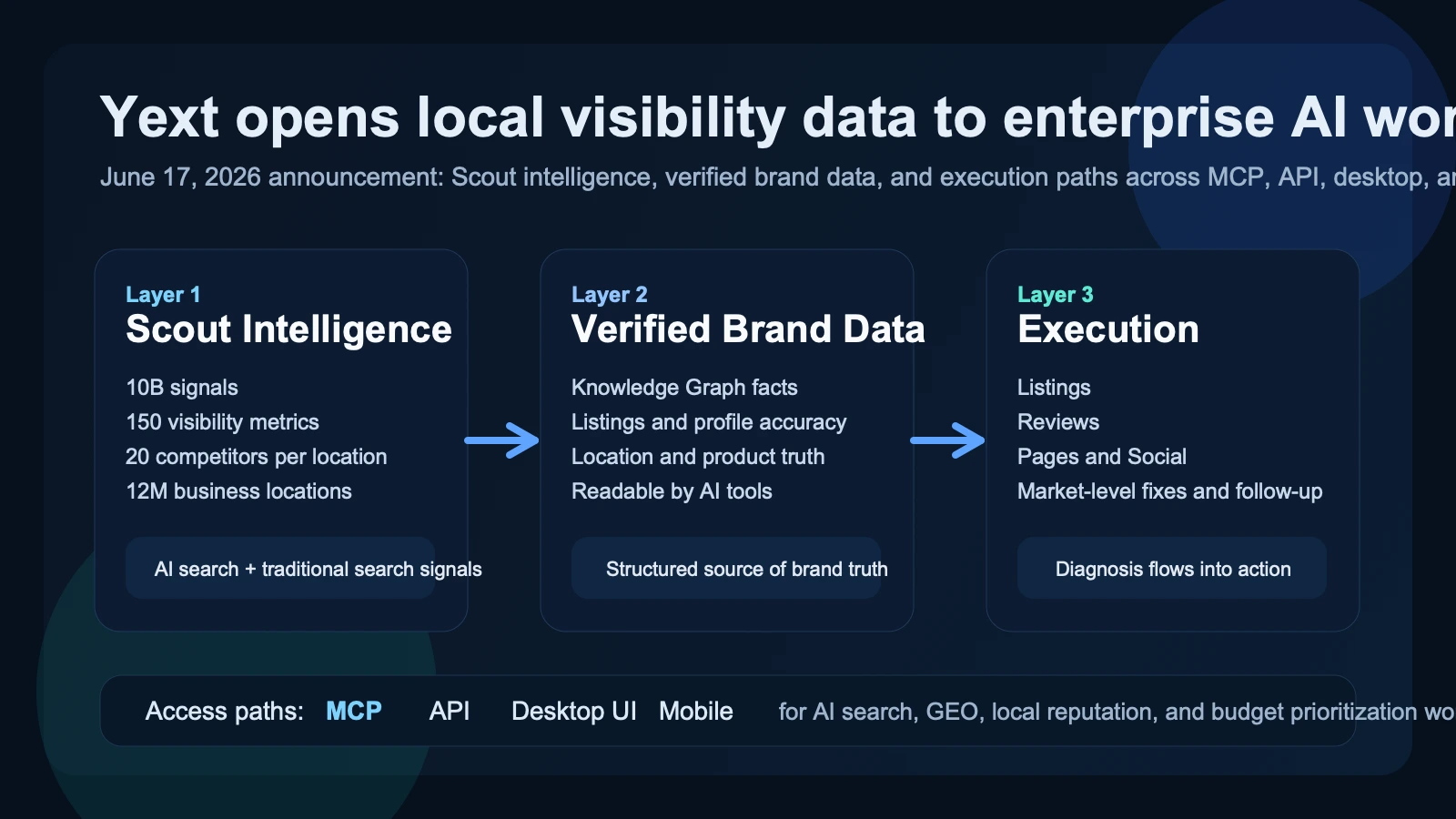
Yext's June 17 press release describes three layers. First, Scout scans competitive signals across AI and traditional search. Second, the Yext Knowledge Graph acts as a structured source of brand truth. Third, the broader Yext platform provides the execution layer across local marketing surfaces.
Yext also published the scale claims behind the pitch: 10 billion signals analyzed, 150 visibility metrics per location, 20 competitors per target business, and 12 million business locations across 186 countries. In its companion blog post, Yext says that data can be queried alongside CRM records, media spend, point-of-sale data, and sales performance inside AI tools such as Claude, ChatGPT, and Gemini.
| Confirmed point | Primary source | Why it matters operationally |
|---|---|---|
| Yext opened its full platform to enterprise AI workflows on June 17, 2026. | Yext press release | The launch is broader than a partner-only beta and is aimed at in-house enterprise teams. |
| Access paths now include MCP, API, desktop, and mobile. | Yext press release | Teams can use the same intelligence in both purpose-built UI and agentic interfaces. |
| Scout intelligence covers 10 billion signals, 150 visibility metrics, 20 competitors per location, and 12 million locations. | Yext press release and May 18 Scout MCP release | The value proposition depends on differentiated local data, not only a chat wrapper. |
| Yext says marketers can query Scout alongside CRM, media spend, point-of-sale, and sales data. | Yext blog post | Visibility decisions can be tied more directly to budget and revenue context. |
| Yext positions the platform around Scout, Knowledge Graph, and execution tools such as Listings, Reviews, Pages, and Social. | Yext press release | It is selling an operating loop from diagnosis to action, not only reporting. |
Why it matters
Many multi-location stacks still break in the same place: listings data lives in one system, local SEO in another, paid media in another, and AI-search monitoring somewhere else. By the time someone identifies a weak market, the operator still has to move to another tool to fix it.
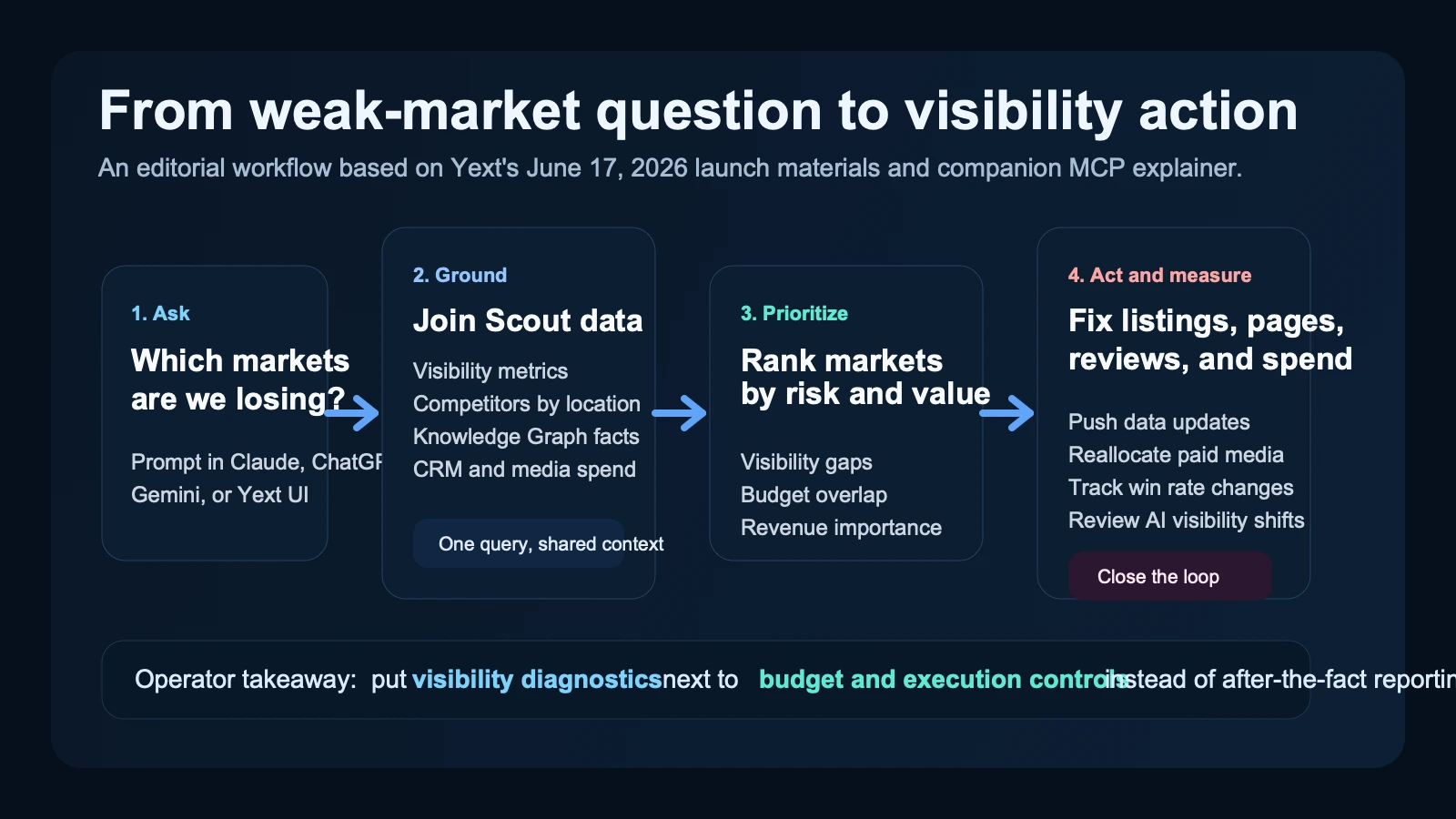
Yext is trying to close that gap. Its June 17 release says enterprise teams can surface competitive insights, close gaps faster, and measure whether they are winning or losing against local competitors in AI and traditional search. The companion blog post makes the paid-media angle clearer: marketers can ask which locations already rank strongly across AI models and Google, compare that with media spend, and reallocate budget toward weaker markets. That is relevant for brands in the United States, Canada, the United Kingdom, Australia, and Europe where local discovery and reputation still shape demand.
This story connects directly to the workflows behind the GEO Visibility Checklist, Marketing ROI Calculator, Digital Marketing Budget Planner, and brand visibility tracking guidance.
Who is affected
The first group is enterprise brands with many locations, branches, stores, or offices. The second is search, SEO, GEO, and paid-media teams deciding where to defend share and where to stop overfunding markets they already dominate. The third is agencies and consultants serving multi-location brands that need repeatable recommendations rather than static reports.
It also matters for customer-experience and reputation teams because listing accuracy, local reputation, and AI visibility may now surface inside the same conversational workflow.
What to do next
Treat the June 17 launch as a workflow design prompt, not as proof that every visibility problem is solved.
- Map which local decisions your team still makes through exports and dashboards rather than direct actions.
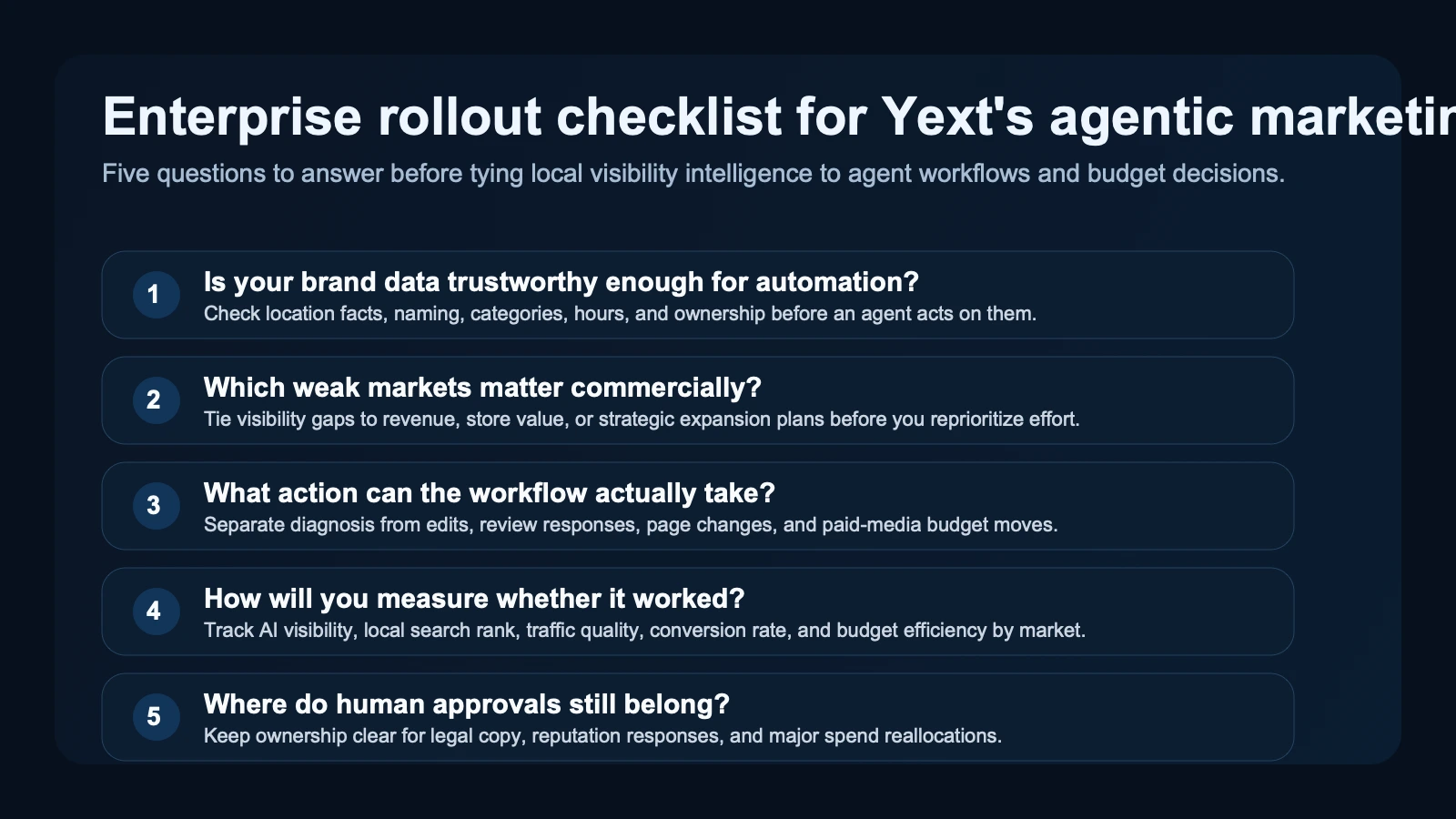
- Audit whether your brand facts, location data, and market naming are clean enough for an agent to use without human translation.
- Pick one high-value use case first: reallocate spend from over-covered markets, fix weak listings in underperforming regions, or compare AI visibility against revenue by location.
- Use the GEO Visibility Checklist and brand mention measurement guide to define what "winning visibility" means before you automate decisions around it.
- Track whether the workflow changes budget efficiency or conversion quality with the Marketing ROI Calculator and Digital Marketing Budget Planner.
What remains uncertain
Important limits remain as of June 18, 2026. Yext's materials describe the infrastructure and the use cases, but they do not publish broad public pricing, universal performance benchmarks, or a simple matrix showing exactly which capabilities are generally available by region, tier, or interface. The May 18 partner release also described early access for some Scout MCP and API capabilities, so enterprise buyers should still verify what is live in their contracts.
Operational discipline is the other constraint. An agent can surface where a brand is losing in AI and local search, but it cannot fix weak ownership, poor data governance, or vague market economics on its own.
The practical takeaway is still meaningful. On June 17, 2026, Yext pushed local visibility intelligence, verified brand data, and execution controls closer together in agentic interfaces. The teams most likely to benefit are the ones that use that access to tighten GEO, local discovery, and budget decisions with cleaner data and narrower operating rules.