Zapier changes AI automation pricing by model tier and adds a hard pause for expensive runs
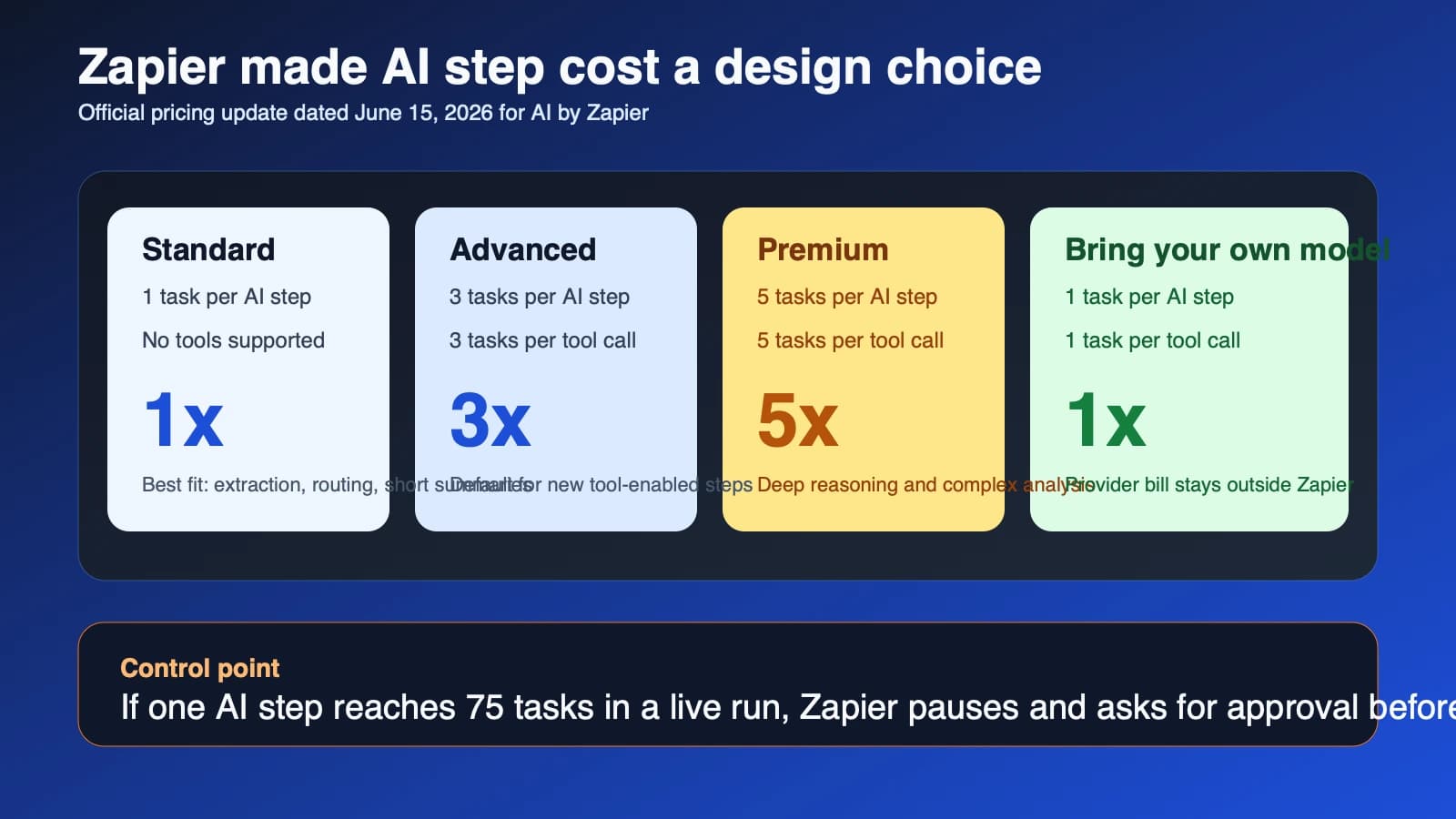
Zapier changed the operating economics of AI by Zapier on June 15, 2026. The official update says AI steps are now priced by model tier, with Standard runs costing 1x, Advanced runs costing 3x, and Premium runs costing 5x per AI step. Tool calls are billed at the same rate as the selected tier, and Zapier also says a live run will pause for approval if one AI step reaches 75 tasks in a single run.
That is not just a billing footnote. For agencies, RevOps teams, ecommerce operators, and internal automation owners, the practical shift is that AI workflow design now has a clearer cost architecture. A prompt-only classification step, a tool-using research step, and a multi-call agent workflow no longer live in the same fuzzy pricing bucket. Starting June 15, 2026, Zapier is telling teams to treat reasoning depth, tool access, and run-time sprawl as explicit budget choices.
What changed
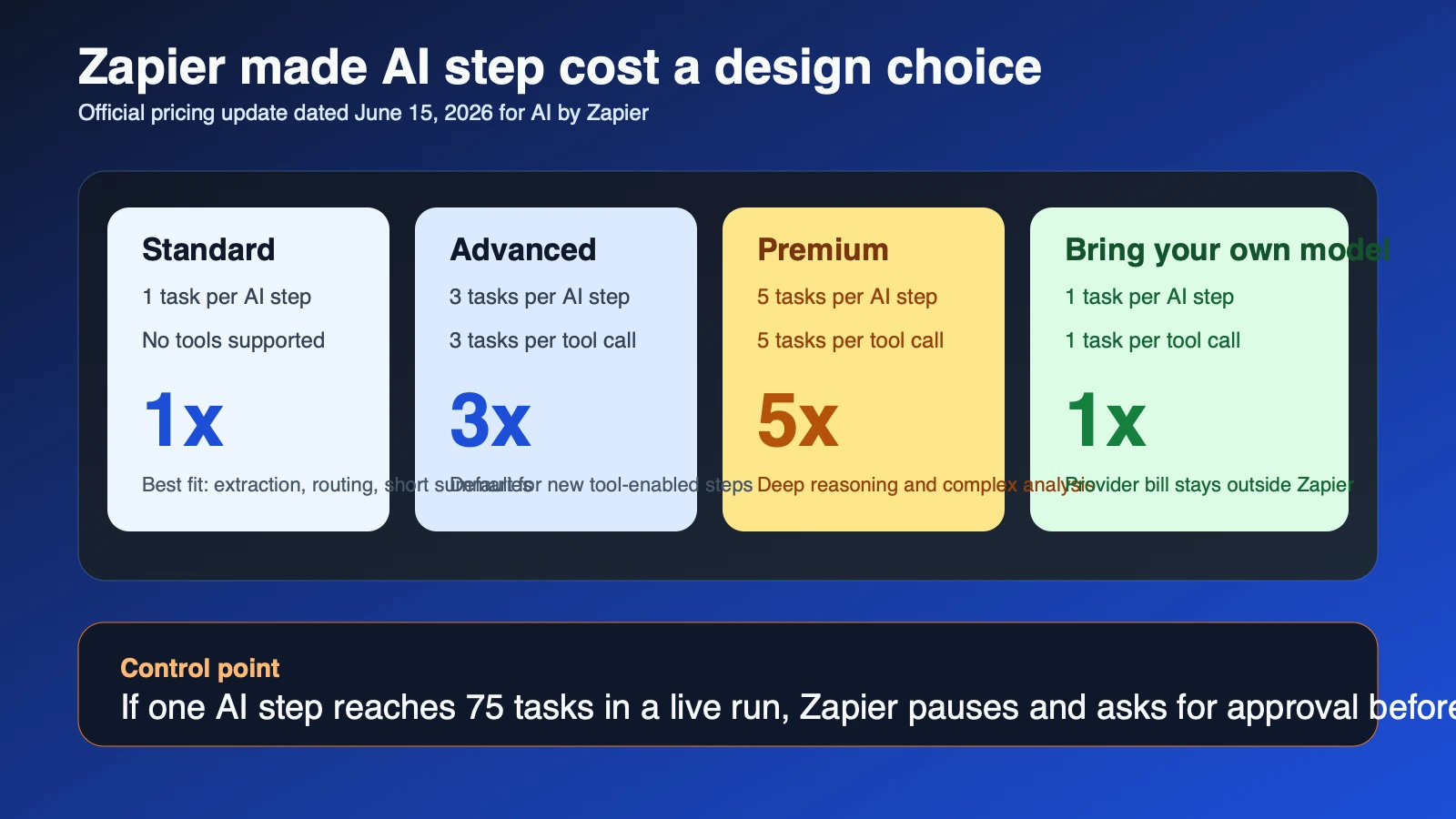
Zapier's June 15 help update says the new rule is simple: the model tier you select determines the base cost per run, and tool calls inherit that same multiplier. Zapier's task usage rates page adds the practical breakdown. Standard models cost 1 task per AI step and do not support tool calls. Advanced models cost 3 tasks per AI step and 3 tasks per tool call. Premium models cost 5 tasks per AI step and 5 tasks per tool call. Zapier also says Bring your own model costs 1 task per AI step and 1 task per tool call while the customer pays the underlying model provider directly.
The default also changed in a way that matters for unsuspecting builders. In Zapier's tool setup guide updated June 15, 2026, the company says new AI by Zapier steps default to the Advanced tier so users can access tools. That means many new AI steps start at 3x task usage unless a builder deliberately downgrades to Standard or chooses a bring-your-own-model path.
| Confirmed pricing rule | Official source | Why operators should care |
|---|---|---|
| Standard tier costs 1 task per AI step and does not support tools. | Zapier pricing rates | Simple extraction and classification runs can stay cheap if teams avoid unnecessary tool access. |
| Advanced tier costs 3 tasks per AI step and 3 tasks per tool call. | Zapier pricing rates | The default builder path now carries a higher cost profile for many practical automations. |
| Premium tier costs 5 tasks per AI step and 5 tasks per tool call. | Zapier pricing rates | Complex agent-like workflows can scale usage fast if tool calls multiply inside one run. |
| Bring Your Own Key costs 1 task per AI step and 1 task per tool call. | Zapier pricing rates and tool setup guide | Teams with existing provider contracts may have a lower-cost path for tool-heavy automation. |
| Zapier pauses an AI step when it reaches 75 tasks in a live run. | June 15 pricing update | There is now a built-in circuit breaker against runaway usage, but it also creates a review point in production workflows. |
Why it matters
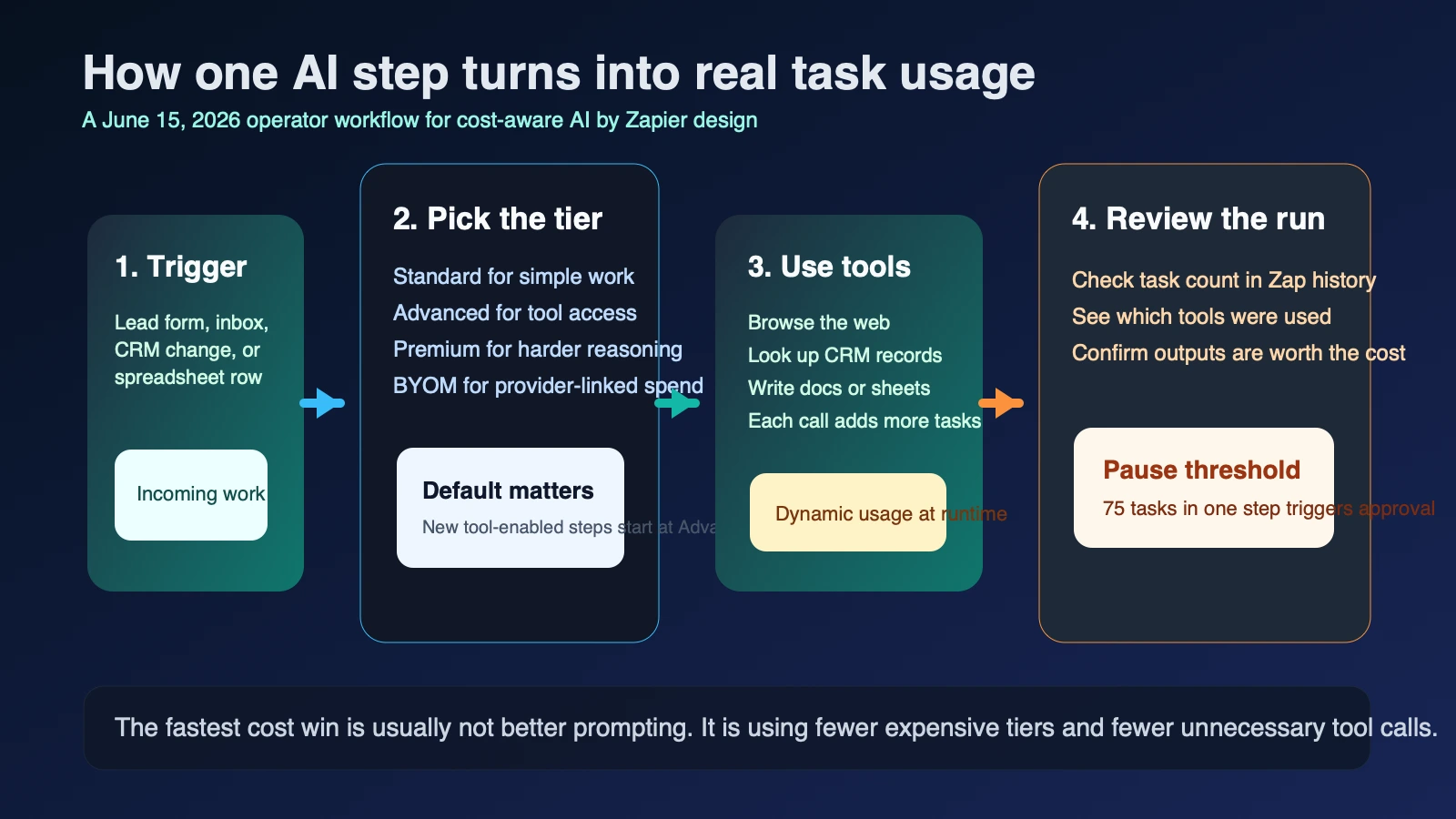
The real implication is governance, not only cost. AI automation tools often look inexpensive at prototype scale because builders think in prompts, not in repeated reasoning cycles plus tool calls. Zapier's new model makes that hidden complexity visible. If one workflow summarizes an inbound form, looks up account data, searches the web, drafts an email, and writes back to a CRM, the operational question is no longer only "does it work?" It is also "what tier is this worth?"
That is relevant to the same teams already using the Digital Marketing Budget Planner or the Marketing ROI Calculator to pressure-test campaign economics. AI orchestration now needs the same discipline. A workflow that saves labor can still become inefficient if it is over-tiered, calls too many tools, or runs on noisy triggers.
Who is affected
The first group is agencies and consultants managing many small client automations, where margin can disappear if every AI step defaults to Advanced. The second is internal ops and RevOps teams that want AI steps to inspect records, route work, or draft follow-ups. The third is builder-led small businesses using Zapier as their automation backbone, especially if they are experimenting with browsing, CRM lookups, spreadsheets, or multi-tool prompts.
Zapier's June 15 documentation also includes one constraint enterprise buyers should not ignore: the pricing update and the tool configuration guide both say tool calls are not currently available for Enterprise accounts. Enterprise users can still run AI by Zapier steps, but not with the same tool-enabled behavior described for other tiers.
What to do next
Treat this as an automation audit moment, not only a pricing announcement.
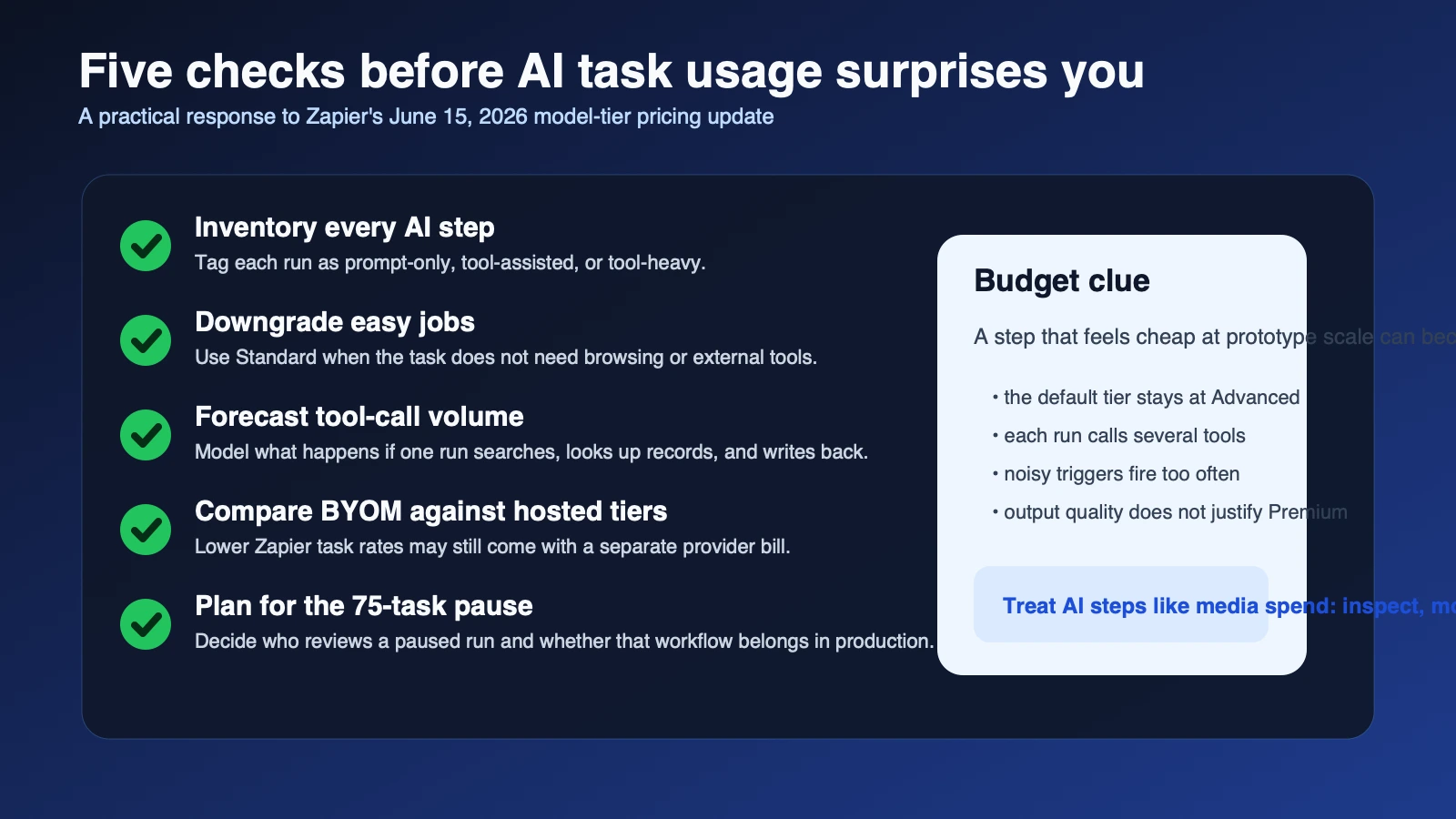
- List every current AI by Zapier step and label it `prompt-only`, `tool-assisted`, or `tool-heavy`.
- Downgrade simple extraction or routing steps to Standard where tools are unnecessary.
- Model the monthly cost of Advanced and Premium tool calls before scaling a workflow across more triggers or clients.
- Compare Zapier-hosted tiers against a bring-your-own-model path if you already pay for OpenAI, Anthropic, or another provider.
- Review high-risk workflows against the GEO Visibility Checklist mindset: define inputs, review points, and measurable business outputs before trusting the automation in production.
What remains uncertain
Zapier's public materials still leave some operating questions open as of June 15, 2026. The company explains the multipliers and the 75-task pause, but it does not publish universal benchmarks for which kinds of real-world prompts reliably stay within each tier. It also says tool usage is dynamic and that task counts are visible after the run in Zap history, which means teams may still need live observation before they understand true cost behavior.
There is also a strategic tradeoff. Bring your own model looks cheaper on Zapier's rate card for tool-heavy workflows, but the official docs make clear that users pay their model provider separately. That can be an advantage for mature teams with negotiated provider spend and model governance, but it is not automatically the lowest total cost for every operator.
The defensible conclusion is narrower. On June 15, 2026, Zapier turned AI workflow pricing into a more explicit systems-design decision. Teams that keep simple jobs simple and reserve expensive reasoning for tasks that actually need it will adapt faster than teams that let every new AI step default to Advanced and hope the monthly bill explains itself.