ZoomMate turns meeting context into search, deliverables, and workflow execution
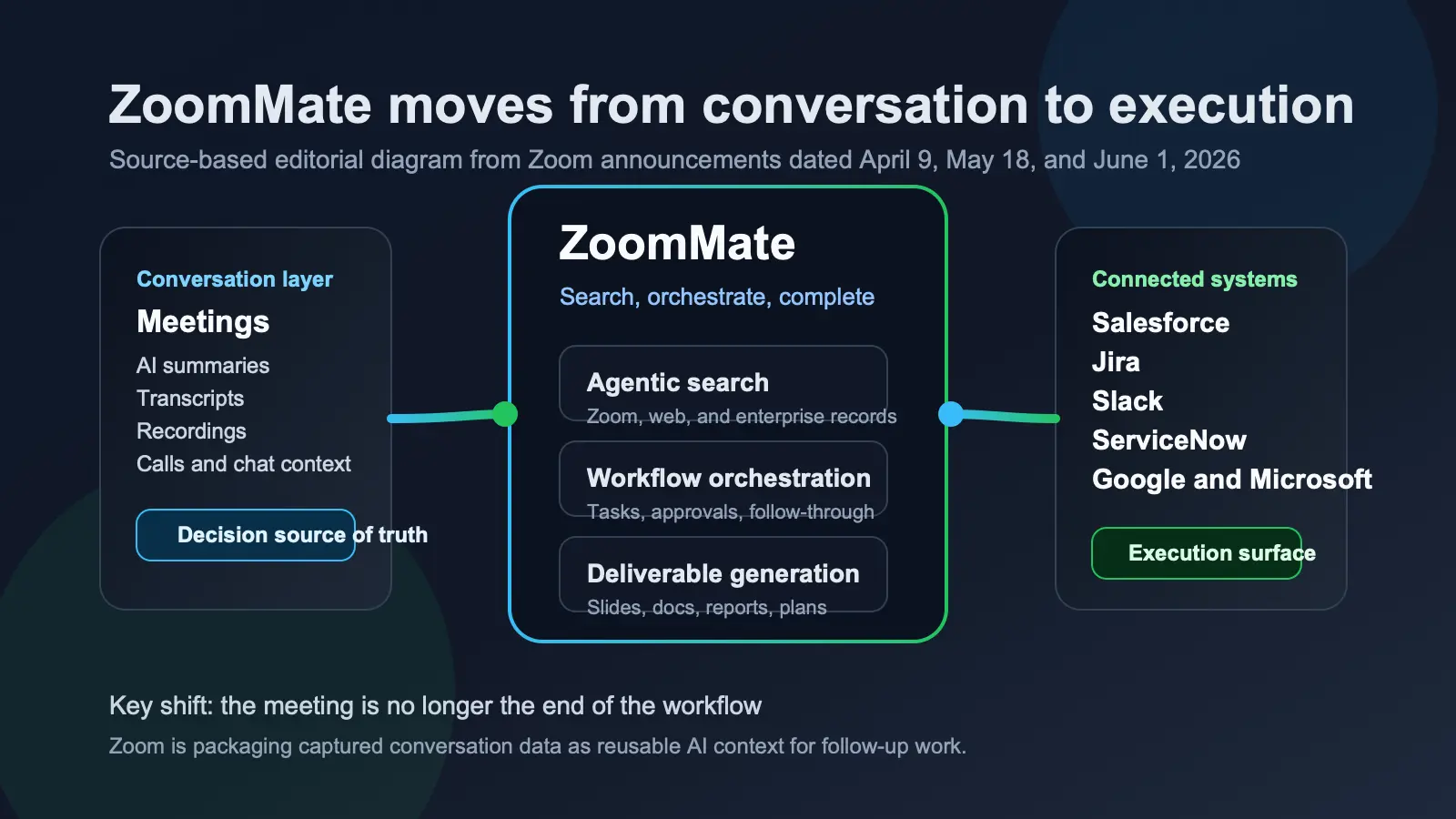
Zoom said on June 1, 2026 that ZoomMate is now generally available in North America as an AI teammate that can search across Zoom and connected business systems, create finished deliverables from meeting context, and trigger follow-up work in tools such as Salesforce, Jira, Slack, ServiceNow, Google Calendar, and Microsoft Outlook. For operators, the practical change is not another meeting summary feature. Zoom is trying to turn the conversation itself into the control layer for execution.
Read together with Zoom's May 18, 2026 MCP expansion announcement and its April 9, 2026 Claude integration post, the signal is clear: Zoom wants its meeting and conversation layer to become reusable operating context inside broader AI workflows.
What changed
Zoom's June 1 product announcement bundles three capabilities into one work surface: agentic search, orchestration, and completion. The company says ZoomMate can search across Zoom, the web, and connected systems; coordinate follow-through across meetings, apps, and systems; and create presentations, documents, spreadsheets, reports, and project plans directly from meeting conversations and enterprise context.
Two supporting announcements make the launch more concrete. On May 18, 2026, Zoom said its expanded MCP capabilities now expose conversation intelligence and enterprise context inside third-party AI environments including OpenAI Codex and Anthropic Claude, with ten connectors now live. Earlier, on April 9, 2026, Zoom said its Claude integration would provide secure access to AI meeting summaries, transcripts, recordings, and scheduling capabilities.
| Confirmed product signal | Official source | Why it matters in practice |
|---|---|---|
| ZoomMate became generally available in North America on June 1, 2026, starting at $20 per user per month with included AI credits. | ZoomMate launch | Zoom has moved from roadmap language to a priced, shipping product. |
| ZoomMate can create presentations, documents, spreadsheets, reports, and project plans from meeting and enterprise context. | ZoomMate launch | Work can move from conversation to draft deliverable without manual re-assembly. |
| Expanded MCP capabilities made ten connectors live across third-party AI workflows on May 18, 2026. | Zoom MCP expansion | Zoom context can now travel into external AI environments instead of staying trapped in Zoom alone. |
| Zoom's Claude integration launched on April 9, 2026 with access to summaries, transcripts, recordings, and scheduling. | Claude integration announcement | The meeting layer is becoming machine-readable context for downstream workflows. |
| Zoom says EMEA and APAC availability for ZoomMate is expected later in 2026. | ZoomMate launch | Global teams should treat the launch as real but regionally phased. |
Why it matters
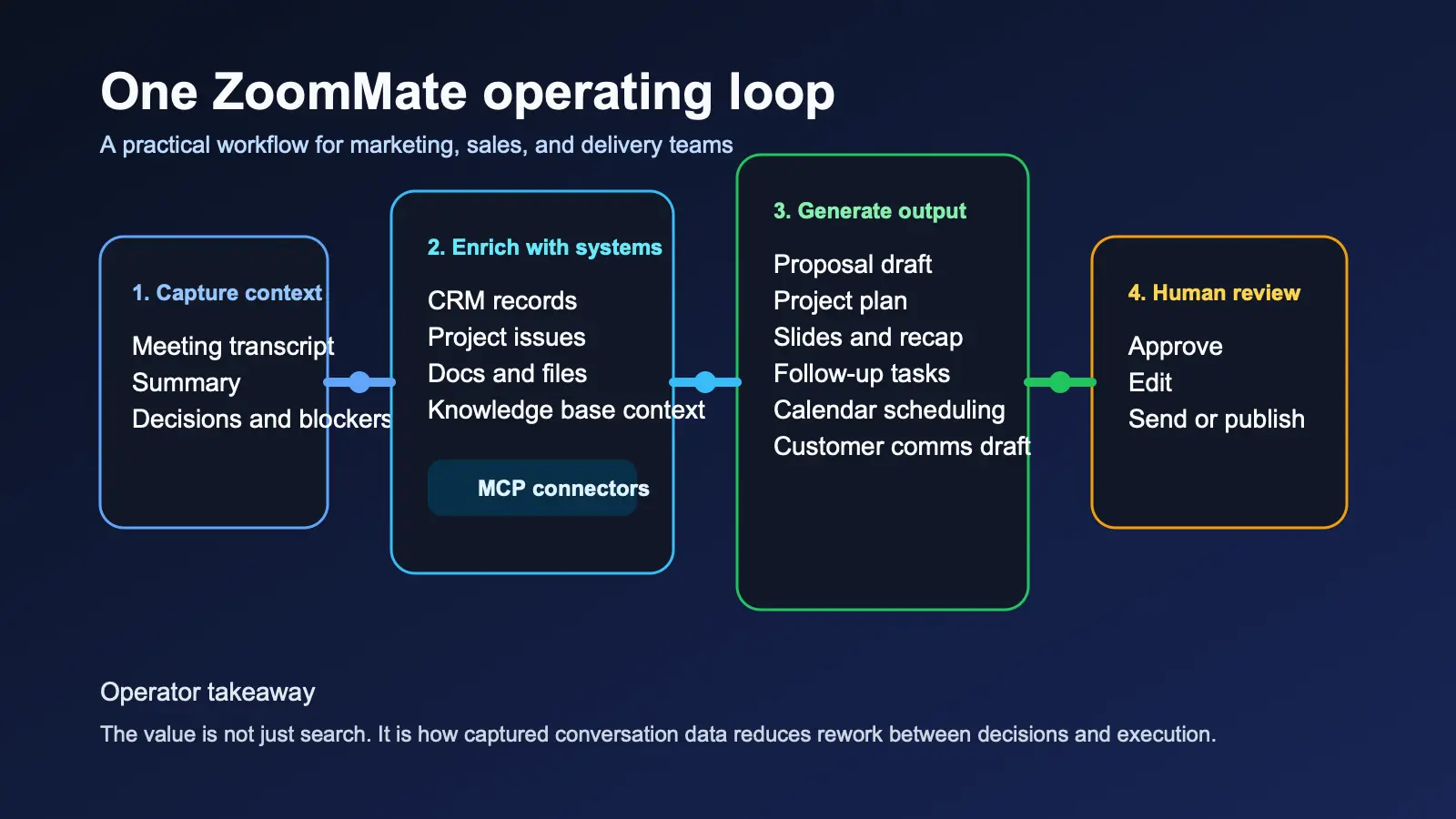
For marketing, revenue, customer-success, and operations teams, the main benefit is workflow compression. A meeting usually produces decisions, objections, follow-ups, ownership questions, and partial drafts. Those details then get copied into project tools, CRM records, slides, briefs, or emails by hand. ZoomMate's June 1 post says it can retrieve account details before a call, update opportunity records after, and draft follow-up proposals from the meeting transcript.
It also changes where enterprise context lives. Zoom's May 18 MCP update argues that disconnected documents and systems often miss the conversations where tradeoffs and commitments actually happen. If that premise holds, meeting transcripts and AI summaries become more valuable inputs for campaign planning, account management, onboarding, support analysis, and cross-functional execution.
That connects naturally to Slogan.website resources such as the tools hub, the Marketing ROI Calculator, the Digital Marketing Budget Planner, the GEO Visibility Checklist, and the guide to tracking brand mentions and visibility.
Who is affected
The clearest fit is for high-context teams that spend a large share of their week in calls, reviews, and handoffs.
- Marketing teams that need briefs, decks, launch plans, or stakeholder updates from strategy meetings.
- Sales and account teams that want proposal drafts, opportunity updates, and follow-up emails tied to the actual conversation.
- Product, delivery, and support teams that need meeting decisions turned into tracked work across Jira, Slack, docs, or service systems.
- Agencies and consultants managing multiple client contexts across meetings, assets, and execution tools.
What to do next
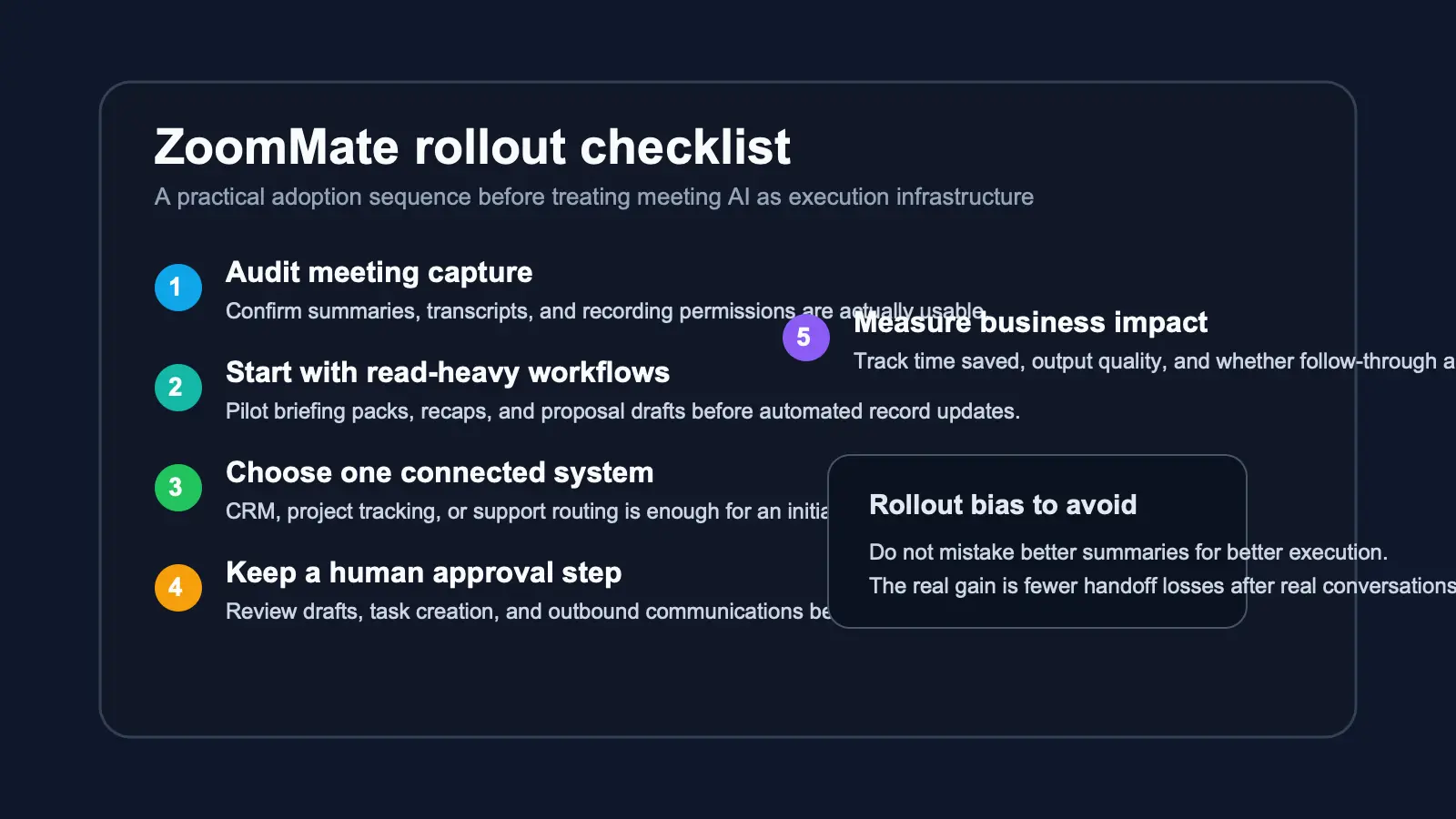
Use this rollout sequence before treating ZoomMate as production infrastructure:
- Map the handoff failures after your most important meetings: proposal drafting, CRM updates, project kickoff notes, stakeholder recaps, or support escalations.
- Decide which systems should be read-only first and which workflows can safely create or update tasks, records, or drafts.
- Confirm whether your meeting setup already supports the required context. Zoom's official Claude support article says Smart Recording and Meeting Summary affect what the app can retrieve.
- Pick one narrow pilot such as sales follow-ups, campaign briefing packs, or project status recaps rather than rolling the tool across every team at once.
- Measure speed gains and quality risk together. If the tool drafts more assets faster but weakens approvals, messaging, or compliance, it is not yet a win.
What remains uncertain
Important limits remain. Zoom says in its June 1 launch post that availability outside North America is still expected later in 2026, and that rollout may be gradual even where the product is generally available. The product also depends on connected systems, permissions, and captured meeting data, so not every organization will get the same value on day one.
There is also a governance question. Zoom's support guidance for the Zoom for Claude app makes clear that access depends on account privileges, enabled AI Companion features, and user access to recordings or meeting assets.
The practical takeaway on June 7, 2026 is narrower and more useful. ZoomMate is a real product launch that pushes Zoom beyond note-taking and toward workflow execution. Teams that already depend on meetings as a decision surface should evaluate it seriously. Teams that still lack clean permissions, connected systems, or disciplined review loops should treat it as a pilot, not an autopilot.