Adobe pushes agentic marketing from pilot mode to production with CX Enterprise Coworker
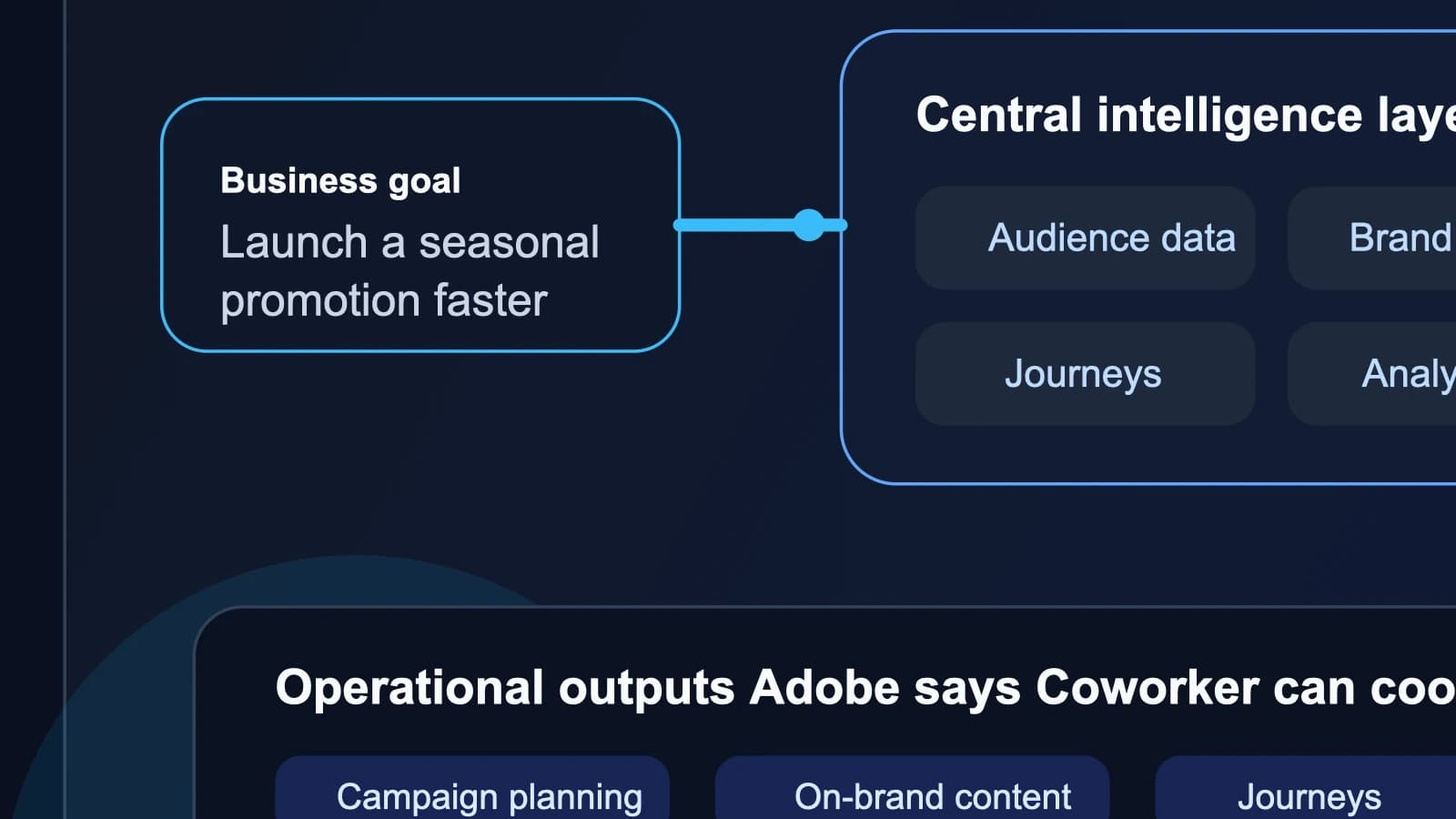
Adobe moved one of its biggest agentic marketing ideas from roadmap language to sellable product on June 10, 2026. The company said CX Enterprise Coworker is now generally available as a standalone offering or add-on, positioning it as the operating layer that can turn brand goals into multi-step campaign, engagement, and governance workflows across Adobe and third-party systems.
That matters because Adobe introduced the broader CX Enterprise vision on April 20, 2026 but, at the time, said Coworker would be generally available only in the coming months. The June 10 announcement changes the practical question for marketing and customer teams. This is no longer just a Summit-stage concept about agentic orchestration. It is Adobe telling enterprise buyers, agencies, and operators that they can start deploying a governed agent layer now, even if pricing still remains described only as an introductory offer.
What changed
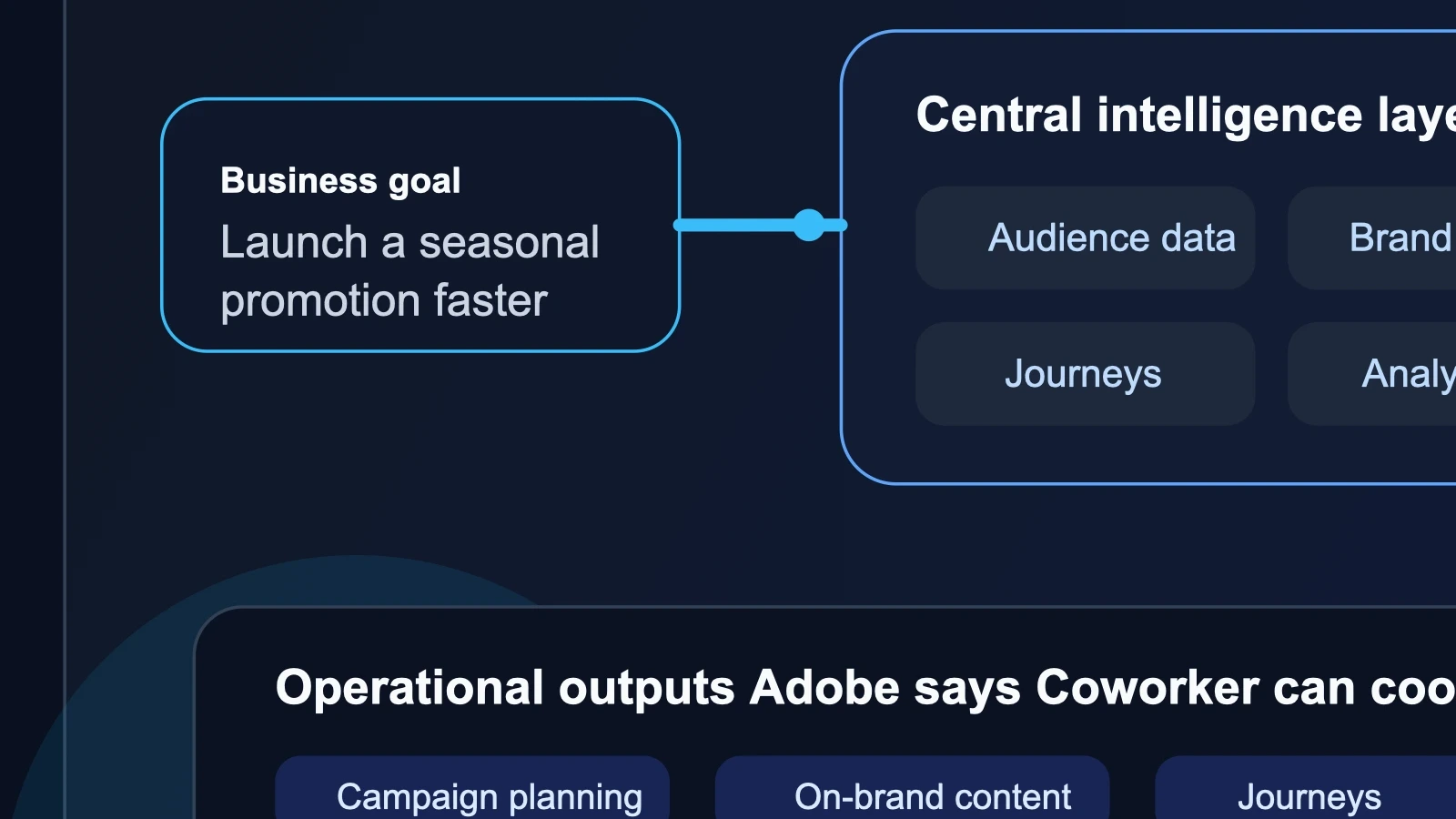
Adobe's June 10 release says CX Enterprise Coworker now acts as a central intelligence layer for teams running initiatives from campaign launches to customer retention programs. Adobe says the system synthesizes insights from Adobe and third-party applications, coordinates agents across analytics, content creation, and journey orchestration, and works on open standards including Model Context Protocol (MCP) and Agent-to-Agent (A2A) frameworks.
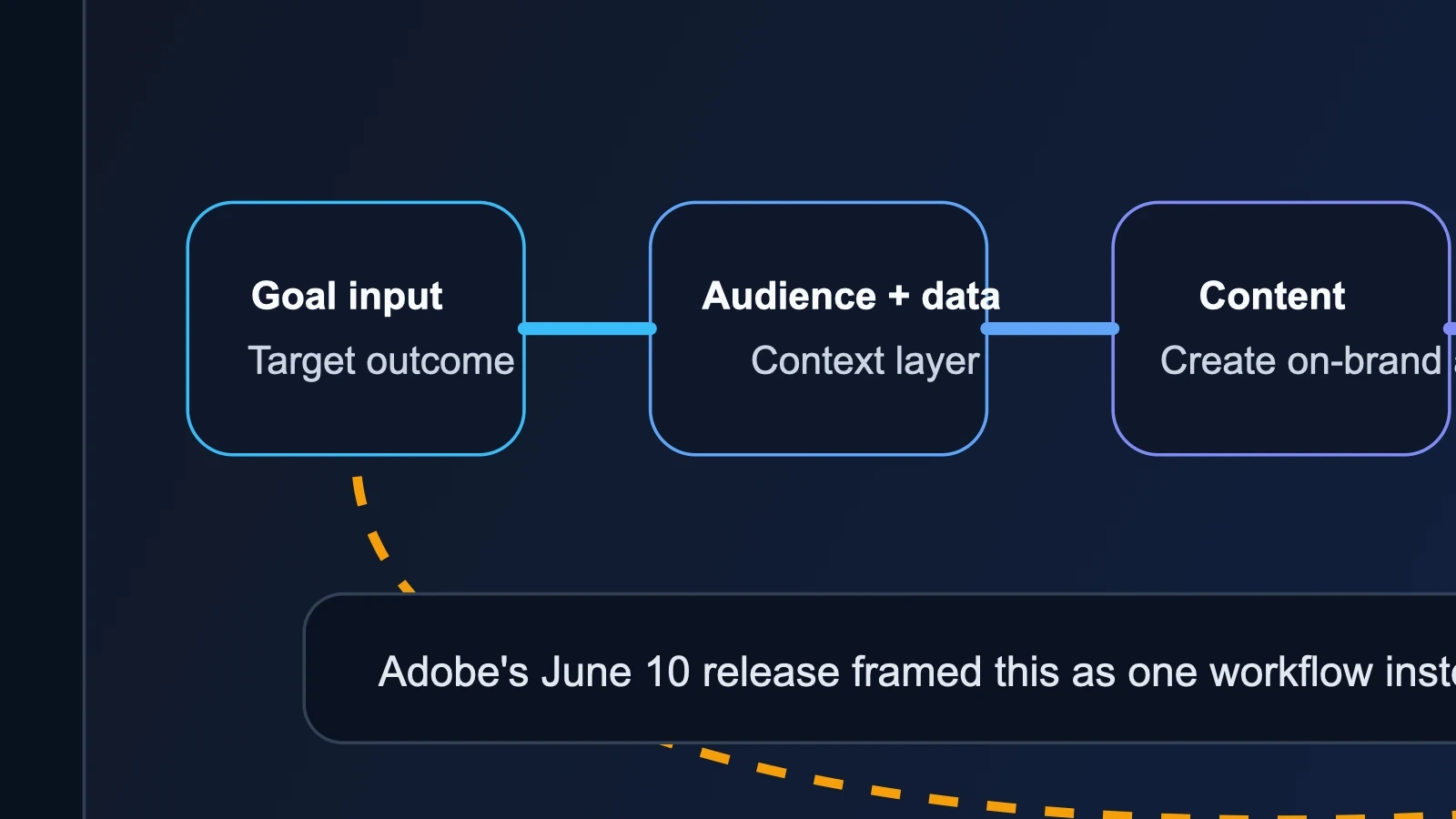
The practical delta is availability and scope. In the earlier April 20 CX Enterprise announcement, Adobe described Coworker as a coming capability that would coordinate agents against defined business goals. On June 10, Adobe added concrete execution examples: building a campaign plan from a natural-language goal, assembling target audiences, creating on-brand content, designing a customer journey, monitoring results, and supporting retention workflows. Adobe also said the product can streamline internal review cycles, inherit data policies and consent rules, and support smaller teams through a self-service model.
| Confirmed detail | Official source | Why operators should care |
|---|---|---|
| Adobe announced general availability for CX Enterprise Coworker on June 10, 2026. | Adobe June 10 release | The product moved from future-state positioning into an active buying and rollout decision. |
| Adobe says Coworker can coordinate analytics, content creation, and journey orchestration. | Adobe June 10 release | Campaign execution is being packaged as one cross-functional workflow instead of separate handoffs. |
| Adobe says the system is built on open standards including MCP and A2A. | Adobe June 10 release | Teams using mixed AI stacks can evaluate interoperability instead of assuming a closed Adobe-only model. |
| Adobe introduced CX Enterprise on April 20, 2026 with AI agents, agent skills, MCP endpoints, and governance. | Adobe April 20 release | Coworker is best understood as the execution layer inside a larger Adobe orchestration stack. |
| Adobe also said in April that the partner ecosystem would span AWS, Anthropic, Google Cloud, Microsoft, NVIDIA, OpenAI, and others. | Adobe partner ecosystem release | The rollout matters beyond Adobe shops because the pitch depends on working across existing enterprise tools. |
Why it matters
For large marketing organizations, the headline is not just "Adobe launched another AI product." The more important shift is that Adobe is trying to productize the messy middle between strategy, production, approval, activation, and optimization. Most teams already have analytics, audience systems, content tools, journey builders, and brand rules. What they usually do not have is a governed layer that turns a business objective into an auditable sequence of actions without relying on manual coordination across five teams.
That is why this release is more useful than the usual agent hype cycle. Adobe is tying Coworker to campaign launch, customer retention, and marketing operations rather than to one chatbot surface. If a team wants to increase engagement, recover churn risk, or launch a seasonal promotion faster, Adobe's claim is that the system can connect the audience, the creative, the journey logic, and the review process in one loop. For CMOs and revenue operators, that means AI is being sold less as a content toy and more as execution infrastructure.
This also fits a broader GEO and brand-governance trend. Slogan.website has already covered Adobe's earlier brand visibility and agentic web position, and the general availability milestone makes that earlier strategy more concrete. If AI assistants, search summaries, and digital journeys increasingly depend on governed source content, then systems that connect visibility, brand rules, and downstream performance become more credible budget contenders. That is the same planning logic behind the GEO Visibility Checklist, the Marketing ROI Calculator, and the Digital Marketing Budget Planner.
Who is affected
The clearest immediate audience is enterprise and upper-midmarket teams already running Adobe, but the signal is wider than that.
Agencies, consultants, and in-house operators working across Adobe plus other AI surfaces now have a more concrete benchmark for what "agentic marketing operations" is supposed to include. That means campaign teams, lifecycle and CRM owners, content operations leaders, and digital-experience teams should all pay attention, especially if they are already trying to reduce approval bottlenecks or connect AI-generated content to brand-safe execution.
What to do next
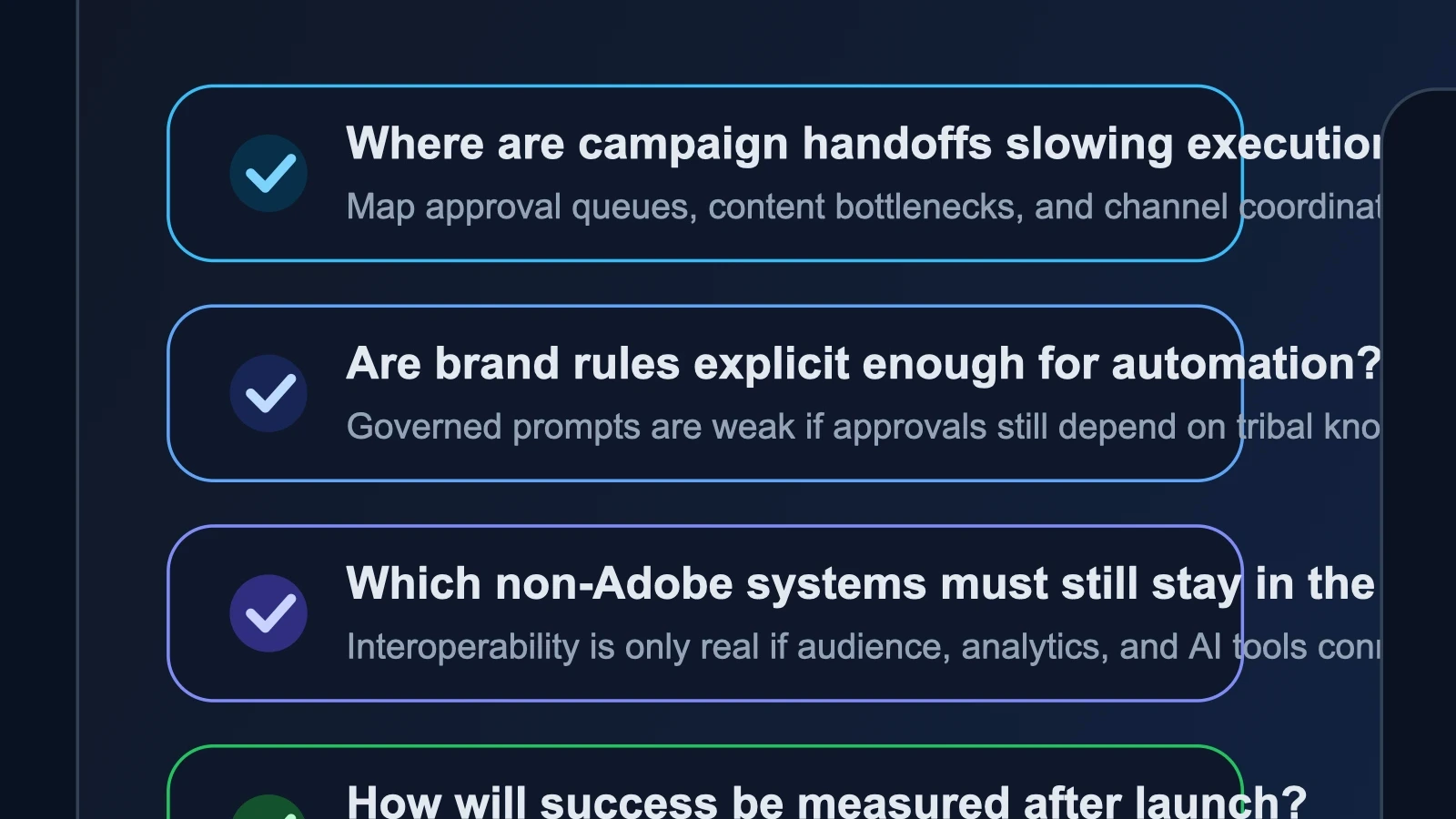
Use the launch as a workflow audit, not an automatic purchase signal.
- List the campaign and retention processes where your team still loses the most time to handoffs, approvals, or context switching.
- Map which parts of those flows depend on governed data, brand rules, audience logic, and channel execution.
- Compare Adobe's announced scope against your current stack and note where interoperability matters most, especially if your team already uses non-Adobe AI tools.
- Pressure-test the business case with a simple scenario in the Marketing ROI Calculator: faster launches, fewer review delays, or better retention offers should translate into measurable assumptions.
- Pair any Adobe evaluation with your existing visibility and measurement work in /insights/generative-engine-optimization-benefits and /insights/brand-mentions-how-to-track-and-measure-visibility, because orchestration only matters if the input signals and source content stay trustworthy.
What remains uncertain
Adobe's June 10 release is detailed about use cases but still thin on buying specifics. The company says Coworker is available at an introductory price and can scale based on realized value, but it did not publish broad public pricing, implementation timelines by customer segment, or customer adoption data in the announcement itself. Buyers should treat the launch as real, but still ask hard questions about rollout effort, governance configuration, and the limits of self-service versus enterprise services.
There is also an execution gap to watch. A governed orchestration layer sounds attractive, but enterprise marketing stacks are usually slowed by messy data, fragmented content models, regional approval rules, and imperfect channel instrumentation. Coworker may reduce those frictions, but it does not remove the need for clean inputs and explicit operating rules. The strongest takeaway on June 11, 2026 is narrower and more useful: Adobe has now turned agentic campaign orchestration into a production-category buying conversation, and that will push the rest of the market to show more than demos.