Amazon Ads API sets a real token-rotation deadline for reporting and campaign automation teams
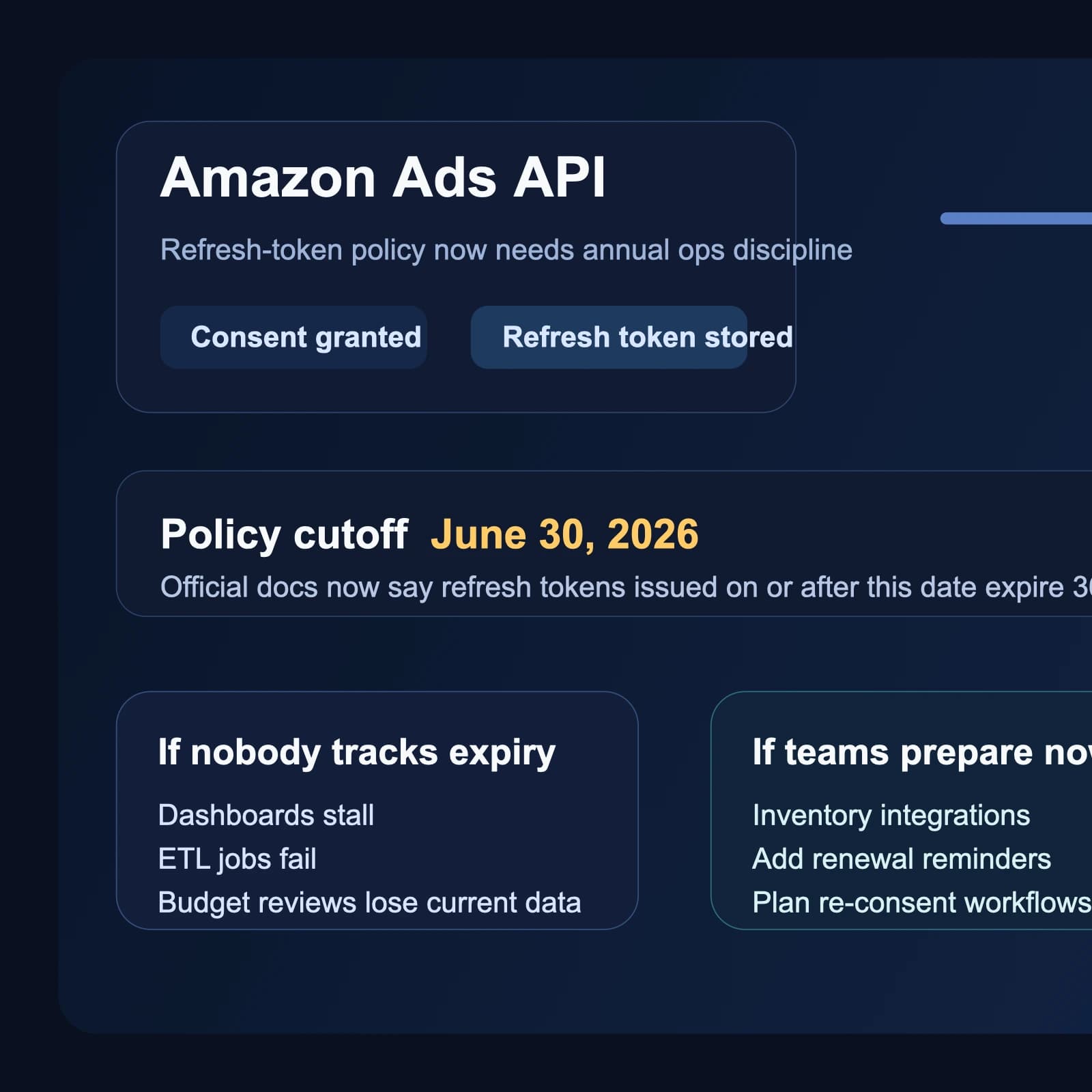
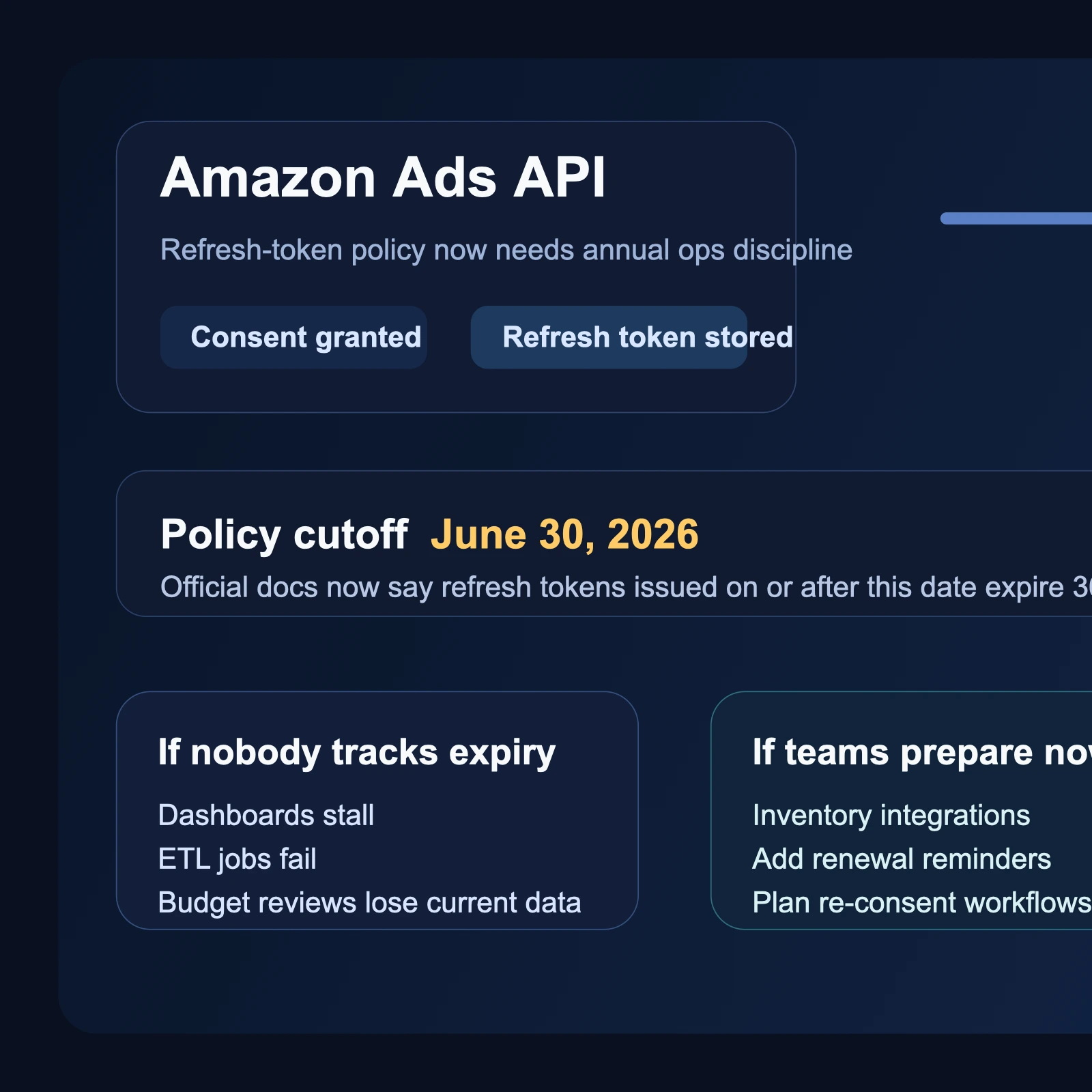
Amazon Ads has turned a quiet authentication detail into a real operations deadline. Its official API release notes, token retrieval guide, and authorization guidance now align on one practical rule: refresh tokens issued on or after June 30, 2026 expire 365 days from the date of advertiser consent. Tokens issued before that date do not carry the same one-year expiry rule in the current documentation.
For marketers, agencies, analytics teams, and adtech vendors, this is not just an OAuth housekeeping change. It affects any workflow that depends on durable Amazon Ads API access for reporting, campaign management, budgeting, or data syncs. If you run unattended jobs and assume your refresh token lasts indefinitely, that assumption now has an end date.
What changed
The official source trail is consistent. Amazon's release notes say the platform updated its refresh-token expiration policy for security and industry-alignment reasons. The guide for generating access and refresh tokens states that refresh tokens issued on or after June 30, 2026 expire 365 days from advertiser consent. The authorization overview and the authorization grants guide repeat the same cutoff.
That matters because many Amazon Ads integrations were built around a softer operational model: win consent once, store the refresh token, and keep renewing short-lived access tokens behind the scenes. After June 30, newly granted access moves onto a lifecycle that needs tracking, alerting, and likely re-consent playbooks.
| Confirmed point | Official source | Operational meaning |
|---|---|---|
| Amazon updated the refresh-token expiration policy. | API release notes | This is a documented platform policy shift, not a rumor from a partner thread. |
| Refresh tokens issued on or after June 30, 2026 expire after 365 days from advertiser consent. | Token retrieval guide | New consents now need annual lifecycle management. |
| Tokens issued before June 30, 2026 do not follow that same one-year expiry note in the current docs. | Authorization grants guide | Old and new integrations may behave differently inside the same organization. |
| The same rule appears in Amazon's authorization overview. | Authorization overview | Teams can treat the cutoff as a durable contract across the docs surface, not a stray sentence. |
Why it matters
This is a high-value story because token expiry breaks quietly. Dashboards stop refreshing. pacing exports fail overnight. Bid-management scripts start throwing authorization errors. Finance and client-service teams notice missing numbers before engineers notice a stale consent. In practical terms, Amazon is pushing API users toward a more mature integration posture: credential inventories, expiry monitoring, renewal prompts, and documented fallback workflows.
That hits several classes of operators at once. Agencies running many advertiser accounts now need a consent calendar, not just a credential vault. In-house retail media teams need to know whether their reporting pipelines, budget pacing sheets, and warehouse connectors depend on refresh tokens that will eventually age out. Software vendors need to design UX for reauthorization before customers feel an outage.
It also connects directly to business planning. A broken Amazon Ads data feed does not only create a technical incident. It distorts spend analysis, ROAS reviews, and budget allocation. That is why this update pairs naturally with Slogan.website's Digital Marketing Budget Planner, Marketing ROI Calculator, and the guide to tracking visibility signals. If your reporting layer goes dark, your growth decisions go blind with it.
Who is affected
The first group is adtech and analytics operators with unattended Amazon Ads jobs. That includes ETL pipelines, internal dashboards, BI connectors, anomaly alerts, and campaign-control scripts.
The second group is agencies and consultants managing Amazon Ads access for multiple clients across the United States, Canada, the United Kingdom, Australia, and Europe. They often inherit mixed consent ages, mixed owners, and inconsistent documentation. A one-year expiry rule makes that mess expensive if nobody owns it.
The third group is any marketing team already migrating other Amazon workflows, especially after Amazon's recent unified reporting transition. If reporting surfaces are changing and API credentials now need annual rotation discipline, the operational cost of "we will clean it up later" just went up.
What to do next
Treat the June 30, 2026 cutoff like a systems change, not a footnote.
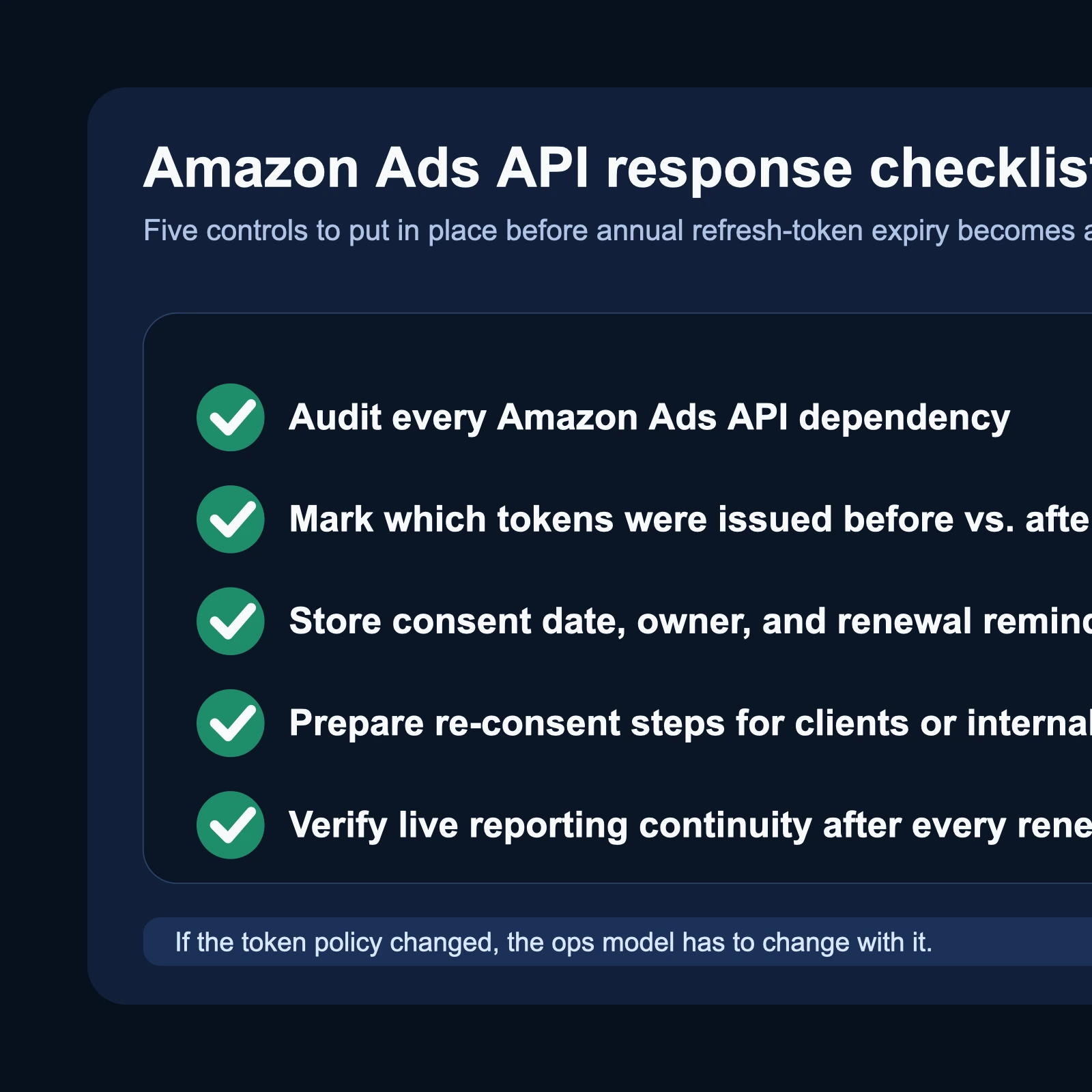
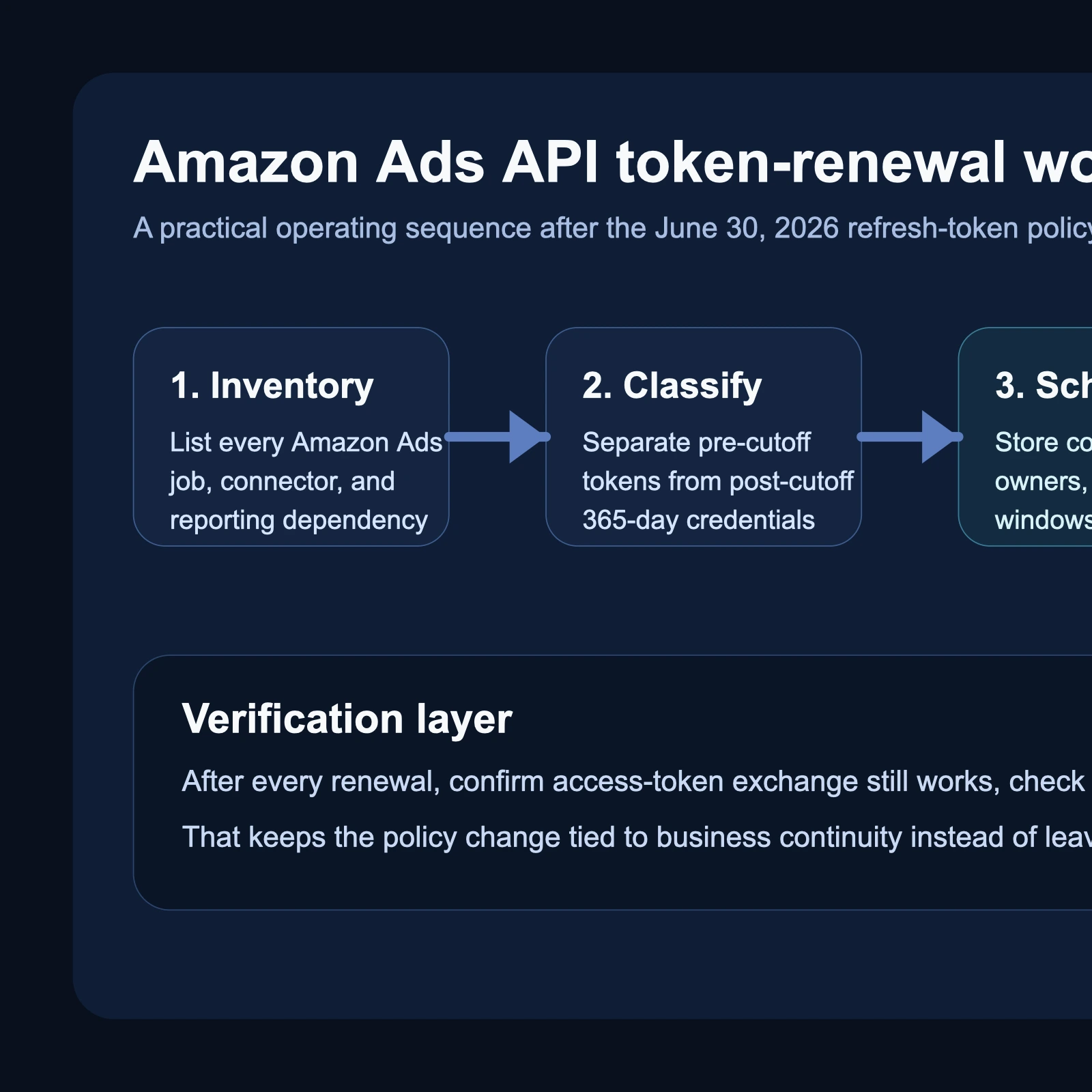
- Inventory every Amazon Ads API integration you own, including reporting jobs, pacing tools, warehouse syncs, and campaign-management automations.
- Identify which refresh tokens were issued before June 30, 2026 and which will be issued after that cutoff, because the lifecycle handling may differ.
- Add expiry metadata, owner fields, and reminder windows to your ops tracker so renewals happen before business reporting breaks.
- Build a re-consent workflow for clients or internal stakeholders who must approve access again, including escalation owners and backup contacts.
- Stress-test downstream dashboards and budget reviews so missing Amazon data triggers alerts instead of silently corrupting decision-making.
What remains uncertain
Amazon's public documentation establishes the policy but leaves a few operational questions open. It does not spell out every edge case around multi-user account ownership, bulk re-consent processes, or how many organizations will discover old undocumented tokens only when a renewal fails. It also does not publish a universal migration assistant for teams with fragmented agency-client ownership.
That uncertainty is exactly why the change matters now, on June 12, 2026, instead of next year. Expiring credentials are manageable when they are visible and scheduled. They become expensive when they are hidden inside reporting pipelines that leadership assumes are stable.