Google's June 10 adtech deadline puts DV360 Demand Gen rollouts and legacy API calls on the same clock
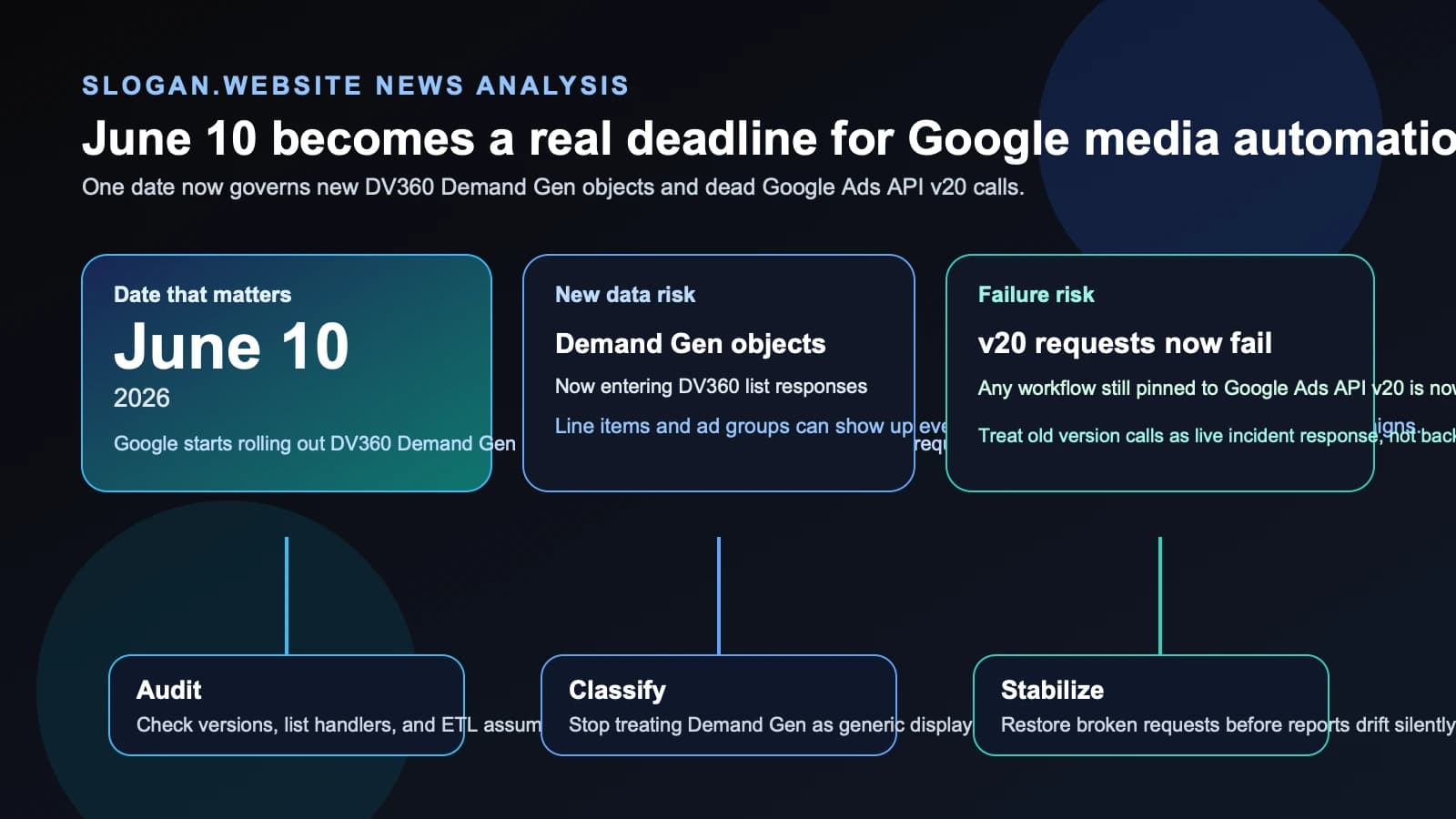
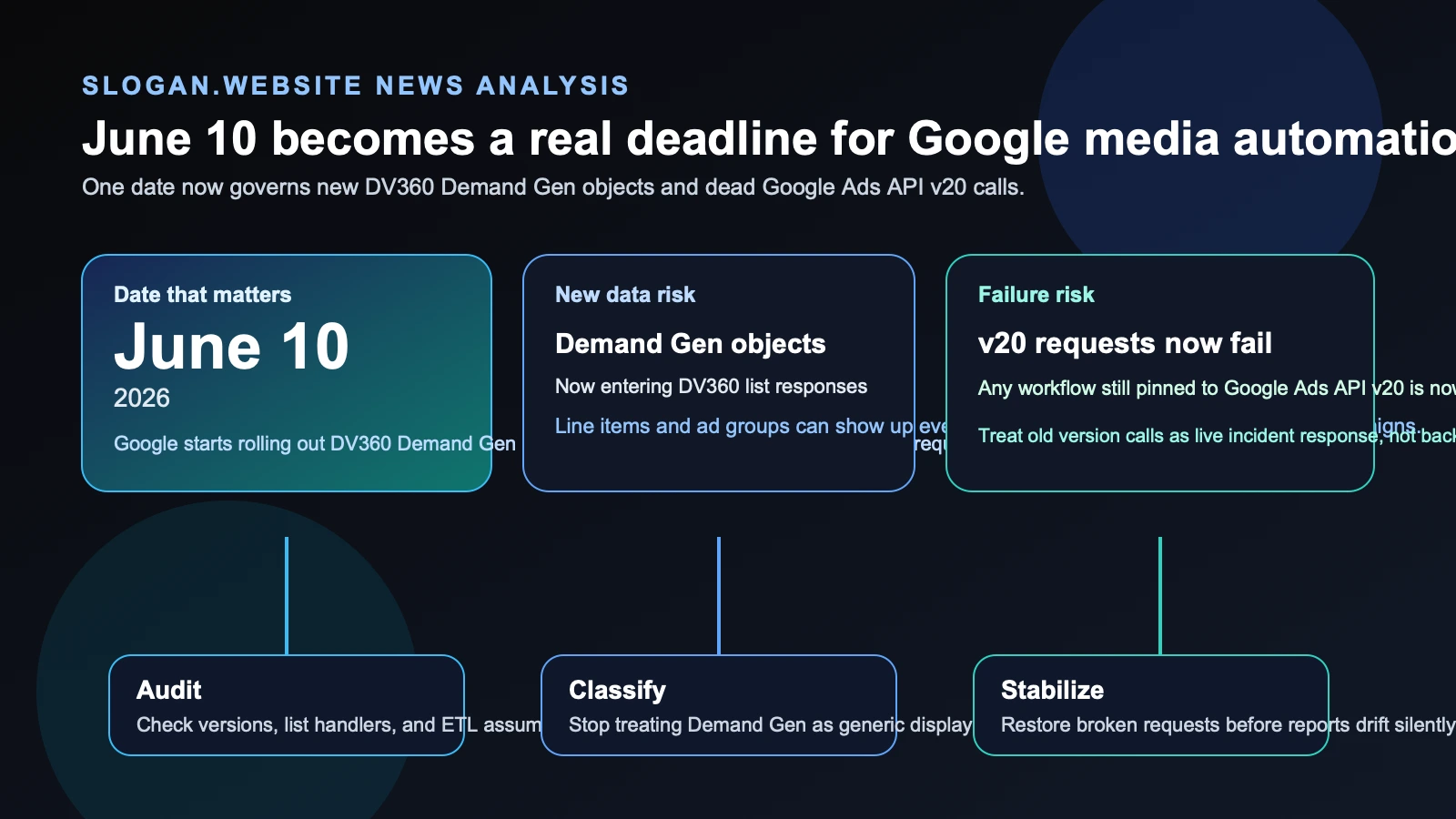
Google created a real operational deadline for advertising automation teams on June 10, 2026. Starting today, Google says Demand Gen resource support begins rolling out to all Display & Video 360 API partners, and the same day Google says the Google Ads API v20 sunset takes effect, meaning all v20 requests begin to fail. For agencies, SaaS vendors, internal growth engineering teams, and enterprise media operators, this is not a vague roadmap moment. It is a practical checkpoint: some integrations now need to become Demand Gen-aware, while others must stop calling a dead API version altogether.
The important nuance is that these are two different changes with one shared date. In Google's May 27 developer announcement, the company said Demand Gen support will roll out to Display & Video 360 partners over two weeks and reach all partners by June 24, 2026. Separately, in Google's April 29 sunset reminder, the company said API calls to v20 would start failing on June 10. Read together, the message is straightforward: media automation teams should treat today as a production-risk date, not a documentation update.
What changed
The first change is additive. Google's official Display & Video 360 API post says Demand Gen resources are starting to appear in API workflows from June 10 onward, with full rollout by June 24. Google specifically says integrations that use advertisers.lineItems.list and advertisers.adGroups.list need to handle additional Demand Gen line items and ad groups as partners are enabled. That matters because integrations can break even when teams are not actively creating new Demand Gen campaigns. A simple parser, filter, sync job, or reporting export can fail if it assumes only older resource types will appear in list responses.
The second change is subtractive. Google's Google Ads API v20 reminder says that starting today, all v20 requests fail. If any custom bidding workflow, reporting pipeline, QA monitor, or third-party connector still calls v20 services, that workflow is now in a broken state until it is migrated.
Google's developer documentation adds more detail about what Demand Gen support really means in practice. The official DV360 API overview says Demand Gen retrieval and management are in beta, that rollout to all partners begins on June 10 and finishes on June 24, and that teams need the right DV360 roles plus YouTube and Floodlight setup before serving campaigns. The companion line item guide says a Demand Gen line item can serve across YouTube, Discover, Gmail, and the Google Display Network, with budget, bid strategy, targeting, and demandGenSettings handled differently from legacy assumptions.
| June 10 change | Official source | Why operators should care |
|---|---|---|
| DV360 API Demand Gen support starts rolling out on June 10 and reaches all partners by June 24. | Google Ads Developer Blog, May 27, 2026 | Existing list-based integrations may need to handle new resource types before teams create any new campaigns. |
Demand Gen resources will be included in advertisers.lineItems.list and advertisers.adGroups.list responses. | Google Ads Developer Blog, May 27, 2026 | Reporting, sync, QA, and middleware jobs can break if schemas are too rigid. |
| Google Ads API v20 sunsets on June 10 and all v20 requests begin to fail. | Google Ads Developer Blog, April 29, 2026 | Any workflow still pinned to v20 now has an immediate outage risk. |
| Demand Gen line items can run across YouTube, Discover, Gmail, and the Google Display Network. | Google for Developers guide | Creative, targeting, and workflow assumptions need to match a broader cross-surface campaign type. |
| Demand Gen rollout is still beta and depends on roles plus DV360 setup such as Floodlight optimization. | Google for Developers overview | Not every partner can treat this as instant production access without setup and governance checks. |
Why it matters
This matters because adtech automation rarely fails in glamorous ways. It fails through small assumptions: enum lists that are too narrow, ETL jobs that reject unfamiliar objects, dashboards that silently omit new resource classes, or middleware that is still pinned to an older API version because "nothing has broken yet." On June 10, that logic stops being safe.
It also matters because Demand Gen is no longer only a UI workflow story. Slogan.website has already covered the broader Google Display Ads move into Demand Gen. The new deadline changes the operational layer beneath that strategy. Once Demand Gen resources are visible in the API, agencies, in-house media teams, and martech vendors need their campaign systems, approval workflows, budget controls, and reporting logic to understand those objects properly.
For companies in the United States, Canada, the United Kingdom, Australia, and Europe running regional Google media at scale, the risk is not just a developer inconvenience. It is campaign execution drift. If your reporting layer cannot classify new line items correctly, your budget reviews, QA alerts, or performance summaries can become unreliable exactly when campaign types are changing.
That is why this story connects naturally to Slogan.website tools such as the Marketing ROI Calculator, the Digital Marketing Budget Planner, and the GEO Visibility Checklist. Better automation is only useful if the business layer above it can still explain spend, outcomes, and workflow ownership clearly.
Who is affected
The first group is agencies and consultants that run custom reporting, QA, pacing, or campaign-sync layers on top of Google media accounts.
The second group is software vendors and internal platform teams that embed Google Ads or DV360 operations inside their own product experience.
The third group is enterprise media and measurement teams that rely on downstream data warehouses, finance reviews, or executive dashboards built from API-fed campaign objects.
Smaller advertisers may be less exposed, but they are not exempt. If a lean team depends on a script, connector, or external tool that still calls v20 or assumes older DV360 object patterns, the failure can still be real even if the stack is simpler.
What to do next
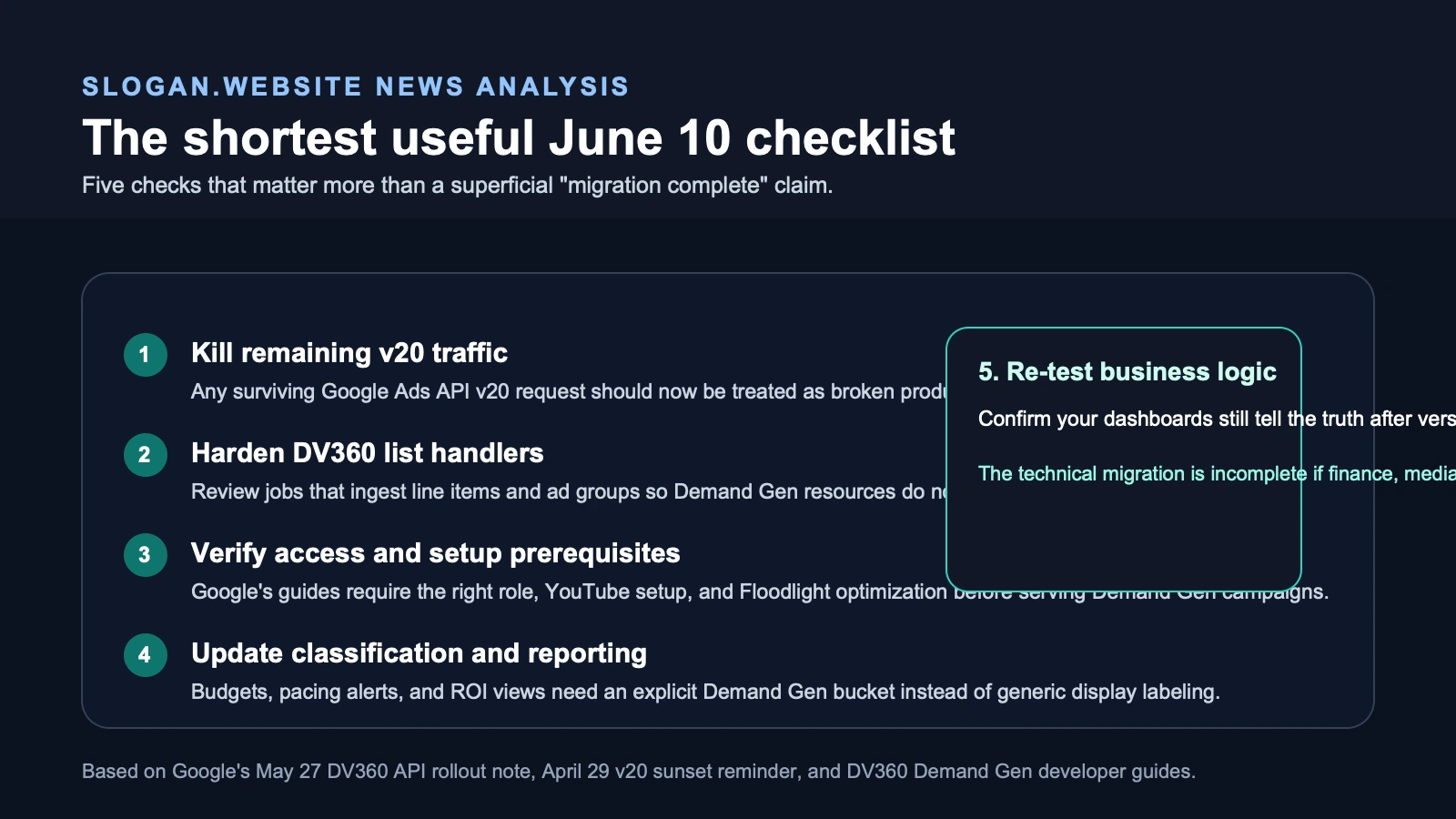
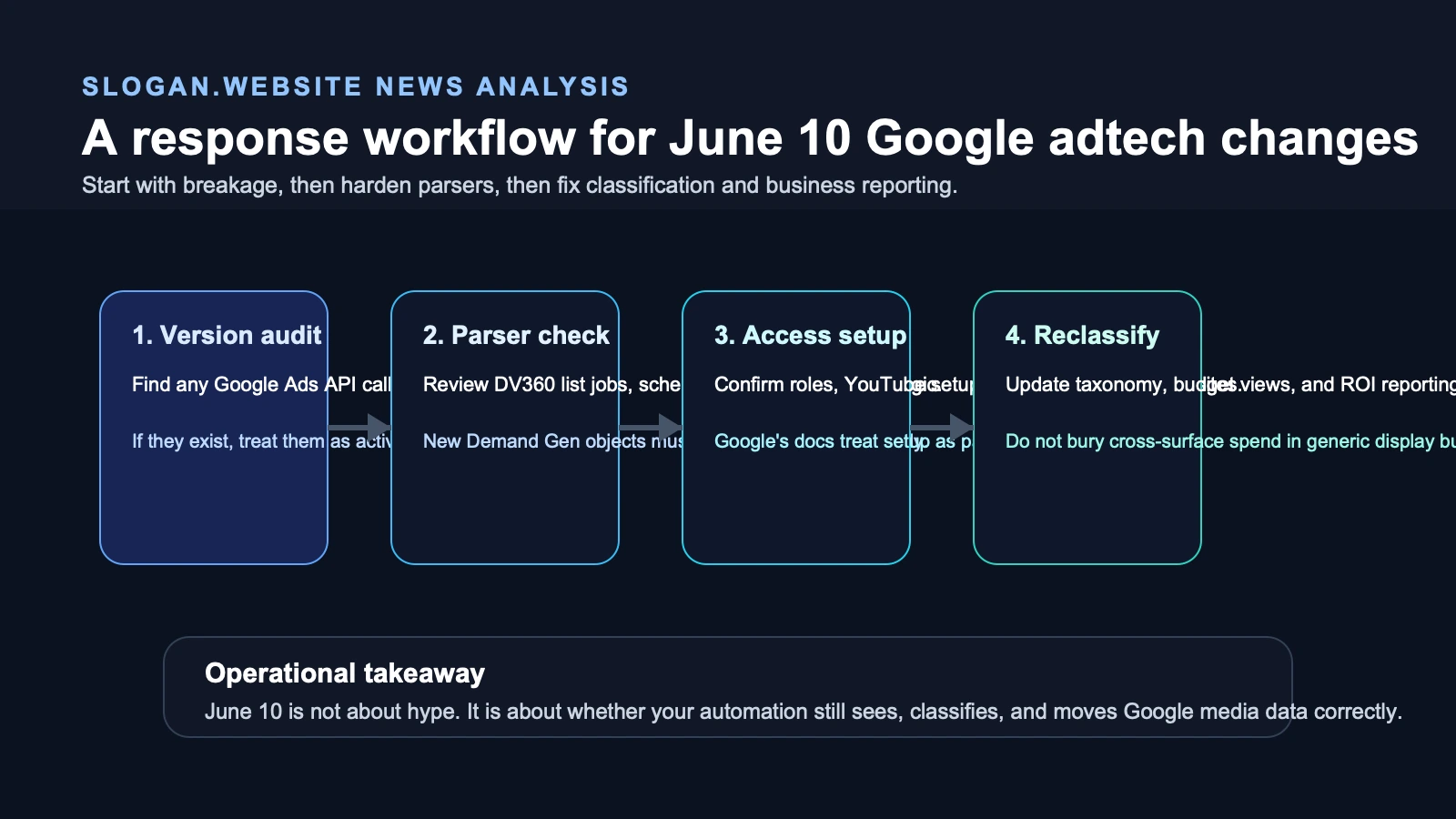
- Audit every Google Ads API integration and confirm whether any calls still reference
v20; if they do, treat that as an active incident, not a future migration task. - Review any DV360 job that consumes
advertisers.lineItems.listoradvertisers.adGroups.listresponses and confirm it can tolerate Demand Gen resource types without crashing or silently dropping them. - Check whether your team has the required DV360 roles and setup, because Google's official overview says Demand Gen serving depends on user role, YouTube setup, and Floodlight optimization.
- Update your campaign taxonomy and reporting labels so Demand Gen is classified intentionally instead of getting lumped into generic display buckets.
- Rework budget and outcome reviews in tools like the Digital Marketing Budget Planner and Marketing ROI Calculator so cross-surface Demand Gen spend is measured on purpose.
What remains uncertain
Google's own materials leave some boundaries open. The DV360 rollout is phased through June 24, so not every partner will see the same behavior on the same day. Google's public documentation also does not promise identical UI, API, and partner readiness across every market or account structure. And while the company says Demand Gen support is rolling out broadly, the developer guides still describe the feature as beta.
So the safest conclusion on June 10, 2026 is not that every team must launch Demand Gen immediately. It is that every serious Google media automation team should verify whether today's date changes what their systems receive, what their APIs can still call, and whether their reporting still tells the truth.