LinkedIn says ad exposure is lifting search, content, and pipeline conversion across B2B journeys
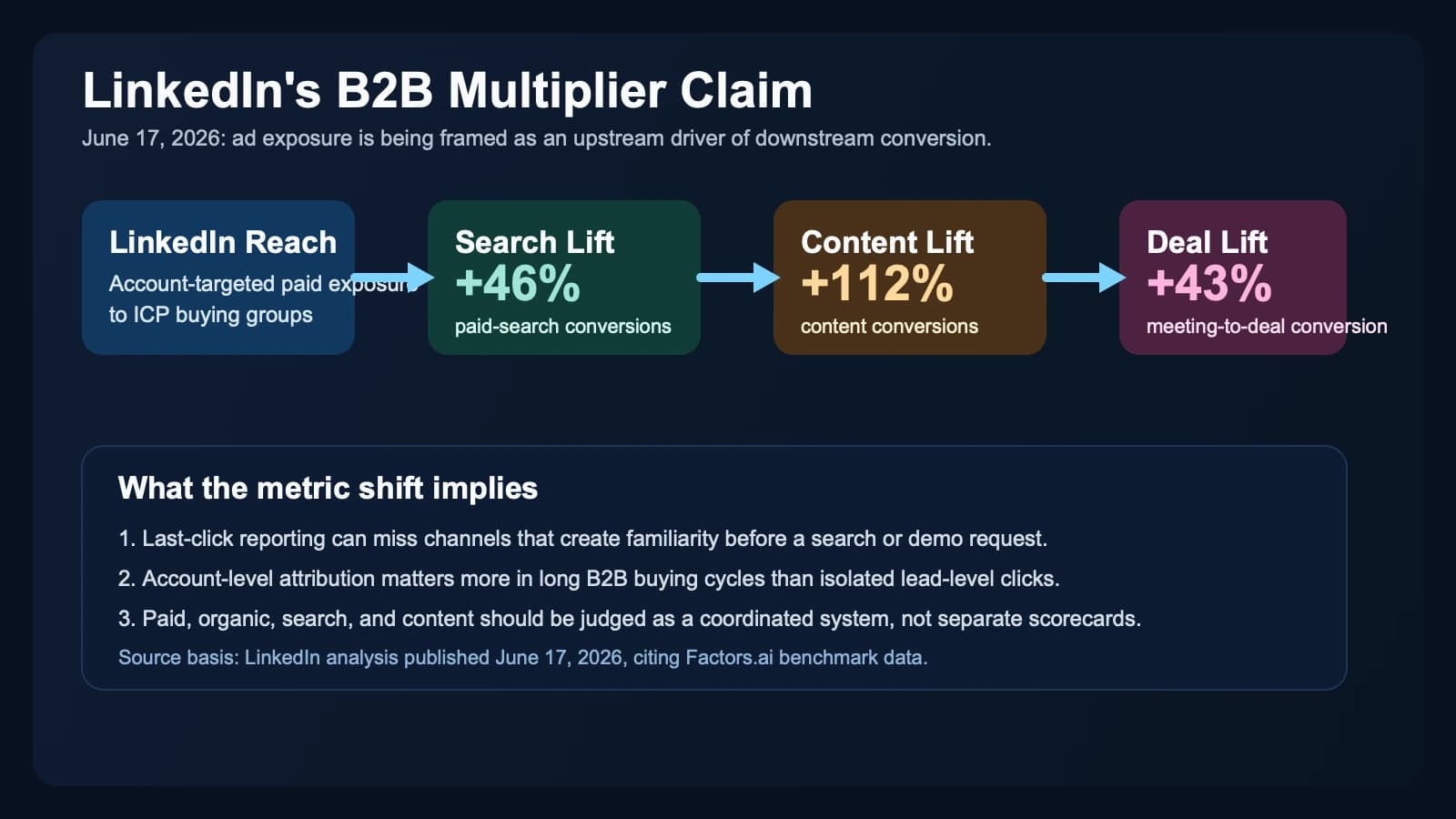
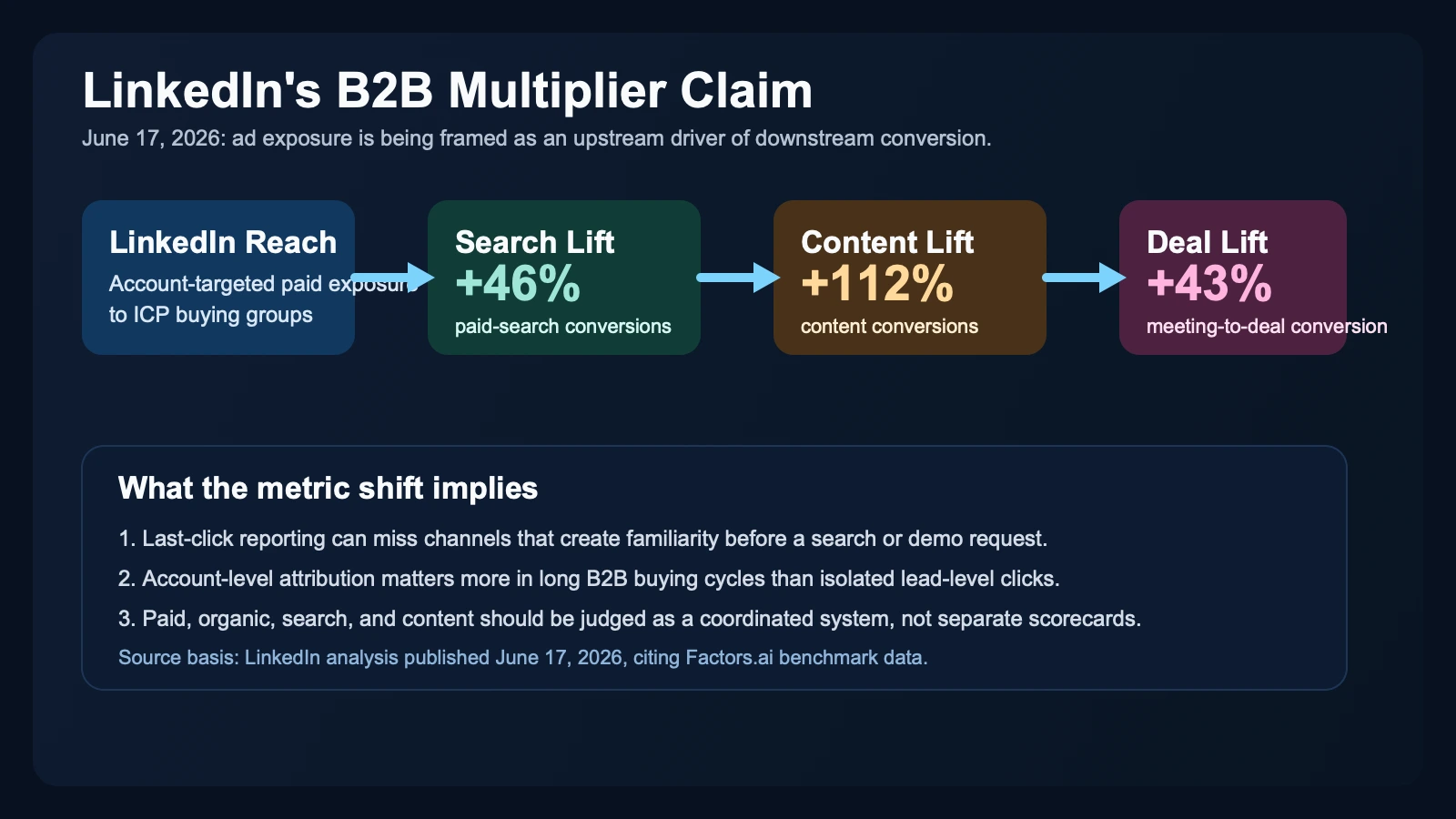
LinkedIn is making a more concrete case for why B2B teams should stop judging paid social as a last-click channel. In its June 17, 2026 analysis, LinkedIn says exposure to LinkedIn ads had a measurable multiplier effect in a Factors.ai benchmark study: when ideal customer profile accounts saw a LinkedIn ad, paid search conversions increased 46%, meeting-to-deal conversions increased 43%, and content marketing conversions increased 112%. For U.S., Canadian, U.K., Australian, and European B2B operators, the practical shift is not “spend more on LinkedIn.” It is “measure how LinkedIn changes what happens later in search, content, and revenue workflows.”
That argument matters because the same LinkedIn article also says 14.3% of paid-search leads originally began their journey on LinkedIn, citing the Factors.ai benchmark report. If that holds inside your funnel, then a team optimizing only around the last ad click will under-credit the channels that create familiarity before a search, form fill, or sales conversation ever happens.
What changed
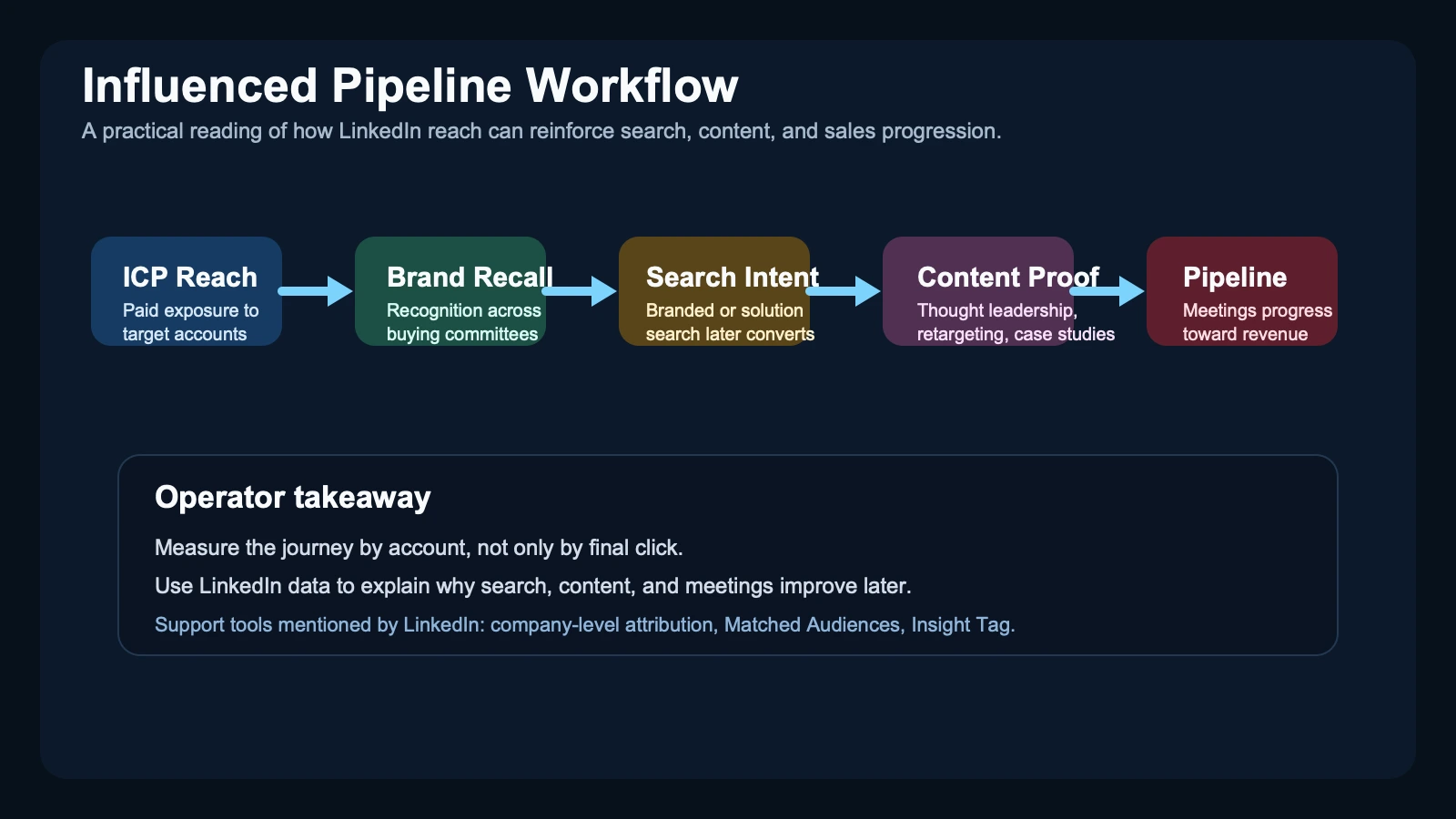
The new piece from LinkedIn packages several ideas into one more actionable framework. First, it points to the Factors.ai LinkedIn benchmark report, which LinkedIn says found stronger downstream conversion when ICP accounts had LinkedIn ad exposure earlier in the journey. Second, LinkedIn ties that to an influenced-pipeline model rather than a narrow click model. Third, it connects that logic to workflow capabilities already inside the LinkedIn ecosystem, including company-level attribution and analytics through LinkedIn Marketing Partners, Matched Audiences, and the Insight Tag.
There is also a second research layer behind the article. LinkedIn cites Fibbler's report, Why Influenced Pipeline Is the Future of LinkedIn Ads Measurement, which says it analyzed more than $100 million of LinkedIn ad spend across 300 SMB SaaS companies. LinkedIn's own June 17 post says the compounding effect gets clearer when teams reach the right accounts consistently enough for later organic and paid touchpoints to convert more efficiently.
| Confirmed June 2026 signal | Source | Why it matters |
|---|---|---|
| LinkedIn says paid-search conversions rose 46% when ICP accounts had LinkedIn ad exposure. | LinkedIn analysis, June 17, 2026 | Search demand may be partially created upstream rather than captured only at query time. |
| LinkedIn says meeting-to-deal conversion rose 43% and content marketing conversion rose 112%. | LinkedIn analysis, June 17, 2026 | Upper-funnel paid reach can change mid-funnel efficiency, not just awareness metrics. |
| LinkedIn says 14.3% of paid-search leads originally began on LinkedIn. | LinkedIn analysis citing Factors.ai | Last-click search reporting can miss meaningful earlier channel influence. |
| LinkedIn Marketing Partners can now integrate company-level engagement insights from paid and organic LinkedIn touchpoints. | LinkedIn partner announcement | Measurement can move from lead-level anecdotes to account-level buying-group behavior. |
| Fibbler says it analyzed more than $100 million in LinkedIn ad spend across 300 SMB SaaS companies. | Fibbler Labs report page | The influenced-pipeline argument is being framed with a broader dataset than a single case study. |
Why it matters
The main implication is measurement discipline. Many B2B teams still separate brand, paid social, paid search, outbound, and content into channel scorecards that rarely explain how one touchpoint increases the yield of another. LinkedIn's June 17 position is that this siloed reading no longer matches how buying committees actually move. A person may see an ad on LinkedIn, encounter supporting thought leadership later, search the vendor by name, click a paid search result, and only then convert. If finance only credits the last query, the team will keep underinvesting in the channels that helped create the shortlist.
That lines up with LinkedIn's broader June research direction. The recent Buyability analysis with Bain argued that B2B deals are won by vendors that feel safer to approve across hidden buyers, not only by vendors with the sharpest feature pitch. Read together, the message is consistent: visibility and familiarity across the buying group shape later conversion efficiency.
For Slogan.website readers, this is where paid media, GEO, and brand visibility stop being separate conversations. If your content, search presence, and LinkedIn programs are supposed to reinforce one another, you need a workflow that checks whether your brand is visible before the click, not only profitable after it. That is why this story connects naturally to the GEO Visibility Checklist, the guide on how to track and measure brand mentions and visibility, the Marketing ROI Calculator, and the Digital Marketing Budget Planner.
Who is affected
The first group is B2B software and services teams with long sales cycles, especially those already splitting budgets between paid search, LinkedIn, outbound, and content.
The second group is agencies and RevOps teams that need to defend why brand and account-reach spend should stay funded even when direct form-fill comparisons make search look cleaner.
The third group is smaller growth teams that have enough CRM and attribution discipline to test whether account-level influence changes win rates, not just click-through rates.
What to do next
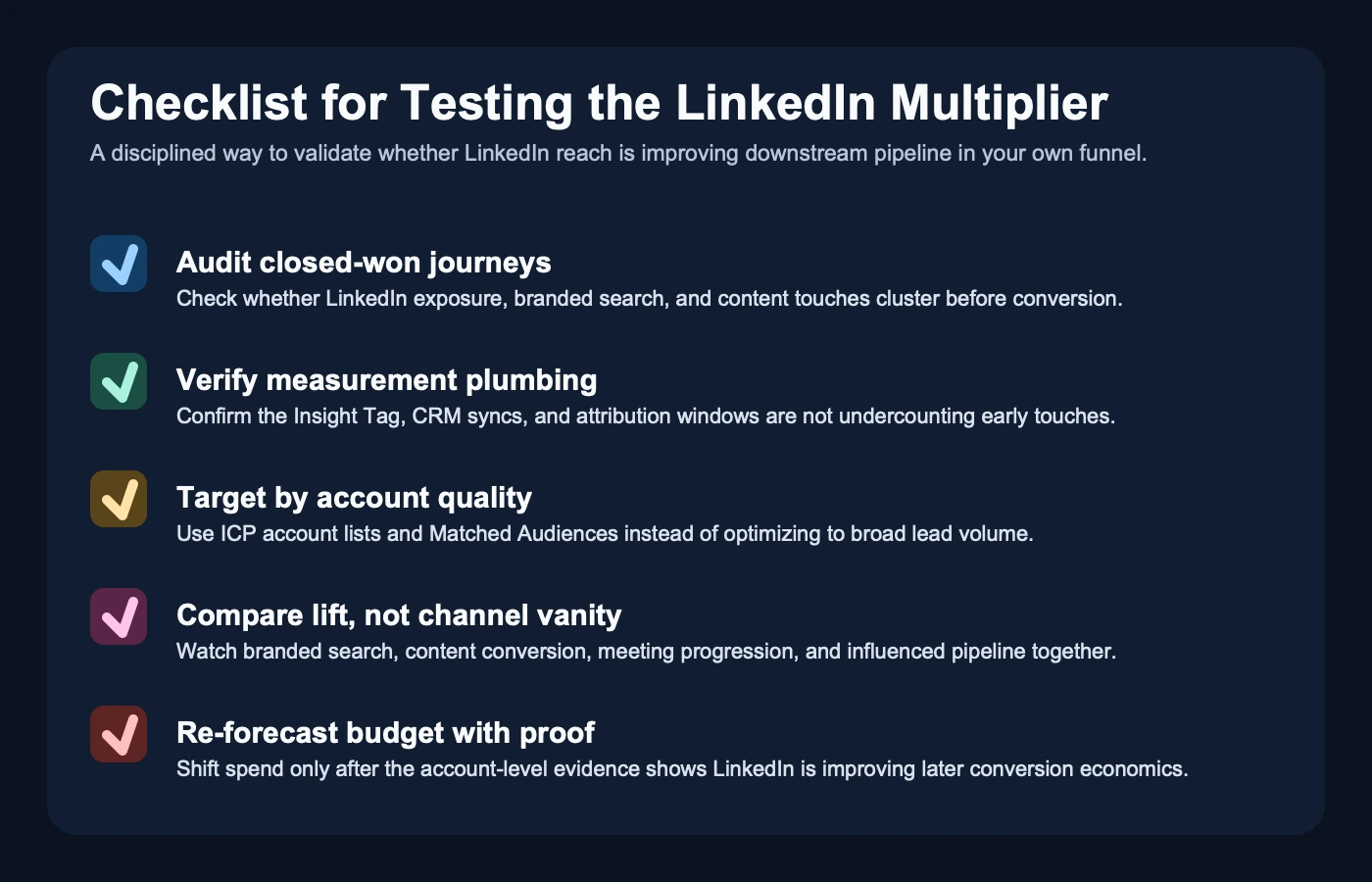
- Map your last 20 to 50 closed-won or late-stage accounts and check whether LinkedIn ad exposure, branded search, and content engagement tend to appear in the same journeys.
- Install or verify the LinkedIn Insight Tag and make sure retargeting and conversion tracking are not partially broken.
- Use Matched Audiences and account lists to keep buying-committee coverage aligned with your ICP instead of optimizing to generic lead volume.
- Pressure-test whether search is harvesting demand that another channel created by comparing branded-search lifts and meeting progression after LinkedIn reach increases.
- Model budget decisions in the Digital Marketing Budget Planner and validate revenue assumptions in the Marketing ROI Calculator before shifting spend.
What remains uncertain
Important limits remain. LinkedIn's June 17 article is persuasive, but the benchmark figures come through partner research rather than a fully disclosed methodology page inside the LinkedIn post itself. The public materials do not spell out how the benchmark normalizes for creative quality, sales-team differences, region, or category mix. They also do not tell marketers exactly how much spend is needed before the multiplier effect becomes reliable.
So the disciplined conclusion is narrower than the headline: LinkedIn has surfaced a credible account-level measurement argument, and it has tied that argument to official LinkedIn tooling and partner integrations that make better attribution possible. But each team still needs to validate the pattern inside its own pipeline before treating LinkedIn as a universal search-and-revenue multiplier.