LinkedIn adds paid advice sessions and mobile post boosting for small-business operators
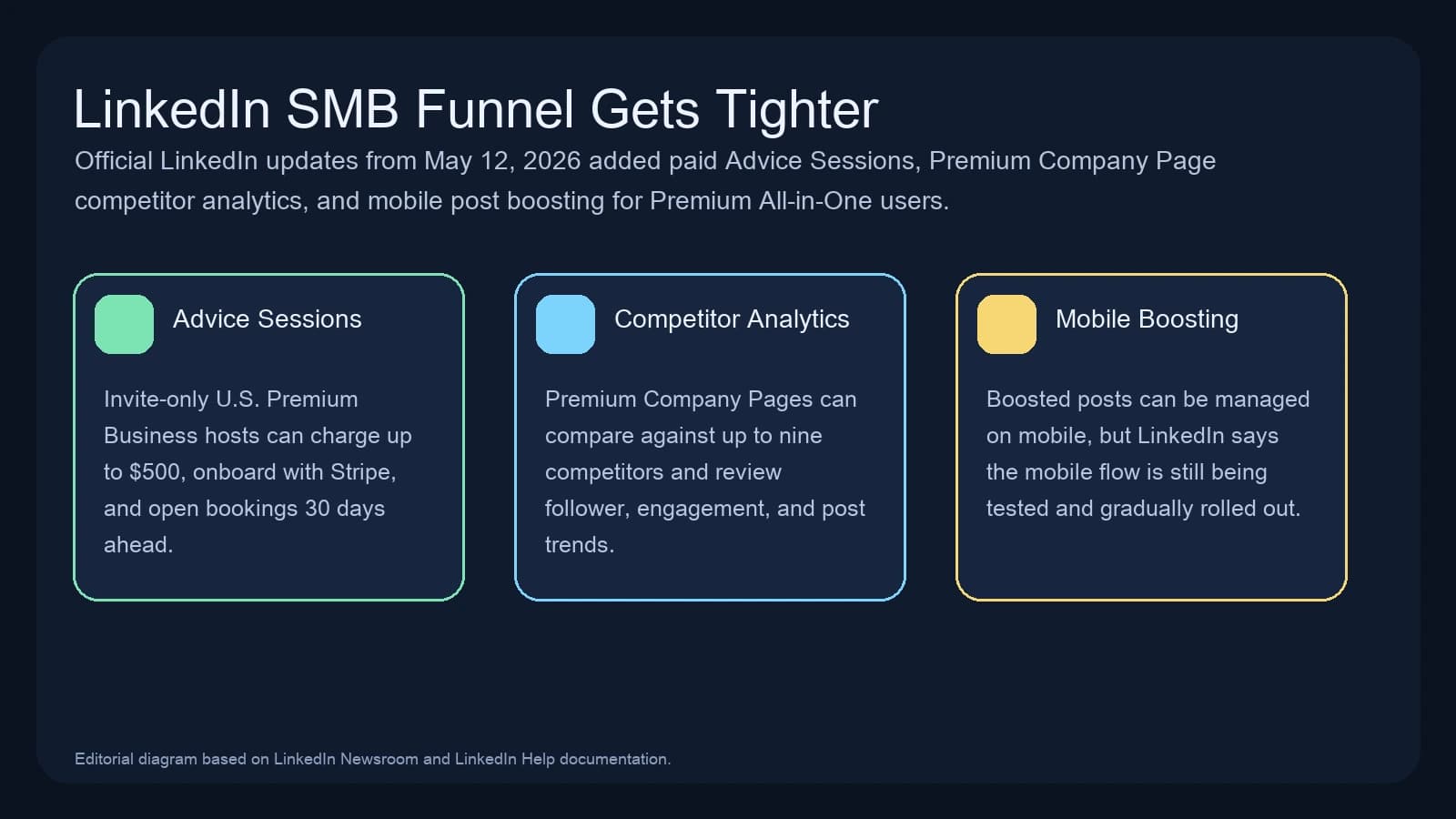
On May 12, 2026, LinkedIn said it is expanding its small-business product stack with three concrete operator moves: paid Advice Sessions from profiles, deeper competitor analytics for Premium Company Pages, and mobile post boosting for Premium All-in-One users. For consultants, agencies, founders, and lean B2B teams, this is more than a broad "SMB support" message. LinkedIn is trying to turn one platform into a tighter loop for discovery, lead capture, paid promotion, and benchmarking.
The update builds on LinkedIn's Premium All-in-One launch from February 12, 2026, which bundled selling, marketing, and hiring workflows into one subscription. What changed in May is that the package became more operational. The product now offers a clearer path from being discovered, to promoting content, to monetizing expertise directly from a profile, with additional signals for how a company page is performing against competitors.
What changed
LinkedIn's May 12 announcement says Premium Business subscribers in the United States can start getting paid for one-to-one expertise through Advice Sessions, while Premium All-in-One users are getting mobile post boosting and Premium Company Page subscribers are getting expanded competitor analytics.
The operational limits matter as much as the launch itself. LinkedIn's Help documentation for Advice Sessions says hosting is currently limited to invited Premium Business subscribers in the United States, bookers also need to be in the United States, hosts must complete Stripe onboarding, can set a price of up to $500, and can open booking windows up to 30 days ahead. LinkedIn's competitor analytics help page says Premium Company Page admins can track metrics across up to nine competitors and review follower, engagement, and trending-post comparisons. Its boosting help pages and setup guide say member boosting can happen on desktop or mobile, but mobile boosting is still in testing and gradually rolling out.
| Feature | Confirmed detail | Official source | Why operators should care |
|---|---|---|---|
| Advice Sessions | Available to invited Premium Business subscribers in the United States; hosts can charge up to $500 and use Stripe onboarding | LinkedIn Help | Turns a personal profile into a direct revenue path for consultants, experts, and service businesses. |
| Mobile post boosting | Boosting is available on desktop and mobile, but mobile boosting is still in testing and gradually rolling out | LinkedIn Help | Founders and solo operators can promote posts without switching into a desktop ad workflow. |
| Competitor Analytics | Premium Company Page admins can compare against up to nine competitors and see trending competitor posts | LinkedIn Help | Small teams gain lightweight competitive intelligence without buying a separate social-monitoring stack first. |
| Premium All-in-One | LinkedIn says subscribers are seeing a 57% rise in followers and a 40% increase in profile views | LinkedIn newsroom | Shows how LinkedIn is packaging brand growth, prospecting, and promotion as one operating system for SMBs. |
Why it matters
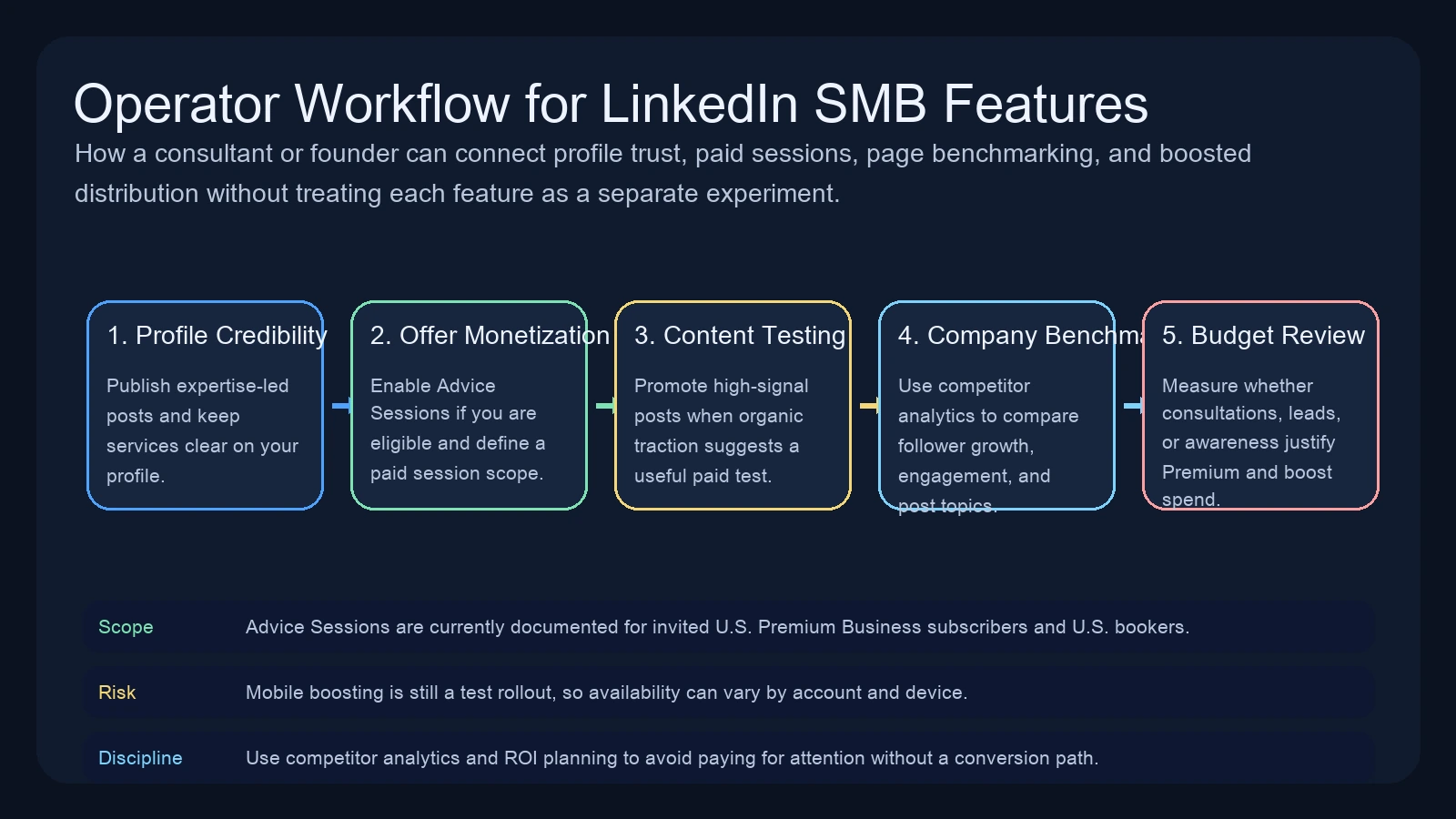
The important shift is workflow compression. Small businesses usually split lead generation, content promotion, calendar booking, and competitor tracking across separate tools. LinkedIn is clearly trying to reduce that sprawl. If a consultant, fractional CMO, recruiter, or niche B2B founder already builds audience on LinkedIn, Advice Sessions means discovery can convert into a paid consultation without forcing the buyer into another booking flow first.
That matters most in the United States right now because the current Help documentation limits Advice Sessions hosts and bookers to the U.S. But the signal is broader for teams in Canada, the United Kingdom, Australia, and Europe: LinkedIn is moving closer to a first-party operating layer where attention, trust, promotion, and monetization sit inside one platform. Even where the exact feature set is not yet broadly available, the strategic direction is now visible.
The second reason this matters is measurement discipline. A boosted post is still an ad, and LinkedIn's own FAQ says boosted-post analytics separate paid and organic performance. That gives smaller teams a cleaner testing path than vague "post more on social" advice, but only if they define what success means before spending. Slogan.website's Marketing ROI Calculator, Digital Marketing Budget Planner, and small-business AI marketing strategy guide are useful for deciding whether a boosted founder post should be treated as lead generation, brand visibility, or both.
Who is affected
The most obvious winners are independent consultants, agencies, coaches, recruiters, and founder-led service businesses that already use LinkedIn as a discovery channel. Advice Sessions gives them a native way to test paid expertise without building a separate funnel from scratch.
Marketing managers at smaller B2B companies are affected too. Competitor Analytics can help answer basic but important questions: who is gaining followers, what content themes are traveling, and whether your page is actually improving relative to nearby rivals. For teams that do not yet need a full social intelligence platform, that can be enough to shape content planning.
Lean operators are also the audience for mobile boosting. If your workflow lives between meetings, travel, and client calls, the ability to boost from mobile lowers execution friction. That does not guarantee good results, but it does shorten the path from "this post is working" to "let's test paid distribution."
What to do next
Use the release as a process prompt, not just a feature announcement.
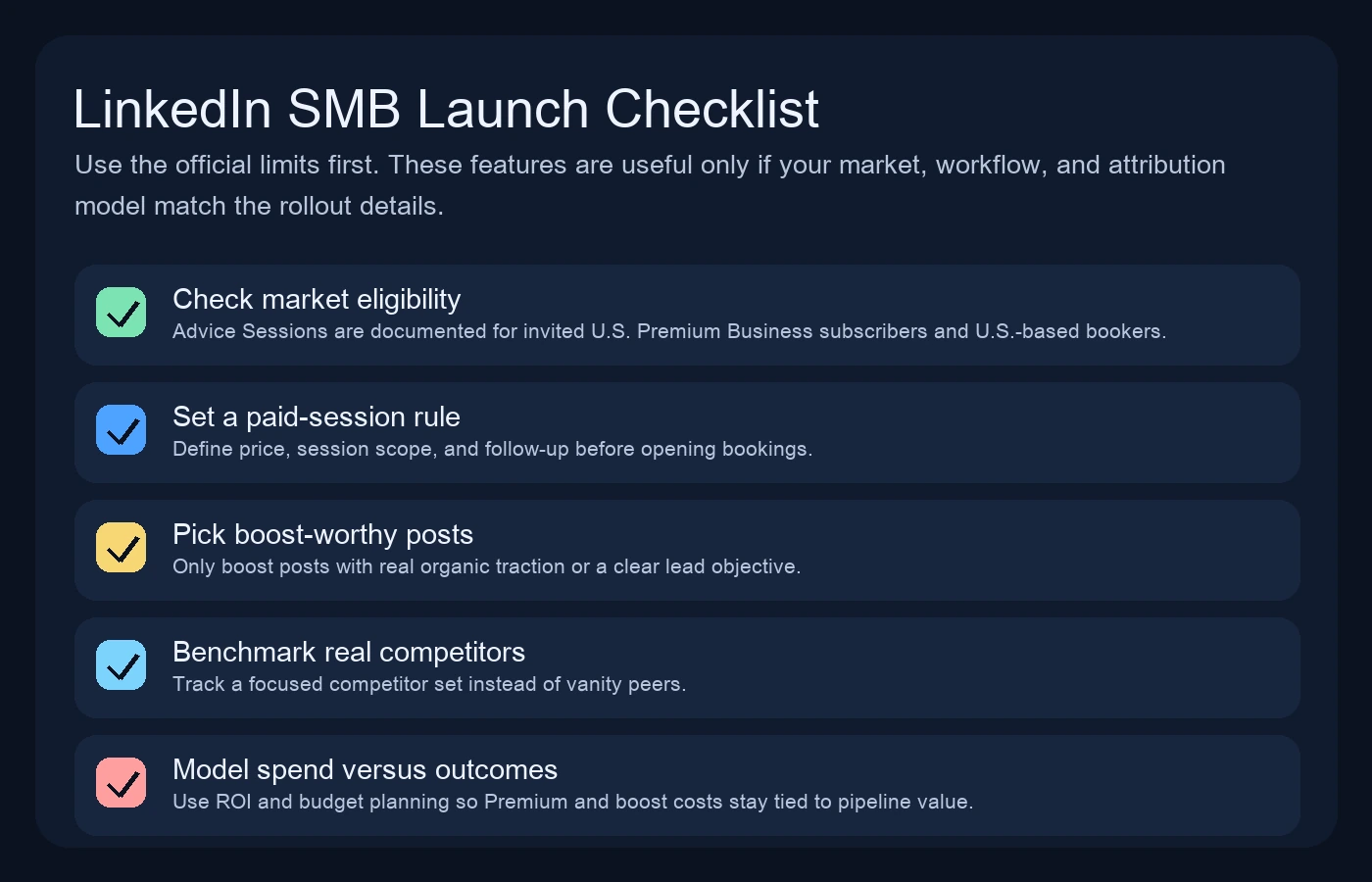
- If your business depends on expertise-led selling, check whether Advice Sessions eligibility and U.S. availability align with your current client market.
- Define a simple boosted-post testing rule: which posts qualify, what budget ceiling you will allow, and whether the goal is leads, profile visits, or audience growth.
- Benchmark your page against a realistic competitor set before changing content strategy. LinkedIn's Premium Company Page analytics are more useful when they guide message and offer decisions, not vanity comparisons.
- Connect your LinkedIn activity to a broader visibility workflow using the brand mentions measurement guide and your own CRM or attribution notes.
- Model how much a consultation, discovery call, or qualified lead is worth before treating boosts or Premium subscriptions as obvious wins.
What remains uncertain
Several important limits remain as of June 2, 2026. LinkedIn's Help pages still describe Advice Sessions as limited to invited Premium Business subscribers in the United States, and mobile boosting as a gradually released test experience. LinkedIn has not published broad benchmark data showing whether boosted founder content outperforms equivalent spend through Campaign Manager or other self-serve social channels for cost per qualified lead.
There is also a platform-governance question. The more LinkedIn becomes the place where a small business gets discovered, promotes content, books sessions, and benchmarks competitors, the more dependent that business becomes on one network's pricing, rollout logic, and policy changes. That does not make the update unimportant. It means operators should treat this as a useful new funnel layer, not as a replacement for owned audience, CRM hygiene, or independent measurement.
The practical takeaway is clear: LinkedIn is no longer just giving small businesses more profile polish. It is assembling a tighter revenue-and-distribution loop. For U.S.-based operators that already sell through trust and expertise, that is real news worth testing now.