Meta expands Business Agent across WhatsApp, Messenger and Instagram
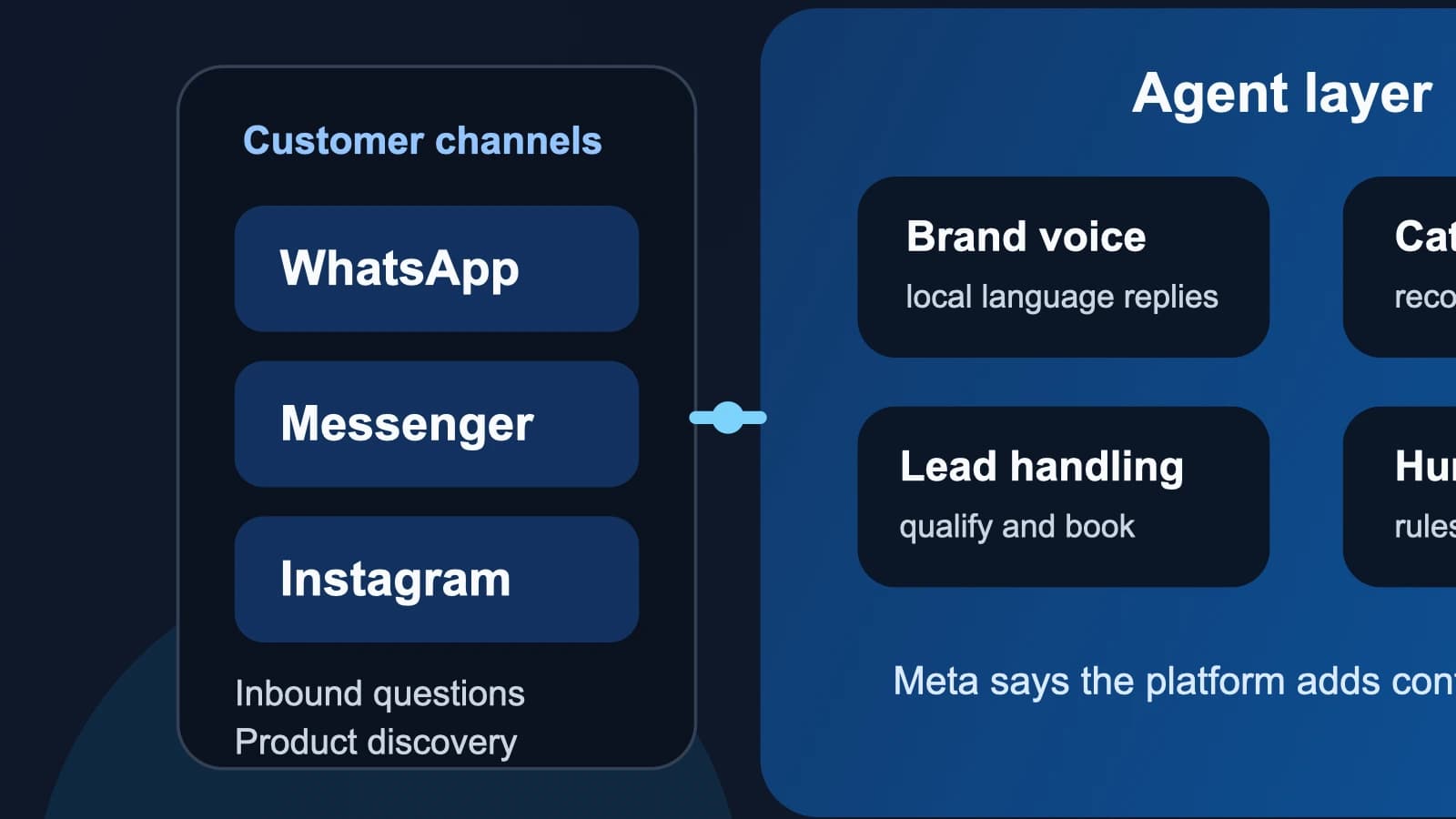
Meta said on June 3, 2026 that it is expanding Meta Business Agent globally for businesses of all sizes across WhatsApp, Messenger, and now Instagram. The direct operational change is that messaging, lead qualification, catalog recommendations, appointment booking, and human handoff are being bundled into one agent layer inside channels where customers already contact businesses every day.
That matters because Meta is not pitching this as a narrow chatbot feature. In the same June 3 product announcement, the company said more than one million businesses are already using a Meta Business Agent on WhatsApp and Messenger, and updated the messaging scale claim at 1:40PM PT on June 3, 2026 to say there are more than one billion active threads with businesses on WhatsApp, Messenger and Instagram every day. For marketers, ecommerce teams, and service operators, the signal is that conversational commerce is moving closer to being an always-on operating system instead of a channel-specific experiment.
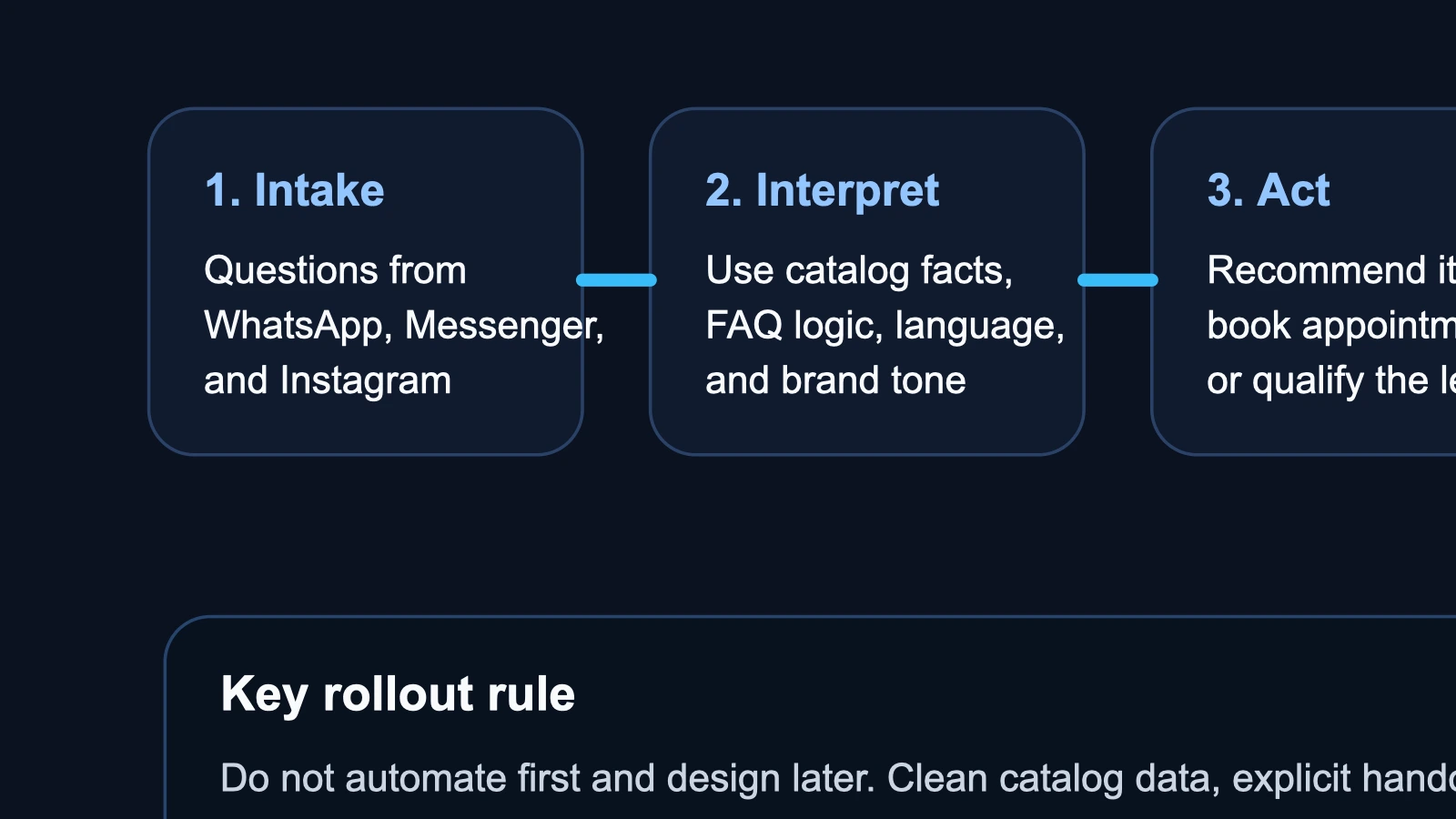
What changed
Meta's official launch post makes five concrete claims that operators should pay attention to.
| Confirmed point | Official source | Why it matters operationally |
|---|---|---|
| Meta is expanding Business Agent globally to businesses of all sizes | Meta product announcement, June 3, 2026 | Small and mid-market teams can treat this as a real rollout signal, not only an enterprise preview. |
| The agent can answer business-specific questions, recommend products, book appointments, qualify leads, and close sales | Meta product announcement, June 3, 2026 | Messaging moves closer to revenue and service execution, not just FAQ automation. |
| Meta is expanding the product to Instagram and says getting started is free before paid subscriptions arrive in coming months | Meta product announcement, June 3, 2026 | Instagram-heavy brands may get a low-friction entry point, but future cost structure is still unsettled. |
| Meta Business Agent Platform connects to hundreds of systems such as Shopify, Zendesk, and Shopee with built-in controls and measurement | Meta product announcement, June 3, 2026 | The product is being positioned as governed infrastructure, not a standalone assistant. |
| WhatsApp Business Platform supports conversational flows, dynamic product lists, rich media, CRM connections, and scale messaging APIs | WhatsApp Business Platform and Business Platform features | Meta already has the commercial plumbing needed to turn agent replies into actual commerce and support workflows. |
The most important product design choice is not the AI label. It is the combination of customer-facing replies and business-facing coordination. Meta says the agent can respond in a company's tone and local language, while also delivering a morning briefing about overnight chats and conversation insights. That means the system is being framed as both a frontline responder and a workflow layer for the team behind it.
Why it matters
For operators in the United States, Canada, the United Kingdom, Australia, and Europe, this launch changes the practical threshold for conversational commerce. A lot of brands still treat WhatsApp, Messenger, and Instagram as separate message queues that require different staff habits, different response times, and different measurement logic. Meta is trying to collapse that fragmentation into one managed layer.
The immediate upside is speed. If a business can answer product questions, recommend from a catalog, route leads, and escalate only the exceptions, it can protect revenue outside staffed hours and reduce the amount of low-value manual reply work during staffed hours. The WhatsApp Business Platform already supports interactive calls to action, dynamic product lists, and two-way conversations across the buyer journey, while the features documentation makes clear that businesses can combine customer-initiated conversations with business-initiated outreach after opt-in. Meta Business Agent sits on top of a stack that already knows how to sell, support, and re-engage.
The bigger implication is organizational. Messaging teams, paid social teams, lifecycle marketers, and customer support leads often optimize different metrics even when they are touching the same buyer. Meta is effectively arguing that one agent layer can connect those moments. That aligns with the broader shift already visible across Slogan.website's own resources: use the Marketing ROI Calculator, the Digital Marketing Budget Planner, and the guide to small-business attribution and CRM workflow to judge whether faster messaging actually improves qualified revenue and service economics, not just response time.
Who is affected
The first group affected is small and midsize businesses already using WhatsApp, Messenger, or Instagram as inbound support and sales channels. Meta explicitly says the product can be set up in minutes and that the rollout is global, which lowers the experimentation barrier.
The second group is ecommerce and retail operators with structured catalogs. Meta says the agent can recommend products from a business catalog, and that matters most when product selection, availability, and purchase guidance are frequent pre-sale friction points.
The third group is enterprise messaging, CRM, and service teams. The new Meta Business Agent waitlist page describes the product as an agent for WhatsApp, Messenger, and Instagram that handles customer conversations around the clock and delivers insights back to the business. Combined with Meta's platform claim about integrations and controls, that makes this relevant for teams deciding whether messaging automation belongs inside the CRM stack, the support stack, or both.
What to do next
Use this rollout as a workflow audit, not just a feature tour.
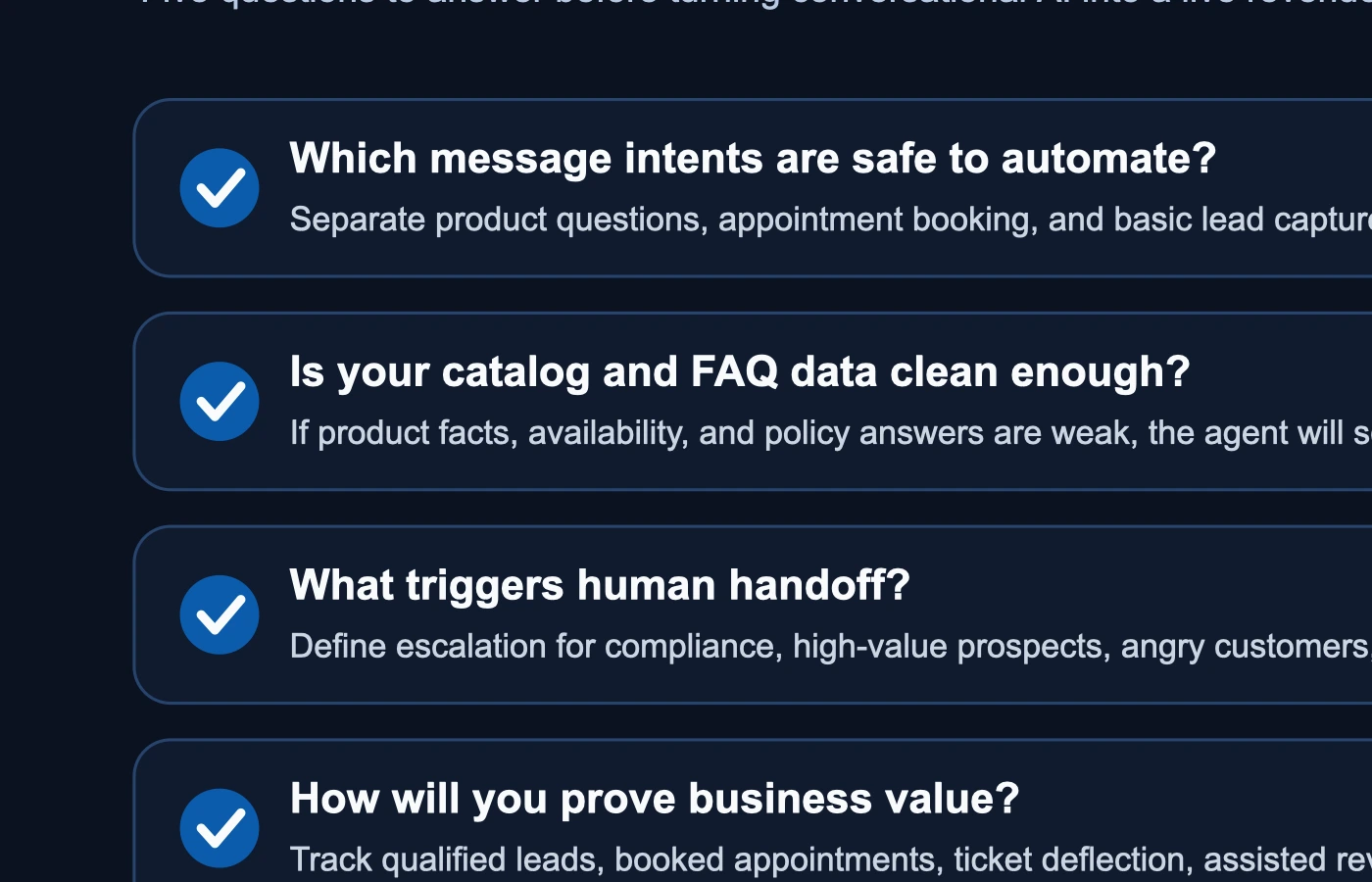
- List the top five message intents your team handles repeatedly across WhatsApp, Messenger, and Instagram.
- Separate intents that are safe for automation from intents that need human review, refunds, policy judgment, or sensitive account access.
- Audit your product catalog, FAQ answers, appointment logic, and lead-routing rules before exposing them through an agent.
- Define the measurement model in advance: response time, qualified leads, booked appointments, assisted revenue, ticket deflection, and escalation rate.
- Pressure-test the budget impact with the Digital Marketing Budget Planner and the payoff assumptions with the Marketing ROI Calculator.
- If your team already depends on CRM and support systems, decide whether Meta's claimed integrations are enough for a pilot or whether you need stricter middleware and approval checkpoints first.
What remains uncertain
Important gaps remain in the public materials. Meta says Instagram access is expanding now and that paid subscription offerings are coming in the next few months, but it does not yet publish detailed pricing, market-by-market feature parity, or the full admin model for every business size. That means early adopters should not assume cost, control, and reporting will look identical across the WhatsApp Business app, Messenger, Instagram Pro, and Meta Business Suite.
There is also a governance question. Meta says larger businesses will get enterprise-grade controls, guardrails, and measurement, but the public announcement does not spell out the exact approval boundaries for catalog changes, promotional claims, regulated offers, or customer-data handoffs. Teams in finance, health, legal, or high-compliance categories should treat that as an unresolved implementation detail.
Finally, discovery and conversation quality are not the same thing. Meta says people will soon be able to find agent-powered businesses directly in WhatsApp search or by sharing a phone number or contact card in chats, but it has not yet published how ranking, trust signals, or reporting for that discovery layer will work in practice.
The practical takeaway on June 4, 2026 is clear: Meta is turning messaging channels into a more unified agent surface for sales, service, and lead capture. The winners will not be the businesses that enable automation fastest. They will be the ones with clean catalogs, explicit handoff rules, and measurement strong enough to prove whether conversation automation is actually creating profit, not just activity.