OpenAI formalizes a tiered partner network for enterprise AI deployment
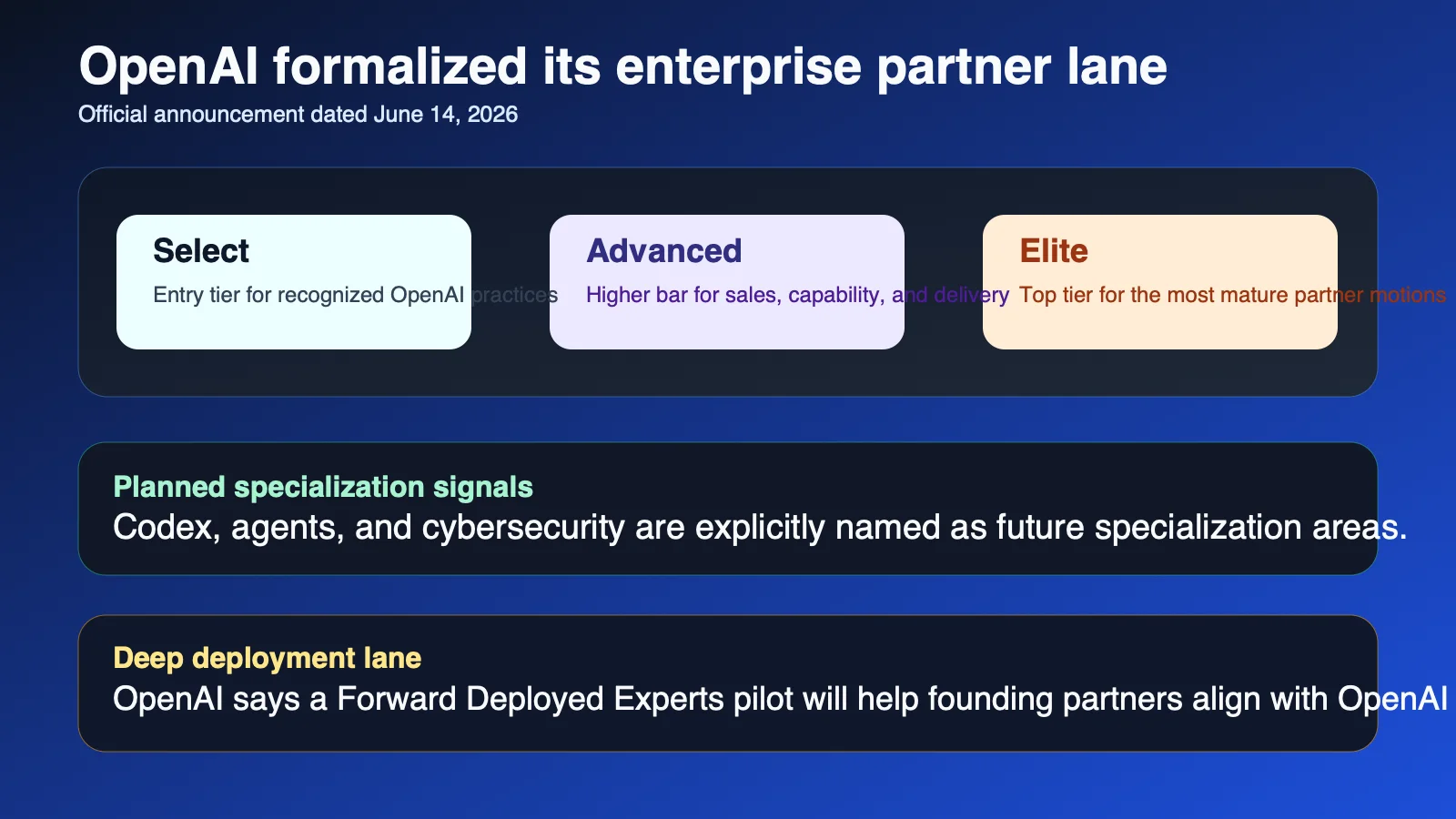
OpenAI said on June 14, 2026 that it is turning its services ecosystem into a formal OpenAI Partner Network with public tiers, future specializations, and a new Forward Deployed Experts pilot for complex deployments. For enterprise buyers, agencies, systems integrators, and digital transformation teams, the practical shift is that OpenAI is no longer treating implementation support as a loose collection of relationships. It is creating a more legible route from AI ambition to co-selling, deployment, governance, and measurable operating outcomes.
That matters because OpenAI is framing the partner layer as part of how enterprise AI actually lands. In the same June 14 announcement, the company says partners help customers identify where AI can create value, build solutions that fit real operating environments, and deploy them with the reliability and support enterprises expect. The companion partner page makes the intended market visible: consulting firms, systems integrators, cloud and data players, and industry specialists ranging from Accenture, AWS, Bain, BCG, Capgemini, Cognizant, Dentsu, Endava, PwC, Snowflake, and more.
What changed
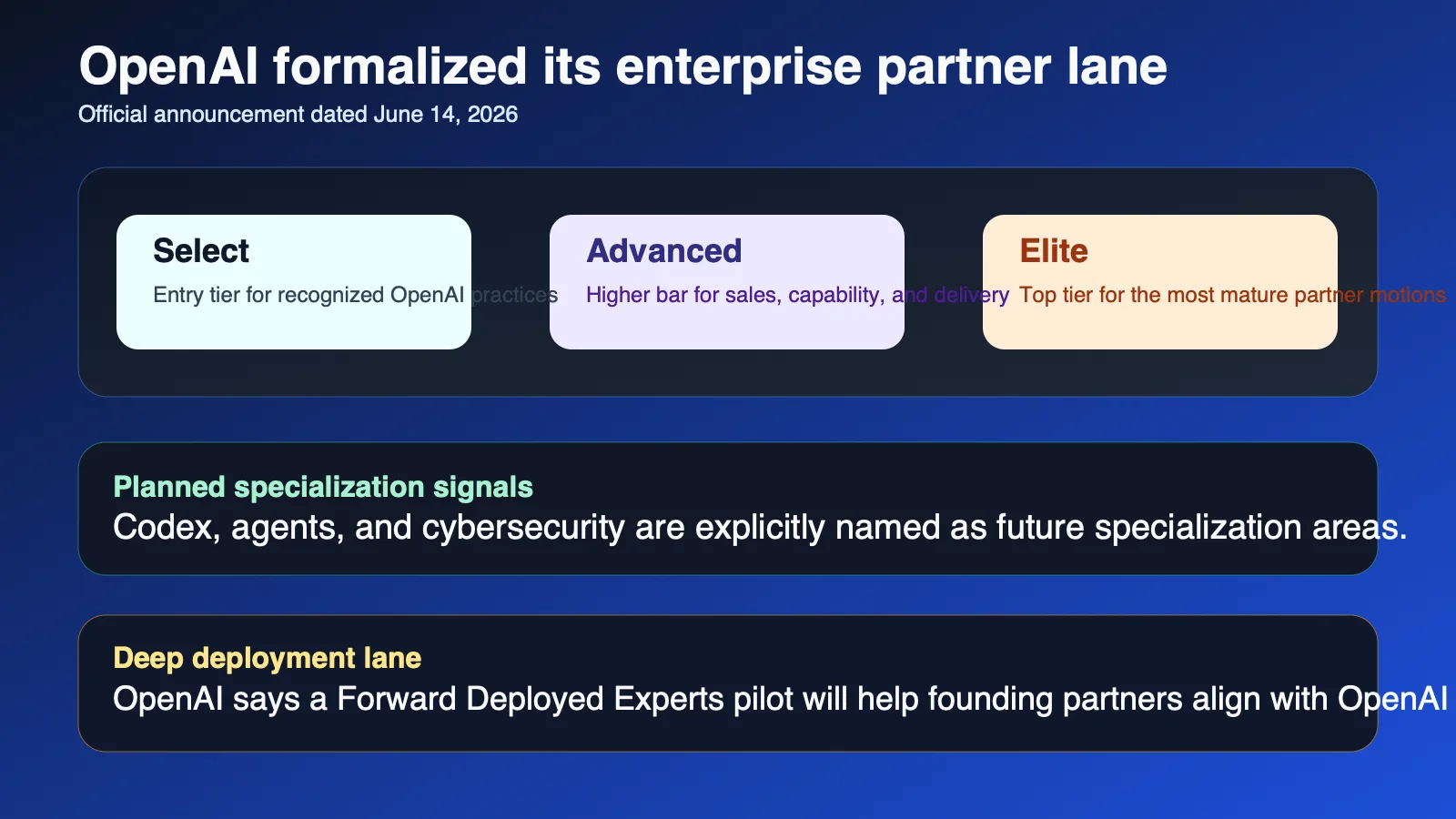
The biggest change is structure. OpenAI says the network now supports partners that are co-selling, deploying, building, or connecting customers to OpenAI technology, and that firms can move through three tiers: Select, Advanced, and Elite. OpenAI also says partners will eventually be able to earn specializations in areas such as Codex, cybersecurity, and agents, giving buyers a more precise way to judge capability than a generic "AI consultancy" label.
OpenAI is also adding a deeper-delivery lane. The launch post says a Forward Deployed Experts pilot is being introduced for a set of founding partners so qualified practitioners can align more closely with OpenAI's own Forward Deployed Engineering teams when customer work requires deeper deployment support.
| Confirmed June 14 detail | Official source | Why it matters |
|---|---|---|
| OpenAI says partners can support co-selling, deploying, building, and customer connections to OpenAI technology. | OpenAI launch announcement | The program is designed as a go-to-market and delivery layer, not just a directory. |
| The network has three tiers: Select, Advanced, and Elite. | OpenAI launch announcement | Partner quality is being translated into a formal progression path buyers can understand. |
| Future specializations are planned in Codex, cybersecurity, and agents. | OpenAI launch announcement | Buyers should expect more product-specific implementation markets around high-impact workflows. |
| OpenAI is piloting Forward Deployed Experts with founding partners for complex deployments. | OpenAI launch announcement | High-stakes work may get a tighter bridge between partner delivery teams and OpenAI engineering patterns. |
| The partner page positions the program around co-sell, build and deploy, and helping customers move from ambition to outcome. | OpenAI Partner Network page | The commercial pitch is explicitly outcome-oriented, not only technical enablement. |
The official examples also show the kind of customer work OpenAI wants this network to support. On the partner page, OpenAI cites Agilent with BCG, eBay with Artium, Paychex with Bain, and T-Mobile with Accenture. The Paychex example is especially concrete: the company says its production-scale AI solution reduced wait time by 80% compared to humans and reduced effort time for human-reviewed requests by 30%.
Why it matters
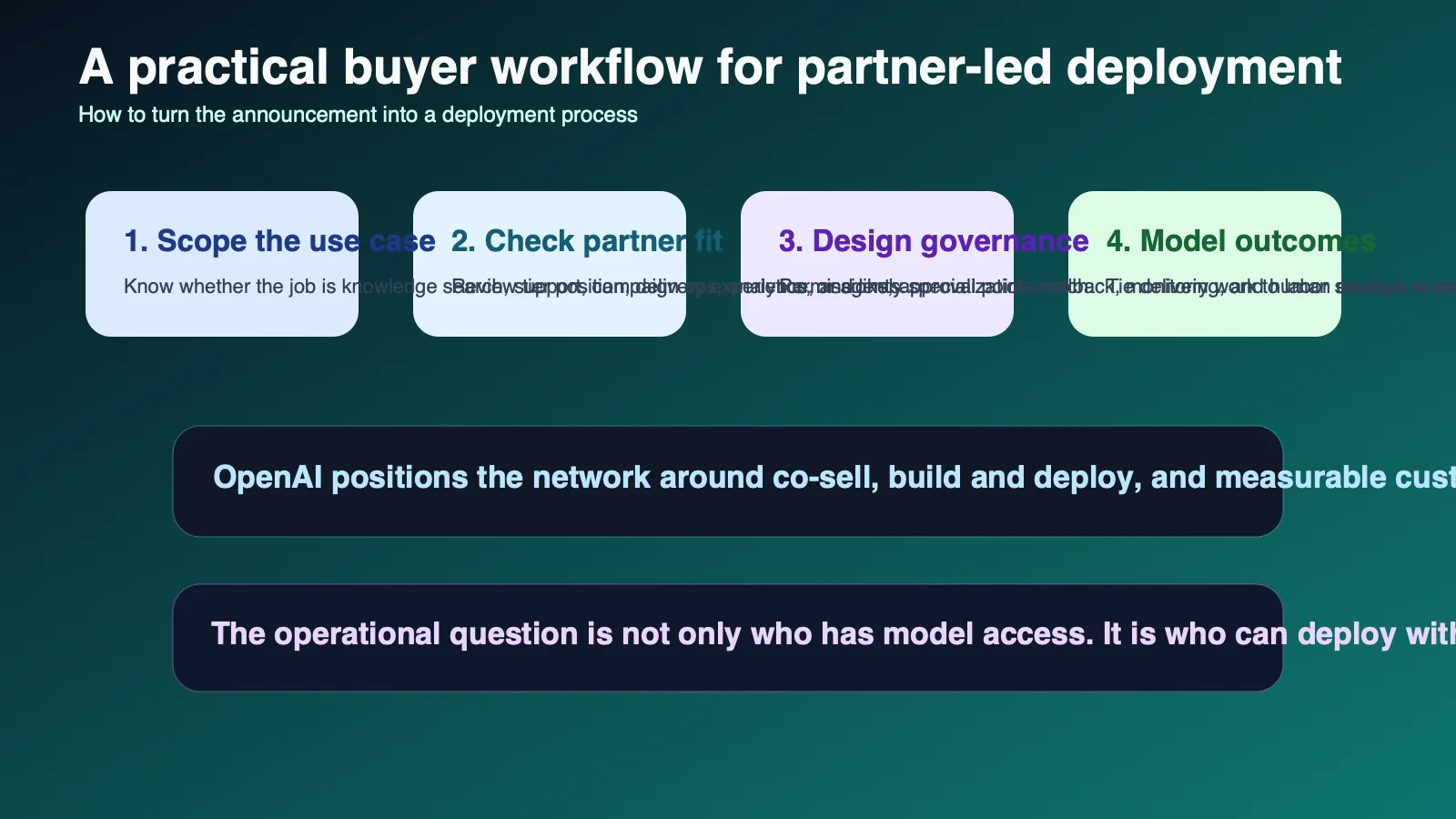
This is important because enterprise AI buying is moving past model access and into delivery discipline. Many leadership teams already know they want copilots, agents, search workflows, customer-service automation, or internal knowledge tools. The harder question is who can deploy those systems safely across data, permissions, review points, measurement, and operating change.
OpenAI is signaling that implementation quality now deserves its own market structure. That is relevant to agencies building AI services, consultancies packaging transformation programs, and internal operators who need outside help without creating governance debt. It is also relevant to marketing and digital teams because the partner list already includes firms such as Dentsu alongside broader enterprise players, which suggests OpenAI expects customer-facing growth, experience, and media workflows to be part of the partner opportunity.
The shift also connects directly to tooling and ROI decisions. If your team is exploring governed AI workflows, internal apps, or shared execution layers, this announcement sits next to OpenAI's recent changes around Codex plugins and Sites. The question is no longer only which model is strongest. It is which deployment path can hold up under procurement, operations, and real business KPIs. That same discipline is why teams still need tools like the GEO Visibility Checklist, the Marketing ROI Calculator, the Digital Marketing Budget Planner, and Slogan.website's guide to tracking brand mentions and visibility.
Who is affected
The first group is large consultancies, systems integrators, and cloud partners that want to formalize OpenAI delivery practices. The second is agencies and specialist firms building AI offers around growth, content, service, analytics, and internal workflow transformation. The third is enterprise buyers trying to distinguish serious delivery partners from firms that are still selling only AI positioning language. The fourth is internal operations, security, and procurement teams that will need to evaluate not just features, but tier signals, specialization claims, and governance readiness.
What to do next
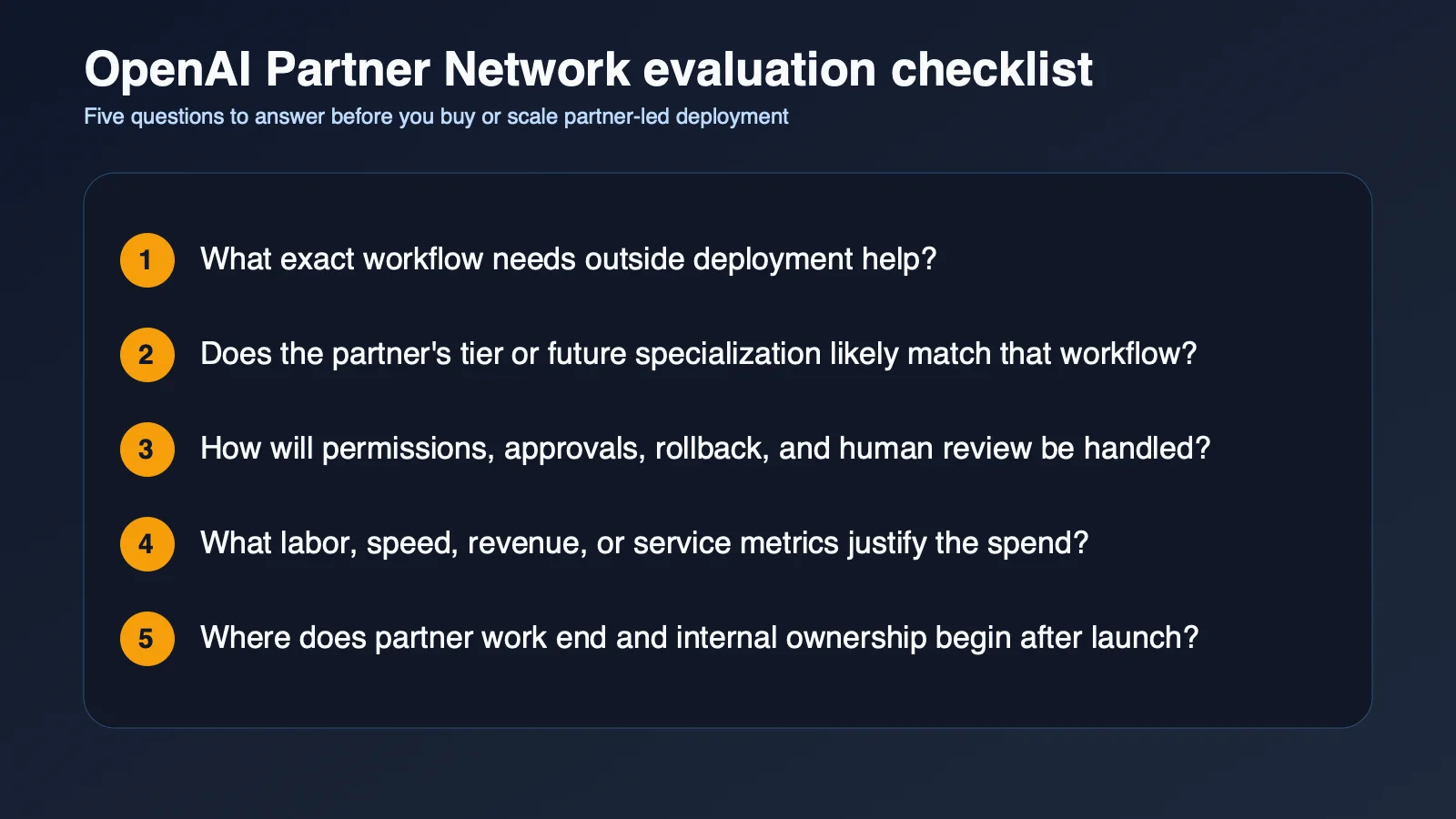
- Define the workflow you actually need help deploying: internal knowledge search, customer support, campaign operations, analytics, or agent orchestration.
- Separate model evaluation from delivery evaluation. Ask prospective partners how they handle permissions, review steps, measurement, rollback, and human escalation.
- Watch for whether future `Codex`, `agents`, or `cybersecurity` specializations map to your real use case instead of choosing partners on brand recognition alone.
- Build a commercial scorecard before signing services work: expected labor savings, risk reduction, speed gains, and revenue impact should be modeled explicitly.
- If your workflow touches content, search, or brand visibility, pair implementation planning with the GEO Visibility Checklist and a reporting baseline in the Marketing ROI Calculator.
What remains uncertain
Important details are still unresolved as of June 17, 2026. OpenAI has published the structure, the tier ladder, the coming specialization model, and the Forward Deployed Experts pilot, but it has not yet published public qualification thresholds for each tier, broad availability details for every specialization, or hard comparative evidence showing how much faster top-tier partners move customers into production.
There is also a market question OpenAI has not fully answered yet. The partner page includes a wide mix of global consultancies, cloud and data vendors, and specialist firms, but buyers still need to determine whether those relationships will produce repeatable packaged solutions or mostly custom enterprise work. For agencies and mid-market operators, that difference will shape whether the network becomes a practical buying tool or mostly a signal for larger transformation budgets.
The near-term conclusion is still meaningful. On June 14, 2026, OpenAI made partner-led AI deployment more explicit, more commercial, and more governable. Teams that already know they will need outside help should treat this launch as a buying-framework update, not just another AI ecosystem headline.