Asana turns work management into a governed operating layer for human-agent teams
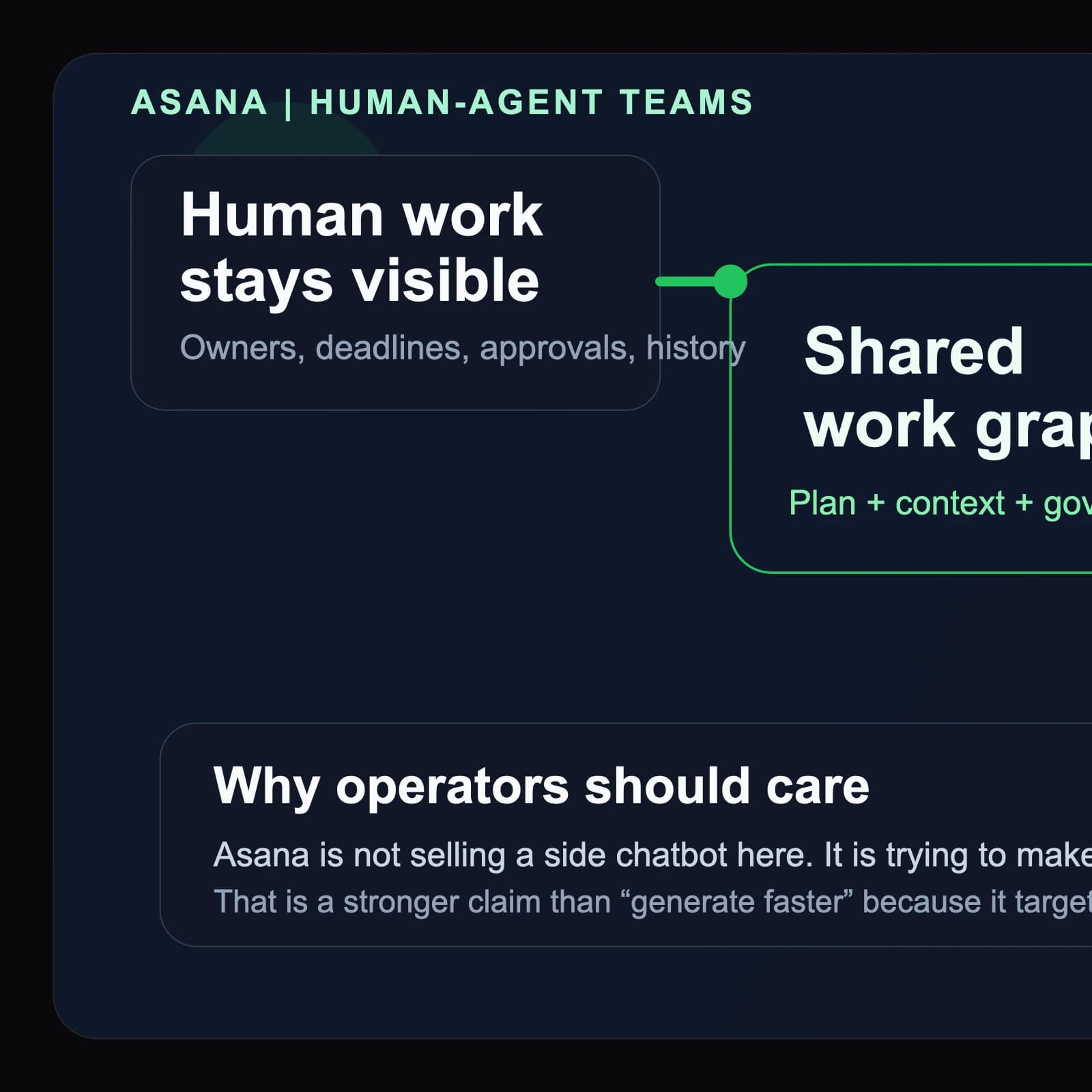
Asana said on June 4, 2026 that it is launching an operating system for human-agent teams, built around what it calls Agentic Work Management. The practical claim is not just that AI can draft or summarize work. It is that humans and agents can run critical work from the same plan, with the same context and the same governance controls. For marketing, operations, client-service, and digital delivery teams, that is a more consequential shift than another chatbot-style productivity feature.
The official launch materials say the package includes next-generation AI Teammates, Asana Dash as an AI chief of staff, and upcoming product surfaces such as Asana Service Management, Command by Asana, and Asana Client Management. Read together with Asana's official AI Teammates overview and its recent StackAI acquisition announcement, the story is less about a single feature and more about Asana trying to become the coordination layer for multi-step, cross-system AI work.
What changed
The core official claim is in Asana's June 4 investor release: teams should be able to run work with humans and AI agents inside one governed operating model instead of splitting planning, execution, and approvals across disconnected tools. Asana says the package includes industry-oriented AI Teammates, Dash for individual prioritization, and new app-level experiences for IT, builders, and professional services.
That matters because Asana is clearly expanding the scope beyond generic task management. Its AI Teammates overview says the product ships with 21 out-of-the-box agents across Marketing, IT, and Ops, including a Campaign Brief Writer, Workflow Optimizer, Compliance Specialist, and Launch Planner. Those examples make the positioning concrete: Asana wants agents to live inside workflows where dependencies, ownership, deadlines, and approvals already exist.
The launch also follows Asana's official StackAI acquisition announcement, which frames the deal around giving human-agent teams stronger cross-system execution. That sequence matters. A governed work layer is more credible if the company is also building toward orchestration beyond a single dashboard.
| Confirmed point | Primary source | Why operators should care |
|---|---|---|
| Asana announced an operating system for human-agent teams on June 4, 2026 | Asana investor release | This is a current product launch, not a speculative roadmap comment. |
| Asana says critical work can run on the same plan, context, and governance model for humans and agents | Asana investor release | The company is positioning AI as an execution layer inside operating workflows, not a side assistant. |
| The launch includes AI Teammates, Asana Dash, and upcoming surfaces for service, builders, and client work | Asana investor release | Multiple team functions are in scope, which raises the strategic importance for operators. |
| Asana's AI Teammates page says 21 out-of-the-box agents are available across Marketing, IT, and Ops | Asana AI Teammates overview | This is framed as workflow-specific execution support, not only generic summarization. |
| Asana says beta teams finished work 2x faster, with stronger ownership and deadline clarity | Asana AI Teammates overview | The product pitch is tied to operational throughput, not just novelty. |
Why it matters
The useful signal for high-value teams in the United States, Canada, the United Kingdom, Australia, and Europe is organizational rather than cosmetic. Many AI rollouts still happen in private chat tabs where a single person drafts something, copies the output into another system, then manually rebuilds all the accountability around it. Asana is arguing that the real productivity gain comes when AI shares the same project structure, history, permissions, and review checkpoints as the team.
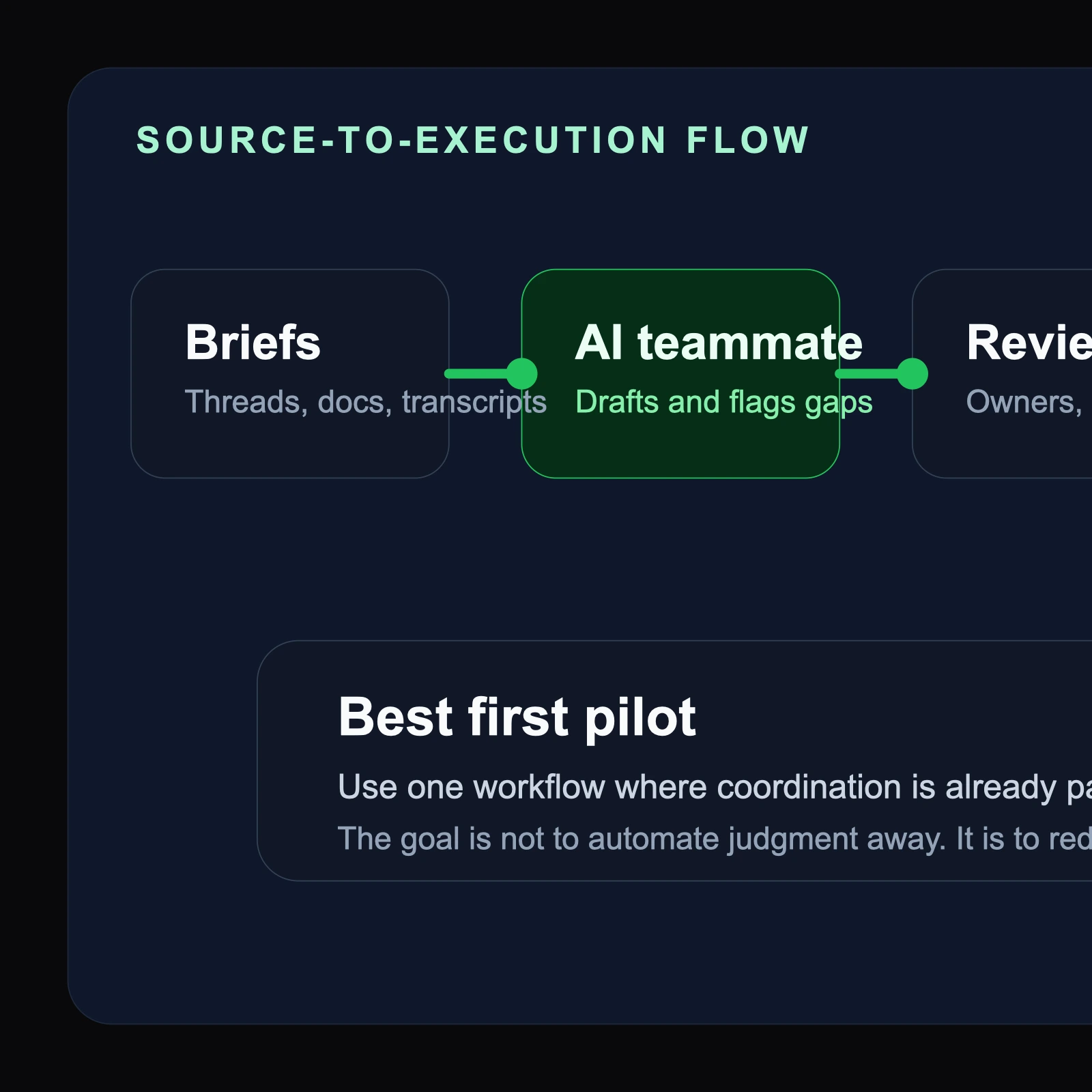
That is particularly relevant for marketing organizations. Campaign planning, launch readiness, asset review, localization, reporting, and postmortem cleanup are not isolated tasks. They are chains of approvals and handoffs. Asana's own AI Teammates overview highlights a Campaign Brief Writer and a Launch Planner, which makes the marketing angle explicit. If those agents can reliably work from transcripts, briefs, and task history inside a governed system, then campaign operations get closer to being redesigned rather than merely accelerated.
There is also an economics angle. More AI assistance often looks cheap at the prompt layer and expensive at the coordination layer. Teams still need owners, deadlines, approval gates, and business review. That is why this story naturally connects to Slogan.website's Digital Marketing Budget Planner, Marketing ROI Calculator, and the broader tools hub. If a platform claims it can reduce coordination tax, operators should pressure-test whether it actually lowers launch delays, revision loops, and reporting overhead.
Who is affected
The closest-to-the-change teams are marketing operations, PMM, creative operations, and lifecycle teams that already run launch-heavy work inside Asana or a similar system. They are the most likely to benefit if AI can draft briefs, catch gaps, reroute work, and warn about dependency risk before a campaign slips.
Client-service and delivery teams are the second group to watch. Asana is openly signaling that professional services and client management are part of the roadmap, which matters for agencies and consultancies packaging repeatable delivery around approvals and reporting.
The third group is RevOps, IT, and cross-functional operations teams. They may not care about creative generation, but they do care about governed execution, visibility, and auditability when work crosses multiple teams and systems.
What to do next
Treat this launch as an operating-model audit, not just a feature announcement.
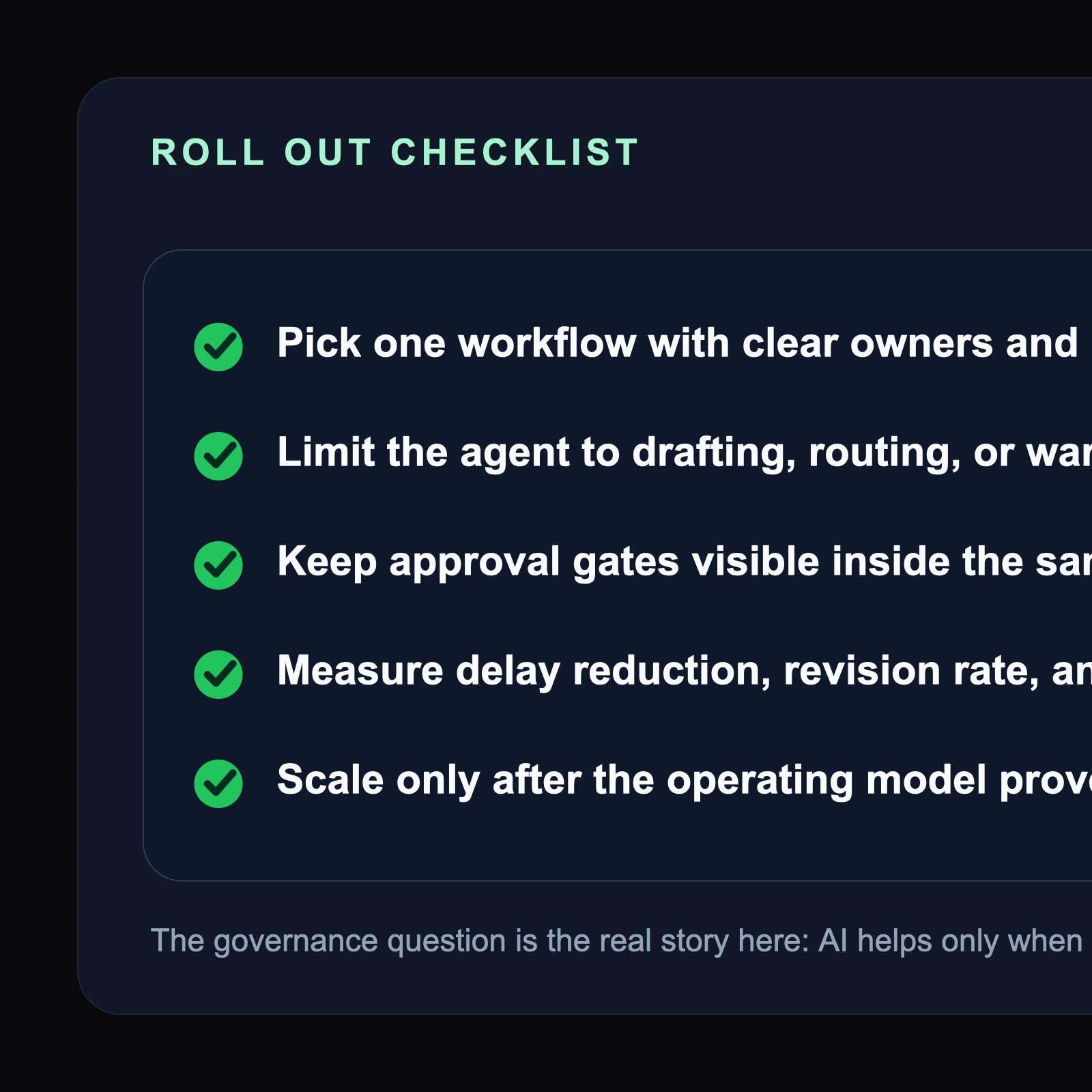
- Map one coordination-heavy workflow that already breaks under handoffs, such as campaign brief creation, launch readiness review, or weekly reporting.
- Separate tasks that need shared context and approvals from tasks that only need content generation.
- Define where an agent could safely draft, flag, or reroute work without making final decisions alone.
- Measure the business case with the Marketing ROI Calculator and Digital Marketing Budget Planner, especially if the tool will expand seat count or AI usage costs.
- Tighten the workflow inputs first using the CRM attribution workflow and the CRM pipeline stages guide, because weak ownership models usually make AI output worse, not better.
What remains uncertain
Important questions remain open in the public materials. Asana's launch pages describe the model, but they do not fully spell out packaging boundaries, workload limits, or how broadly the newest app surfaces will roll out by region or plan. The company also highlights strong beta results in its AI Teammates overview, but external operators still need to test whether those gains hold up in messy real-world environments with multiple approvers, changing priorities, and cross-tool dependencies.
There is also a governance question hiding under the excitement. Shared context is powerful, but it only helps if permissions, source quality, and approval rules are clean enough for an agent to work safely. Teams with scattered campaign data, vague owners, or inconsistent delivery processes may discover that the blocker is not the model. It is the operating system they never documented. That is why this June 4, 2026 launch matters: it pushes AI adoption away from isolated prompting and toward the harder question of whether a business is actually structured for human-agent execution.