Klaviyo turns multilingual customer support into one CRM-native service workflow

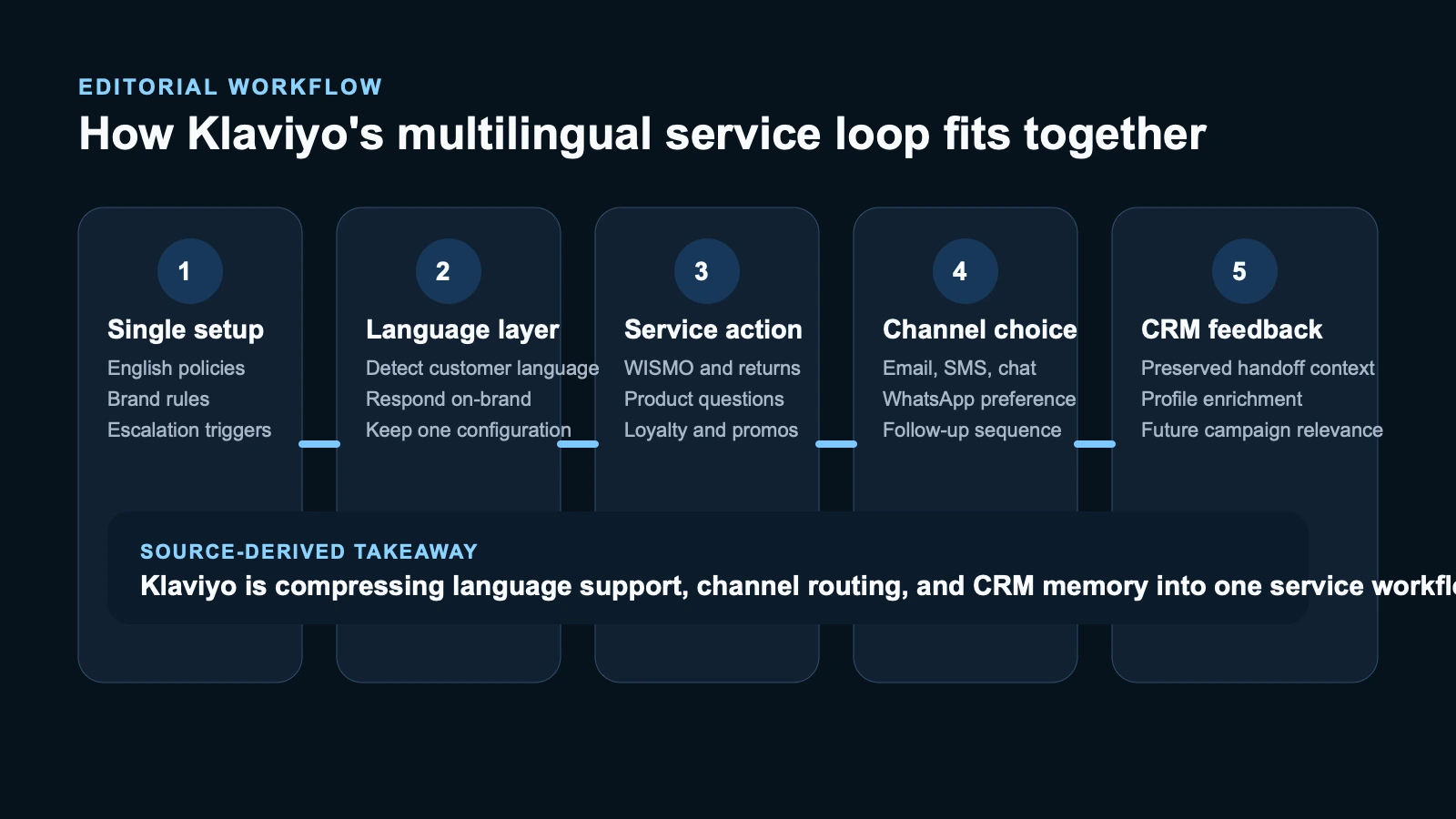
Klaviyo made a more practical cross-border commerce move on June 3, 2026 than the headline might suggest. Its Customer Agent now automatically detects and answers in the shopper's language across web chat, email, SMS, and WhatsApp, while a separate June 3 update adds WhatsApp to Klaviyo's channel-affinity routing. For ecommerce and lifecycle teams, the shift is not just "AI now speaks more languages." Klaviyo is trying to reduce three expensive frictions at once: multilingual support staffing, duplicated configuration by market, and guesswork about which mobile channel should handle the conversation.
That matters because many brands serving the United States, Canada, the United Kingdom, Australia, and Europe still treat service, retention, and messaging as separate operating lanes. Support lives in one tool, lifecycle marketing in another, and regional language coverage depends on ad hoc staffing or translation layers. Klaviyo's June 3 updates point toward a different operating model: one CRM-native agent and one profile system that can resolve service issues, preserve context when a human takes over, and make better channel choices for each customer.
What changed
Klaviyo's public materials from June 3, 2026, its Customer Agent product page, and the same-day WhatsApp channel-affinity update line up around one core idea: service and retention logic should adapt to the customer's language and preferred channel without forcing the operator to rebuild the system market by market.
| Confirmed point | Official source | Why operators should care |
|---|---|---|
| Customer Agent now automatically detects and responds in the shopper's language across web chat, email, SMS, and WhatsApp. | Klaviyo multilingual update, June 3, 2026 | Brands can expand language coverage without maintaining a separate agent configuration per market. |
| Klaviyo says teams set up Customer Agent once, in English, then let the language layer adapt on its own. | Klaviyo multilingual update, June 3, 2026 | Operational complexity moves down if the claim holds in real production workflows. |
| The Customer Agent page says the product supports 113 languages and handles conversations across email, text, chat, and WhatsApp, with social coming soon. | Customer Agent product page | Channel coverage is broad enough to matter for international B2C brands, not just web chat pilots. |
| Klaviyo says Customer Agent resolves 65% of questions without human involvement and preserves full context when handing off to Klaviyo Helpdesk or a third-party helpdesk. | Customer Agent product page | Cost reduction only matters if escalation keeps the conversation intact instead of restarting the case. |
| Channel affinity now predicts WhatsApp preference alongside email, SMS, and push. | Klaviyo WhatsApp channel-affinity update, June 3, 2026 | Brands running both SMS and WhatsApp get a better starting point for where the first message should go. |
The most useful detail is the setup model. Klaviyo says brands configure skills, policies, and brand guidelines once in English, then let the agent handle detection and response in the customer's language. If that works as described, it lowers the practical barrier for brands that want to test German, French, Spanish, or Italian support without staffing every market from day one.
Why it matters
The business value is not translation by itself. It is workflow compression. A lot of international ecommerce teams still bounce between three separate jobs: answer the shopper, decide whether the interaction belongs in SMS or WhatsApp, and then reconnect the result to the customer profile so future campaigns stay relevant. Klaviyo is trying to collapse those steps into one system.
That creates a more defensible operating case for brands that already rely on CRM-driven retention. When the service agent sees purchase history, loyalty context, prior campaign behavior, and channel preference inside the same stack, it can do more than clear tickets. It can protect revenue, steer shoppers to the right follow-up channel, and enrich the profile for future segmentation. That overlaps directly with Slogan.website's guidance on email automation for small business, small-business attribution and CRM workflows, and the broader /tools stack for budgeting and performance review.
There is also a market-expansion angle. For brands entering Europe or serving multilingual audiences in North America, service friction often shows up before paid acquisition inefficiency does. Customers ask pre-purchase questions, shipping questions, and return questions long before the operator has enough data to decide whether the market is working. If those conversations fail because the language layer is weak or because the brand guesses the wrong mobile channel, the market can look worse than it really is.
Who is affected
The first group is mid-market ecommerce brands that already use Klaviyo for lifecycle marketing and want service to run on the same customer context instead of a disconnected support layer.
The second group is cross-border DTC teams serving English plus one or two additional languages but not yet ready to hire full multilingual support coverage for each market.
The third group is agencies and operators managing both SMS and WhatsApp. Klaviyo's June 3 channel-affinity update matters most when both channels are live and the team needs a defensible rule for which one should lead.
What to do next
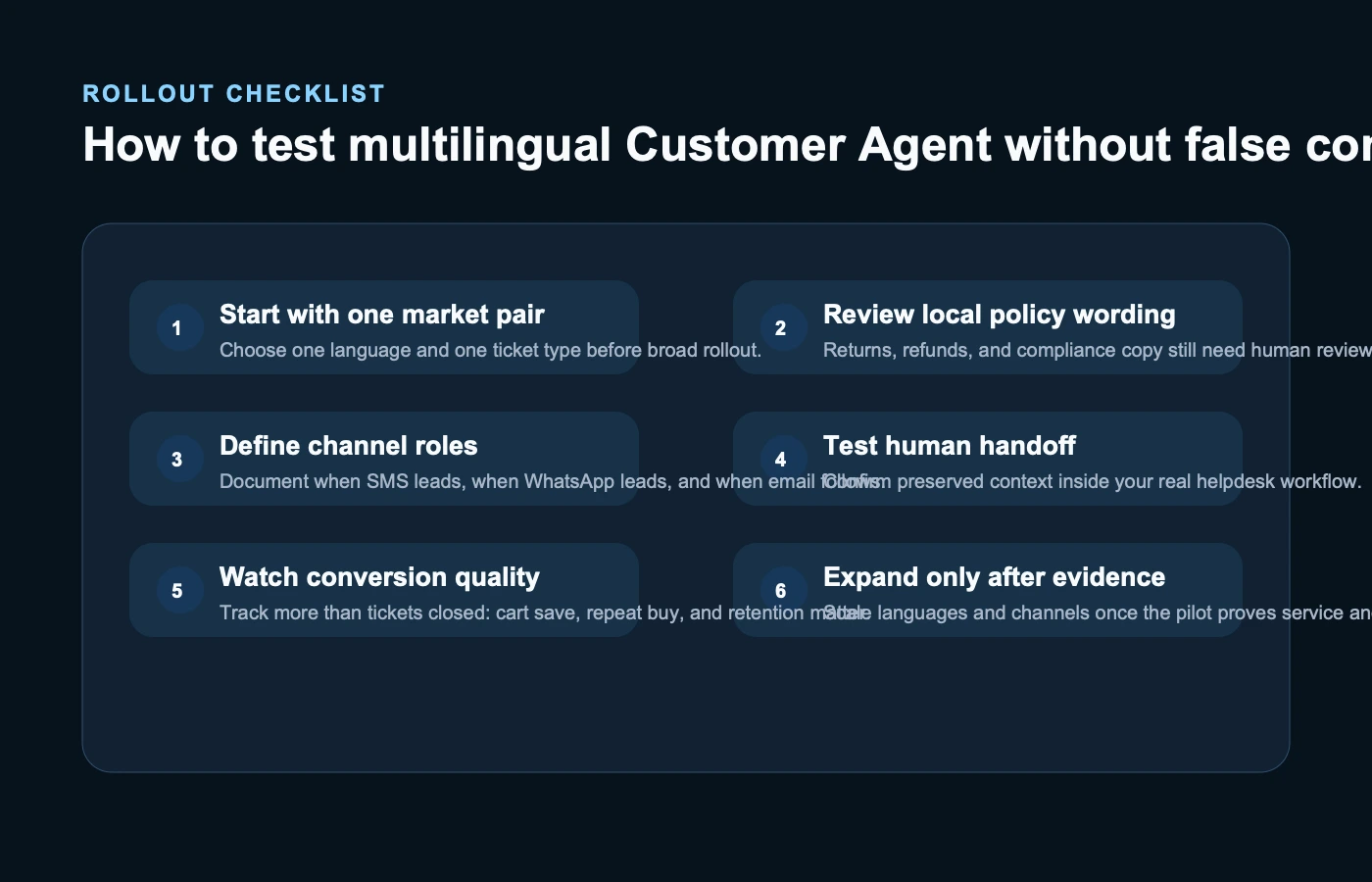
Treat this update as an operating pilot, not a blanket automation win:
- Pick one language pair and one service use case first, such as order tracking, returns, or pre-purchase product questions.
- Verify which policies, brand rules, and escalation conditions are safe to configure once in English versus which need local market review.
- Compare WhatsApp and SMS roles explicitly before launch if both channels are active, using Klaviyo's channel-affinity logic as a starting signal rather than a blind rule.
- Track whether multilingual resolution reduces ticket load, protects conversion, or improves repeat purchase quality, then pressure-test the economics with the Marketing ROI Calculator and Digital Marketing Budget Planner.
- Audit human handoff quality, because a lower automation cost is not a win if escalated conversations lose context or create policy mistakes.
What remains uncertain
Several important limits remain as of June 6, 2026. Klaviyo's public pages describe the multilingual and channel-routing capabilities, but they do not publish detailed benchmarks by language, region, or ticket type. The product page also says social support is still coming soon, so teams should not assume one universal conversation layer already exists across every channel they care about.
There is also a governance question. One English-language setup may reduce maintenance, but it can also hide local compliance, returns-policy, or tone risks if teams skip market review. And while Klaviyo says human escalation preserves full context, operators still need to verify that handoff quality in their own helpdesk, not just accept the product claim at face value.
The practical takeaway is narrower and more useful. Klaviyo's June 3 updates turn multilingual service from a fragmented market-by-market project into a more realistic CRM workflow for B2C brands. Teams that validate language quality, channel choice, and escalation discipline could gain a faster route to international support coverage than teams still stitching together separate service, messaging, and retention systems.