Outreach adds web search, closed-deal context, and MCP connectors to its AI sales workflow
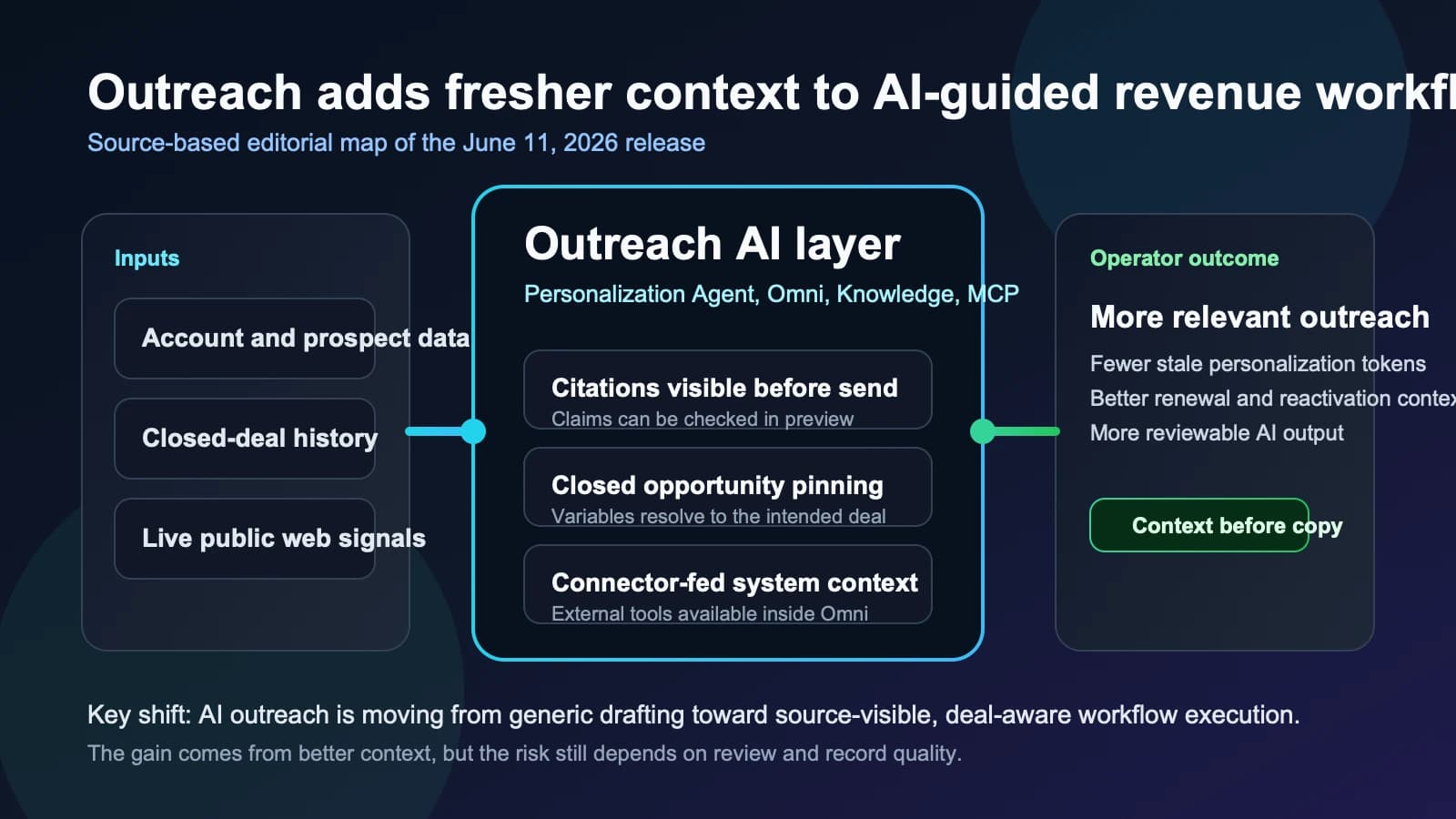
Outreach shipped a meaningful workflow update on June 11, 2026: its June release adds web search inside the Personalization Agent, lets teams associate AI-generated outreach with closed opportunities, and brings MCP connectors into Omni so reps can pull context and actions from other systems without leaving Outreach. For RevOps, sales-tech, and lifecycle teams, Outreach is trying to make its AI layer more current, more source-aware, and more usable across real revenue workflows.
The supporting documentation shows why that matters. Outreach says web search can combine internal prospect, account, and opportunity data with real-time public web context powered by Google Gemini 2.0, while citations remain visible in preview before a message is sent. In the same release, Outreach says reps can now pin a specific closed opportunity so template variables resolve against the right historical deal. That moves AI outreach closer to accountable workflow design and farther from generic one-shot prompting.
What changed
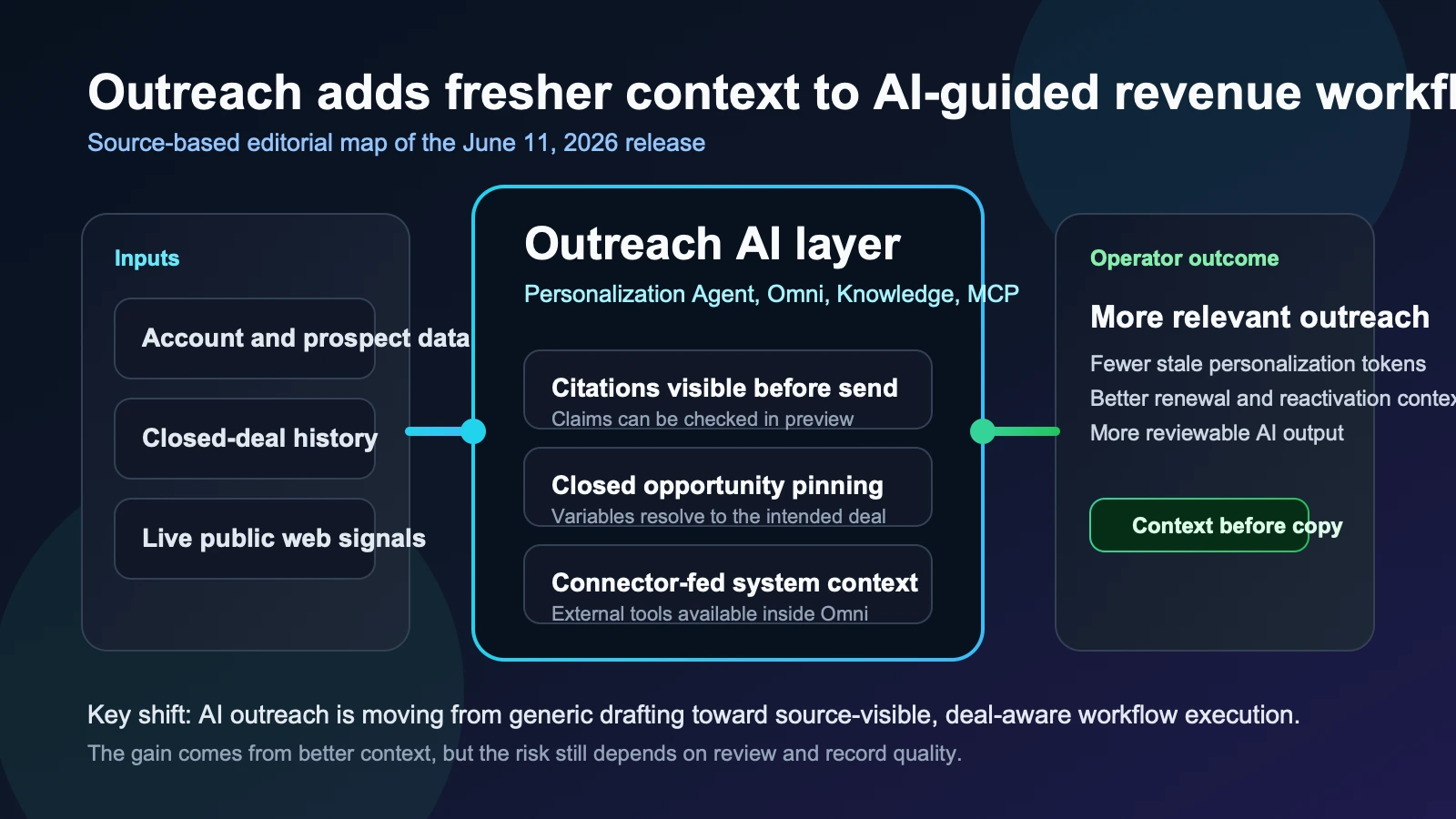
Outreach's June 2026 release notes bundle several related updates under one operational idea: AI output should be grounded in fresher data and broader business context. The most visible change is Web Search in Personalization Agent, scheduled to roll out from June 11 through June 25, 2026. Outreach says reps can enable web search in personalization blocks, pull in recent company news or announcements, and review source citations inside the personalization preview.
The second important change is context reuse from historical pipeline. Outreach says closed opportunities can now be associated across workflows including email composition, call logging, task creation, meeting logging, and sequence enrollment. The documentation also says the Personalization Agent can pin a specific closed opportunity so variables like opportunity name, stage, and type use the intended deal context.
The third shift is broader system access. Outreach says its new MCP Client lets Omni connect to third-party tools through marketplace and private connectors.
| Confirmed release point | Primary source | Why it matters operationally |
|---|---|---|
| Web Search in Personalization Agent rolls out June 11 to June 25, 2026. | Outreach June release notes | Personalized outreach can use fresh public information instead of relying only on stale CRM enrichment. |
| Source citations are visible in the personalization preview. | Web Search Support overview | Teams can review claims before sending AI-generated copy to prospects. |
| Web search is powered by Google Gemini 2.0 with grounding. | Web Search Support overview | Model behavior and source quality now become part of sales-governance work, not just prompt design. |
| Closed Won and Closed Lost opportunities can now be associated across outreach workflows. | Closed Opportunity Activity Association | AI personalization can use the right deal history for renewals, re-engagement, and expansion motions. |
| Omni can pull from marketplace and private MCP connectors. | Outreach June release notes | Reps can work across external systems without fragmenting context across separate tools. |
Why it matters
The usual failure mode in AI sales outreach is not that the model cannot write. It is that the context is thin, outdated, or attached to the wrong deal. That is why this release matters. If a rep is contacting an expansion account, a recently funded startup, or a prospect coming back after a lost deal, timing and business context matter more than a polished sentence. Outreach's own documentation says web search can surface recent funding rounds, leadership changes, and product launches, while the closed-opportunity picker keeps historical deal context from getting lost.
There is also a governance angle. Outreach's support article says common names, ambiguous company names, thin public web presence, stale indexing, and missing citations from Gemini can all produce wrong or incomplete context. That makes this a useful upgrade, but not a hands-free one.
That connects naturally to Slogan.website resources such as the tools hub, the Marketing ROI Calculator, the Digital Marketing Budget Planner, and the guides to CRM attribution and data hygiene. Faster outbound only creates value if it improves qualified pipeline and data quality at the same time.
Who is affected
The main audience is B2B revenue teams already using Outreach for sequences, one-off email, LinkedIn tasks, and account-based follow-up. RevOps and enablement leaders are the second group, because Outreach's own release notes make clear that admins control connectors and organization-wide opportunity association settings. Agencies and consultants should also pay attention because the release shows where AI personalization is heading: away from isolated copy generation and toward system-grounded execution.
What to do next
Use the release as a workflow redesign prompt, not as a reason to turn every AI toggle on at once.
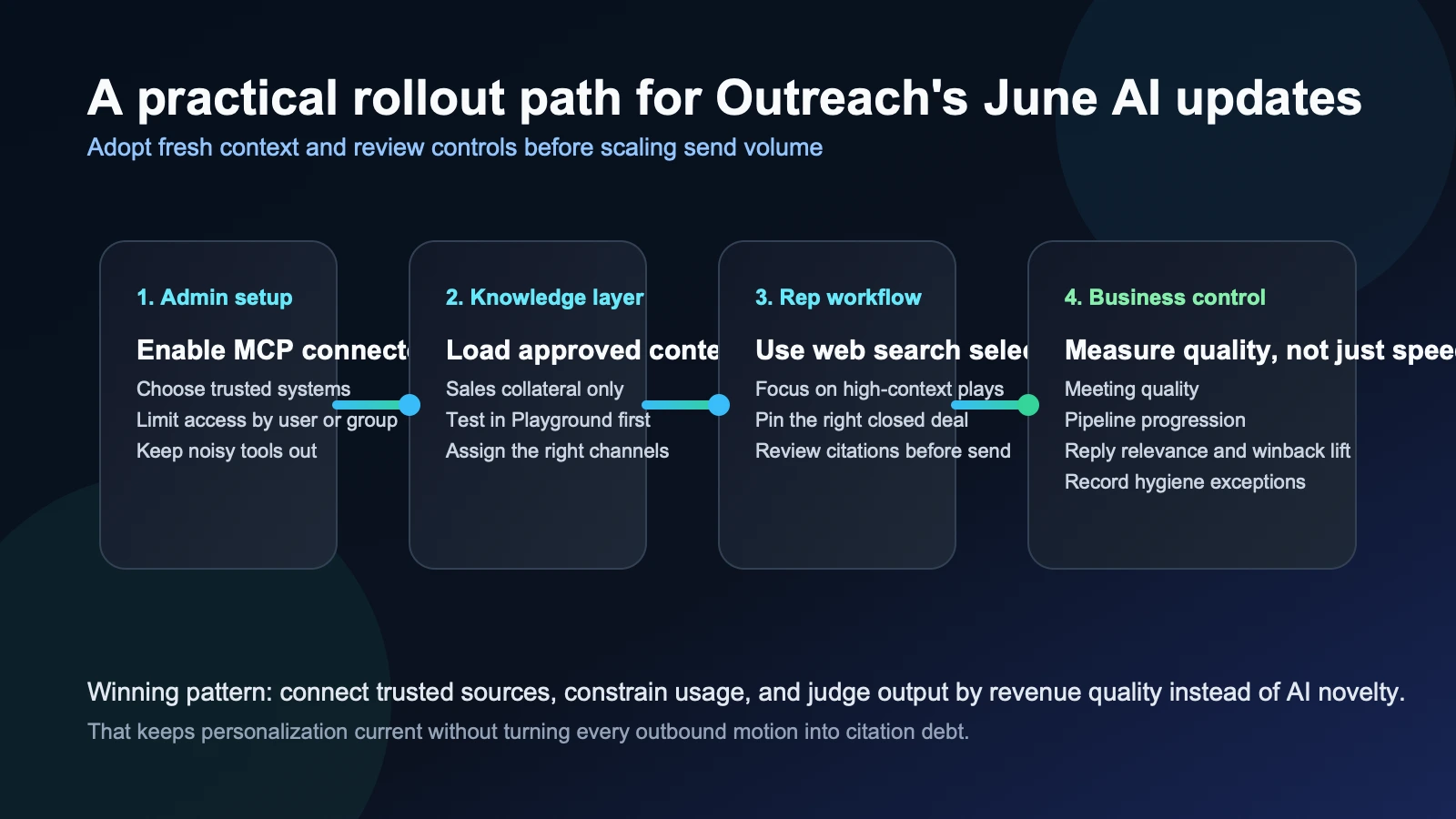
- Decide which message types truly need web search: reactivation, expansion, event-triggered outreach, or leadership-change plays are better candidates than every sequence step.
- Define review rules for citation quality, especially when the prospect has a common name or the company has a generic brand name.
- Turn on closed-opportunity association only after checking whether your pipeline stages, naming conventions, and owner rules are clean enough to avoid noisy historical context.
- Load only approved internal documents into Knowledge channels so Omni is grounded in current collateral rather than draft or contradictory content.
- Measure the business effect with reply quality, meeting quality, stage progression, and pipeline impact, not only with send speed.
Pressure-test the economics with the Marketing ROI Calculator and clean up record hygiene with the CRM data hygiene guide.
What remains uncertain
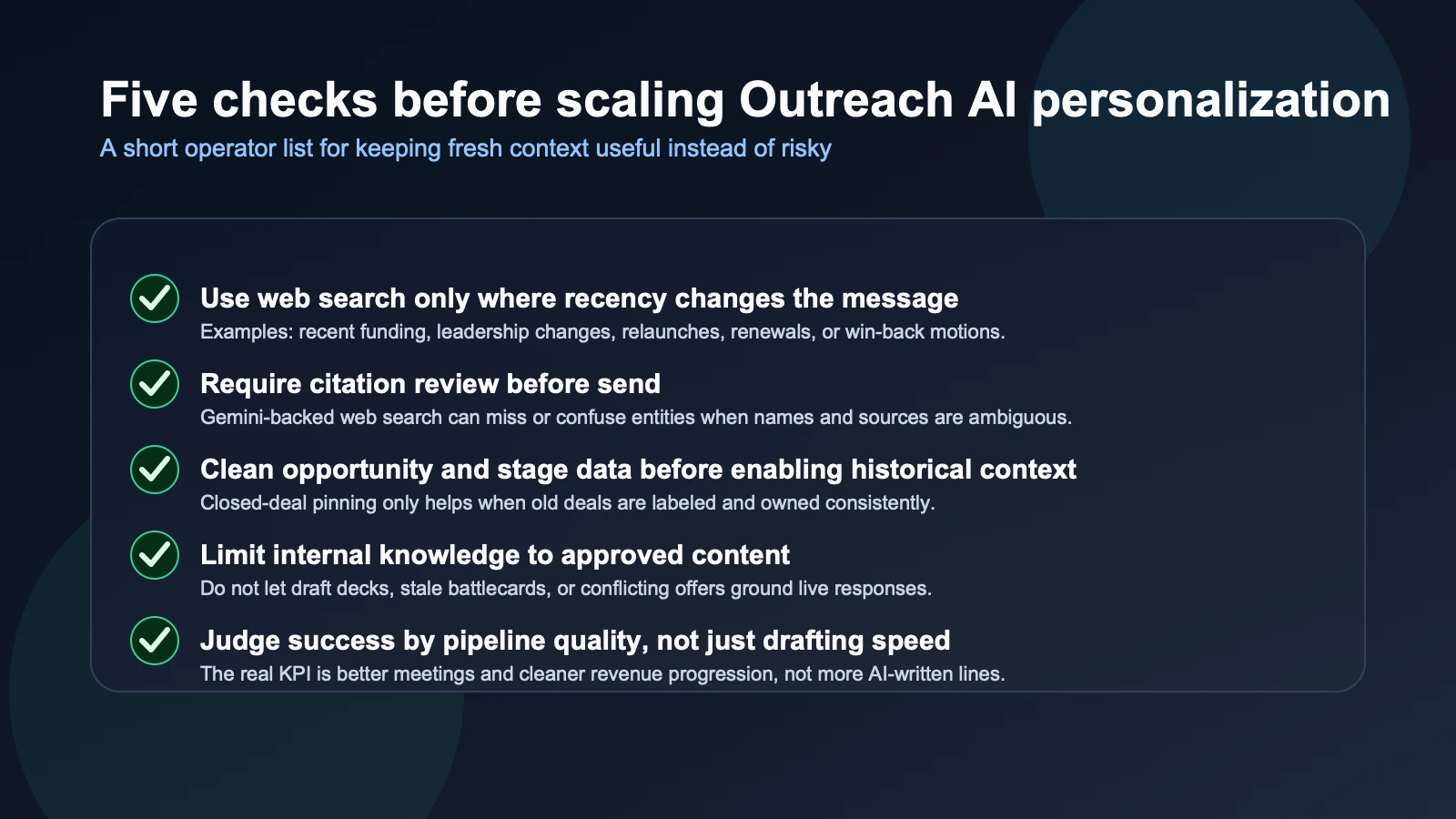
Outreach documents several important limits that teams should not ignore. The company says public web data may be outdated, smaller companies may have weak search coverage, and Gemini may sometimes fail to return citations. It also notes that LinkedIn data is limited to public search indexing, not live private profile access.
That means the release should be treated as a meaningful upgrade, but not as a substitute for account research or data governance. Outreach is making AI outreach more current, more source-visible, and more connected to deal history, but teams still need disciplined prompts, clean records, and clear review thresholds before they can trust the output at scale.