Twilio turns customer messaging into an agent-ready conversation layer at SIGNAL 2026
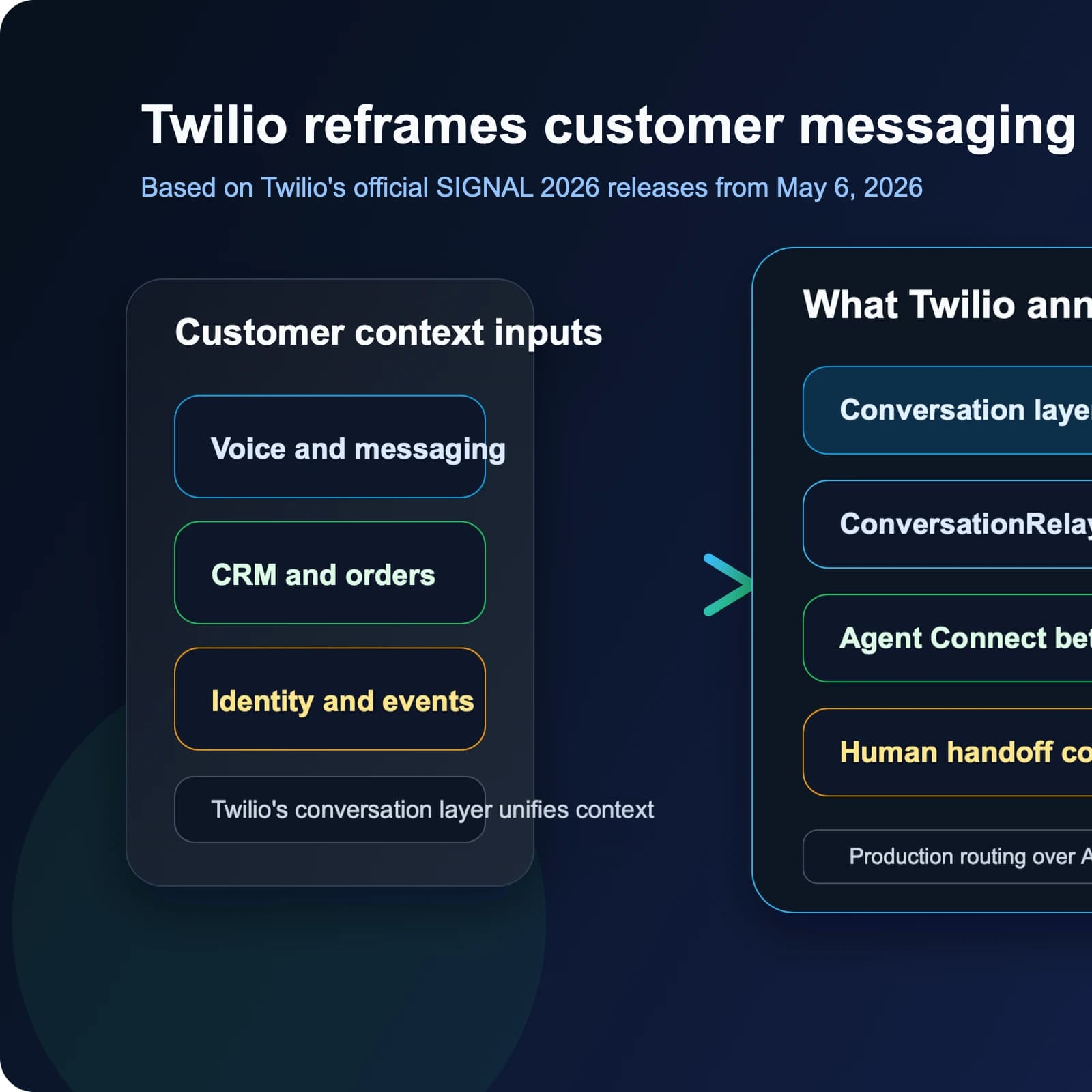
Twilio used SIGNAL 2026 on May 6, 2026 to make a broader platform claim than a normal feature round-up. Alongside a formal press release published the same day, the company said it is building a next-generation customer engagement platform around three pieces that matter together: a conversation layer that unifies customer context, ConversationRelay to connect communications with large language models, and Agent Connect to help businesses deploy AI agents with governance, escalation, and channel support across voice and messaging.
For operators, that is the real news. Twilio is no longer framing messaging as a transport utility alone. It is repositioning messaging, identity, and engagement data as the infrastructure layer that lets AI agents act across support, sales, and lifecycle workflows without losing context when a customer switches channel or needs a human handoff.
What changed
The official materials line up around one core shift: Twilio wants customer conversations to become reusable system context.
In its May 6, 2026 press release, Twilio said the new platform is designed to help companies personalize every interaction across the customer journey. That announcement introduced the conversation layer, which Twilio describes as a cross-platform data foundation that can unify communications, transactional records, and behavioral context.
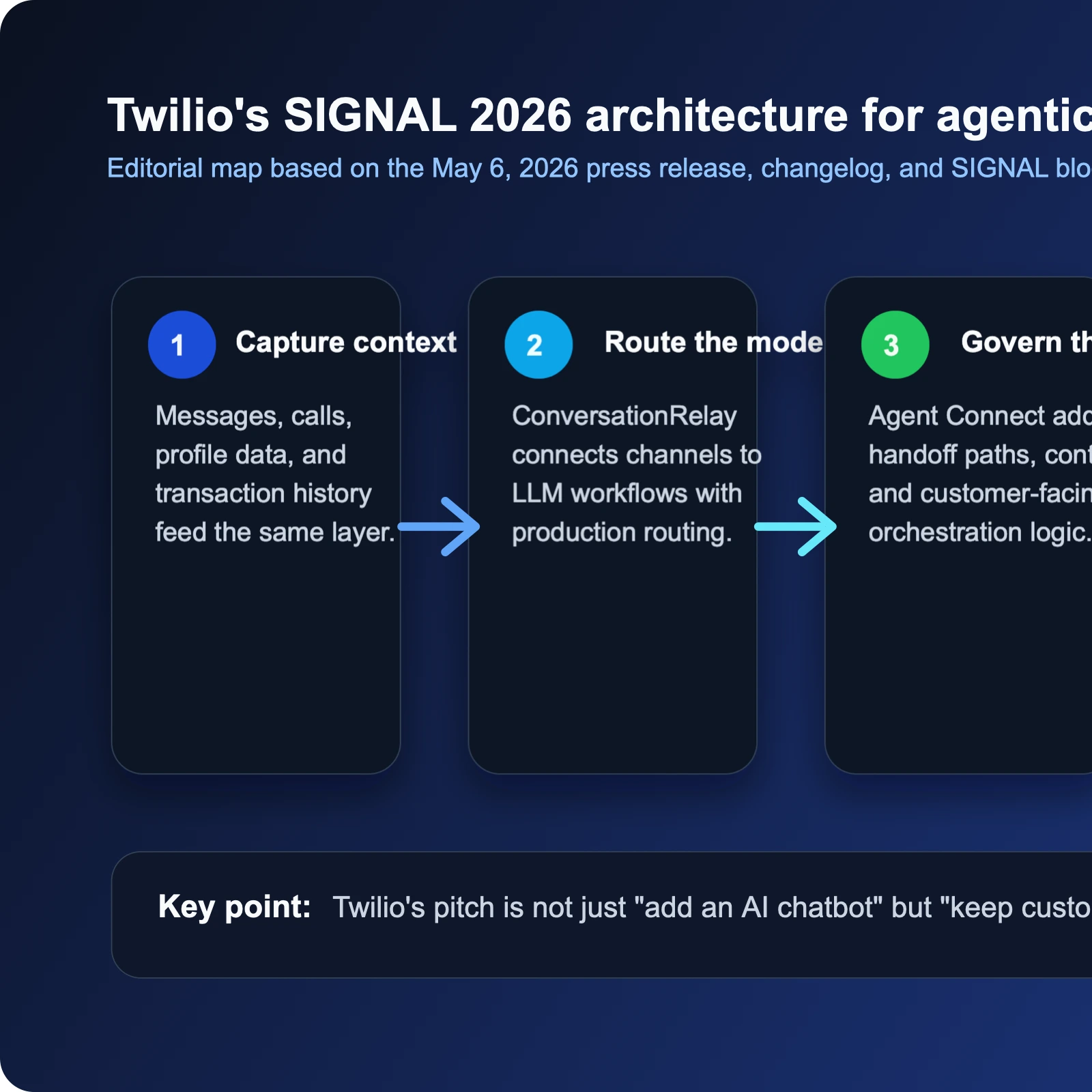
The more practical rollout details came from Twilio's SIGNAL 2026 product blog. There, the company said ConversationRelay is generally available, giving developers a way to connect voice and messaging flows to LLM-driven experiences while keeping routing and orchestration inside Twilio. Twilio also said Agent Connect is moving into private beta, focused on AI agents for customer-facing interactions with tools for handoff, channel continuity, and operational control.
Twilio's Agent Connect changelog entry from May 6, 2026 adds another useful detail: the product is aimed at agentic voice and messaging experiences that still need contact center controls such as escalation to a human. The ConversationRelay changelog confirms the general-availability status separately, which matters because it distinguishes what is available now from what is still early-access.
| Confirmed update | Official source | Why it matters |
|---|---|---|
| Twilio introduced a next-generation customer engagement platform on May 6, 2026 | Twilio press release | Messaging and customer data are being repositioned as a core AI execution layer. |
| The conversation layer unifies customer context across interactions and systems | Twilio press release | AI agents can become more useful only if they inherit consistent identity and history. |
| ConversationRelay reached general availability on May 6, 2026 | Twilio changelog | Teams can move from prototype LLM call flows toward production implementation now. |
| Agent Connect launched in private beta for customer-facing AI agents | Twilio changelog | Twilio is adding a governance and escalation layer instead of treating AI chat as a demo feature. |
| SIGNAL 2026 also emphasized channel continuity across voice and messaging | Twilio SIGNAL 2026 blog | Support and revenue teams can plan around shared context instead of separate channel silos. |
Why it matters
The strategic implication is that Twilio is trying to solve the hardest part of applied customer AI: continuity. Many companies can connect a model to a chatbot or phone tree. Far fewer can make that system remember the right customer, respect channel history, trigger the right downstream action, and escalate cleanly when the interaction crosses a policy or revenue threshold.
That matters for marketers and operators because customer communication stacks are no longer separate from growth stacks. If the same identity, message history, and event context can be reused across acquisition follow-up, lifecycle messaging, support resolution, and sales assist, then AI deployment stops being a side experiment and becomes an operating-model question. This is also why measurement discipline matters. Teams evaluating agentic messaging need clear baselines for pipeline movement, attribution, and downstream revenue quality, not only AI output volume. Slogan.website's Marketing ROI Calculator, Digital Marketing Budget Planner, and small-business marketing attribution CRM workflow are useful precisely because they force that economic framing.
There is also a governance angle. The official materials keep coming back to channel routing, orchestration, human handoff, and production controls. That is a stronger signal than many agent announcements because it implies Twilio expects buyers to care about reliability and compliance, not just novelty.
Who is affected
The first group affected is customer support and contact center teams already handling high volumes across SMS, WhatsApp, voice, email, or web messaging. They are the clearest fit for context-aware AI agents that can contain simple work while escalating sensitive cases.
The second group is lifecycle and CRM operators. If conversation history becomes a reusable data layer, then cart recovery, onboarding, renewal outreach, and win-back programs can become more context-aware without forcing customers to restart from zero.
The third group is revenue and operations teams in SaaS, ecommerce, fintech, travel, and other service-heavy categories where customer conversations often influence conversion or retention. For teams serving the United States, Canada, the United Kingdom, Australia, and Europe, the broader lesson is not limited to Twilio customers: channel orchestration and agent governance are becoming buying criteria across the customer stack.
What to do next
Use the launch as a practical audit prompt before committing to any agentic messaging rollout.
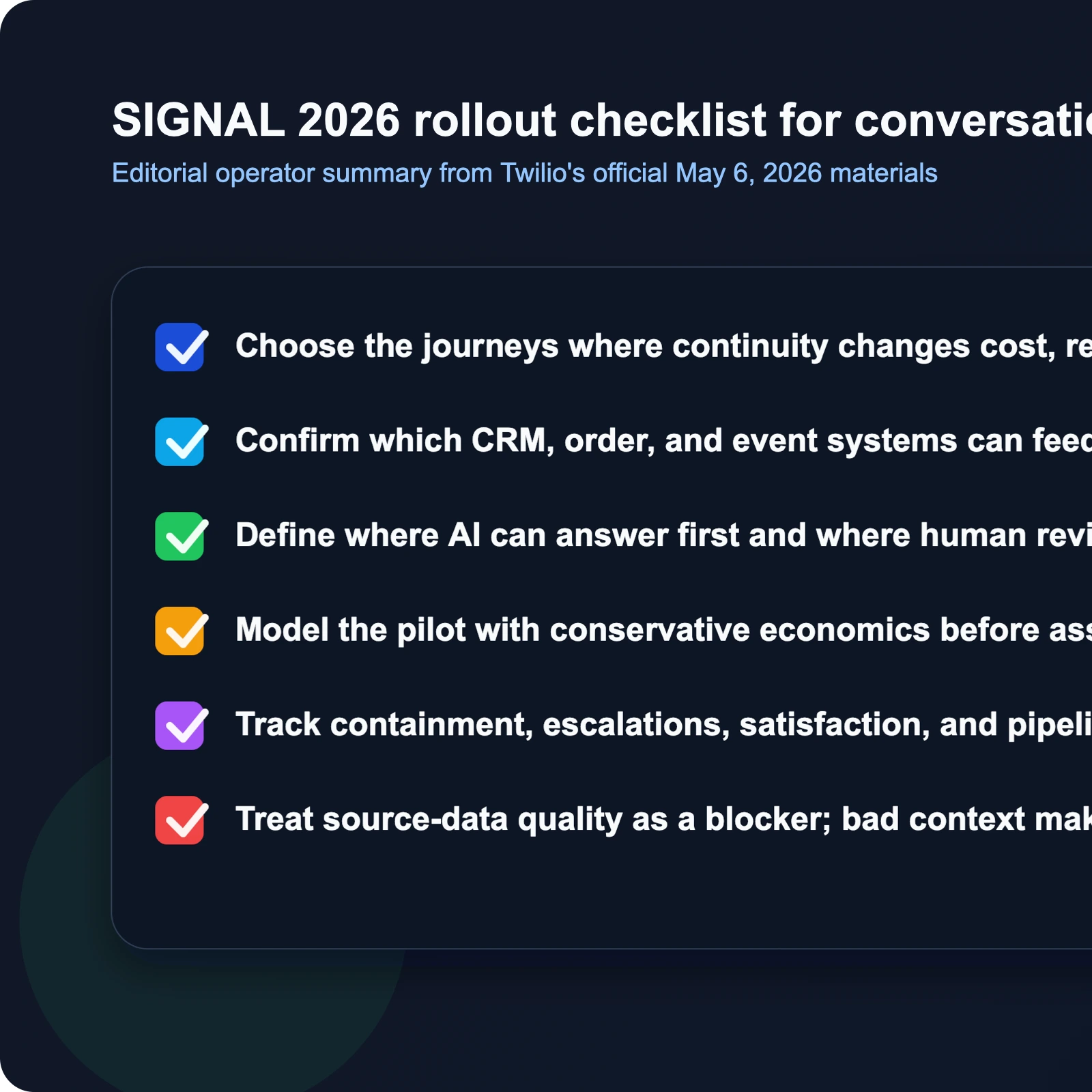
- List the top three conversation journeys where faster response and better continuity would change revenue, retention, or support cost outcomes.
- Map which systems already hold the context those journeys need: CRM, billing, order data, help desk, identity, and event streams.
- Separate use cases that can tolerate AI-first handling from those that require immediate human review, then define the escalation rule for each.
- Estimate conservative and aggressive rollout scenarios in the Digital Marketing Budget Planner and check payback assumptions in the Marketing ROI Calculator.
- Review whether your current CRM and pipeline stages can capture agent-assisted touches cleanly; if not, tighten the operating model first with the CRM pipeline stages guide.
What remains uncertain
Important limits remain. Agent Connect is still in private beta as of May 6, 2026, so broad availability, pricing, and real production adoption are not yet clear from the public materials. Twilio also has not published a detailed benchmark showing how much better these AI-assisted flows perform than conventional routing or rules-based automation across industries.
There is also an implementation question. A conversation layer only helps if source systems are clean, customer identity is resolved correctly, and channel ownership across marketing, support, and engineering is well defined. Otherwise, AI agents inherit messy context and simply scale confusion faster.
The durable takeaway on June 2, 2026 is that Twilio has made the infrastructure argument for customer-facing AI more concrete. The company is telling the market that the winning stack is not just model access. It is model access plus identity, event history, channel continuity, and human fallback. That is the standard teams should now evaluate every agentic customer platform against.