How to Track AI Referral Traffic in GA4 (ChatGPT, Perplexity, Gemini)

If AI answer engines are becoming a discovery channel, the obvious question is: how much traffic do they actually send? For most sites the honest answer today is "a small but fast-growing slice" — and GA4 hides that slice inside generic referral and unassigned buckets unless you set up tracking deliberately.
This guide walks through the exact setup: one custom channel group, one regex, and a monthly KPI routine that takes fifteen minutes.
Why default GA4 reports mislead you
GA4's default channel grouping has no concept of AI search. A visitor who clicks a citation in ChatGPT arrives with the referrer chatgpt.com and lands in the Referral channel next to random blog mentions. Traffic from AI mobile apps that strip the referrer header lands in Direct or Unassigned.
The result: your acquisition report shows "referral is flat" while AI-driven visits quietly grow inside a bucket you never open. If you are investing in GEO work like the visibility checklist, you cannot see whether it pays off without splitting this traffic out.
The setup: one channel group, one regex
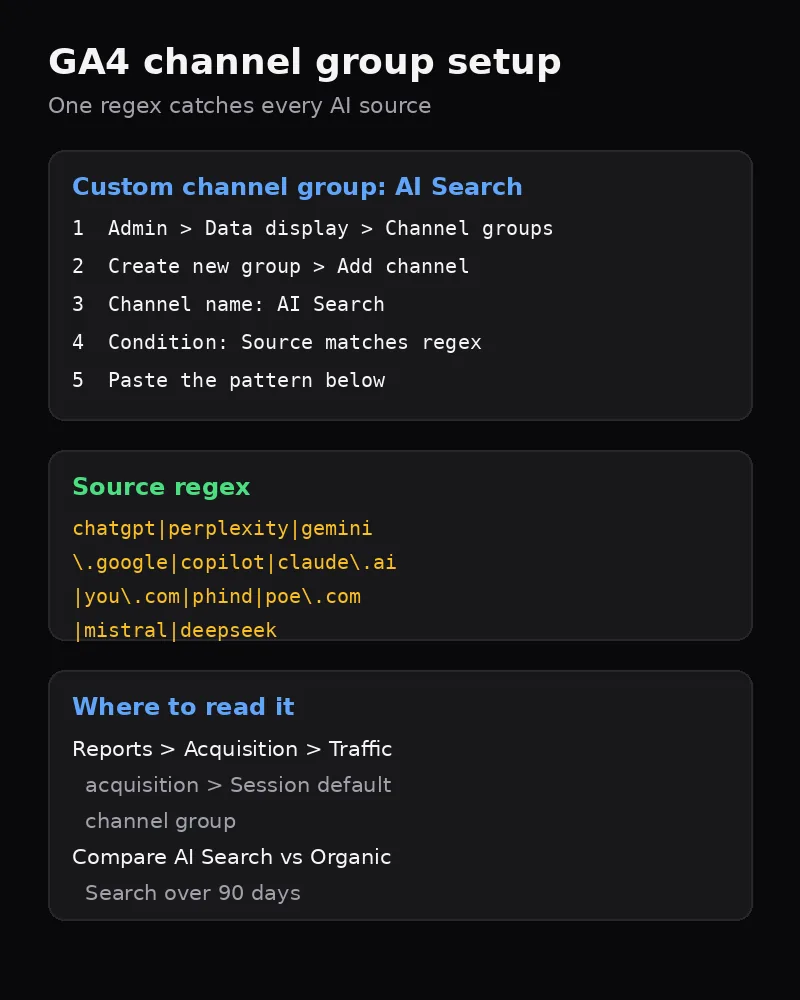
In GA4, go to Admin > Data display > Channel groups, create a new group, and add a channel named AI Search with a single condition: Source matches regex.
A working pattern that covers the major answer engines as of 2026:
chatgpt|perplexity|gemini\.google|copilot\.microsoft|claude\.ai|you\.com|phind|poe\.com|mistral|deepseek|meta\.ai|grok
Two practical notes:
- Order matters. Put the AI Search channel above Referral in the group so it wins the match.
- Review quarterly. New answer engines and new domains appear regularly; add them when you spot unfamiliar AI referrers in your source/medium report.
Once the group exists, select it in Reports > Acquisition > Traffic acquisition by switching the dimension to your custom channel group. AI traffic now reports as its own line next to Organic Search, Paid, and Referral.
The KPIs that actually matter
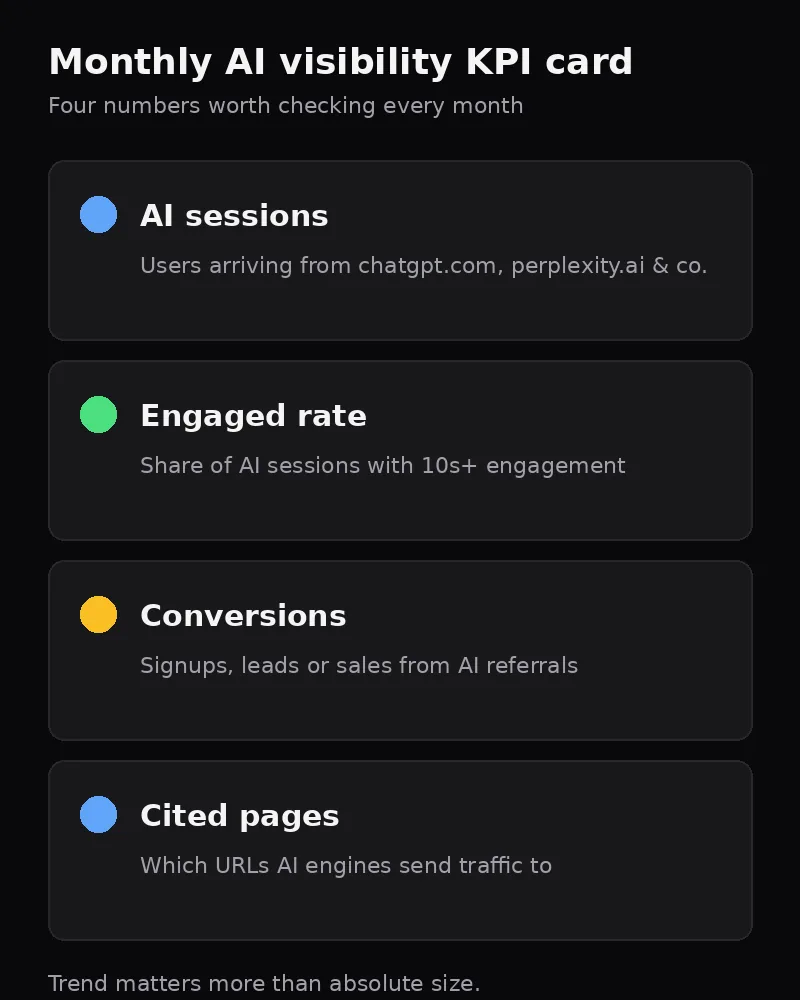
Raw AI session counts flatter you; a mention in a viral answer can spike a day and vanish. The durable signals are these four:
| KPI | Where to find it | What a good trend looks like |
|---|---|---|
| AI sessions | Traffic acquisition, AI Search channel | Steady month-over-month growth, even from a small base |
| Engaged session rate | Same report, engagement columns | At or above your organic search rate — AI citations pre-qualify intent |
| Key events / conversions | Conversions report filtered to AI Search | Non-zero and growing; AI visitors often convert well because the answer already sold them |
| Landing pages receiving AI traffic | Exploration: AI Search channel x landing page | A widening set of pages, not one lucky URL |
The landing page view deserves emphasis: the pages AI engines send traffic to are the pages they currently cite. That list is ground truth for your AI citation tracking workflow — it shows which content formats, heading structures, and answer-first paragraphs earn citations without you having to prompt every engine manually.
Expect undercounting, and say so in reports
Measured AI referral traffic is a floor, not a ceiling. Three mechanisms hide real AI-influenced visits:
- Copy-paste behavior. Users copy a URL or brand name from an answer and visit directly. No referrer survives.
- App referrer stripping. Some AI apps and in-app browsers drop the referrer header entirely.
- Branded search lift. A user asks ChatGPT, gets your brand name, then googles you. GA4 credits organic branded search, not the AI answer.
Because of this, pair the GA4 channel with brand mention tracking and branded search volume trends. When all three move together, you have a defensible AI visibility story for a client or a boss; when GA4 alone moves, treat it as the minimum measurable effect.
A 15-minute monthly routine
- Open traffic acquisition with your AI Search channel group; note sessions and engaged rate for the last 28 days versus the previous period.
- Check the landing page exploration for new URLs entering the AI referral list.
- Cross-reference with branded search volume in Search Console.
- Log the four KPIs in a spreadsheet next to your citation tracking notes.
That is the whole routine. AI referral tracking is not a new analytics platform or an expensive AI search analytics tool — it is one regex and a monthly habit, and it turns "we think AI mentions help" into a number you can watch compound. Compare the landing pages on that list with the Marketing ROI Calculator and audit them with the GEO visibility checklist before you scale spend.
Frequently asked questions
Does GA4 track ChatGPT traffic automatically?
No. GA4 lumps most AI referrals into the generic Referral channel or, worse, into Unassigned. You need a custom channel group with a source regex that matches chatgpt.com, perplexity.ai, gemini.google.com, copilot.microsoft.com, claude.ai, and similar domains before you can report on AI traffic cleanly.
Why does some AI traffic show up as direct or unassigned?
When a user copies a link from an AI answer instead of clicking it, or when the app strips referrer headers, GA4 sees no source and buckets the visit as direct or unassigned. This is unavoidable; expect measured AI referral traffic to undercount real AI-influenced visits.
How much AI referral traffic should a small business expect?
For most small business sites in 2026, AI referrals are still a single-digit percentage of total sessions, but the growth rate is the signal that matters. A site going from 0.3% to 1% AI referral share in a quarter is gaining AI visibility faster than its organic rankings suggest.
Can I see which pages AI engines send traffic to?
Yes. In GA4, build an exploration or add a landing page dimension to your AI Search channel. The pages receiving AI referrals are the ones answer engines currently cite or link, which tells you exactly which content formats earn citations.