Zero-Click Search Strategy: How Small Businesses Win When Nobody Clicks
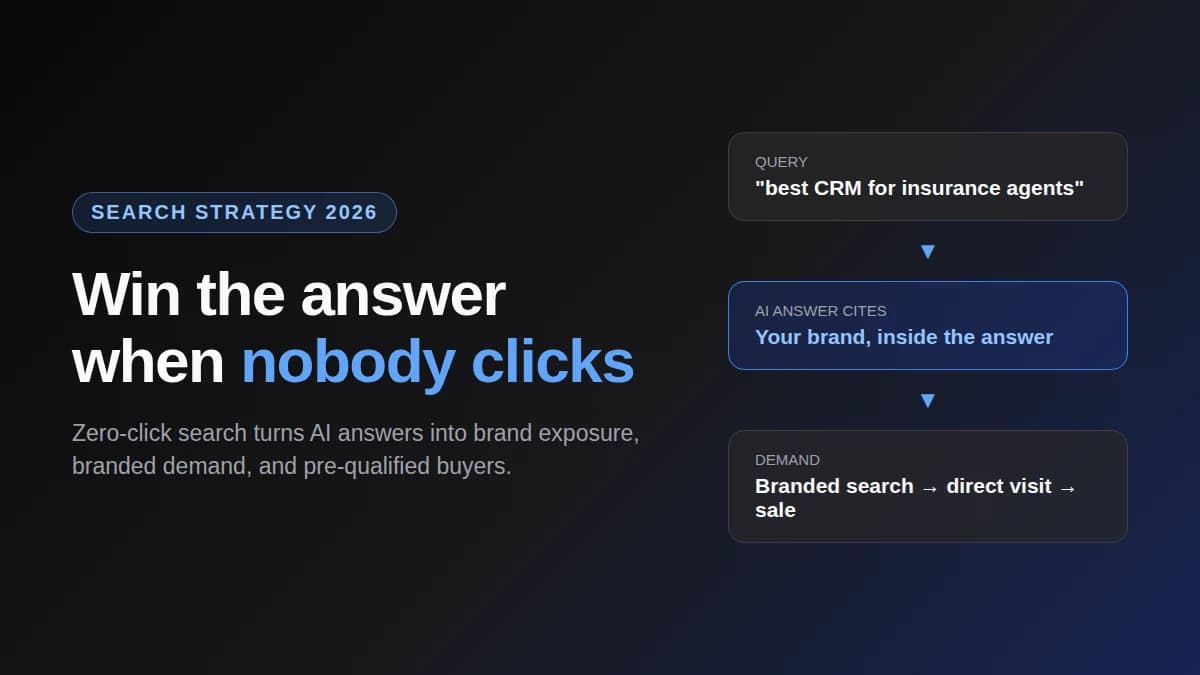
More than half of Google searches have ended without a click for years, and AI Overviews plus answer engines like ChatGPT and Perplexity are accelerating the trend. For a small business that was told "rank and get traffic," that sounds like the end of SEO.
It is not the end. It is a scoreboard change. When the answer appears on the results page, the businesses named inside that answer still get the exposure — they just do not get the session. A working zero-click search strategy turns that exposure into branded demand, direct visits, and sales conversations instead of mourning lost clicks.
What zero-click search actually is
A zero-click search is any query resolved on the results page or inside an answer engine without a visit to a website. The main formats:
- AI Overviews and AI answer engines. Google, ChatGPT, Perplexity, and Copilot synthesize an answer and cite a handful of sources.
- Featured snippets and knowledge panels. The classic zero-click formats: definitions, conversions, hours, and quick facts answered inline.
- Local pack and map results. Calls, directions, and reviews happen without a website visit.
- Instant tools. Calculators, translators, weather, and unit conversions remove entire query classes from the click economy.
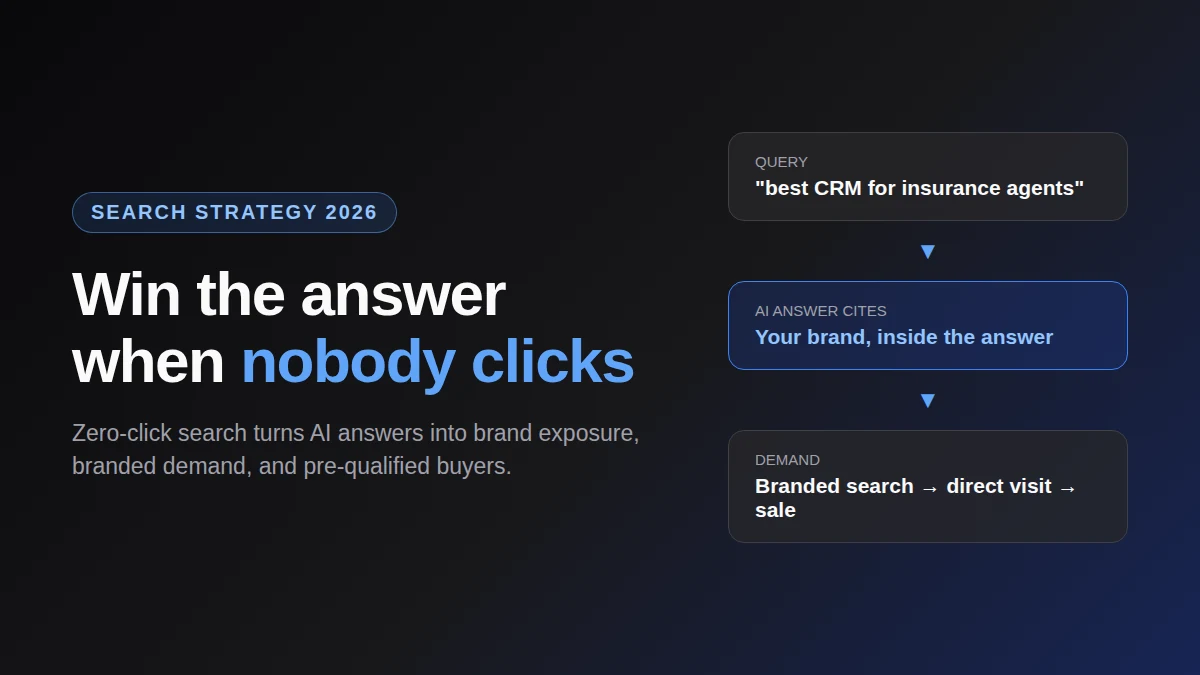
The important distinction: some zero-click queries were never going to convert (weather, definitions). Others are commercial — "best CRM for insurance agents" or "accounting software for contractors" — and those are the ones worth fighting for. If you work in a high-intent niche, our comparisons like the best CRM software guide show what commercial zero-click visibility looks like in practice.
Why zero-click is not zero-value
The mental shift is from traffic asset to visibility asset.
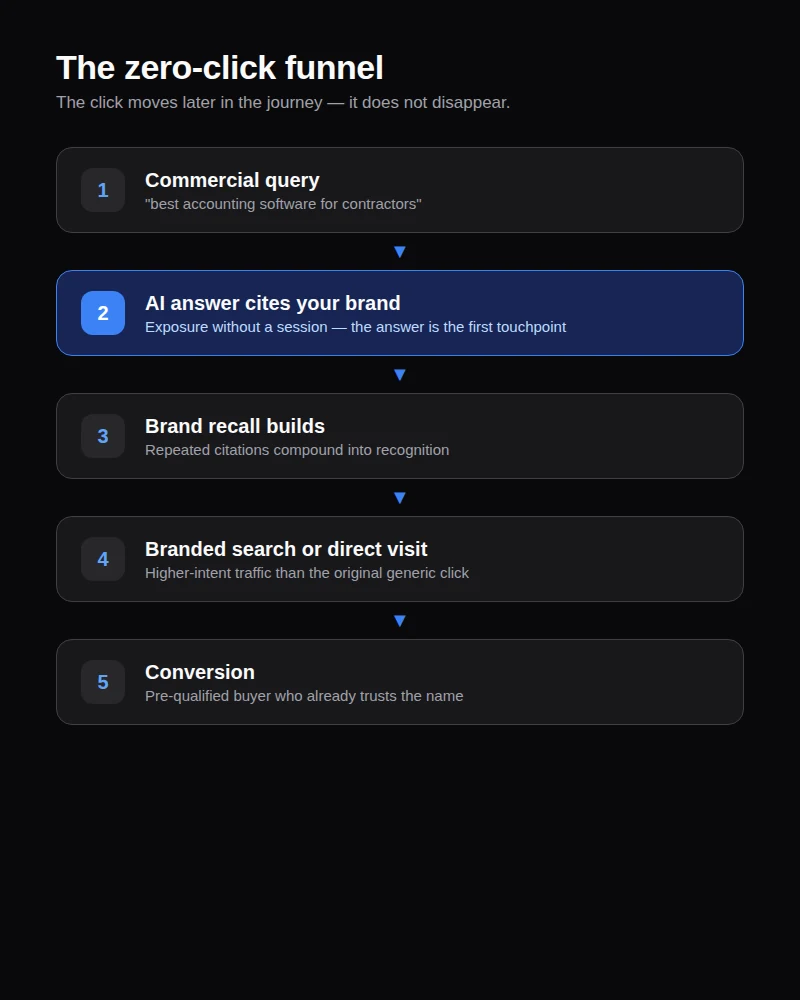
- The answer is the ad. When an AI Overview names your product or quotes your page, every user who reads that answer sees your brand. That is impression-level exposure you did not pay for.
- Citations compound. Being cited repeatedly in a topic cluster builds the association that makes answer engines cite you again — see how brand mentions feed visibility.
- Branded demand follows. Users who see your name in answers later search your brand directly. Branded queries convert at a multiple of generic ones and cannot be taken by a competitor's content.
- The click you do get is better. Users who click through after reading an AI summary arrive pre-qualified. Many sites report lower organic sessions but stable or better conversion rates.
The zero-click playbook
These are the moves that put a small business inside the answer instead of below it.
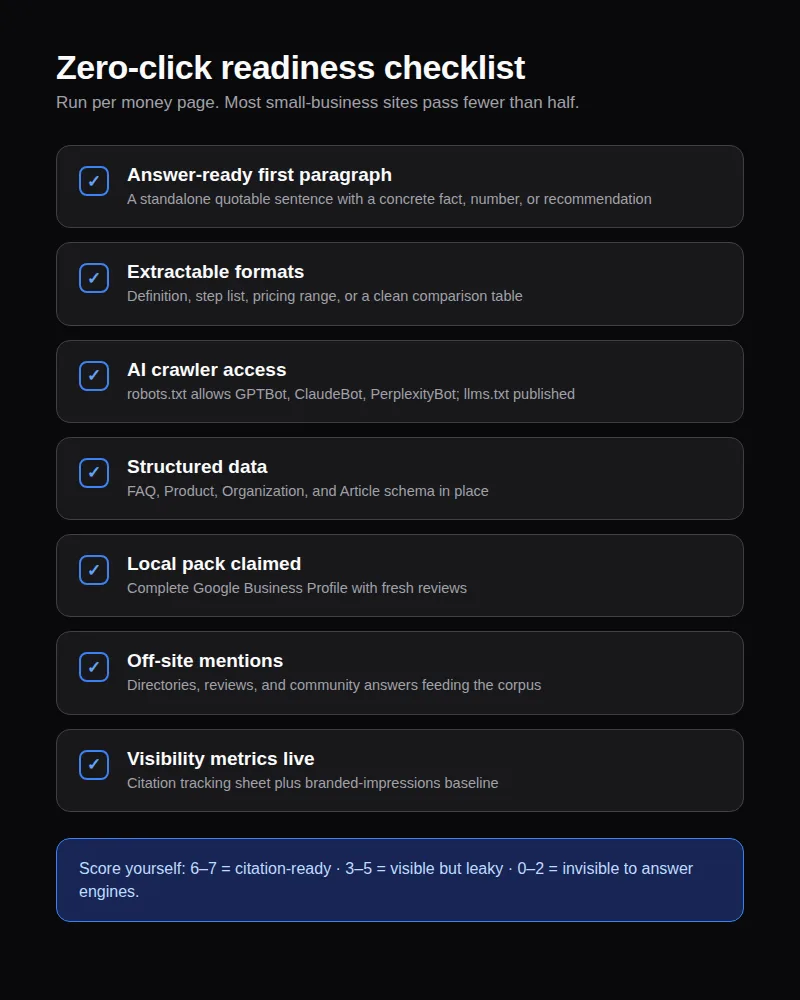
- Write answer-ready copy. Put a standalone, quotable sentence with the fact or recommendation in the first paragraph of every section. The prompt-ready brand copy workflow covers the exact pattern.
- Claim the extractable formats. Definitions, step lists, pricing ranges, and comparison tables are what answer engines lift. If your page has the cleanest table on the topic, it gets quoted.
- Open the technical gates. AI crawlers must be able to read the content: check your robots.txt rules for AI crawlers and consider an llms.txt file.
- Add structured data. FAQ, Product, Organization, and Article schema help engines identify what your page states. The schema markup guide for AI search has the priority list.
- Win the local pack. For service businesses, a complete Google Business Profile with reviews is the highest-ROI zero-click asset that exists — calls and directions never needed a click.
- Earn mentions off-site. Reviews, directories, guest posts, and community answers feed the corpus that answer engines trust. Citations on third-party sites count even when they never linked traffic to you.
- Optimize for the AI Overview specifically. Formatting and source-selection details differ from classic snippets; the AI Overviews optimization guide breaks them down.
Measurement when clicks disappear
The scoreboard has to change before the strategy makes sense. Keep tracking organic sessions, but add the visibility layer.
| Old metric | What it misses | Zero-click metric to add |
|---|---|---|
| Organic sessions | Exposure that never produced a visit | Impressions on target queries (Search Console) |
| CTR | Answers consumed on the SERP | Citation presence in AI answers for tracked prompts |
| Keyword rankings | Brand recall from being named | Branded search volume and impressions over time |
| Referral traffic | Demand created elsewhere | Direct traffic trends and assisted conversions |
| Backlinks | Unlinked authority | Brand mention volume and sentiment |
A practical cadence: once a month, run your ten most important commercial prompts through ChatGPT, Perplexity, and Google, record whether you are cited, and log it next to Search Console branded impressions. The AI citation tracking workflow has a ready-made sheet for this, and the GEO vs SEO guide explains why this layer sits on top of — not instead of — classic SEO work.
A 30-day starting sequence
- Week 1 — Audit. Run the GEO visibility checklist on your five money pages. Note which are quotable, crawlable by AI bots, and schema-complete.
- Week 2 — Rewrite intros. Make the first paragraph of each money page a standalone answer with one concrete fact, number, or recommendation.
- Week 3 — Structure. Add the missing schema, one clean comparison table per page, and fix robots.txt or llms.txt gaps.
- Week 4 — Measure. Set up the citation tracking sheet and a branded-impressions baseline so next month's change is visible.
Zero-click search rewards the businesses that treat the answer as the product page's first screen. Start with one page, get cited, and let the branded demand compound. Draft the hero line in the slogan generator or tagline generator, then audit the page with the GEO visibility checklist before you publish.
Frequently asked questions
What is a zero-click search?
A zero-click search is a query where the user gets the answer directly on the results page — from an AI Overview, featured snippet, knowledge panel, map pack, or an AI answer engine — and never visits a website. Studies of clickstream data have put the share of searches ending without a click above half, and AI-generated answers are pushing it higher.
Is zero-click search bad for small businesses?
It is bad if your only metric is raw clicks. It is an opportunity if you treat answers as brand exposure: being named or cited in the answer builds recall, branded searches, and direct visits later. Businesses that appear inside the answer often win the customer even when nobody clicked.
How do I measure results if traffic does not grow?
Shift the scoreboard from sessions to visibility and demand signals: citation presence in AI answers, brand mention volume, branded search impressions in Search Console, direct traffic, and assisted conversions. Track these monthly and compare against the periods where your answer presence grew.