Google AI Overviews Optimization: How to Get Cited in AI Answers
Google AI Overviews are the AI-generated answer panels that appear at the top of a growing share of search results. They answer the query directly, cite a handful of sources, and push classic blue links further down the page. For a small business that depends on search traffic, the question is no longer whether AI Overviews affect you — it is whether your content is one of the sources being cited when they appear.
This guide covers what Google has actually said about AI Overview eligibility, what independent citation studies show, the page-level tactics that earn citations, and how to measure whether any of it is working.
How Google chooses AI Overview sources
Google's public guidance is deliberately boring: there is no special markup, no opt-in file, and no separate "AI ranking system" to game. AI Overviews are built on the same core ranking systems as classic search, and the company has said that following Search Essentials — helpful, people-first content, crawlable pages, honest structured data — is the entire eligibility checklist.
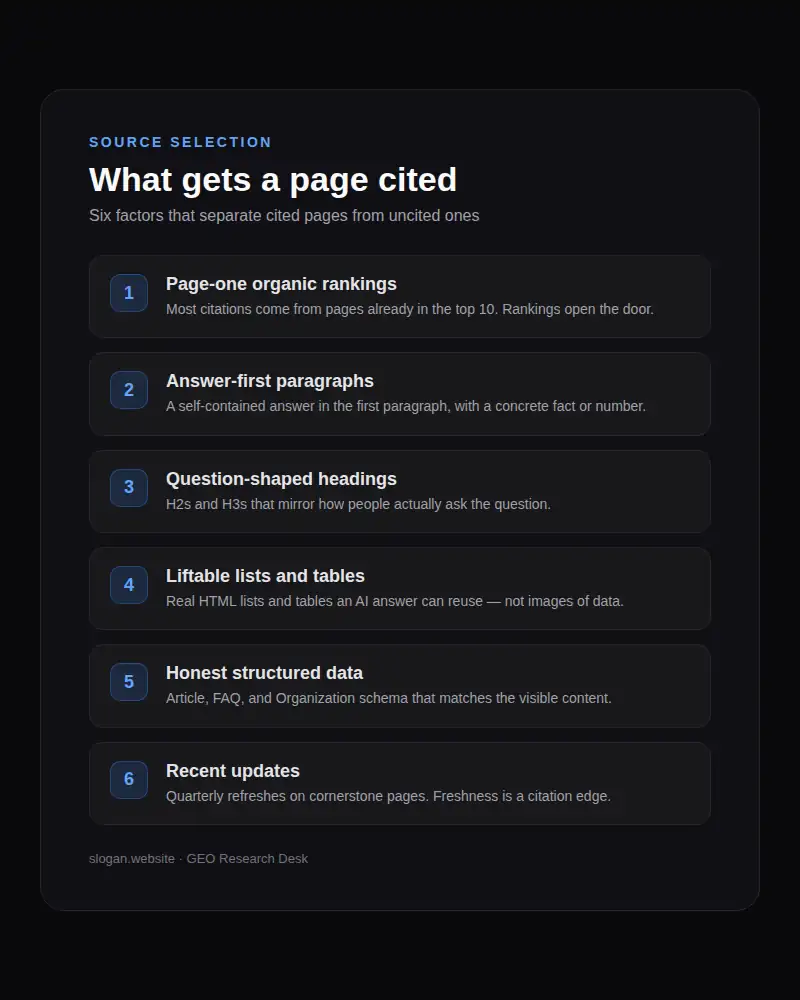
Independent research fills in the practical detail. Citation studies from major SEO platforms consistently find three patterns:
- Rankings carry over. The large majority of pages cited in AI Overviews already rank in the top 10 organic results for the same or a closely related query. You do not have to be number one, but you almost always have to be on page one.
- Structure decides who gets quoted. Among the eligible pages, the ones that get cited tend to answer the query in a self-contained paragraph near the top, use question-shaped headings, and include lists or tables that are easy to lift into an answer.
- Freshness and consensus matter. AI Overviews lean toward recently updated pages and toward claims that multiple credible sources agree on. Outlier claims without corroboration rarely make it into the synthesized answer.
The short version: classic SEO gets you into the candidate pool, and answer-ready formatting gets you picked from it. The GEO vs SEO guide explains how this overlaps with visibility in ChatGPT, Gemini, and Perplexity, which weight sources differently.
AI Overviews optimization vs classic SEO
Most of the work is the same work, which is good news: you are not starting a second SEO program. The differences are about emphasis.
| Area | Classic SEO | AI Overviews optimization |
|---|---|---|
| Goal | Rank high enough to earn the click | Be cited inside the answer, with or without the click |
| Content shape | Comprehensive pages targeting a keyword | Self-contained answer paragraphs, question headings, liftable lists and tables |
| Technical base | Crawlable, indexable, fast, mobile-friendly | Same, plus AI crawlers allowed in robots.txt and structured data that matches visible text |
| Success metric | Rankings, organic clicks, CTR | Citation presence on target queries, brand visibility in answers, assisted conversions |
| Biggest risk | Losing positions to competitors | The answer is given without you: zero-click loss with zero brand exposure |
One technical prerequisite is easy to miss: Google-Extended and the other AI crawlers need access before any of this matters. The robots.txt AI crawler guide has the exact directives to check first.
Page-level tactics that earn citations
These are the changes with the best effort-to-impact ratio on pages that already rank:
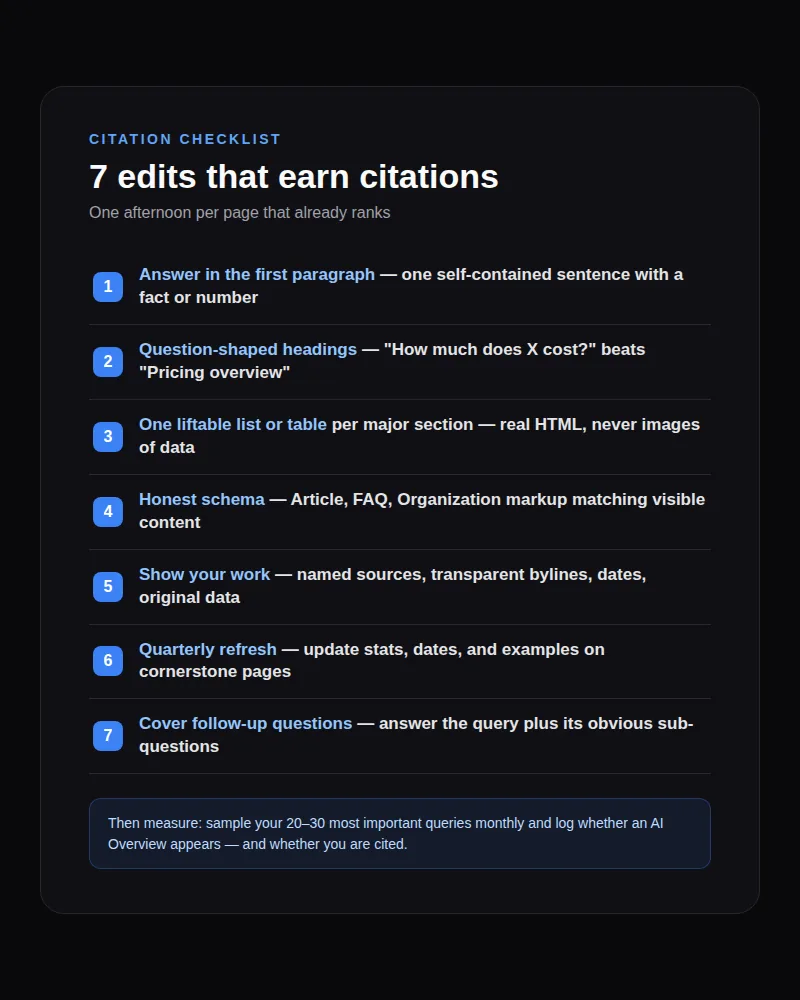
- Answer the query in the first paragraph. One or two sentences that stand alone, with a concrete fact or number. If a sentence cannot be quoted without surrounding context, rewrite it until it can.
- Use question-shaped H2 and H3 headings. "How much does X cost?" beats "Pricing overview." AI Overviews frequently trigger on question queries and match headings that mirror them.
- Add one liftable list or table per major section. A five-step numbered process or a compact comparison table is exactly the shape an AI answer wants to reuse. Use real HTML tables, not images of tables — machines cannot quote pixels.
- Keep structured data honest and complete. Article, FAQ, Organization, and Product schema that mirrors visible content helps Google's systems trust and parse the page. The schema markup for AI search guide covers which types matter most.
- Show your work. Named sources, transparent bylines, dates, and original data give the ranking systems — and the humans behind quality guidelines — reasons to trust the page. Anonymous, undated content is increasingly filtered out.
- Refresh on a schedule. Update statistics, dates, and examples quarterly on cornerstone pages. Citation studies show a measurable preference for recently updated content on competitive queries.
- Cover the follow-up questions. AI Overviews often synthesize sub-questions into one answer. A page that answers the main query plus its two or three obvious follow-ups is eligible for more citation slots.
What does not work
A few tactics are being sold hard right now and deserve skepticism:
- A magic file or tag. There is no equivalent of a sitemap that "submits" you to AI Overviews, and publishing an llms.txt does not change your eligibility — useful as citation hygiene, but not a lever.
- Keyword-stuffing questions. Repeating the query in every heading reads as spam to the same quality systems that decide eligibility.
- Blocking AI crawlers to protect traffic. This removes you from AI answers while competitors take the citations and the brand exposure. The traffic you "protect" was often a zero-click impression anyway.
- Chasing volume with thin AI content. Scaled, unedited AI text is precisely what Google's scaled-content abuse policy targets, and it fails the originality bar that citations require.
How to measure AI Overview visibility
There is no official AI Overviews report in Search Console, so measurement is a workflow, not a dashboard:
- Sample your target queries monthly. Twenty to thirty queries that matter most, checked in an incognito window, logged in a spreadsheet: does an AI Overview appear, and are you cited? This is tedious and still the most reliable method.
- Use rank trackers that flag AI Overviews. Several major platforms now report AI Overview presence per keyword and list cited domains. Use them for breadth, and manual checks for truth.
- Watch informational-page traffic for divergence. Impressions rising while clicks fall on a question-page is the classic zero-click signature — check whether an AI Overview appeared before assuming your content failed.
- Track brand mentions alongside citations. Being quoted without a click still builds branded search demand; a brand mention tracking workflow captures that value.
The GEO visibility checklist bundles these checks into a repeatable audit — crawler access, answer-ready formatting, structured data, and measurement — so you can score a page in minutes instead of guessing. Start with your five highest-impression informational pages, apply the seven edits above, and re-check citation presence in thirty days.
Frequently asked questions
Do I need special markup to appear in Google AI Overviews?
No. Google has stated there is no special schema or opt-in file for AI Overviews. Pages that follow Search Essentials, rank well organically, answer questions clearly, and use structured data that matches visible content are eligible. Classic SEO fundamentals carry most of the weight.
Do AI Overview citations only come from page-one results?
Not exclusively, but close. Independent studies consistently find that the large majority of cited pages already rank in the top 10 organic results for the query, and being number one is not required. Strong rankings plus a clear, quotable answer is the reliable combination.
Will AI Overviews kill my organic traffic?
They reduce clicks on some informational queries — roughly six in ten Google searches already ended without a click before AI Overviews expanded. The counter-strategy is twofold: get cited so your brand is visible inside the answer, and invest in content formats AI Overviews complement rather than replace, such as tools, calculators, comparisons, and original data.
How do I track whether my site appears in AI Overviews?
Combine three checks: manual sampling of your 20 to 30 most important queries each month, rank-tracking tools that flag AI Overview presence, and analytics segments for google.com referral traffic shifts on informational pages. There is no official AI Overviews report in Search Console yet.