AI Search Buyer Journey Map: Build the Four Pages Answer Engines Need
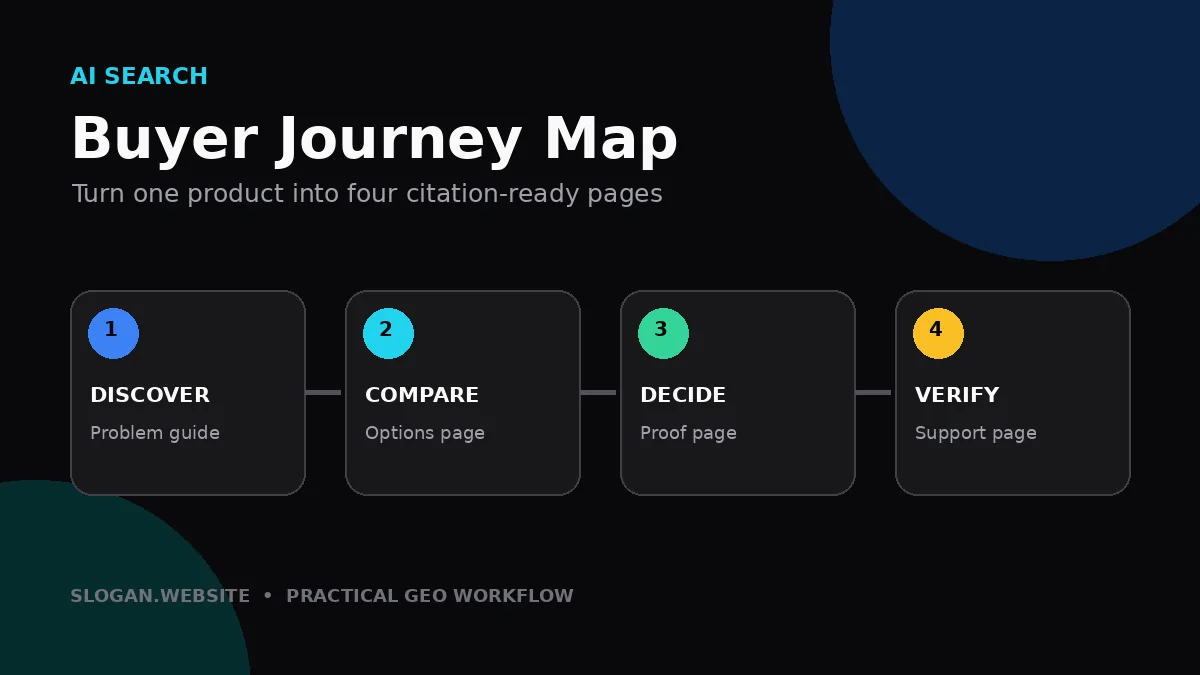
A buyer rarely jumps from “I have a problem” to “buy this exact product” in one step. They discover the problem, compare approaches, narrow the options, and verify that the final choice will work for them. AI answer engines follow the same evidence trail — but most small-business websites give them only a homepage and a pile of disconnected blog posts.
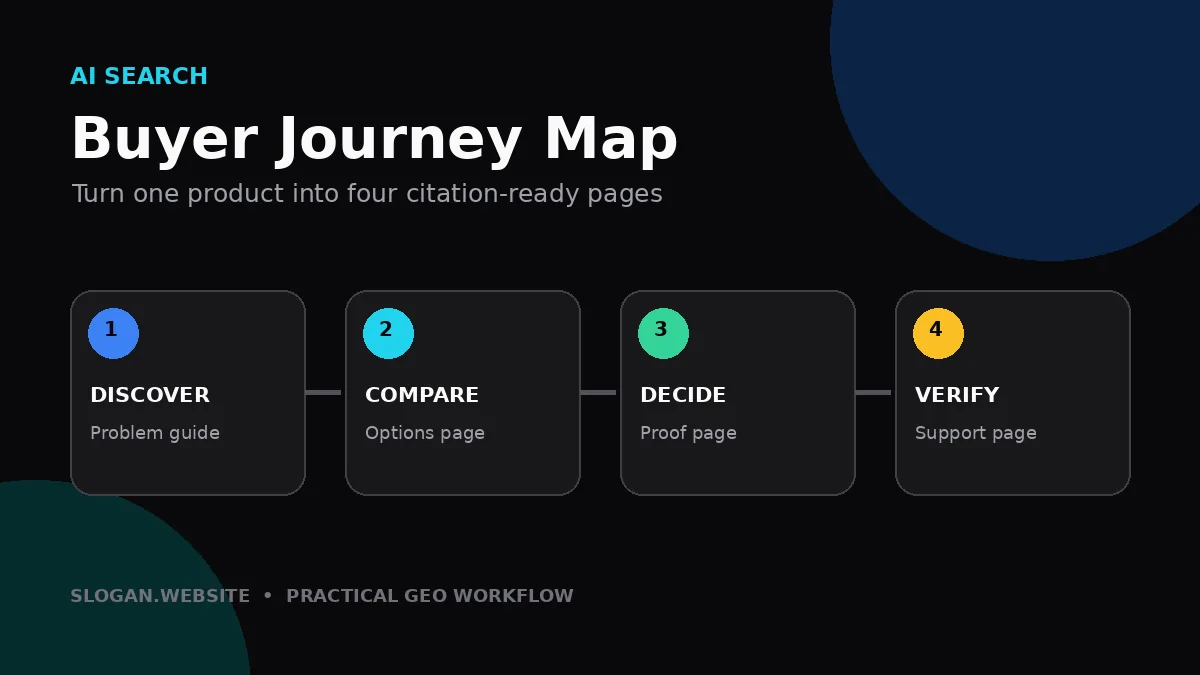
An AI search buyer journey map fixes that gap. It turns one priority offer into four focused content assets: a discovery guide, a comparison page, a decision page, and a verification page. Each asset answers a different kind of question and supplies a different kind of evidence. The result is a site that is easier for buyers to navigate and easier for ChatGPT, Gemini, Perplexity, and Google’s AI experiences to understand and cite.
Why a keyword list is not a buyer journey
A keyword list tells you what people type. It does not tell you what decision they are trying to make, what evidence would move them forward, or which page should own the answer. That is why keyword-led content plans often produce ten articles that compete with each other while the service page still answers none of the buyer’s hard questions.
AI search makes this weakness more visible. An answer engine may combine a definition from one site, trade-offs from a forum, pricing from a directory, and proof from a review profile. If your site contributes only a generic sales page, the engine has little reason to use it.
The better unit of planning is question + journey stage + required evidence. “What is payroll software?” needs a clear explanation. “Payroll software versus an accountant for five employees” needs a comparison. “Does this platform support contractors in Guatemala?” needs specific product evidence. Those are not three keywords for one article; they are three different jobs.
The four-query ladder
Start with one offer that matters commercially — your core service, highest-margin package, or most promising product. Then collect the questions buyers ask before and after they know your category name.
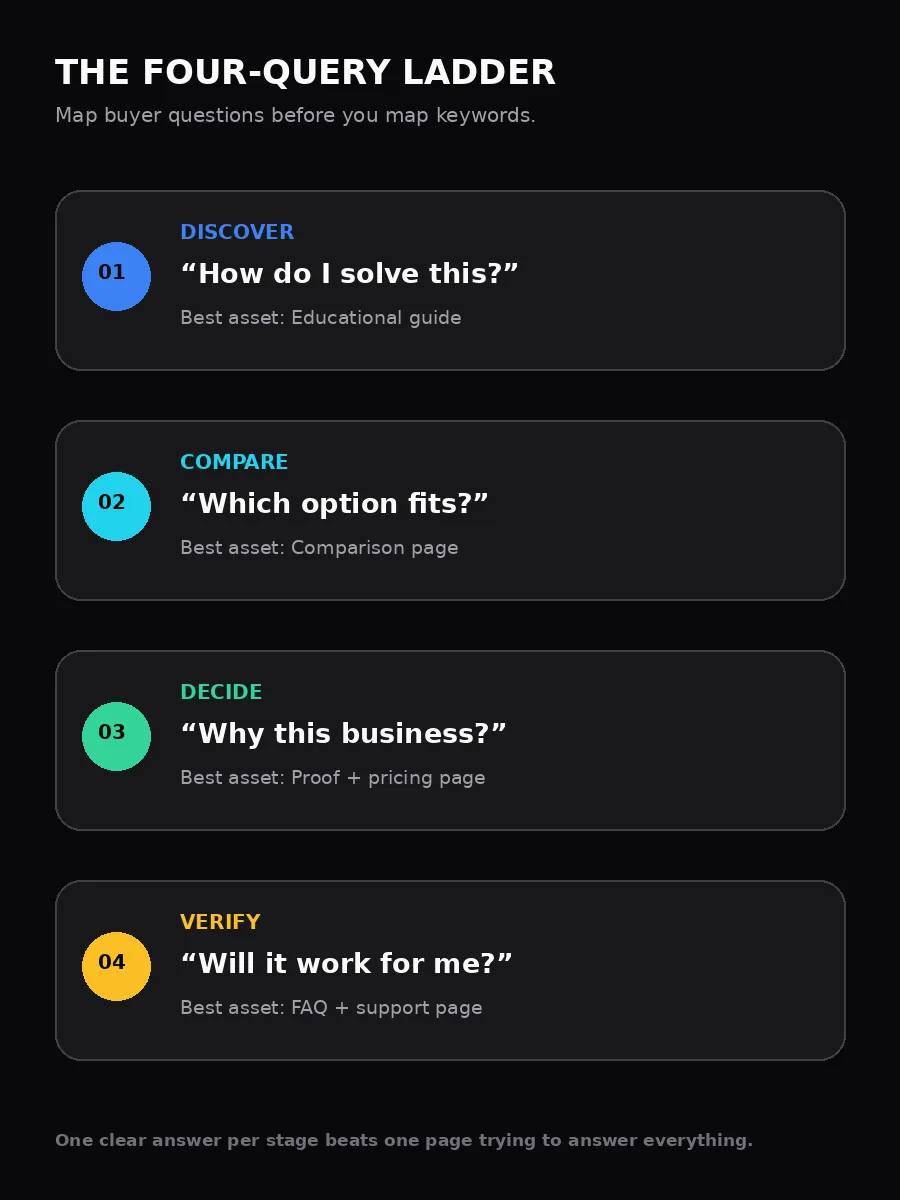
| Journey stage | Buyer question | Best content asset | Evidence the answer needs |
|---|---|---|---|
| Discover | “How do I solve this problem?” | Problem guide, checklist, or calculator | Clear definitions, steps, examples, and limitations |
| Compare | “Which approach or product fits my situation?” | Comparison or alternatives page | Trade-offs, fit criteria, scenarios, and transparent methodology |
| Decide | “Why should I choose this business?” | Product or service page | Specific capabilities, pricing context, proof, and next step |
| Verify | “Will it work for me, and what happens next?” | FAQ, implementation guide, policy, or case study | Eligibility, process, constraints, support, and first-hand outcomes |
The stages are not a rigid funnel. A buyer can enter at comparison, return to discovery, or verify one concern before deciding. The purpose of the ladder is not to force a path; it is to make sure every important question has a clear home.
Stage 1: build the discovery answer
Discovery content names the problem in the language buyers use before they know your solution. A local accounting firm might answer “How do I separate personal and business expenses?” rather than starting with “outsourced bookkeeping services.” A CRM vendor might answer “How do I stop leads from going cold?” rather than “pipeline automation platform.”
The page should give a direct answer near the top, then explain the process, common mistakes, and when the reader needs a different solution. Useful formats include checklists, simple calculators, decision trees, and step-by-step guides. The AI answer extraction writing guide shows how to make each section quotable without making it robotic.
Do not turn discovery content into a disguised pitch. If the page only reaches “contact us” after every question, buyers leave and answer engines find a more complete source.
Stage 2: make the comparison honest
Comparison questions reveal evaluation criteria: price, setup time, risk, integrations, location, team size, or use case. Your page should explain who each option is for, where it falls short, and what information could change the recommendation.
This is where small businesses can beat larger competitors. You know the edge cases buyers ask about on calls. Put those details into a semantic HTML table, then add short explanations for the trade-offs that cannot fit in a cell. The comparison-page workflow for AI citations covers the structure in depth.
Avoid declaring yourself the winner in every row. A credible comparison sometimes recommends another option. That honesty makes the rest of the page more useful to both buyers and retrieval systems.
Stage 3: connect the answer to your offer
The decision page is not just a list of features. It must connect those features to the criteria established in the comparison stage. State who the offer is for, the problem it solves, what is included, how the process works, and what proof supports the claims.
Use concrete language: supported locations, typical setup steps, compatible tools, response times, deliverables, and pricing model. If exact prices vary, explain the variables and give a realistic range or example where possible. Replace unsupported superlatives such as “best” and “leading” with verifiable specifics.
Add a clear next step that matches the purchase. A low-cost template can lead to checkout; a complex service may need an assessment. The page should never make an answer engine guess how the product described in the copy connects to the business named in the header.
Stage 4: close the verification gap
Verification questions are where many content maps fail. Buyers want to know what happens after purchase, whether the product works in their specific situation, what the limitations are, and whether the company can be trusted.
Useful verification assets include implementation guides, compatibility pages, returns or cancellation policies, detailed FAQs, methodology notes, and real case studies. Review profiles and community discussions can corroborate these claims off-site, but your website should still publish the primary facts.
This stage also reduces inaccurate AI answers. When policies, availability, and limitations are stated in one maintained location, engines have a cleaner source than an old forum reply or third-party directory.
Score the gaps before creating anything new
Do not assume the missing asset is another blog post. Score each stage from 0 to 2 on four dimensions:
- Page: does one clear, indexable page own this stage?
- Answer: does it answer the buyer’s main question directly?
- Proof: does it provide the evidence appropriate to the claim?
- Next step: can the buyer move forward without searching elsewhere?
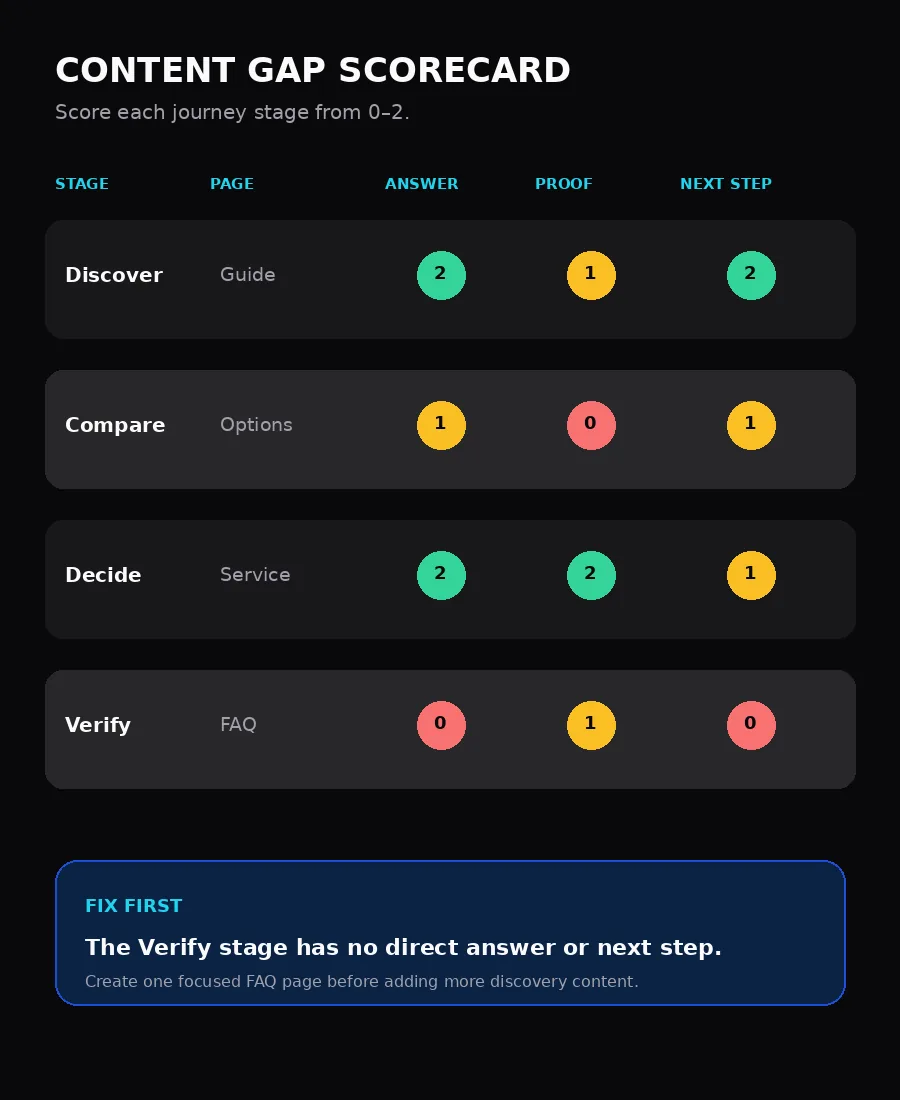
A zero means absent, one means partial, and two means strong. Fix the lowest-scoring commercially important stage first. If discovery scores eight out of eight but verification scores two, publishing another top-of-funnel guide is busywork.
For a broader technical and off-site baseline, pair this exercise with the one-hour AI search visibility audit or run the interactive GEO visibility checklist.
A 30-day implementation plan
Keep the first cycle narrow: one offer, four stages, and a small fixed prompt set.
- Week 1 — collect and classify questions. Review sales calls, support tickets, on-site search, community threads, and Search Console queries. Put 12 to 20 questions into the four stages. Record the exact wording rather than rewriting everything as a keyword.
- Week 2 — audit the existing pages. Assign each question to the page that should answer it. Score page, answer, proof, and next step. Consolidate overlapping pages before proposing new ones.
- Week 3 — repair the biggest gap. Improve or create one focused asset. Add the direct answer, appropriate evidence, internal links to the next stage, and structured data that accurately reflects the visible page content.
- Week 4 — test the path. Ask the fixed prompt set in multiple answer engines. Record whether your business appears, which pages are cited, whether the answer is accurate, and which competing sources fill the gaps. Use the AI citation tracking workflow to keep the test repeatable.
Repeat the cycle for the same offer until all four stages are credible. Only then map the next offer. This keeps production tied to business value instead of rewarding article count.
Measure stage coverage, not just traffic
Organic sessions remain useful, but they are incomplete for zero-click AI answers. Track a small set of journey-specific signals:
- prompt-level mentions and citations by engine;
- the source URL chosen for each journey stage;
- answer accuracy and freshness;
- assisted conversions from guides and comparison pages;
- AI referral visits, when the platform sends a click;
- sales questions that still have no clear page to share.
The GA4 AI referral tracking guide covers the analytics setup. Keep prompt testing separate from referral reporting: an answer can influence a buyer without producing a measurable click.
The bottom line
An AI search content strategy should not begin with “publish more.” Begin with one offer and four buyer questions: how do I solve this, which option fits, why this business, and will it work for me? Map each question to a focused page, score the answer and evidence, then repair the weakest stage.
That four-page path gives buyers a coherent decision journey and gives answer engines a set of specific, corroboratable sources. Run the scorecard before your next content brief, then use the GEO visibility checklist to check the technical foundation underneath it. Draft the offer headline in the slogan generator and model campaign return in the Marketing ROI Calculator once the pages are live.
Frequently asked questions
What is an AI search buyer journey map?
It is a simple plan that connects the questions buyers ask at four stages — discovery, comparison, decision, and verification — to the specific pages on your site that answer them. Unlike a keyword list, it shows whether an answer engine has enough useful evidence to mention your business from the first problem question through the final trust check.
How many pages does a small business need for AI search visibility?
Start with four focused pages around one priority offer: a problem guide, a comparison page, a service or product page with proof, and a verification page such as an FAQ, methodology, or implementation guide. Improve those pages before expanding into more topics. One strong four-page path is more useful than twenty disconnected posts.
Should every buyer question get its own page?
No. Group questions that share the same intent and can be answered completely on one page. Split them only when the buyer needs a different type of evidence or action. A comparison question needs trade-offs; a verification question needs policies, proof, and limitations. Mixing both into one long page often weakens the answer.
How do I measure whether the content map works?
Track the same 12 to 20 buyer prompts monthly across ChatGPT, Gemini, Perplexity, and Google AI Overviews when available. Record mentions, citations, source URLs, accuracy, and whether the cited page matches the question's journey stage. Also track assisted conversions and AI referral visits in analytics, but do not treat clicks as the only outcome because many AI answers are zero-click.