Answer-First Writing: How to Format Content AI Engines Extract and Quote
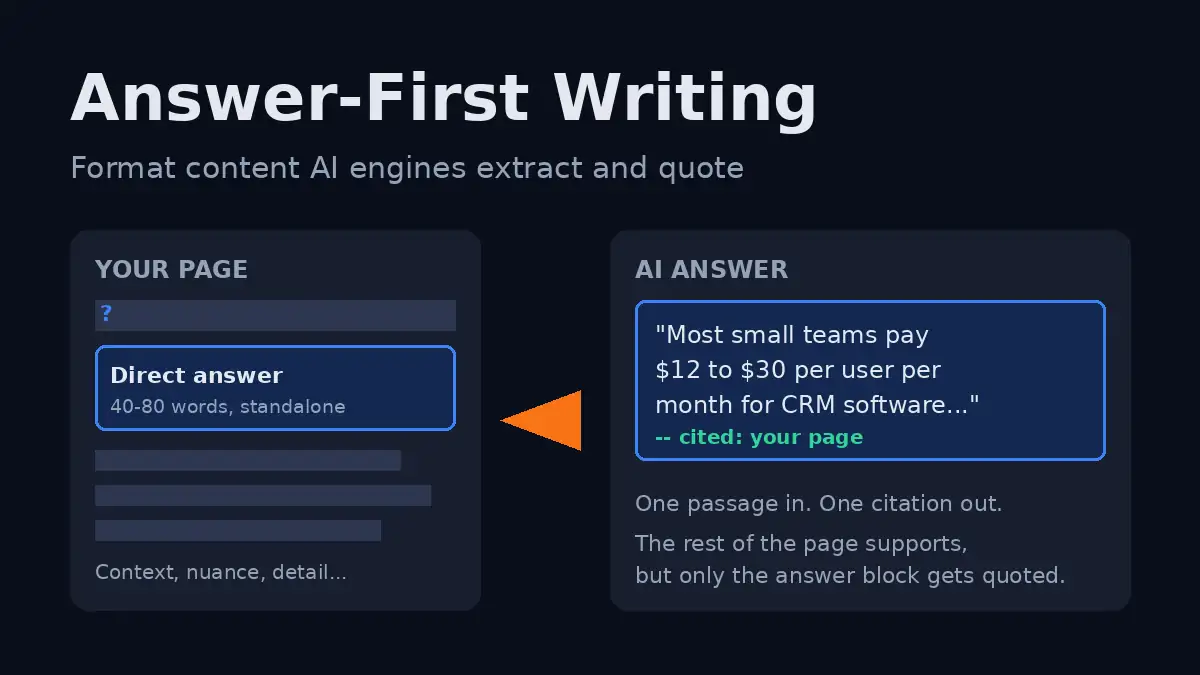
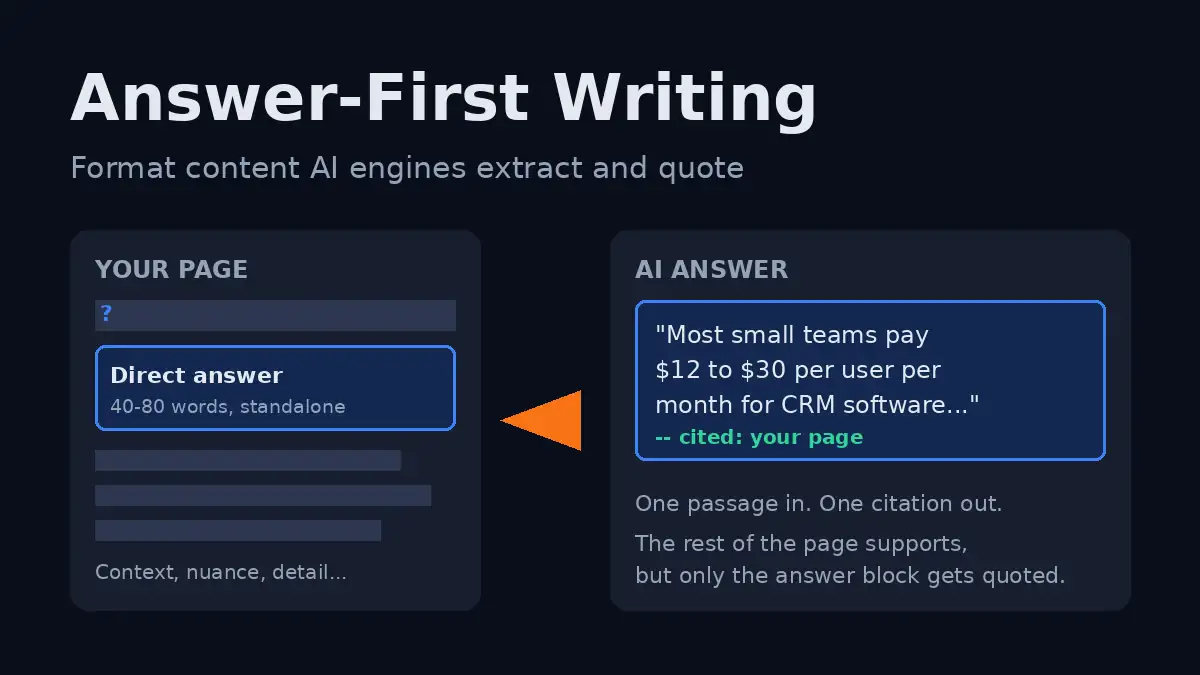
AI answer engines do not read your page the way a person does. They scan for the smallest passage that resolves a question, extract it, and stitch it into a generated answer. If your best line is buried in paragraph six, the engine quotes a competitor whose equivalent line sits in sentence one.
This is the practical writing layer of GEO. Technical access, schema, and llms.txt get your content into the candidate pool; answer-first formatting decides whether anything from the page actually gets quoted. This guide covers the passage-level structure that makes content extractable, with before-and-after rewrites you can apply to existing pages.
Why extraction is different from ranking
Classic search ranks whole pages. AI answer engines rank passages. Google AI Overviews, ChatGPT search, and Perplexity all retrieve text chunks, score them for relevance and reliability, and then quote or paraphrase the best ones. Three consequences follow:
- A strong page can lose to a strong passage. A mediocre page with one perfectly extractable answer block beats a great page where the answer is implied but never stated.
- Position inside the page matters. Retrieval systems weight content near question-shaped headings and near the top of a section more heavily than content buried mid-article.
- Standalone sentences win. If a sentence needs the previous paragraph to make sense, it fails extraction. Pronouns like "it" and "this" with no local antecedent are extraction killers.
The GEO vs SEO breakdown covers the strategy-level split. What follows is the sentence-level craft.
The anatomy of an extractable passage
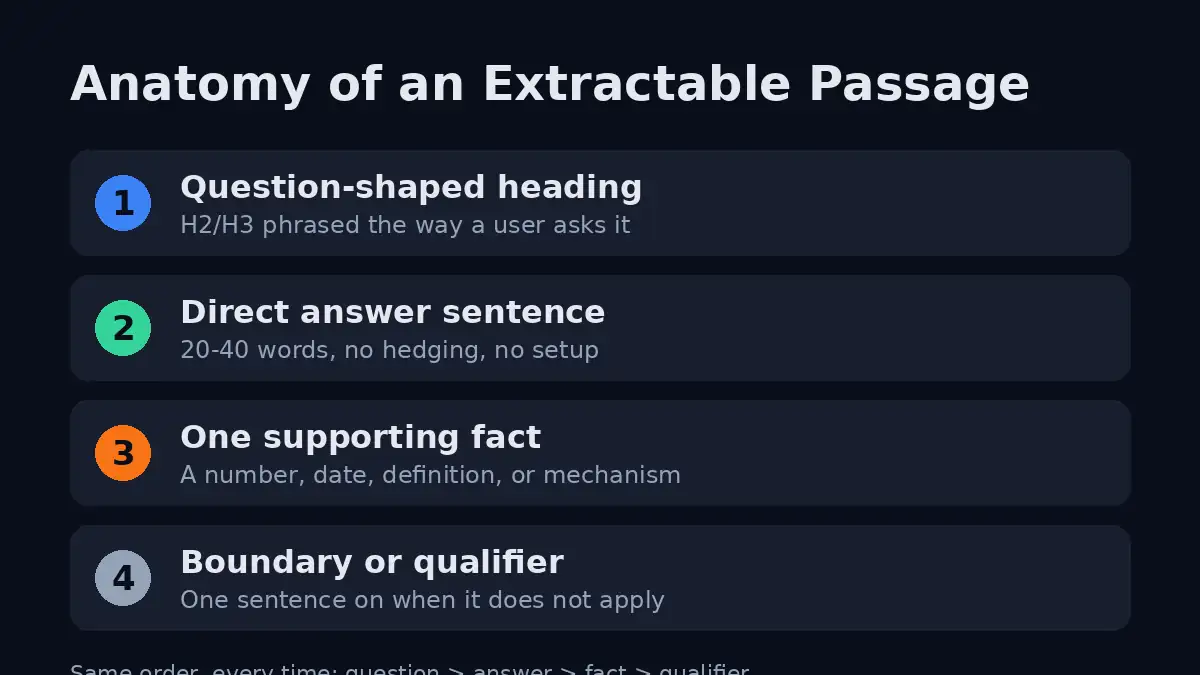
Every passage that AI engines reliably quote has the same four parts, in order:
- Question-shaped heading. An H2 or H3 phrased the way a user would ask it, or a short declarative label that maps cleanly to a query.
- Direct answer in sentence one. One sentence, 20 to 40 words, that fully answers the heading question with no hedging, no setup, and no reference to other sections.
- One supporting fact. A number, date, definition, or named mechanism that gives the answer weight. Engines prefer passages that carry a concrete detail.
- Boundary or qualifier. One sentence stating when the answer does not apply. Qualifiers increase citation confidence because they make the passage self-limiting instead of absolute.
Before and after: a real rewrite
The pattern is easiest to see in a rewrite. Both versions below say the same thing; only one is extractable.
| Version | Text | Extraction verdict |
|---|---|---|
| Buried (before) | "When businesses think about pricing software, there are many factors to consider, and over the years we've seen that it really depends on your situation, though most small teams find that..." | Fails. No answer in the first 50 words, pronouns without antecedents, hedging stack. |
| Answer-first (after) | "Most small teams pay $12 to $30 per user per month for CRM software in 2026. That range covers entry tiers from the five largest small-business CRM vendors. Teams needing built-in phone or advanced automation should budget above it." | Passes. Complete answer, concrete number, named scope, one qualifier, all in 60 words. |
The "after" version is not dumbed down. It is reordered: conclusion, evidence, boundary. Everything the original implied is still there, but each sentence survives being lifted out of context.
Formatting rules that move extraction rates
These rules come from the pattern across Google AI Overviews, ChatGPT search, and Perplexity citation behavior:
- One question per heading. If a heading covers two questions, split it. Engines match headings to queries; compound headings match neither query well.
- Front-load numbers and named entities. "CRMs cost $12 to $30 per user per month" extracts. "The cost varies, but typically falls in a reasonable range" does not.
- Keep the answer block to 40 to 80 words. Long enough to be complete, short enough to fit in a generated answer without truncation.
- Use lists for enumerations, prose for answers. AI engines quote list items as-is, so make each item a complete sentence.
- Date your claims. "In 2026" or "as of September 2026" signals freshness, which answer engines weight heavily for time-sensitive queries.
- Avoid pronoun chains. Repeat the subject ("the CRM," "the checklist") instead of "it" when more than one sentence separates mentions.
- Do not answer in an image. Text inside graphics is invisible to text retrieval. Keep the quotable sentence in HTML and let images support it.
If your pages also feed prompt-ready brand copy into campaigns, the same discipline applies: short, self-contained, concrete.
The extraction readiness scorecard
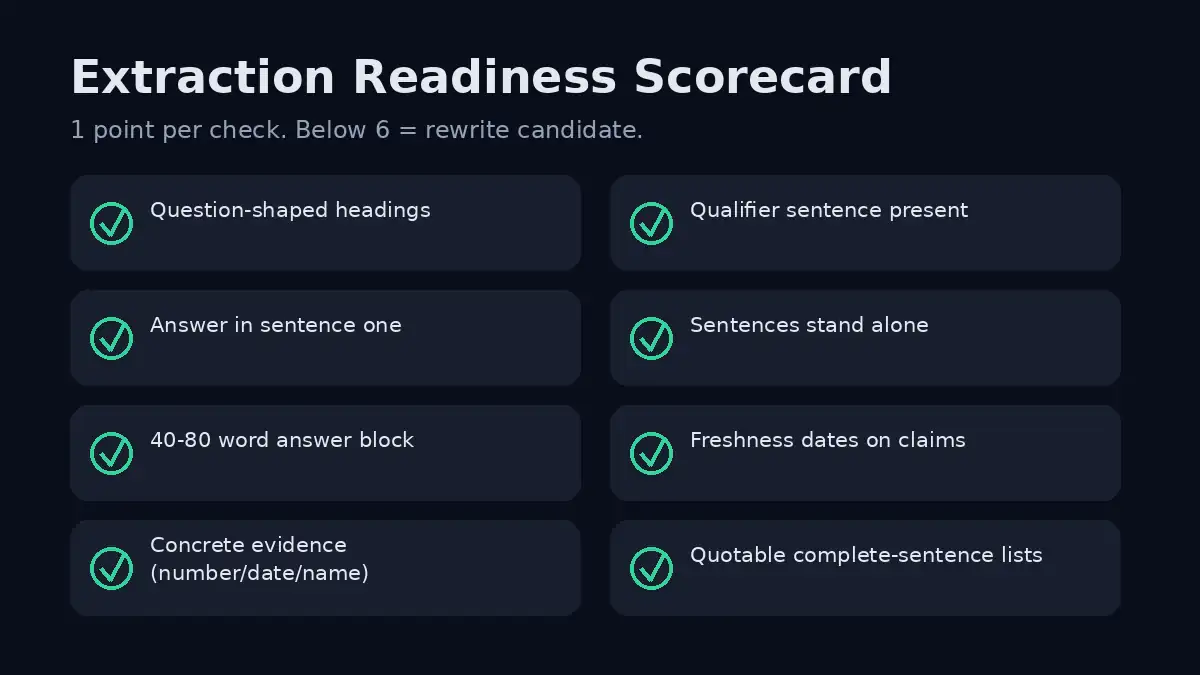
Run any existing page through this eight-point check. Score one point per item; anything below six is a rewrite candidate.
| # | Check | Pass condition |
|---|---|---|
| 1 | Question-shaped headings | At least half of H2/H3 headings map to a real user query |
| 2 | Answer in sentence one | First sentence under each heading answers the heading directly |
| 3 | Answer block length | Core answers run 40 to 80 words before the first aside |
| 4 | Concrete evidence | Every answer block contains a number, date, name, or definition |
| 5 | Qualifier present | Key answers state scope or an exception in one sentence |
| 6 | Standalone sentences | Any single quoted sentence makes sense out of context |
| 7 | Freshness signals | Time-sensitive claims carry a year or "as of" date |
| 8 | Quotable lists | Enumerations are HTML lists with complete-sentence items |
A weekly rewrite workflow
Rewriting for extraction does not mean rewriting everything. A focused loop on your highest-value pages pays back faster:
- Pick five pages that already get impressions or that you want cited for a money query. Start where citation tracking shows competitors being quoted instead of you.
- Score each page against the eight-point scorecard above and mark the failing checks.
- Rewrite answer blocks only. Keep the rest of the page intact; you are reordering conclusions, not reauthoring articles.
- Re-test in the engines. Ask the target query in ChatGPT, Perplexity, and Google a week later and record whether the passage appears.
- Run the technical layer. Confirm the page passes the GEO visibility checklist so retrieval is not the bottleneck — extraction fixes cannot help a page the crawlers never see.
Where this fits in the GEO stack
Answer-first writing is one layer of four. Technical access (robots.txt, sitemaps) decides whether engines can read you. llms.txt and schema decide whether they understand site structure. Answer-first formatting decides whether they quote you. Citation tracking decides whether you know any of it worked. Pages that get all four layers right compound: every citation reinforces the brand-mention signal that feeds the next citation. Score the page with the GEO visibility checklist after you rewrite the opening sections.
Frequently asked questions
What is answer-first writing?
Answer-first writing puts the direct, complete answer to a question in the first one or two sentences under a heading, before any context or nuance. AI answer engines extract the passage that most directly resolves the query, so the answer has to stand alone without the surrounding paragraphs.
Does answer-first writing hurt human readers?
No. It matches how people scan pages anyway: readers want the conclusion up front and the reasoning after. Journalists call it the inverted pyramid. The only real change is discipline: one question per heading, one self-contained answer per passage.
How long should an extractable passage be?
Aim for 40 to 80 words for the core answer block: enough to be a complete, quotable unit, short enough to fit inside a generated answer. Supporting detail, examples, and edge cases go in the paragraphs after it.
How do I know if my content is being extracted?
Track citations directly. Run your target queries in ChatGPT, Perplexity, and Google AI Overviews on a schedule and record whether your brand is named or linked. A structured process for this is in our AI citation tracking workflow.