Prompt-Ready Brand Copy: Build an AI Message Library That Stays on Brand
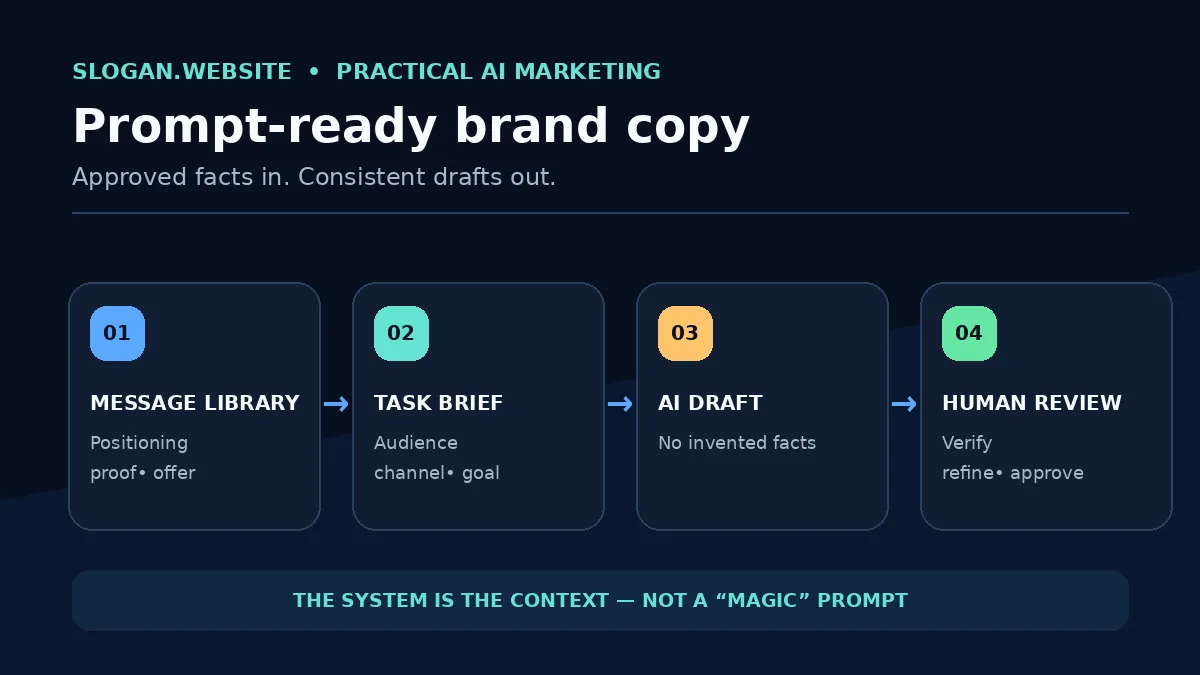
AI copy gets inconsistent when every request starts with a blank prompt. One person pastes a slogan, another adds an old brochure, and a third asks a chatbot to “make it punchy.” The drafts may sound polished, but pricing drifts, proof gets exaggerated, and the voice changes from channel to channel.
A prompt-ready message library fixes the context problem. It turns approved brand facts into a compact system that a marketer can reuse across landing pages, emails, ads, sales scripts, and AI-assisted search content. The goal is not to automate judgment. It is to stop rebuilding the brand brief every time someone opens a prompt box.
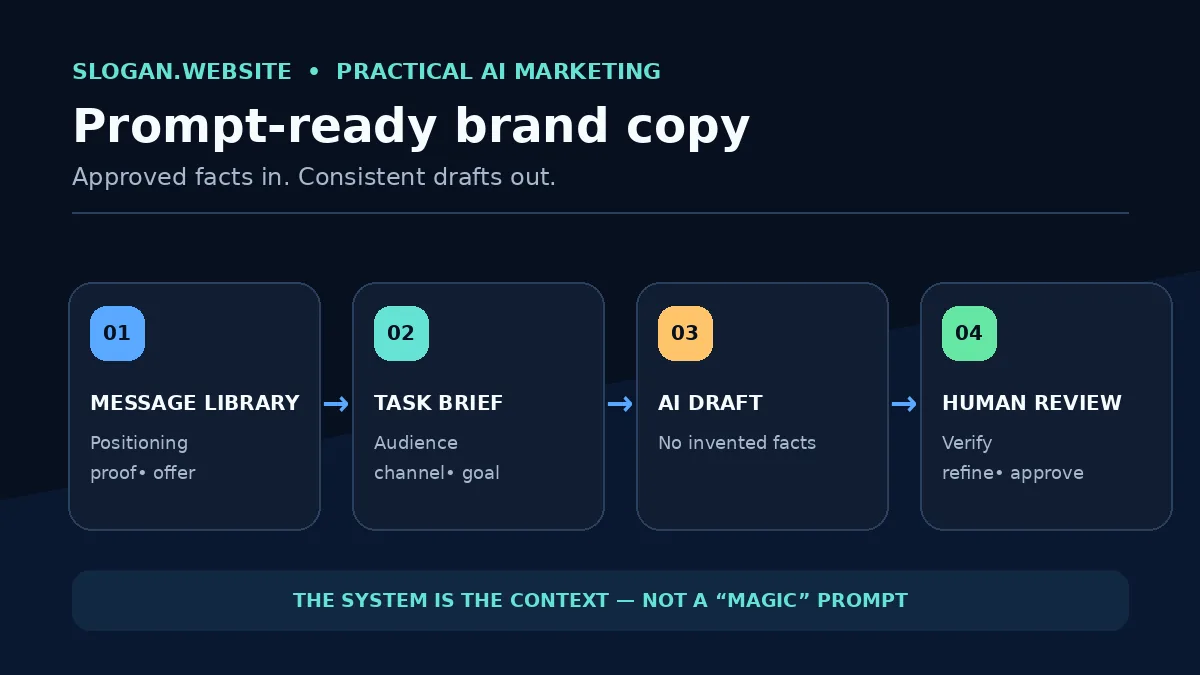
Start with a message library, not a giant prompt
A useful library separates durable facts from campaign instructions. Durable facts include the audience, problem, positioning, proof, offer boundaries, voice rules, and required disclosures. Campaign instructions change with the task: the channel, objective, length, audience segment, and call to action.
Keeping those layers separate makes updates safer. If delivery time changes, you edit one approved fact instead of hunting through twenty saved prompts. If a campaign needs a playful tone, that temporary instruction does not silently rewrite the core brand voice.
Use six blocks:
- Audience: who the message is for, what situation they are in, and what they already understand.
- Positioning: the category, practical difference, and reason to choose the offer.
- Proof: verified numbers, policies, credentials, demonstrations, reviews, or customer outcomes.
- Offer: scope, price or pricing rule, availability, exclusions, and next step.
- Voice: desired qualities, banned habits, reading level, terminology, and representative examples.
- Guardrails: claims the business cannot make, legal or platform constraints, and facts that always need human confirmation.
Your slogan can anchor the positioning block, but it cannot carry the whole system. If the core line is still vague, use the landing page copywriting framework to clarify the promise before turning it into reusable AI context.
Convert claims into evidence-backed message cards
Do not store unsupported superlatives such as “best,” “fastest,” or “guaranteed.” Store a claim beside the evidence that permits it. This keeps the AI from treating promotional language as a verified fact.
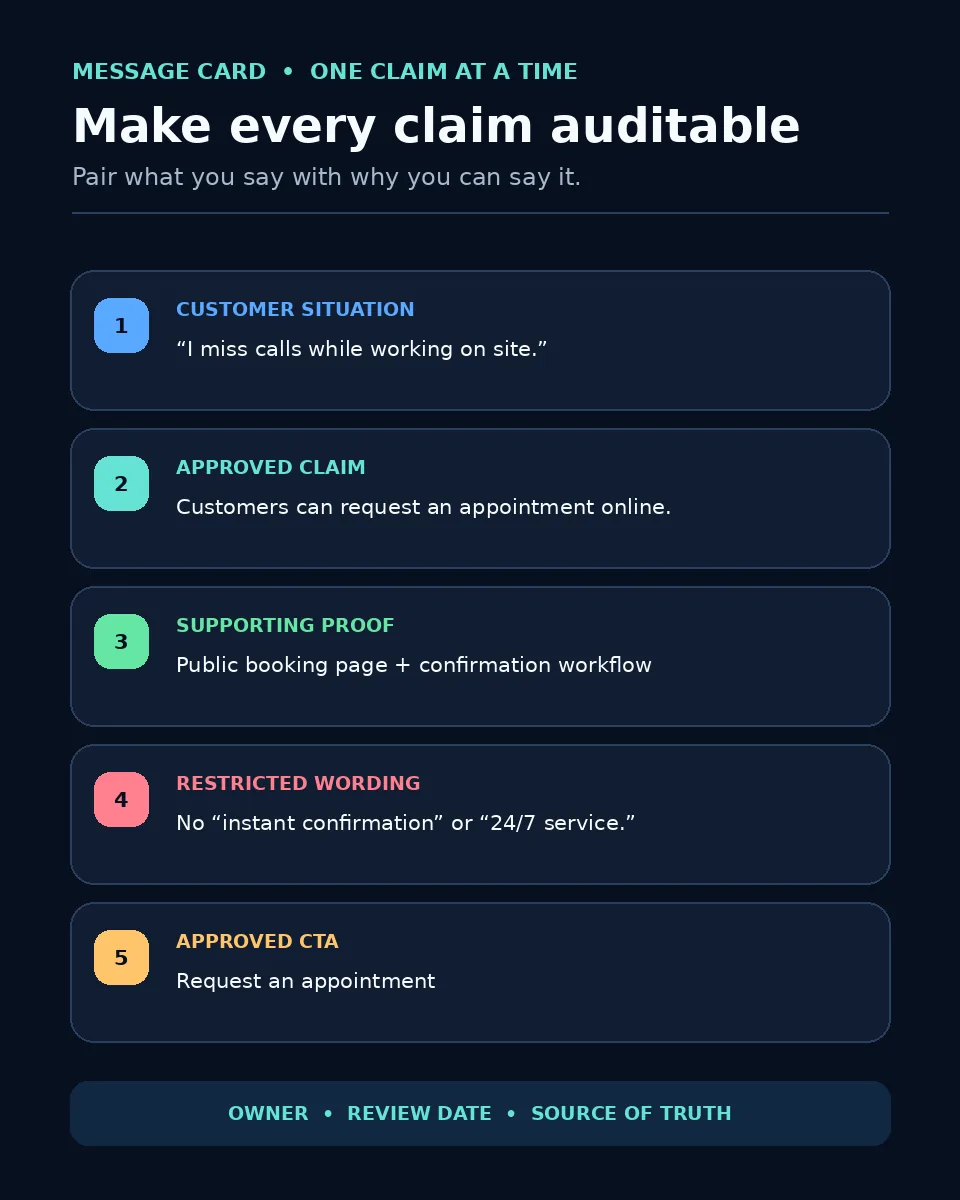
A message card can be a row in a spreadsheet, a page in a knowledge base, or a small structured file. Give it these fields:
| Field | What to store | Example |
|---|---|---|
| Customer situation | The problem in the customer's language | “I miss calls while working on site.” |
| Approved claim | A precise promise the business can support | “Customers can request an appointment online at any time.” |
| Evidence | The feature, policy, data, or source behind the claim | Public booking page and confirmation workflow |
| Restrictions | Words or implications to avoid | Do not promise immediate confirmation or 24/7 service |
| Approved CTA | The exact next step | “Request an appointment” |
| Owner and review date | Who confirms the fact and when it was checked | Operations · reviewed September 2026 |
This format is especially useful for prices, turnaround times, coverage areas, integrations, qualifications, and customer results. Those are the details most likely to become stale or overstated in a generated draft.
Add examples that teach decisions, not phrases to copy
AI tools learn the pattern you provide. Give them two or three approved examples with short annotations explaining why each one works. An example might note: “Leads with the customer's job, names the concrete outcome, and uses the approved request CTA.”
Include one rejected example too. Explain whether it fails because it makes an unsupported claim, uses a banned phrase, hides the offer, or sounds unlike the brand. A contrast often teaches the boundary faster than a longer list of adjectives.
Avoid loading dozens of old campaigns into the context. Historical copy may contain expired pricing, a discontinued service, or a voice the business has outgrown. Curate examples; do not turn the archive into the source of truth.
Use a task brief for every draft
The library tells the AI what is true. The task brief tells it what to make. A practical brief includes:
- Asset: landing-page hero, email, social post, ad variation, product description, or sales follow-up.
- Objective: book a call, request a quote, start a trial, compare options, or explain a decision.
- Audience segment: choose one situation rather than “everyone.”
- Message card: identify the approved claim and proof to use.
- Channel constraints: character count, format, required disclosure, and prohibited content.
- Output shape: number of options, sections, headline length, or table fields.
- Review instruction: list facts that require verification and do not invent missing information.
A compact prompt can then say: “Use the attached brand library and message card. Draft three landing-page hero options for the stated audience. Preserve the approved claim and CTA. Do not add facts. After the options, list any assumption or unsupported detail.”
The request is deliberately boring. The quality comes from the structured context, not from clever prompt theatrics.
Run a five-check review before publishing
A fluent draft is not an approved asset. Review it in a fixed order so style preferences do not distract from factual mistakes.
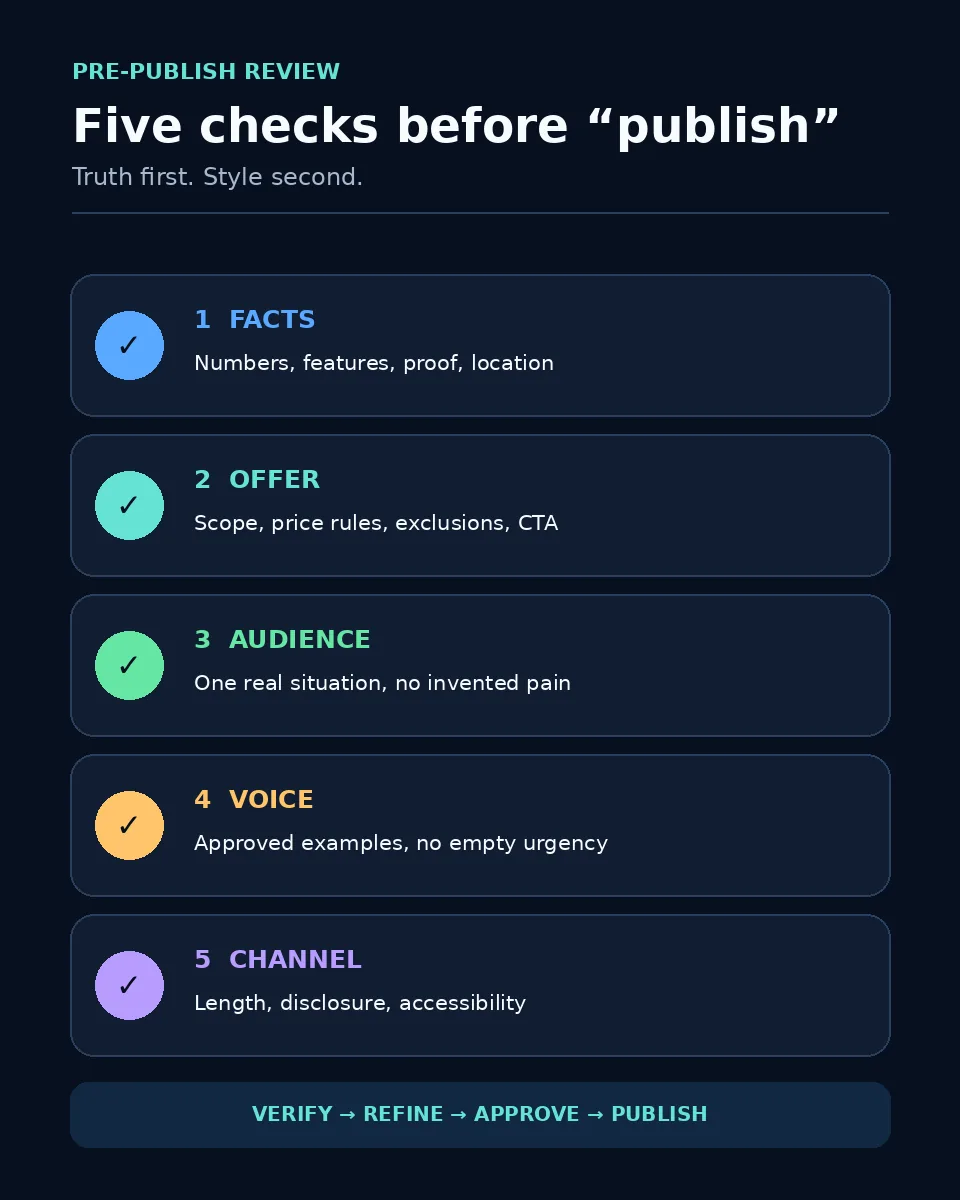
- Facts: Is every number, feature, location, credential, and customer outcome supported by the current library?
- Offer: Does the copy preserve scope, price rules, exclusions, timing, and the approved call to action?
- Audience: Does it address one real customer situation without inventing pain points?
- Voice: Does it match the approved examples and avoid banned language, clichés, and empty urgency?
- Channel: Does it meet length, disclosure, accessibility, and platform requirements?
For regulated, financial, medical, legal, employment, or insurance claims, assign review to someone qualified to approve that subject. A prompt guardrail is not professional sign-off.
Version the library like an operating asset
Give the library a visible version, owner, and last-reviewed date. Log meaningful changes such as a new price, narrower service area, approved proof point, or retired offer. When a campaign launches, record which version it used.
A simple operating rhythm is enough:
- At every offer change: update the fact and every affected message card before requesting new drafts.
- Monthly: review facts that change often, including pricing, inventory, integrations, and availability.
- Quarterly: review positioning, proof, examples, voice rules, and restrictions with marketing and operations.
- After a correction: add the failure pattern to the guardrails so it is less likely to recur.
Do not paste confidential customer information, private contracts, credentials, or sensitive internal data into an AI tool without an approved data policy. Use the minimum context needed for the drafting task.
Connect the library to campaign measurement
A message library becomes more useful when every campaign records which positioning block, message card, and CTA it used. You can then compare message families instead of debating individual headlines.
Use stable labels such as problem-speed, proof-booking-data, and cta-request-demo. Carry those labels into campaign naming or your experiment log. The campaign message workflow shows how to connect the approved message to a measurable campaign, while the Marketing ROI Calculator helps keep spend and return separate from copy preferences.
Do not let weak performance automatically rewrite a verified fact. Diagnose the audience, channel, offer, creative, and measurement setup first. Testing should improve how the truth is presented, not pressure the system to invent a stronger truth.
Build the first version in one working session
Start small. Choose one high-value offer and create six to ten message cards from current website copy, sales questions, policies, and verified proof. Add three approved examples, one rejected example, and the five-check review list. Test the system on one landing-page section and one email.
Have operations verify the facts and marketing verify the voice. Correct the library before producing more assets. Once the first offer works, repeat the structure for the next offer instead of expanding one enormous prompt.
Finally, run the GEO visibility checklist on the resulting page. Prompt-ready copy helps internal consistency; clear entities, crawlability, structured data, and citation-ready evidence help that message travel through search and AI answer systems.
The durable advantage is not a secret prompt. It is a maintained source of truth that makes every prompt easier to write, every draft easier to review, and every claim easier to defend. When the approved message still needs a public-facing line, draft options in the slogan generator before you lock the hero.
Frequently asked questions
What is prompt-ready brand copy?
Prompt-ready brand copy is a structured set of approved positioning, proof points, offers, voice rules, examples, and restrictions that an AI tool can use as reliable context when drafting marketing assets.
Is a brand prompt the same as a brand voice guide?
No. A voice guide describes how the brand should sound. A prompt-ready message library also defines what the brand can claim, which proof supports those claims, who each offer serves, and which calls to action are approved.
How often should a prompt library be updated?
Review it whenever pricing, offers, proof, policies, or positioning change, plus a scheduled quarterly check. Give every important fact an owner and last-reviewed date.
Can a prompt library replace human review?
No. It improves draft consistency, but a person should still verify facts, tone, legal or policy-sensitive claims, and whether the final asset fits its channel and audience.