AI Citation Tracking: A Practical Workflow for Small Businesses

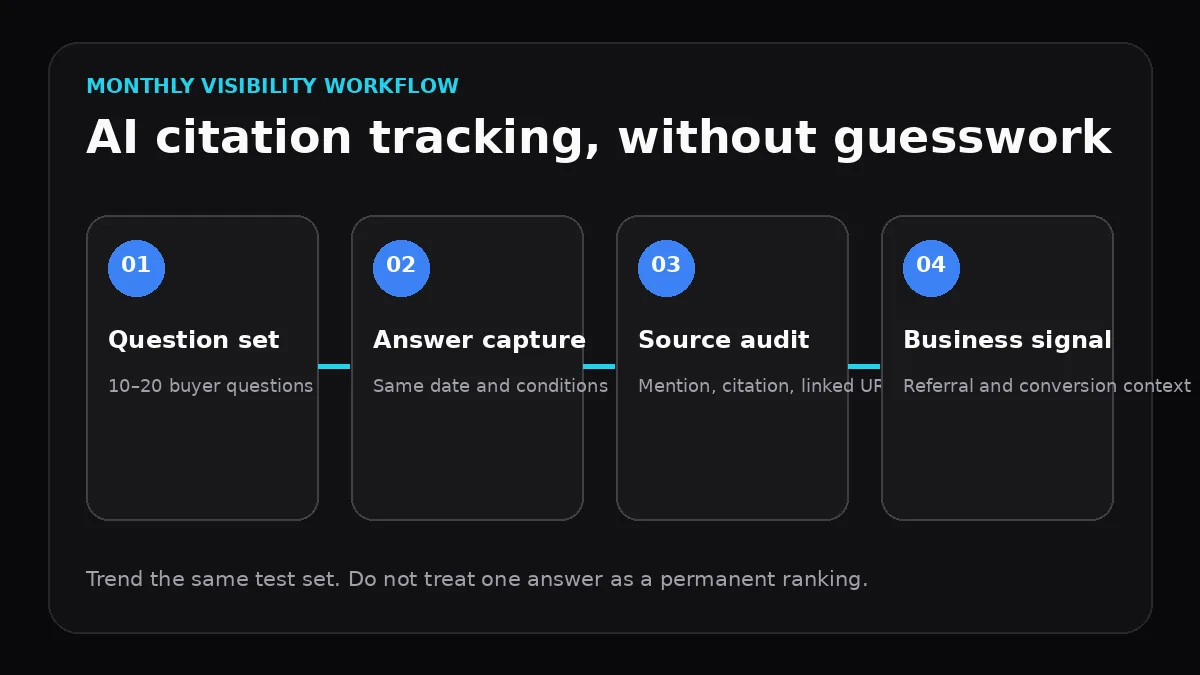
AI citation tracking measures whether answer engines mention your brand, cite your site, or use a competitor as the source for questions that matter to your customers. The useful unit is not a single flattering screenshot. It is a repeatable set of questions, captured under consistent conditions and reviewed alongside referral and conversion data.
For a small business, the workflow can fit into one spreadsheet and a monthly 60-minute review. This guide shows what to test, what evidence to save, how to score it, and which site change to make next.
Decide what you are actually measuring
AI visibility has several outcomes. Record them separately:
- Brand mention: the answer names your business but may not link to it.
- Source citation: the answer attributes information to your page or domain.
- Linked citation: the interface provides a usable link to a specific page.
- Accurate representation: the description, price, location, capability, or recommendation context is correct.
- Qualified referral: a visitor reaches your site from an AI product and takes a meaningful next step.
A mention is not automatically a citation, and a citation is not automatically a conversion. Separating the outcomes prevents a visibility report from overstating revenue impact.
Build a question set from real buying journeys
Start with 10 to 20 questions that represent commercial decisions, not vanity prompts such as “What is the best company?” Group them by intent:
- Problem discovery: “How can a local service business reduce missed appointments?”
- Category comparison: “Which appointment scheduling tools work for a five-person team?”
- Vendor evaluation: “What should I compare before choosing scheduling software?”
- Brand verification: “Does [brand] support bilingual reminders?”
- Purchase or contact: “Where can I book or request a quote from [brand]?”
Use wording customers already use in sales calls, search queries, support tickets, reviews, and site-search logs. Keep the core set stable for at least three monthly checks. You can add timely questions, but do not replace the baseline whenever results disappoint you.
The GEO visibility checklist can help identify the technical and content gaps to test. If product discovery is the priority, use the more specific ChatGPT and Perplexity product visibility workflow.
Control the test conditions
AI answers are variable, so log enough context to make the observation useful. Record the engine, product or mode, date, country or market, signed-in status when relevant, exact question, and whether the answer used live web search.
Do not claim a universal ranking from one browser, one account, or one result. The goal is consistency, not laboratory perfection. Choose a method your team can repeat: for example, one clean browser profile, the same market, one run per question, and no follow-up prompts that feed the answer extra information.
If personalization cannot be disabled, note it. If a platform changes its interface or source display, note that too. Those details explain trend breaks later.
Record evidence, not just a score
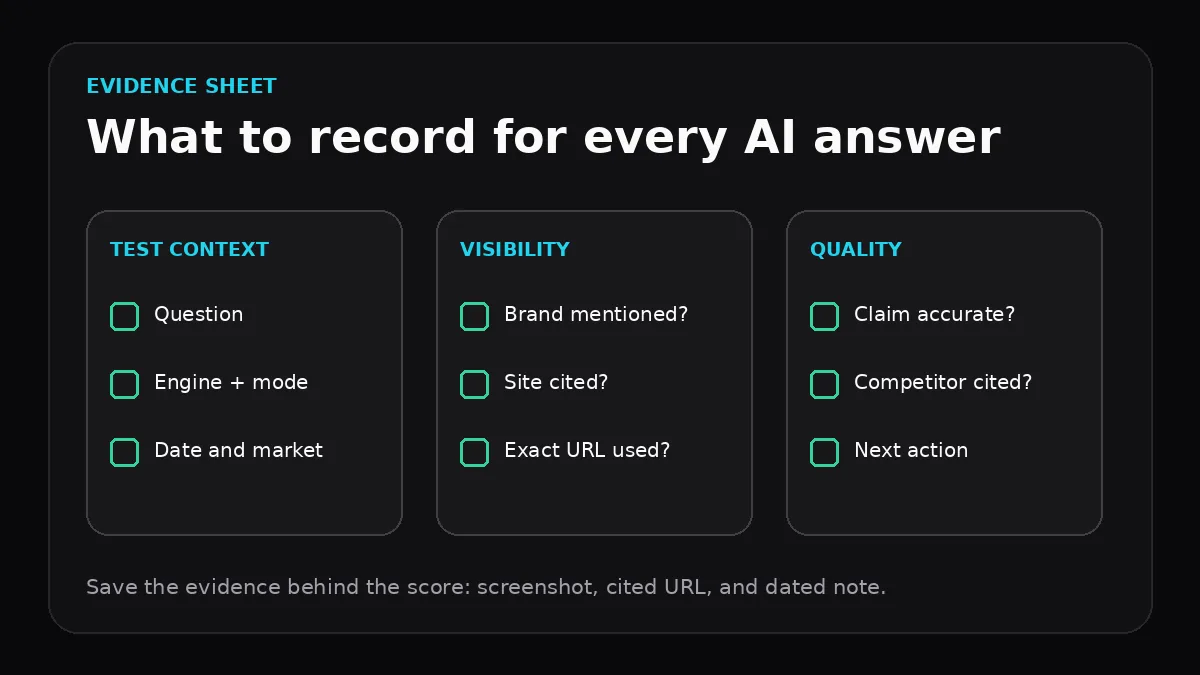
For every answer, save the following fields:
| Field | What to capture | Why it matters |
|---|---|---|
| Test context | Question, engine, mode, date, market, and account state | Makes repeat tests comparable and exposes interface changes. |
| Visibility | Brand mention, citation, link, product card, or no appearance | Separates recognition from attributable site visibility. |
| Cited source | Exact domain and URL, including competitor or third-party pages | Shows which evidence the engine preferred. |
| Answer quality | Correct, incomplete, outdated, misleading, or unverifiable | Prevents a visible but harmful description from counting as success. |
| Evidence | Dated screenshot or saved response plus the cited-page copy | Supports review when an answer changes later. |
| Business context | Referral session, landing page, lead source, or assisted conversion when available | Connects visibility to outcomes without pretending correlation is attribution. |
Screenshots are supporting evidence, not the dataset. Keep one structured row per question and preserve the exact linked URL. A domain-level “yes” hides whether the cited page is a useful product page, an old PDF, an unrelated directory, or a competitor comparison.
Use a simple citation visibility score
A lightweight score helps summarize the sample without disguising uncertainty. For each question, assign:
- 0 points: no brand mention and no owned citation.
- 1 point: brand mentioned, but no owned source is cited.
- 2 points: owned page is cited or linked.
- 3 points: owned page is cited and the brand or offer is represented accurately.
Add a separate accuracy flag and a separate qualified-referral count. Do not award extra points for repeatedly refreshing until your site appears.
| Metric | Calculation | Use |
|---|---|---|
| Mention rate | Questions with a brand mention ÷ total tested | Tracks brand inclusion. |
| Owned citation rate | Questions citing an owned page ÷ total tested | Tracks source selection. |
| Accuracy rate | Accurate brand appearances ÷ all brand appearances | Detects reputation and data-quality risk. |
| Competitor citation share | Questions citing each competitor ÷ total tested | Reveals sources worth studying, not copying. |
Compare month to month only when the baseline set and method stay similar. A score moving from 18 to 22 can be directional evidence. It is not proof that an algorithm rewarded last week's edit.
Diagnose the source gap before changing content
When another page earns the citation, inspect why it may be easier to use. Look for a direct answer near the top, clear definitions, current dates, original data, visible author and source information, semantic HTML tables, stable URLs, and corroborating mentions elsewhere.
Then check your own page for crawl blocks, noindex, incorrect canonicals, script-only copy, stale claims, inconsistent business details, and structured data that disagrees with visible content. The robots.txt guide for AI crawlers and schema markup guide for AI search cover those technical checks.
Do not copy a competitor's language or manufacture third-party proof. Improve the evidence you can substantiate: a clearer answer, an original comparison, a documented method, a current product specification, or a cited customer policy.
Turn each pattern into one next action
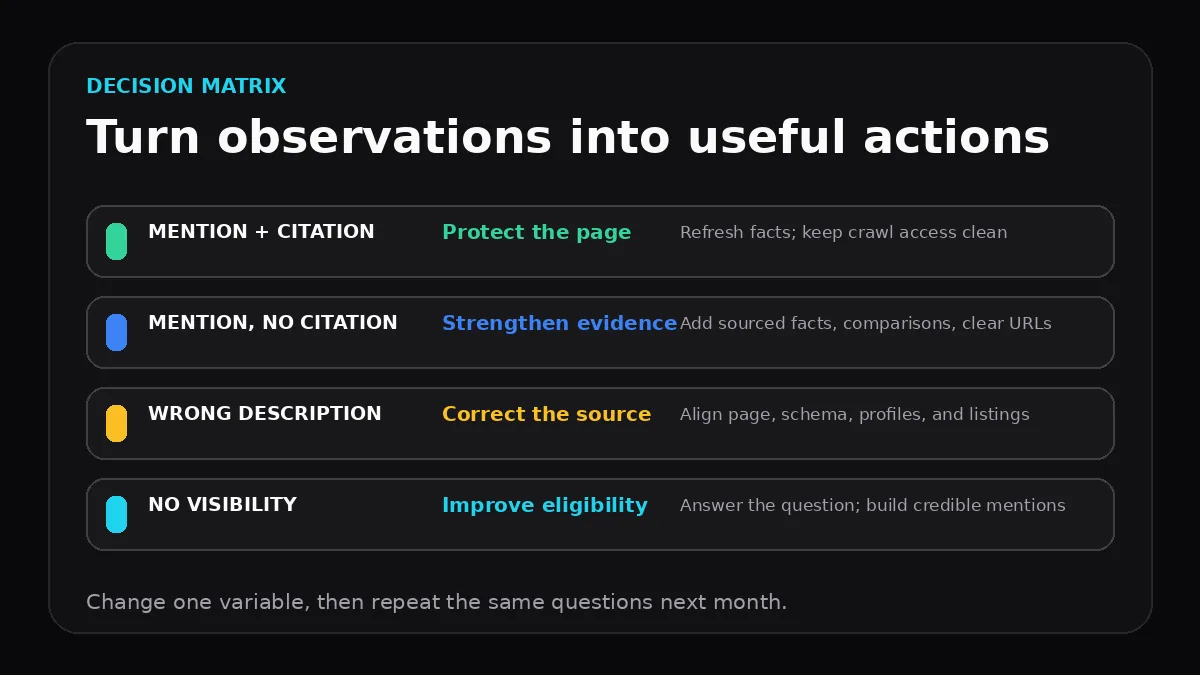
Use the result pattern to choose one change:
- Mention plus owned citation: protect the winning page. Keep facts current, preserve the URL, and monitor crawler access.
- Mention without an owned citation: strengthen attributable evidence. Add a sourced definition, a useful comparison, or a concise answer that clearly belongs on your domain.
- Owned citation with an inaccurate description: correct the visible page, structured data, business profiles, listings, and feeds that repeat the bad fact.
- Competitor citation: study the cited page's information shape, freshness, and proof. Build a more useful asset rather than a paraphrase.
- No visibility: confirm eligibility first, then answer the question directly and earn credible mentions from relevant sources.
Change one meaningful variable on a priority page, document it, and repeat the baseline next month. That is slower than chasing every answer, but it gives you a cleaner signal.
Connect citations to business results carefully
Analytics can show referral sessions from some AI products, but source labels and in-app browsers are inconsistent. Create an AI-referral segment using the referrers your analytics actually records, annotate important content changes, and review landing-page engagement and conversions.
Also ask qualified leads how they found you. A simple optional field can catch journeys that analytics misses. Report citations, referrals, leads, and revenue as separate layers. Use “assisted by” when you have supporting evidence but cannot establish a direct causal path.
For software options, compare capabilities and limitations in the AI search analytics tools guide. A tool can expand coverage, but manual evidence checks remain necessary when an automated tracker cannot reproduce location, account state, or source links.
Run the 60-minute monthly review
A practical review agenda is:
- First 20 minutes: run the baseline questions and save citations.
- Next 15 minutes: compare mention, owned-citation, and accuracy rates with the prior month.
- Next 10 minutes: inspect the pages most often cited by competitors or third parties.
- Next 10 minutes: review AI referrals and any self-reported lead sources.
- Final 5 minutes: assign one page-level improvement with an owner and review date.
Finish by checking the GEO visibility checklist for the selected page. The output of citation tracking should be a specific improvement — not a larger dashboard and not a promise of guaranteed inclusion.
The measurement habit matters more than the tool
AI answer engines do not provide a stable position to defend. A small business therefore needs a disciplined sample: real customer questions, consistent test conditions, exact cited URLs, accuracy checks, and business outcomes kept separate from visibility.
Run that sample monthly. Preserve the evidence. Improve one source page at a time. Over several cycles, you will learn which questions your brand is trusted to answer, where competitors still own the source layer, and which content investments produce useful visibility.
Frequently asked questions
What is AI citation tracking?
AI citation tracking is the practice of testing a fixed set of relevant questions in AI search tools, recording whether your brand is mentioned, checking which pages are cited or linked, and comparing the results over time.
How often should a small business check AI citations?
A monthly check is usually enough for a small business. Use the same priority questions, market, and testing method each time so the results are comparable.
Can AI citation tracking prove that a citation caused a sale?
Not by itself. Citation tracking measures visibility. Use referral analytics, landing-page behavior, lead-source questions, and conversion data to understand whether that visibility contributes to business results.
Do AI answers have permanent rankings?
No. Answers can change by date, model, location, mode, and query wording. A repeatable sample reveals directional trends, not a permanent position.