How to Make Products Visible in ChatGPT and Perplexity
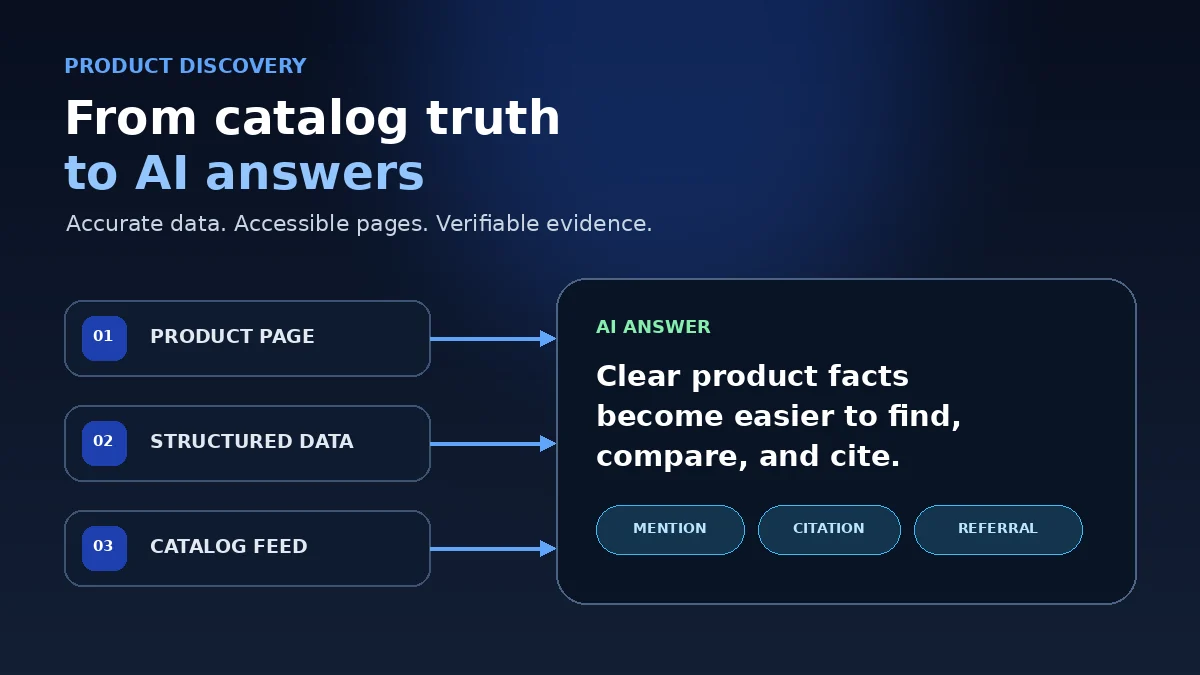
AI product visibility is less about writing for a chatbot and more about giving discovery systems accurate, accessible evidence. If your product page, structured data, feed, and checkout agree on what an item is, what it costs, and whether it is available, ChatGPT and Perplexity have a stronger foundation for finding and describing it.
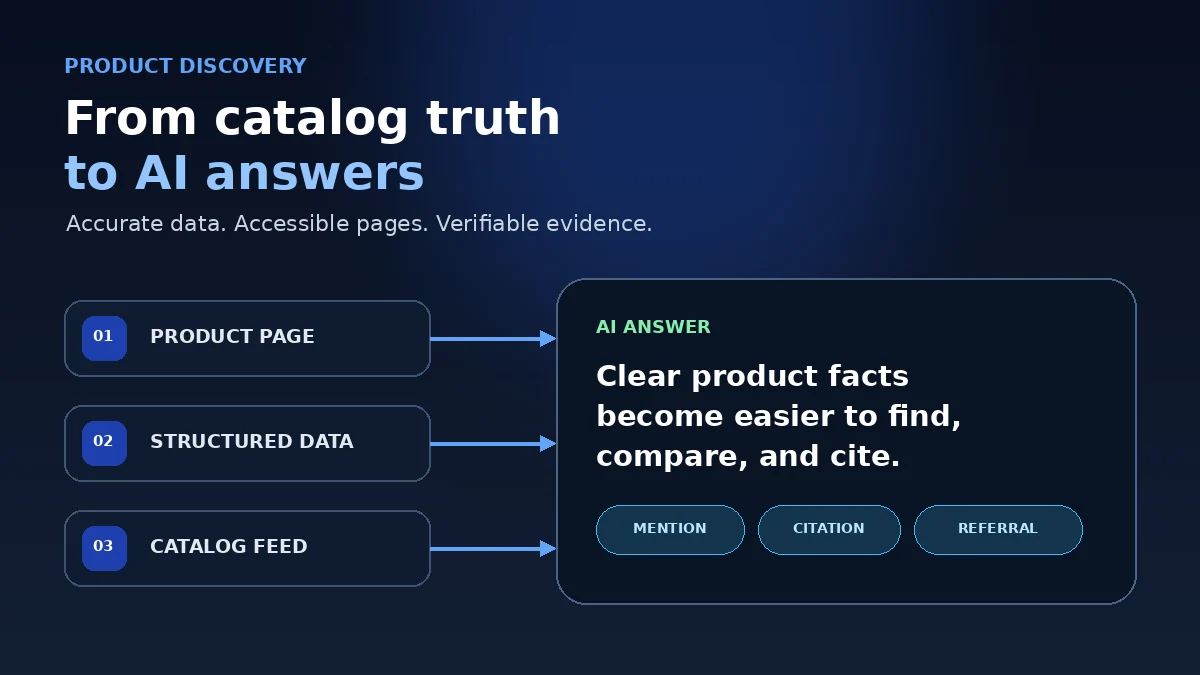
There is no guaranteed first position in an AI answer. The practical goal is to improve four observable outcomes: a brand mention, a citation to your site, a product card, or a qualified referral visit. This guide shows a small business how to improve those outcomes without buying into placement promises.
What product visibility means in an AI answer
A shopper might ask for a product by category, use case, budget, compatibility, size, or delivery requirement. The answer engine may then mention a brand, quote a buying guide, show a product result, or link to a merchant. Those are different forms of visibility, and each depends on the query, location, inventory, and evidence available online.
Do not treat one favorable response as a permanent ranking. AI answers can change between sessions and as catalog data changes. Track the four outcomes separately so a citation does not get confused with a product-card placement or a sale.
Build one reliable product-information foundation
Start with the five products that matter most. Each should have:
- One stable canonical URL. Variants should remain clearly identifiable without creating a maze of duplicate parameter pages.
- A specific title and factual description. Include the product type, meaningful variant attributes, intended use, materials, dimensions, compatibility, and limitations.
- Current commercial facts. Show price, currency, availability, shipping, and return information without hiding essential details behind a login or interaction-only widget.
- Stable identifiers. Keep SKU or item ID, brand, seller, and variant identifiers consistent everywhere.
- Original product images. Show the actual item and use descriptive alt text.
- Genuine supporting evidence. Publish real reviews and useful FAQs only when customers can verify them.
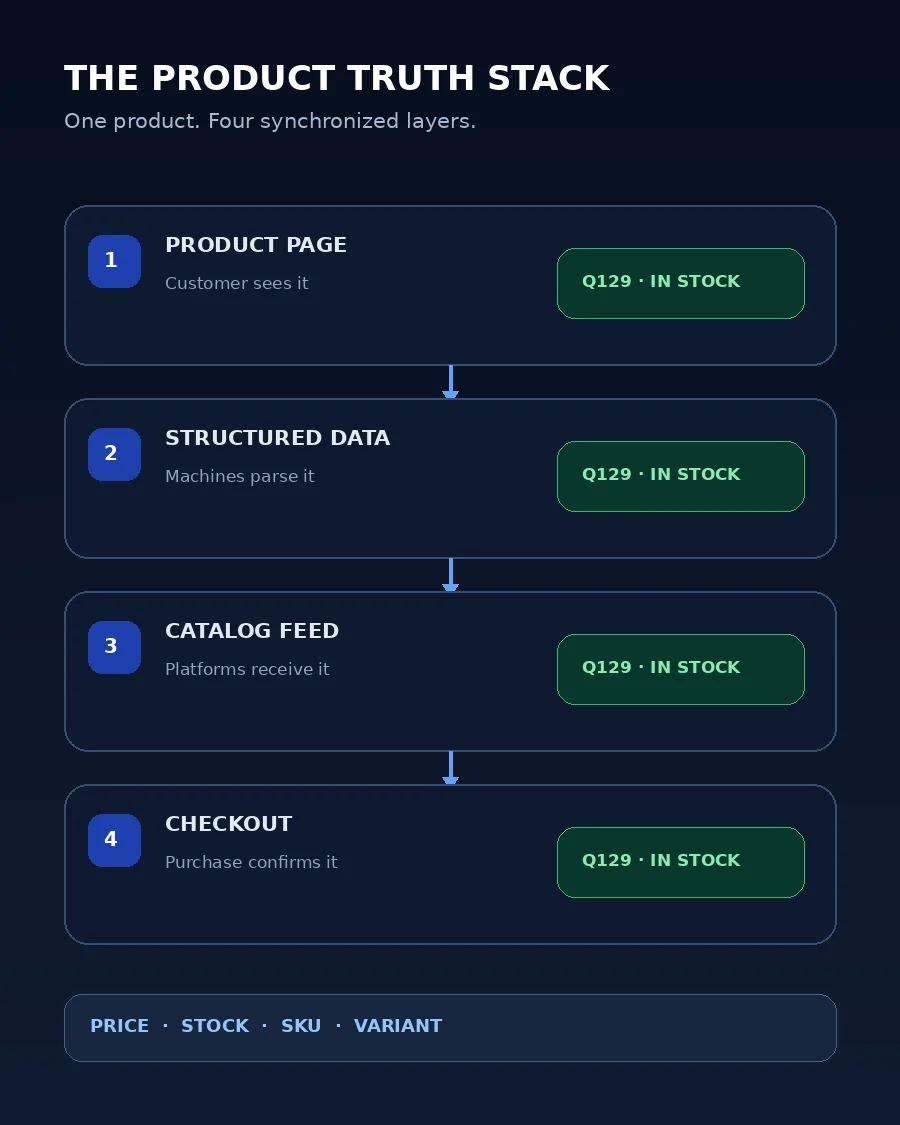
The key is consistency. A stale feed saying “in stock” while checkout says “sold out” is not just a customer problem; it also makes automated systems less confident in the catalog.
Add Product schema without treating it as a ranking trick
Use Product and Offer structured data for individual products, and ProductGroup when variants need a shared parent. Include the canonical URL, brand, identifiers, image, condition, availability, price, and currency. Add shipping, returns, ratings, and reviews only when the visible page supports those claims.
Structured data makes facts easier to parse; it does not guarantee an AI recommendation. Validate the markup, then fix warnings that correspond to information a buyer actually needs. The schema markup for AI search guide explains how to keep JSON-LD aligned with visible content.
Keep product pages crawlable and dependable
Check robots.txt, noindex, canonical tags, authentication walls, CDN rules, and bot protection. OpenAI says sites should allow OAI-SearchBot if they want public page content considered for ChatGPT search summaries and snippets. That discovery control is separate from GPTBot, which publishers can manage independently for model training.
Server-render essential product facts when possible. Maintain an XML sitemap, repair broken redirects, and give discontinued products a useful successor or category path instead of a dead end. For crawler names and directives, use current official documentation and server logs rather than copying an old allowlist. The AI crawler robots.txt guide provides a safe audit workflow. Confirm one preferred HTTPS URL with the canonical URL checker.
Use catalog feeds and commerce integrations when available
OpenAI documents a merchant product-feed program with fields such as stable item ID, title, factual description, URL, brand, seller, image, availability, and price. It also describes existing catalog integrations for some commerce platforms. Perplexity has announced shopping integrations and merchant options as well, although access and regional coverage can change.
For a small business, the sensible order is:
- Use a supported commerce integration if one is available to you.
- Clean the source catalog before connecting it.
- Apply for direct feed access only through an official platform channel.
- Keep feed prices and stock synchronized with checkout.
- Avoid vendors promising guaranteed answer placement.
ChatGPT vs Perplexity: what should you change?
The shared foundation matters more than platform-specific tricks.
| Visibility lever | ChatGPT | Perplexity | Small-business action |
|---|---|---|---|
| Crawl access | Allow OAI-SearchBot on public pages you want eligible for search discovery; access does not guarantee inclusion. | Keep useful product pages publicly accessible and confirm crawler behavior through current documentation and server logs. | Audit robots.txt, noindex, canonicals, CDN blocks, and script-only product facts. |
| Product content | Clear attributes and factual descriptions provide evidence for answers and comparisons. | Complete specifications and use-case information support cited answers and shopping comparisons. | Improve the five highest-value products before expanding to the entire catalog. |
| Structured data | Product and Offer markup can reduce ambiguity but does not guarantee placement. | Consistent machine-readable data is a sound foundation, not a substitute for useful visible content. | Match schema to the page and checkout; never mark up claims customers cannot verify. |
| Catalog connections | OpenAI documents product feeds and commerce-platform integrations; onboarding can vary. | Perplexity has described platform integrations and merchant participation for shopping. | Keep the source catalog accurate and apply only through official channels. |
| Measurement | Track cited URLs, product cards, referrals, and landing pages. | Track citations, product appearances, referrers, and landing-page behavior. | Re-run a fixed set of customer questions monthly instead of chasing individual responses. |
Create evidence for comparison questions
Thin manufacturer copy rarely answers why one product fits a particular customer better than another. Publish factual buying guides around real constraints: budget, size, compatibility, maintenance, materials, delivery window, and intended use. Use comparison tables that disclose trade-offs rather than declaring every item “best.”
Accurate third-party mentions can also support product claims. Pursue relevant coverage, association listings, retailer pages, and genuine customer communities. Do not manufacture reviews, awards, or mass-produced “best product” pages. The brand mention tracking workflow helps separate useful evidence from vanity mentions.
Run a five-product monthly visibility audit
Use a fixed test instead of repeatedly prompting until you see the answer you want:
- Select five priority products and ten realistic customer questions.
- Record whether each platform mentions the brand, cites your site, shows a product card, or links elsewhere.
- Review referral sources and the landing pages that receive AI-search traffic.
- Check feed errors, structured-data validation, crawl logs, price mismatches, and stock discrepancies.
- Change one product-data or content issue at a time.
- Preserve dated notes or screenshots and review the same test set next month.
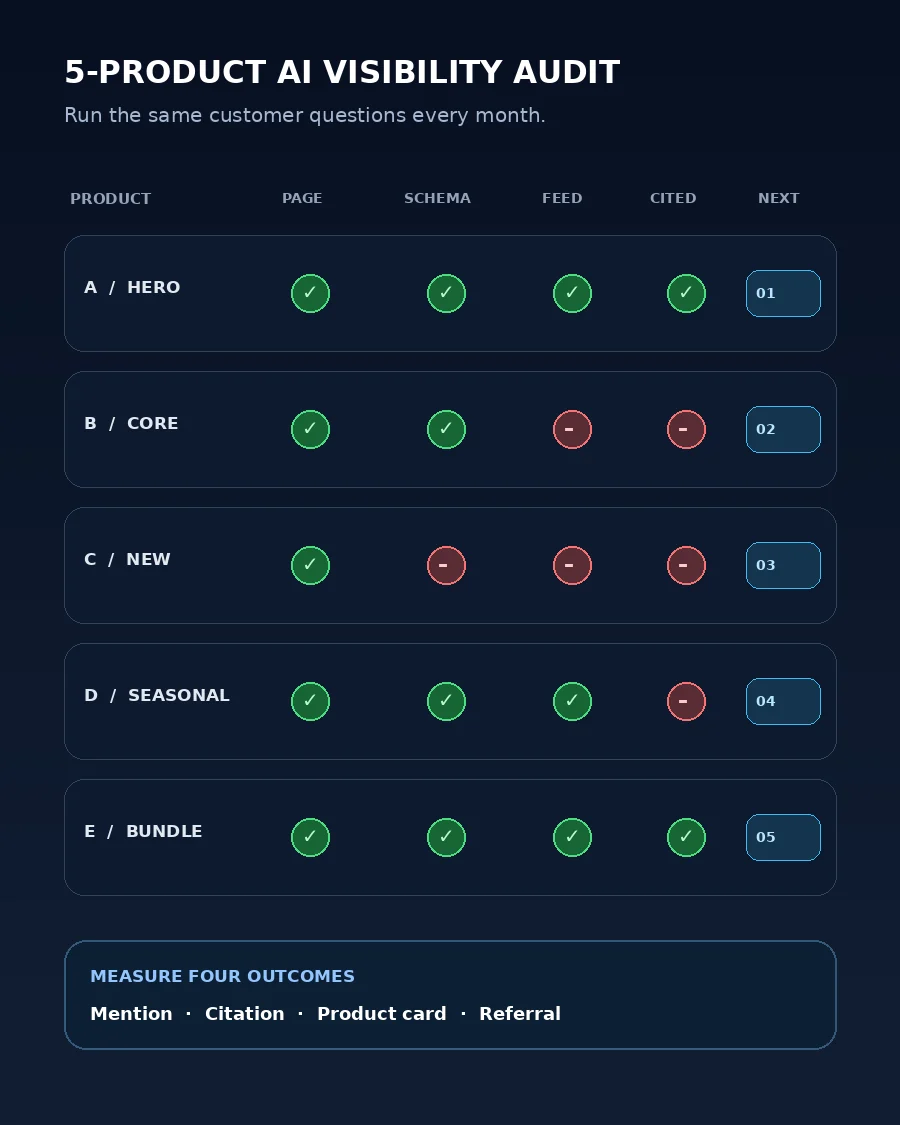
The GEO visibility checklist covers the technical and content prerequisites in one quick audit. For a broader tool stack, compare AI search analytics tools for marketing teams.
Start with five products, not the whole catalog
Fixing the source data for five commercially important products is more useful than publishing fifty thin “AI-optimized” pages. Make the pages accessible, align the page-schema-feed-checkout truth stack, connect only supported commerce channels, and measure the same customer questions monthly.
That workflow cannot force an answer engine to recommend you. It can make your products easier to understand, verify, and represent accurately — which is the part a small business can control.
Sources
Frequently asked questions
Can I guarantee that my products will appear in ChatGPT or Perplexity?
No. Accurate pages, crawl access, structured data, and supported feeds can improve eligibility and representation, but neither platform guarantees placement for a particular question. Relevance, availability, location, query context, and platform coverage can all affect the answer.
Do I need an llms.txt file for product visibility?
No. Treat llms.txt as optional documentation, not as merchant enrollment or a ranking mechanism. It does not replace crawlable product pages, robots.txt controls, canonical URLs, product schema, sitemaps, or an accepted catalog feed.
Should a small business optimize for ChatGPT and Perplexity separately?
Start with the shared foundation: accurate product pages, consistent identifiers, accessible content, valid structured data, and credible supporting information. Add platform-specific crawler, commerce integration, or feed steps only where official options are available.