llms.txt for AI Visibility: What It Is, What It Actually Does, and How to Write One
If robots.txt tells crawlers what they may read, llms.txt tries to tell language models what they should read first. The idea is appealing: one small Markdown file at the root of your domain that maps your most important content so AI systems can find your best answers quickly.
The honest version is more nuanced. This guide covers what llms.txt is, what AI providers actually do with it today, and how to publish a solid one in under an hour without expecting miracles from it.
What llms.txt actually is
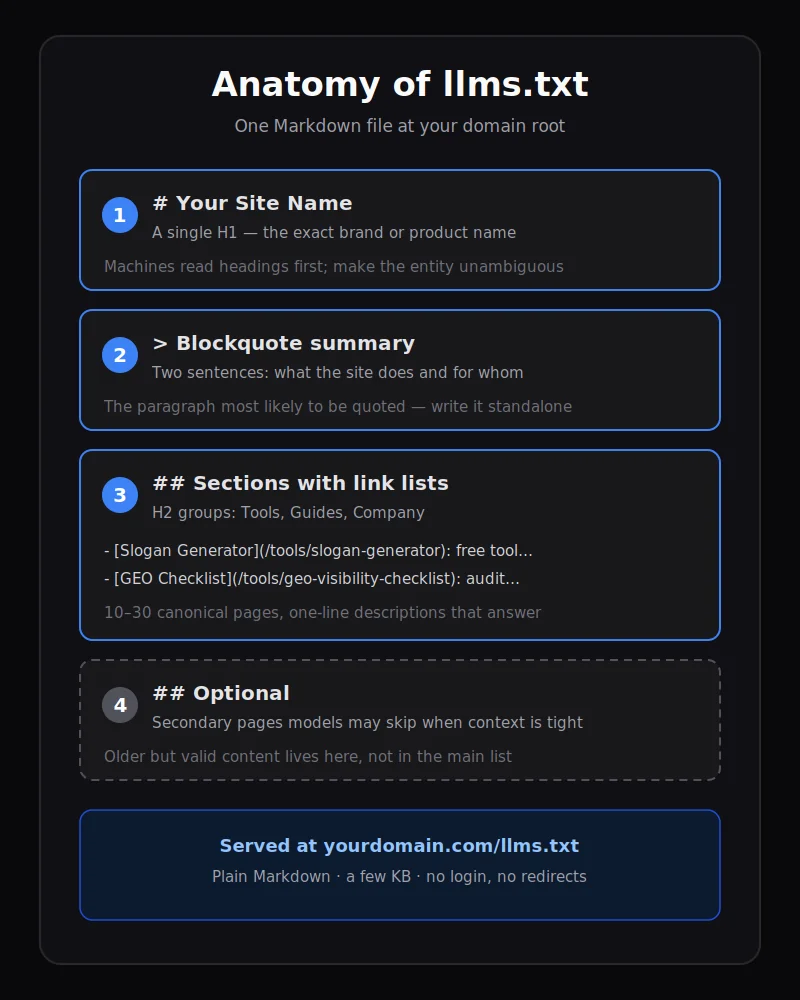
llms.txt is a proposal, published in late 2024 by Jeremy Howard of Answer.AI, for a plain Markdown file placed at https://yourdomain.com/llms.txt. The format is deliberately simple:
- One H1 with the name of your site or product.
- A blockquote summary: one or two sentences describing what the site is and who it helps.
- H2 sections containing Markdown link lists to your most important pages, each with a short description after a colon or dash.
- An
## Optionalsection for secondary pages that AI systems can skip when context is tight.
A companion file, llms-full.txt, goes further and inlines the full text of your key pages in a single Markdown document so a model can ingest everything in one fetch. For most small business sites, llms.txt alone is the reasonable scope.
The core insight behind the proposal is real: language models work best with clean Markdown and clear structure, and most websites are optimized for human eyes and ad layouts, not for machine reading. A curated index removes the guesswork about which of your 400 pages actually matter.
What AI providers really do with it today
Here is where expectations need calibration. As of 2026:
- No major AI provider has committed to honoring llms.txt. OpenAI, Google, Anthropic, and Perplexity have not announced that their crawlers or answer engines fetch it as part of retrieval. Google representatives have publicly said it has no effect on AI Overviews.
- Adoption is growing but mostly among developer tools. Documentation sites, API products, and dev-focused startups publish llms.txt files because their audiences use coding assistants that can be pointed at them manually.
- It is cheap and harmless. Publishing the file costs an hour at most, returns a few kilobytes of text, and cannot hurt your SEO. Some smaller crawlers and third-party AI tools do fetch it.
The practical framing: llms.txt is citation hygiene, not a ranking lever. It belongs in the same bucket as clean Markdown export endpoints and well-structured pages — useful when a machine does read you, invisible when one does not. If you want the actions with proven impact, the GEO visibility checklist and the robots.txt AI crawler guide come first.
llms.txt vs robots.txt vs sitemap.xml
These three files do different jobs, and confusing them leads to bad decisions — like blocking AI crawlers in robots.txt while hoping llms.txt will invite them back.
| File | Purpose | Who honors it | Controls access? |
|---|---|---|---|
| robots.txt | Tells crawlers which paths they may or may not fetch | All major search and AI crawlers (GPTBot, ClaudeBot, PerplexityBot, Googlebot) | Yes — it is an access gate |
| sitemap.xml | Lists indexable URLs with last-modified dates for discovery | Search engines; some AI crawlers use it for discovery | No — discovery hint only |
| llms.txt | Curated Markdown map of your most important content for language models | Some AI tools and smaller crawlers; no major provider commitment | No — a recommendation, not a gate |
One warning worth repeating: robots.txt remains the only one of the three that controls access. If you block GPTBot there, a beautiful llms.txt changes nothing — the crawler never gets in the door. The AI crawler robots.txt guide has the exact directives to review first.
How to write a useful llms.txt in under an hour
If you decide to publish one — and for most marketing-led sites it is a reasonable, low-cost addition — do it properly:
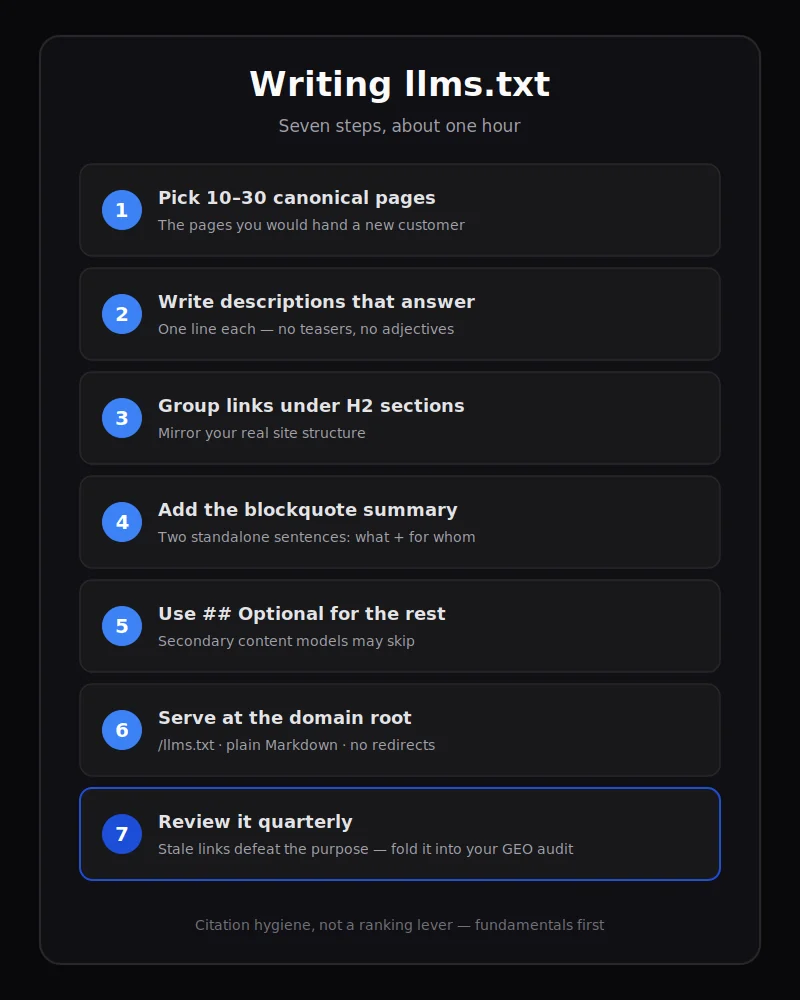
- Pick 10 to 30 canonical pages. Not every blog post: the pages you would hand to a new customer. Cornerstone guides, your main tools, your about and editorial standards pages.
- Write one-line descriptions that answer, not tease. "Free slogan generator for small businesses with industry filters" beats "Check out our amazing tool."
- Group links under descriptive H2 sections. Tools, Guides, Company — whatever matches your real structure.
- Add the blockquote summary. Two sentences: what the site does and for whom. This is the paragraph most likely to be quoted, so make it stand alone.
- Use the Optional section for the rest. Older but still valid content goes here so models skip it when context is limited.
- Serve it at the root with a Markdown content type.
https://yourdomain.com/llms.txt, plain text, no login, no redirect chains. - Add a quarterly review to your GEO audit. llms.txt rots quickly when navigation changes; stale links undermine the point of curating.
What moves AI visibility more than llms.txt
If your hour is limited, spend it in this order:
- Open your robots.txt to AI crawlers. GPTBot, ClaudeBot, PerplexityBot, and Google-Extended blocked at the edge is the most common self-inflicted GEO wound.
- Write answer-ready paragraphs. A standalone sentence with a concrete fact or number in the first paragraph of a section gets quoted; a claim buried in paragraph six does not. The GEO vs SEO guide explains why.
- Keep structured data honest. Organization, Article, and FAQ schema that matches visible content helps machines trust what they read.
- Track brand mentions and citations monthly. llms.txt will not tell you whether it worked; a brand mention tracking workflow will.
Then publish llms.txt as the finishing touch. It signals that you take machine readability seriously, it costs almost nothing, and if the major providers ever formalize support, you will already be there. Run the llms.txt checker on the live file, then the GEO visibility checklist to see where your site stands across all of these layers.
Frequently asked questions
Does llms.txt improve my rankings in AI answers?
There is no confirmed evidence that llms.txt directly improves citations or rankings in ChatGPT, Gemini, Perplexity, or Google AI Overviews. No major AI provider has committed to reading it. Treat it as low-cost citation hygiene, not a ranking lever.
Do AI crawlers read llms.txt?
As of 2026, the major AI providers have not announced official support for llms.txt the way they honor robots.txt. Some tools and smaller crawlers fetch it, and the file is harmless to publish, but the proven fundamentals are still crawlable pages, clear answers, and structured data.
What is the difference between llms.txt and llms-full.txt?
llms.txt is a curated index: a short Markdown map of your most important pages with one-line descriptions. llms-full.txt goes further and inlines the full content of those pages in one Markdown file. Most small business sites only need llms.txt.
How often should I update llms.txt?
Update it whenever your canonical pages change: new cornerstone guides, retired pages, restructured navigation. For most small sites that means a quarterly review, ideally as part of a broader GEO audit.