AI Search Competitor Gap Analysis: A 90-Minute Workflow
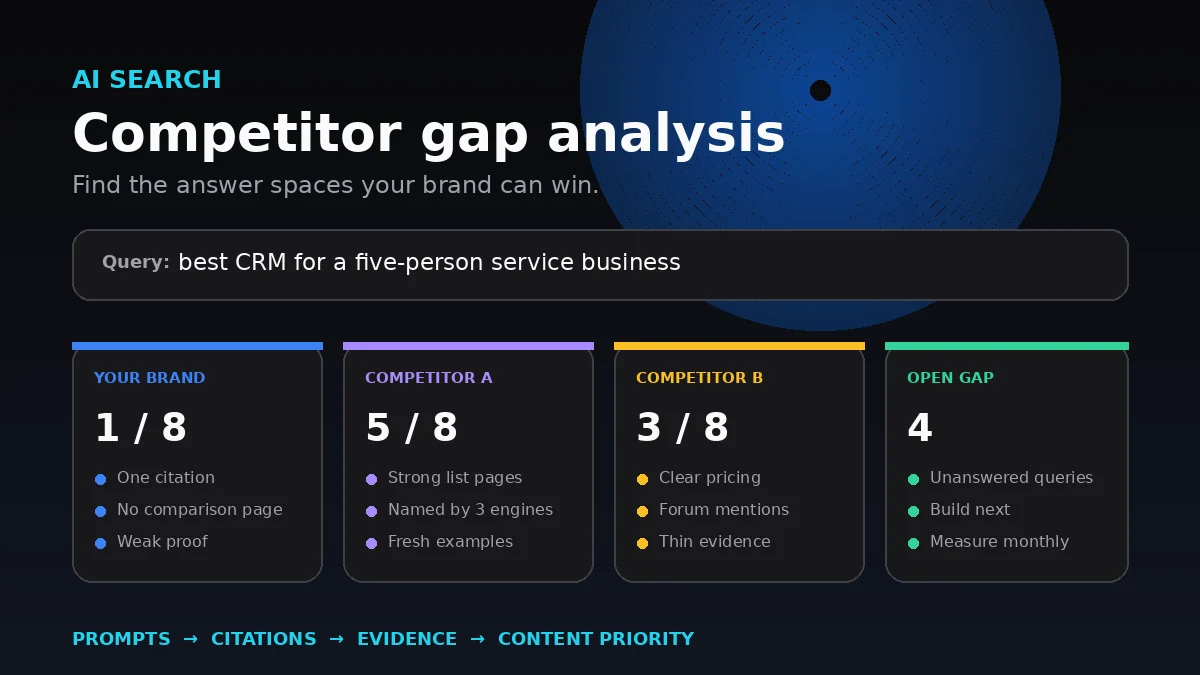
Traditional competitor research asks who ranks on page one. AI search competitor analysis asks a different question: which brands and pages are used to assemble the answer?
That difference matters because an answer engine can recommend a competitor that ranks below you, cite a forum instead of either company, or mention your category without naming your brand at all. A practical gap analysis reveals those patterns and turns them into a short list of pages, proof points, and distribution moves worth building next.
This workflow takes about 90 minutes for one product or service line. You need a spreadsheet, a stable set of prompts, and access to the answer engines your customers are likely to use. You do not need an expensive monitoring platform to run the first benchmark.
Step 1: choose the market you are actually trying to win
Keep the scope narrow enough to produce decisions. "Marketing software" is too broad. "Email automation for a five-person home-services company" is useful because the customer, task, and constraints are visible.
Write one sentence with these four inputs:
- Customer: the business type, role, or buyer you serve.
- Job: the problem they are trying to solve.
- Constraint: budget, location, team size, compliance need, or software stack.
- Decision: the action you want them to take after researching.
A local accounting firm might use: "A Guatemala-based retailer needs affordable inventory software that supports local tax workflows and wants to shortlist three options." This becomes the boundary for every prompt and every content recommendation.
Step 2: build a 24-prompt query map
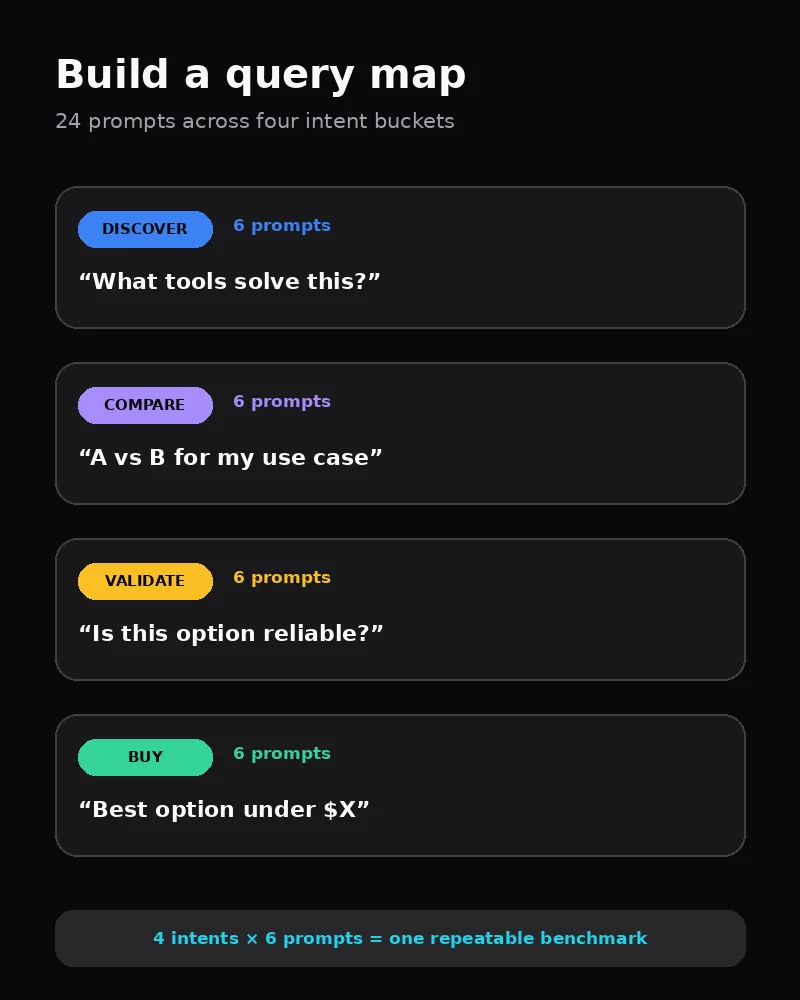
Create six prompts in each of four intent buckets. Keep the wording natural; these should sound like questions a customer would ask, not keyword fragments copied from a search tool.
| Intent | What the customer asks | Example prompt |
|---|---|---|
| Discover | What approaches or products exist? | What is the simplest CRM for a five-person cleaning company? |
| Compare | Which option fits this situation? | Compare HubSpot and Pipedrive for a small field-service team. |
| Validate | Can I trust the option or claim? | Is this CRM reliable for tracking leads from WhatsApp? |
| Buy | What should I choose within a constraint? | Which CRM under $50 per month is best for five users? |
Use the same prompts every month. You may add a small exploratory set, but changing the whole list destroys the baseline. The AI citation tracking workflow explains how to store dated results without mistaking normal answer variation for a trend.
Step 3: collect answers without training the result
Run each prompt in a fresh chat or private session. Reusing one conversation lets previous turns influence later answers, which makes competitors appear more or less often for reasons unrelated to market visibility.
For each prompt, record:
- Engine and date.
- Brands named in the answer.
- Pages or domains cited.
- The exact claim attached to each citation.
- Whether your brand appears accurately, inaccurately, or not at all.
- The answer's proposed next step, such as visit, compare, calculate, or contact.
Do not only capture answers where you win. Missing citations and unexpected sources are the useful evidence. If Reddit, YouTube, a trade association, or a review directory appears repeatedly, it tells you which source types the engine trusts for that intent.
Step 4: score the gap consistently
A simple zero-to-two rubric keeps the audit focused. Score each answer on five signals, then compare your brand with the most visible competitor.
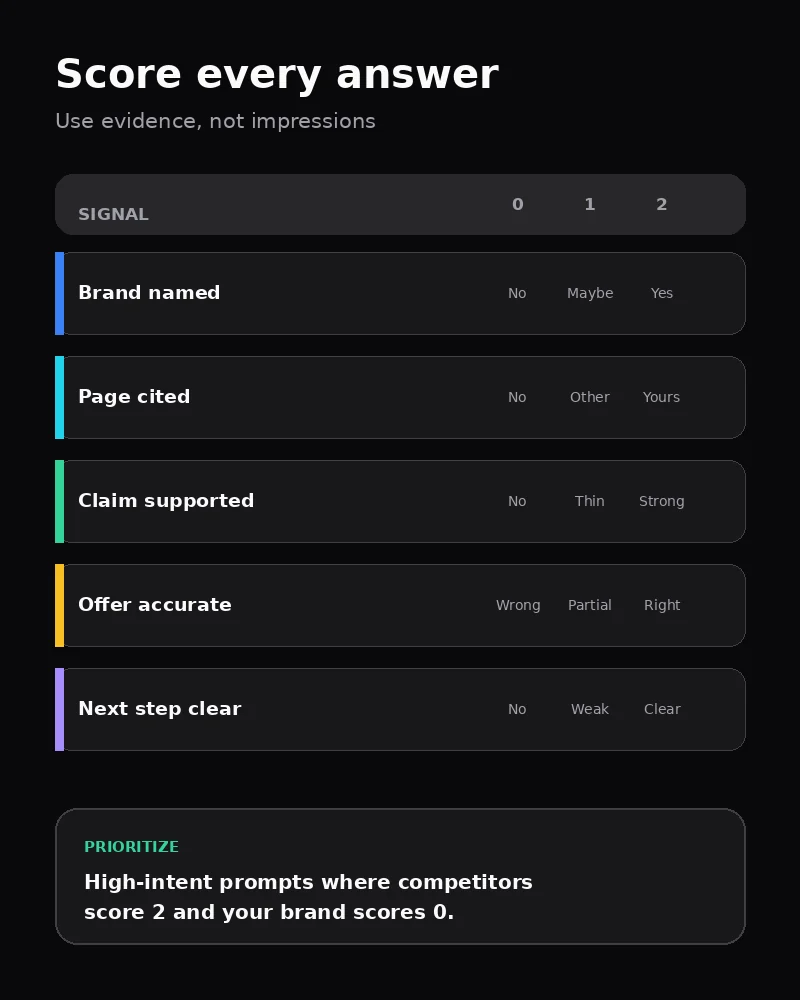
| Signal | 0 points | 1 point | 2 points |
|---|---|---|---|
| Brand presence | Not named | Implied or listed without context | Named with a relevant reason |
| Citation | No supporting source | A third party mentions the brand | Your owned page is cited |
| Evidence | Unsupported claim | General explanation | Specific data, example, or method |
| Accuracy | Wrong or outdated | Partly accurate | Current and complete |
| Next step | No action path | Generic visit or search | Clear page, tool, or comparison |
The score is not an official ranking factor, and it is not meant to predict one. It is a decision aid: a repeatable way to decide whether the gap is about awareness, evidence, page structure, factual accuracy, or conversion readiness.
Step 5: classify why the competitor won
Read the cited page, not only the generated answer. Most useful gaps fit one of five patterns:
- Answer gap: the competitor gives a direct definition or recommendation and you do not.
- Evidence gap: the competitor has a named method, original data, concrete example, or transparent pricing.
- Format gap: the engine can extract a comparison table, checklist, FAQ, or concise answer block from the competitor page.
- Entity gap: third-party sources consistently connect the competitor with the problem, while your brand identity is ambiguous.
- Distribution gap: the winning source is a forum, directory, video, or publication where your brand has no credible presence.
This diagnosis prevents the default response of publishing another long blog post. If the answer cites a competitor's pricing page, improve your offer clarity. If it cites an association's checklist, add evidence and earn inclusion in relevant industry resources. If it misstates your product, repair the entity and product facts that machines can verify.
Step 6: rank gaps by business value
Add three columns to the sheet: customer intent, ability to win, and commercial connection. Rate each from one to three.
| Priority factor | 1 point | 2 points | 3 points |
|---|---|---|---|
| Customer intent | General learning | Evaluating approaches | Comparing or buying |
| Ability to win | No unique proof | Can improve clarity | Has first-party expertise or evidence |
| Commercial connection | No relevant offer | Supports an adjacent service | Leads to a real product or tool |
Start with gaps scoring seven to nine, especially where your brand scored zero and a competitor scored two on citations or evidence. Ignore a high-volume topic when you cannot add anything trustworthy or connect it to customer value.
Step 7: convert findings into a four-week plan
A balanced plan usually contains four kinds of work:
- Repair: correct inaccurate or missing product facts on an existing page.
- Build: create one answer-ready comparison, guide, calculator, checklist, or template.
- Connect: add internal links and schema that clarify the relationship between the brand, offer, and supporting content.
- Distribute: earn a legitimate mention where answer engines already find credible category information.
For owned pages, lead with a short direct answer, use semantic headings, and make important facts understandable outside their surrounding paragraph. The answer extraction writing guide shows how to do that without turning the page into robotic fragments. Run the GEO visibility checklist before publishing to catch crawlability, entity, and structured-data gaps.
What not to copy from competitors
A citation is evidence of visibility, not proof of quality. Do not reproduce a competitor's wording, unsupported statistics, review claims, or inflated superlatives. Verify factual claims independently and explain what is based on your own testing, customer data, or public documentation.
Also avoid mass-producing pages for every prompt variation. One strong comparison page may answer six related questions better than six thin posts. The goal is a useful content system, not a larger URL count.
The monthly benchmark
Repeat the 24 prompts once a month under similar conditions. Track these four trends:
- Share of prompts where the brand is named.
- Share where an owned page is cited.
- Number of inaccurate descriptions.
- Number of high-intent prompts with a clear next step.
Pair citation presence with AI referral traffic in GA4, branded search trends, and actual leads. AI answers vary, and referral data is incomplete, so no single metric proves impact. A consistent rise across citations, accurate brand mentions, qualified visits, and conversions is more useful than celebrating one favorable response.
A competitor gap analysis works when it produces a short build list and a stable benchmark. If the spreadsheet ends with fifty vague content ideas, narrow the market, raise the evidence standard, and keep only the gaps your business can credibly own.
Frequently asked questions
What is an AI search competitor gap analysis?
It is a structured comparison of which brands, pages, and claims answer engines cite for the queries that matter to your customers. The goal is to find high-intent questions where competitors are visible, your brand is absent, and you can publish stronger evidence or a clearer answer.
Which AI engines should a small business benchmark?
Start with ChatGPT, Perplexity, Gemini, and Google AI Overviews because their answer formats and source choices differ. Add Claude, Copilot, or a vertical search tool only when your customers actually use it.
How often should the analysis be repeated?
Run a lightweight benchmark monthly and a full gap analysis quarterly. AI answers can change between sessions, so compare trends across a stable prompt set instead of treating one response as a permanent ranking.
Should every competitor citation become a new article?
No. Prioritize gaps that match customer intent, your real expertise, and an existing product or service. Sometimes the right fix is a clearer product page, a comparison table, stronger proof, or better internal linking rather than another article.