Entity SEO for AI Search: Make Your Business Easy to Identify
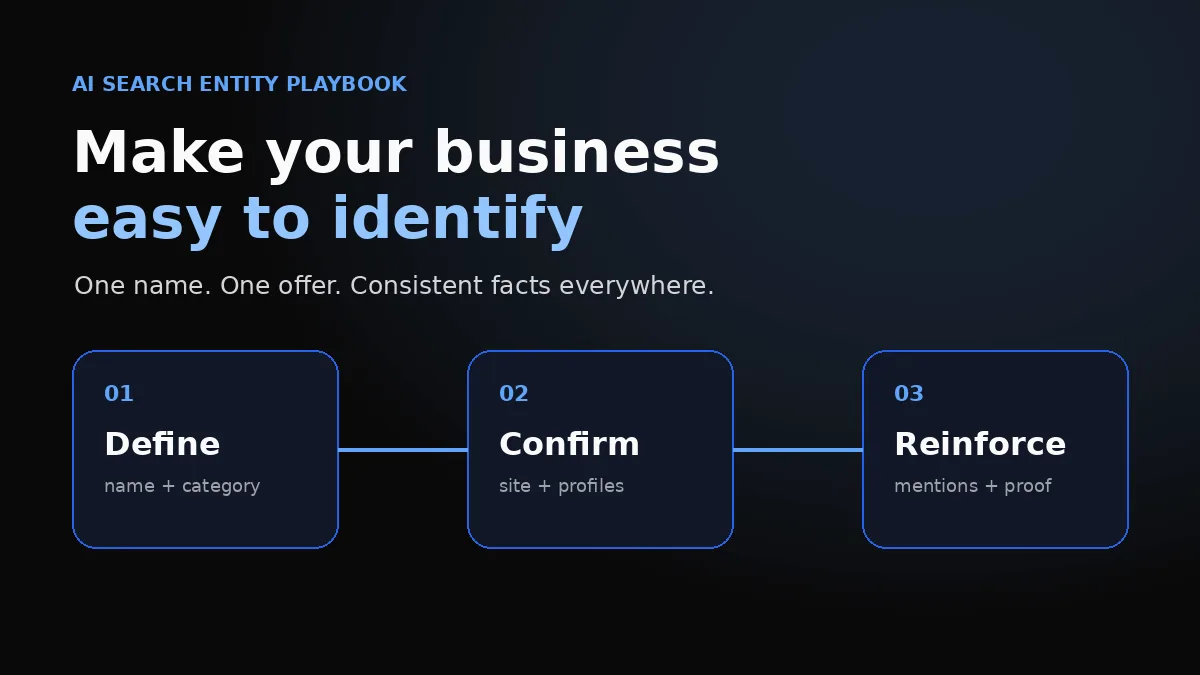
AI search engines cannot cite a business confidently if they cannot tell exactly what the business is. A company name that changes between the website and Google Business Profile, three different category labels, an old address in a directory, and social profiles with no link back to the official site all create the same problem: ambiguity.
Entity SEO removes that ambiguity. It gives search engines and AI answer systems a consistent set of facts they can connect to one company, product, person, or place. For a small business, the work is not a technical knowledge-graph project. It is a disciplined identity cleanup across the pages and profiles customers already use.
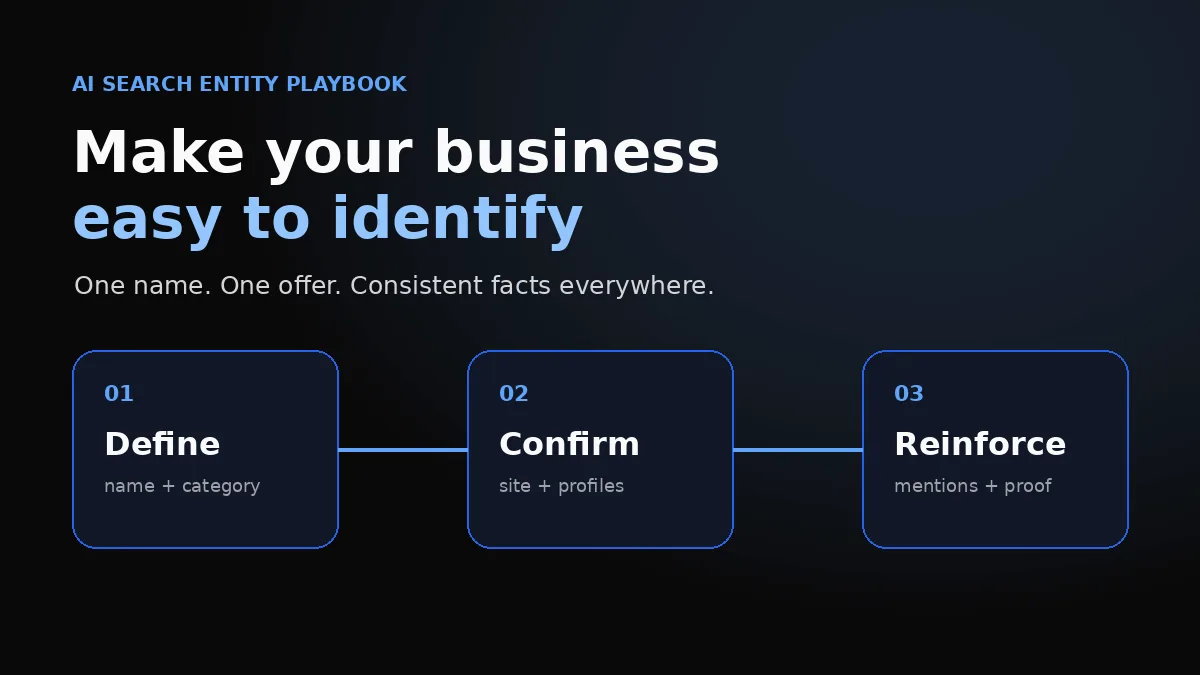
What entity SEO changes in AI search
Classic keyword SEO asks whether a page is relevant to a query. Entity SEO asks whether the system understands the real-world subject behind the page. That distinction matters when an answer engine has to combine information from several sources and decide whether they describe the same business.
A strong entity footprint helps an engine answer five questions without guessing:
- What is the business called? The trading name, legal name, abbreviations, and former names are connected rather than treated as different companies.
- What does it do? One primary category and a few precise services replace a cloud of vague marketing labels.
- Who and where does it serve? The audience, location, and service area are explicit.
- Which properties are official? The website, business profile, social accounts, app listings, and other owned profiles point to one another.
- What confirms the claims? Reviews, reputable directories, memberships, partnerships, coverage, and customer references provide independent corroboration.
This is part of the extra citation layer described in GEO vs SEO. Technical SEO gets the page crawled; entity clarity helps an answer engine understand who the page represents and when that source belongs in an answer.
Build the four-layer entity stack
Treat the business identity as a stack. Each layer should agree with the one below it. If the foundation is vague, adding more profiles or schema only distributes the confusion faster.
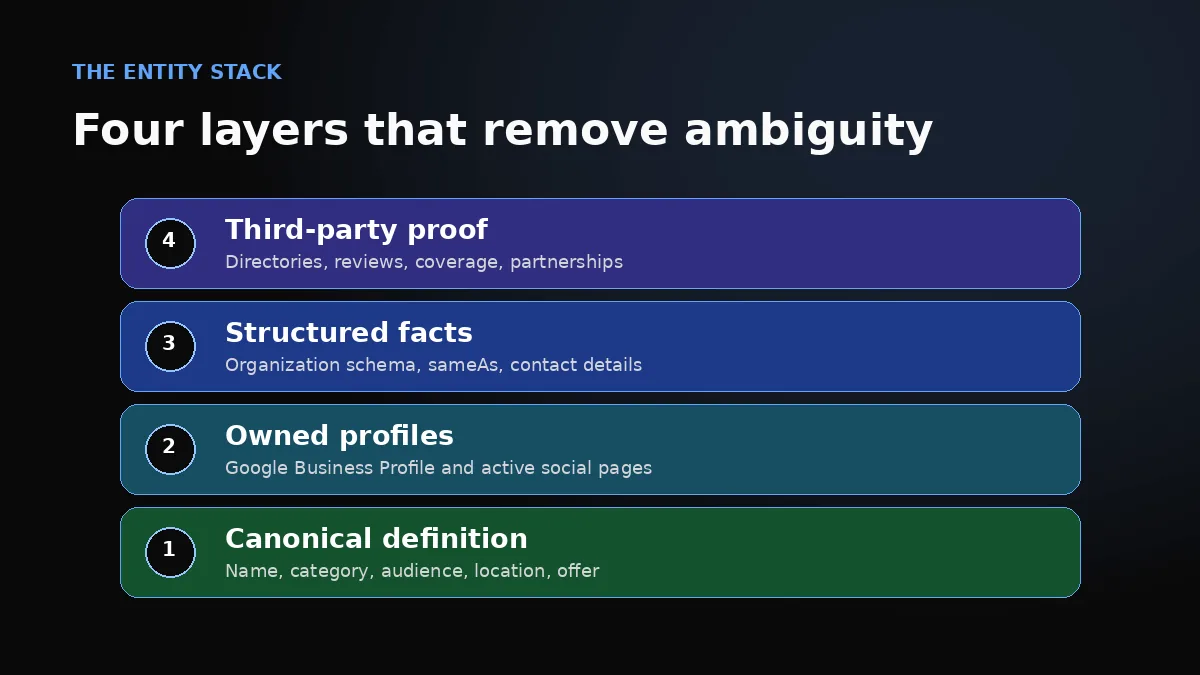
Layer 1: write the canonical definition
Create one plain sentence that names the business, category, audience, location or service area, and core offer. Avoid slogans in this sentence. A slogan can express personality, but the canonical definition must remove doubt.
A useful pattern is:
[Business name] is a [primary category] serving [audience] in [location or service area] with [core offer].
Put the sentence on the About page and use its facts consistently on the homepage, contact page, key product or service pages, and media profile. If the legal company name differs from the trading name, state the relationship once instead of switching between them without explanation.
Layer 2: connect the owned properties
List the official profiles that are actively maintained. The website should link to them, and each profile should link back to the canonical website when the platform allows it. Close or clearly mark abandoned duplicate profiles rather than leaving several plausible identities online.
Prioritize the profiles customers and answer engines are most likely to encounter: Google Business Profile for local companies, major social accounts, app marketplaces, industry directories, and marketplace seller pages. Ten stale profiles are weaker evidence than three current, connected profiles.
Layer 3: encode the facts in structured data
Use Organization or the most accurate subtype supported by Schema.org's Organization vocabulary. Include the canonical name, URL, logo, contact information, and sameAs links to official profiles. Local businesses can use a relevant LocalBusiness subtype when it accurately describes the operation.
Structured data should repeat visible facts, not invent new ones. Google's structured data guidelines require markup to represent the page users can see. If the schema says one address and the contact page shows another, fix the business record before adding more markup.
Use the schema markup guide for AI search to implement the code, then run the GEO visibility checklist to catch missing identity fields and crawler issues.
Layer 4: reinforce the entity with independent proof
Outside references help systems verify that the business exists and does what it claims. Keep major directories accurate, earn genuine customer reviews, join relevant trade associations, and pursue useful partnerships or coverage. The goal is not to manufacture mentions. It is to make real relationships and reputation legible online.
A mention is especially useful when it connects the same business name to the same category, location, offer, or expertise shown on the official site. The brand mention tracking workflow explains how to monitor these references without confusing raw mention volume with quality.
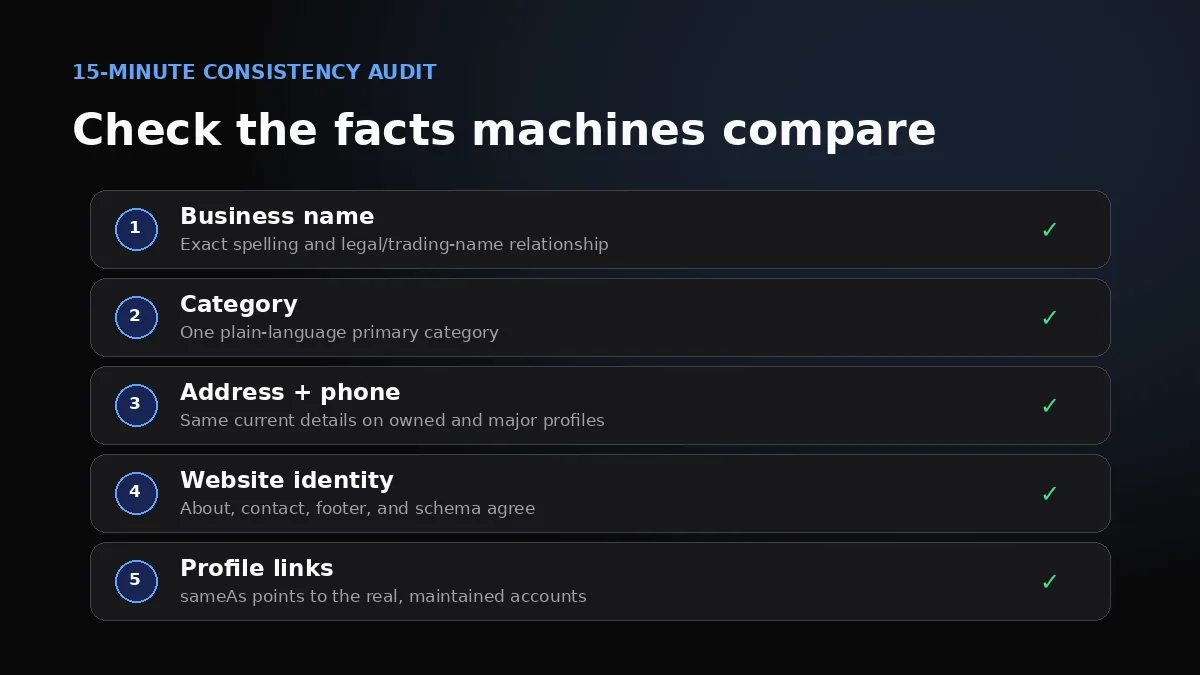
Run a 15-minute consistency audit
Entity errors often hide in ordinary places: a footer, an old directory listing, a forgotten Facebook page, or a schema block copied from a previous location. Audit the facts machines are most likely to compare.
| Field | Where to check | Pass condition |
|---|---|---|
| Business name | Homepage, About, contact, schema, Google Business Profile, directories | One current trading name; legal-name relationship is explicit where needed |
| Primary category | Title copy, About definition, business profile, directory categories | One plain-language category appears consistently |
| Location and contact | Contact page, footer, schema, maps, directories | Current address or service area, phone, and hours agree |
| Official URL | Profiles, directories, app listings, campaign links | All durable profiles point to the canonical HTTPS domain |
| Profile connections | Website social links and schema `sameAs` values | Only real, maintained profiles are connected |
| Core offer | Homepage, service pages, profiles, review language | The same main product or service is recognizable everywhere |
Record each conflict in a simple sheet with the URL, incorrect value, correct value, owner, and fix date. Work from the properties you control outward. Your website can change today; a third-party directory may take days to approve an edit.
Test the entity in answer engines
Do not ask an AI engine whether your entity SEO is "good." That invites a vague assessment. Ask neutral factual questions and compare the answers with your canonical definition.
Use the same prompt set in ChatGPT, Perplexity, Gemini, Claude, and Google AI Overviews when available:
- What does [business name] do?
- Who does [business name] serve?
- Where does [business name] operate?
- What is the official website for [business name]?
- Which profiles belong to [business name]?
- How is [business name] different from similarly named companies?
Log whether each answer gets the name, category, audience, location, URL, and offer correct. Also record its cited sources. A wrong answer is not a copywriting problem to patch inside the prompt; it is evidence that one or more source facts are missing, weak, or contradictory.
The AI citation tracking workflow provides the measurement loop. Re-run the entity prompts monthly and after a rebrand, move, domain change, merger, or major offer change.
A 30-day entity cleanup plan
A small team can finish the foundation in four weekly blocks without turning it into an endless brand audit.
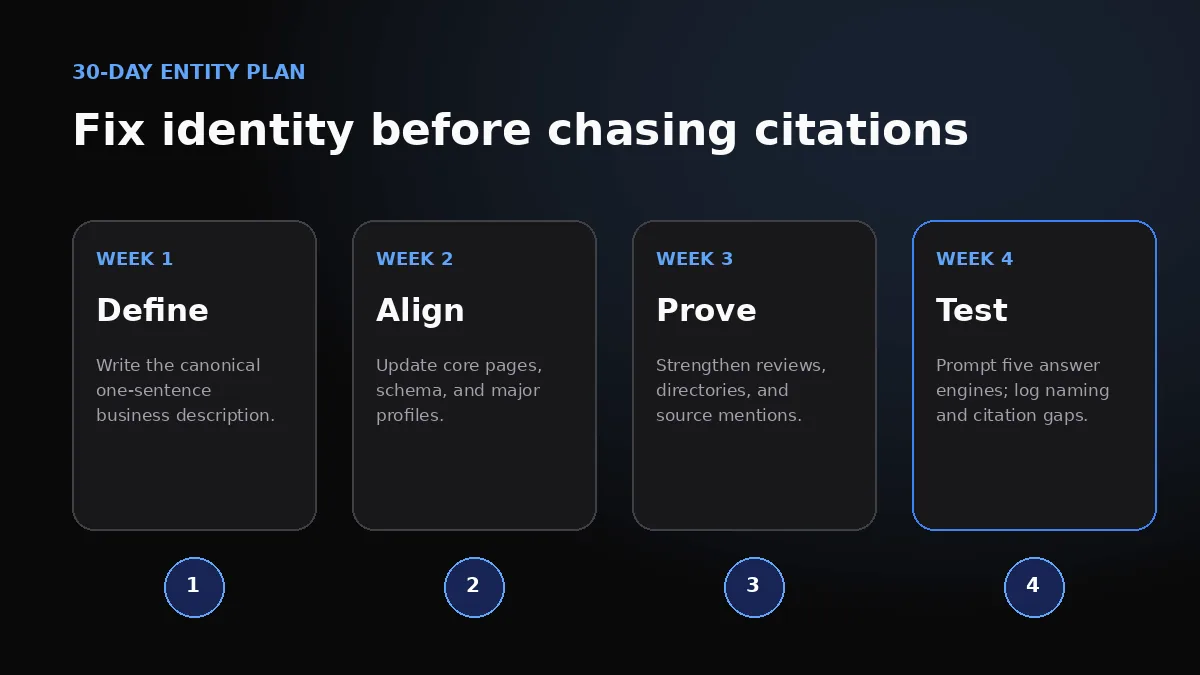
- Week 1 — Define. Approve the canonical sentence, primary category, naming rules, official domain, service area, and core profile list.
- Week 2 — Align. Update the homepage, About, contact page, footer, Organization schema, Google Business Profile, and priority social profiles.
- Week 3 — Prove. Correct major directory listings, request legitimate review updates where details are stale, and connect relevant partnerships or memberships.
- Week 4 — Test. Run the six factual prompts across five answer engines, save the outputs and citations, and queue the remaining contradictions.
At the end of the month, the deliverable is not a score. It is a clean identity record: one definition, one set of current facts, connected official properties, and a baseline showing how answer engines describe the business today.
Common entity SEO mistakes
- Using a slogan as the category. "Building tomorrow together" says nothing about what the company is. Keep the slogan, but pair it with a precise category.
- Adding every profile to
sameAs. The field should identify the entity, not archive abandoned accounts. Link only the profiles that are genuinely official. - Treating schema as a correction layer. Markup cannot override visible contradictions. Fix the website and profiles first.
- Creating directory listings for volume. Low-quality duplicates add maintenance work and more places for facts to drift.
- Changing the brand name casually. Punctuation, abbreviations, and location modifiers can help users, but unexplained variations can look like separate entities.
- Testing with leading prompts. "Why is our company the best?" measures model compliance, not understanding. Neutral factual prompts reveal the real gaps.
Make the business citable by making it clear
Entity SEO is identity operations for the web. Define the business in one sentence, make the pages and profiles agree, encode the visible facts with accurate structured data, and reinforce the identity through real third-party proof. Then test whether answer engines can repeat those facts without help.
Start with the canonical definition and the consistency table above. Once those pass, use the GEO visibility checklist to verify the technical layer and the product visibility guide for ChatGPT and Perplexity to extend the same entity discipline to individual offers.
Frequently asked questions
What is entity SEO?
Entity SEO makes the person, company, product, or place behind a website unambiguous. It aligns the brand name, category, location, contact details, profiles, structured data, and independent mentions so search and AI systems can connect them to one real business.
Does a small business need a knowledge graph?
It does not need to build a complex database. It needs a consistent set of facts across its website, Organization schema, Google Business Profile, major directories, and active social profiles. Those connected facts function as a practical small-business knowledge graph.
Which entity SEO fix should I make first?
Write one canonical sentence that states the business name, primary category, audience, location or service area, and core offer. Put that definition on the About page, then make the homepage, contact page, profiles, and structured data agree with it.
How do I test whether AI systems understand my business?
Ask several answer engines the same neutral questions: what the company does, who it serves, where it operates, and which official website and profiles belong to it. Log omissions and contradictions, fix the underlying source facts, then repeat the test monthly.