The One-Hour AI Search Visibility Audit: A Small-Business Workflow
Ask ChatGPT, Gemini, or Perplexity the questions your buyers actually ask — "best accountant for a food truck," "is [your category] worth it," "[your service] near me" — and one of three things happens: your business appears, a competitor appears, or nobody local appears at all. Most small businesses have never checked which one is true for them.
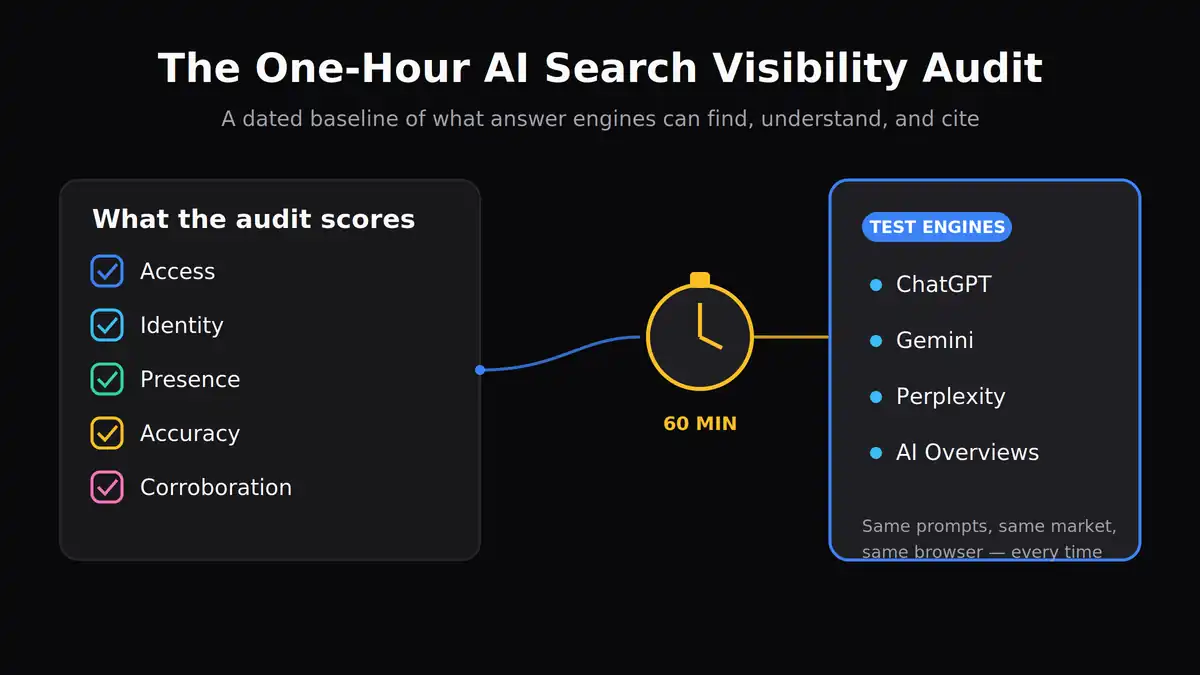
This audit fixes that in one hour. It is not rank tracking and it does not require paid tools. It produces a dated baseline: which engines can reach your site, whether they understand what you do, which questions you show up for, and a short, ordered fix list. Run it once to know where you stand, then quarterly to measure whether your work is moving anything.
What the audit actually measures
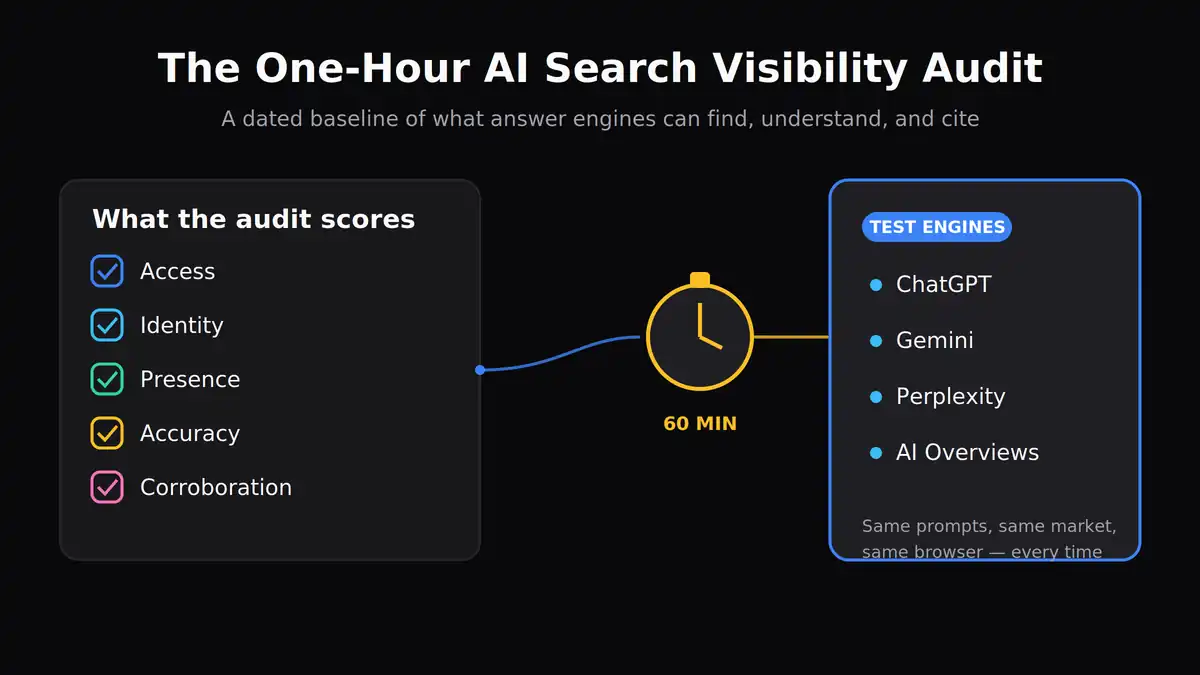
AI answers are generated, not ranked, so the audit measures five things rather than positions:
- Access: can AI crawlers reach and read your pages at all?
- Identity: do engines know who you are — name, location, category, offering — consistently enough to cite you?
- Presence: do you appear in answers to real buyer questions, and in what form (mention, citation, or link)?
- Accuracy: when you appear, is the description correct, current, and safe to show a customer?
- Corroboration: do third-party sources — reviews, directories, community threads — back up what your site claims?
A business can score well on access and still be invisible because its identity is ambiguous or its pages contain nothing an engine can quote. Keeping the five outcomes separate is what turns the audit from a vibes check into a fix list.
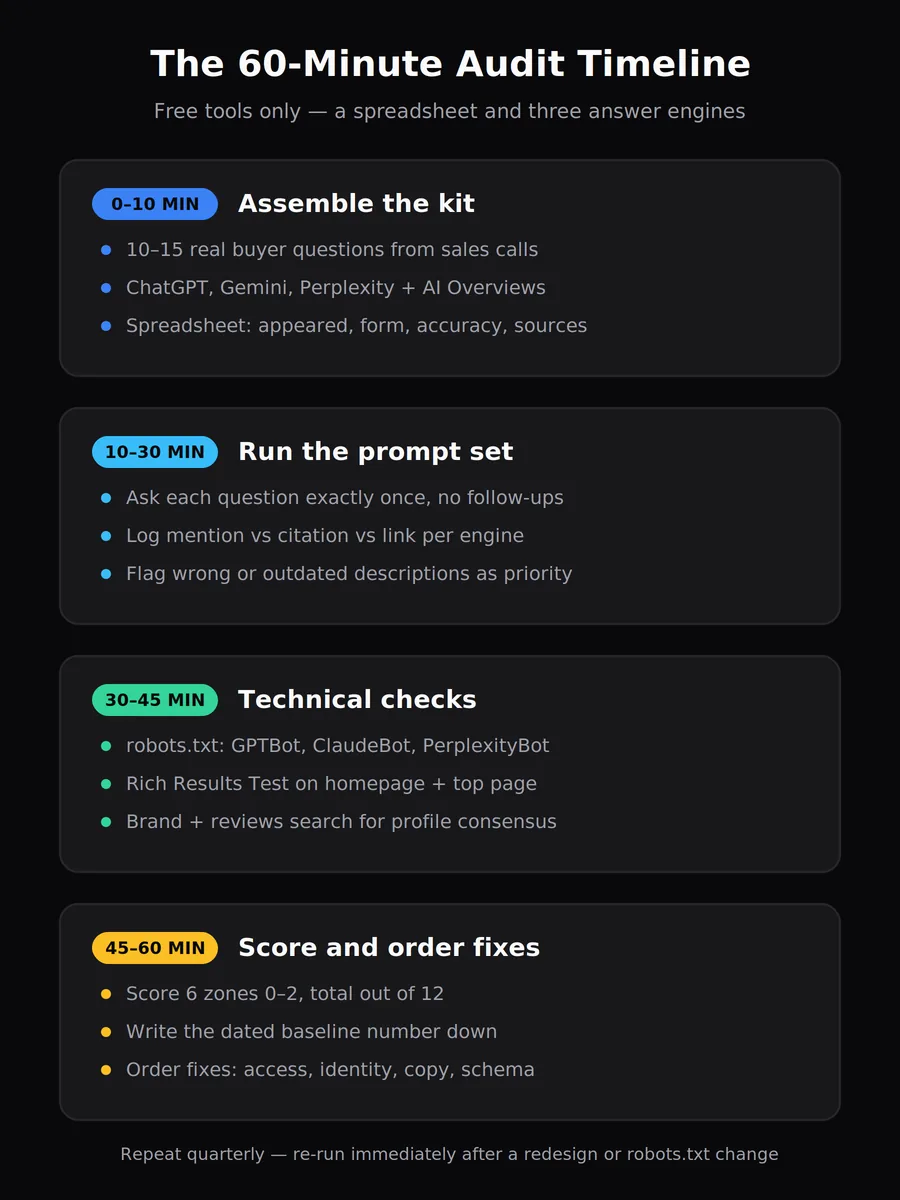
Assemble the kit before you start (minutes 0–10)
Preparation is what makes the hour productive. You need four things:
- A prompt set of 10–15 real buyer questions. Pull the wording from sales calls, emails, support tickets, and search queries — not from marketing copy. Group them into discovery ("how do I…"), comparison ("which tool for…"), evaluation ("what should I check before…"), and brand verification ("does [brand]…"). The AI citation tracking workflow has the full prompt-set method if you want to go deeper.
- Three to four answer engines. ChatGPT and Gemini at minimum, plus Perplexity (which always shows sources) and Google AI Overviews for queries where they trigger.
- A spreadsheet with one row per question per engine and columns for: appeared? (yes/no), form (mention/citation/link), accuracy (correct/incomplete/wrong), sources cited, and notes.
- Your own site's basics in another tab: homepage, your most important service or product page, robots.txt, and your Google Business Profile or equivalent directory listing.
Use the same browser, market, and signed-in state every time you re-run the audit. Consistency matters more than laboratory conditions.
Minutes 10–30: run the prompt set
Work through the prompt set engine by engine. Ask each question exactly as a buyer would — no follow-up prompts that feed the engine extra context. For every answer, record the five columns from your spreadsheet.
Two patterns matter most. First, which sources get cited when you do not appear: that is your real competition in AI search, and it is often a Reddit thread, a review site, or a directory rather than a rival's homepage. Second, wrong appearances: if an engine confidently states your old pricing, a discontinued service, or a competitor's description under your name, that is a priority fix — an inaccurate citation is worse than no citation.
Perplexity deserves one extra pass because it exposes its sources on every answer. Note which of your pages (if any) it can see, and which third-party pages it prefers.
Minutes 30–45: run the technical checks
Six quick checks cover the technical half of AI visibility:
| Check | How to test it | What a pass looks like |
|---|---|---|
| Crawler access | Open yoursite.com/robots.txt and look for blocks on GPTBot, ClaudeBot, PerplexityBot, and Google-Extended |
No blanket disallow on major AI crawlers — or a deliberate decision you can defend |
| Entity clarity | Read your homepage and About page as a stranger: is your name, category, location, and offering stated in plain sentences? | A first-time reader can say what you do, where, and for whom within ten seconds |
| Answer-ready copy | Check your top three pages for a direct, quotable answer in the first paragraph under each heading | Each key page contains at least one self-contained sentence an engine could quote verbatim |
| Structured data | Run your homepage and top page through Google's Rich Results Test | Organization or LocalBusiness plus page-type schema, with no errors |
| Third-party consensus | Search your brand name plus "reviews" and check your top three directory or review profiles | Profiles exist, are claimed, and describe the same business your site describes |
| Freshness | Look at the dates, prices, and claims on your five most-visited pages | Nothing a customer or an engine could quote is stale |
For a guided version of these checks with scoring, run the GEO visibility checklist alongside this audit — it covers the same zones interactively and flags the gaps.
Minutes 45–60: score the six zones and build the fix list
Score each zone from 0 to 2: 0 means missing or blocked, 1 means partial, 2 means solid. Total it out of 12 and write the number down with the date — that is your baseline.
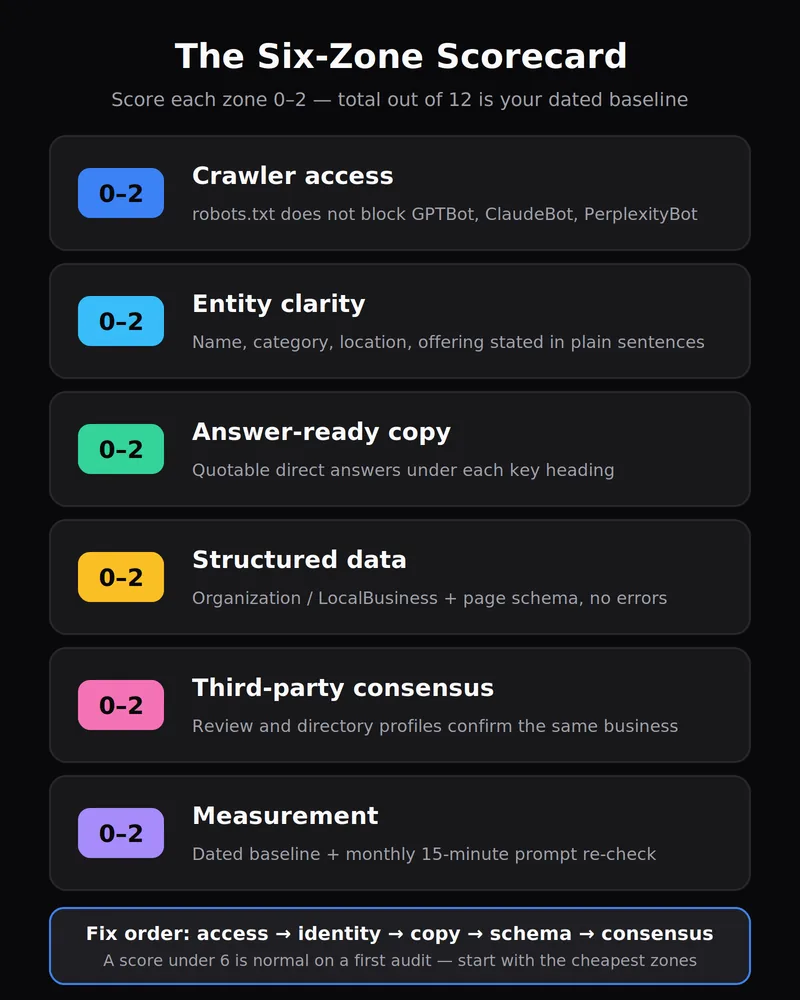
Then turn low scores into an ordered fix list. The order matters more than the scores:
- Access first. A blocked crawler invalidates everything downstream. The robots.txt AI crawler guide walks through the exact directives, and the llms.txt guide covers the optional companion file.
- Identity second. Engines cannot cite a business they cannot identify. The entity SEO guide shows how to make your name, category, and location unambiguous across your site and profiles.
- Quotable content third. Rewrite the opening paragraphs of your top pages so each contains one direct, specific, self-contained answer. The AI answer extraction guide covers the format engines prefer.
- Structured data fourth. Add or repair Organization, LocalBusiness, Product, or FAQ schema so the facts you just made quotable are also machine-readable — see the schema markup guide for AI search.
- Corroboration fifth. Claim and align your review and directory profiles, then build presence in the community threads your prompt runs showed getting cited.
- Measurement last. Set a monthly 15-minute re-check of the prompt set so fixes are verified rather than assumed. AI referral tracking in GA4 covers the click side.
A total score under 6 is normal for a first audit and usually means access or identity problems — the two cheapest zones to fix. A score of 8 or more with weak prompt-run results points to corroboration: the engines can read you, but third parties are not confirming you yet.
How often to re-audit
Run the full hour quarterly, and a 15-minute version — just the prompt set, no technical checks — monthly. Re-run the full audit immediately after a redesign, rebrand, migration, or any change to robots.txt or schema. AI platforms shift how they pick and display sources several times a year; a dated baseline is the only way to tell a platform change apart from a problem you introduced.
The bottom line
AI search visibility is measurable, and the first measurement takes one hour with free tools: ten minutes of setup, twenty minutes of buyer prompts, fifteen minutes of technical checks, fifteen minutes of scoring. What you get is a dated baseline and an ordered fix list — access, identity, quotable copy, structured data, corroboration, measurement — instead of a vague sense that AI search "probably matters." Run the audit this week, then let the GEO visibility checklist score the technical zones in more detail before you start fixing.
Frequently asked questions
How often should a small business run an AI search visibility audit?
Run the full one-hour audit quarterly, and a lightweight 15-minute version monthly. Quarterly cadence is enough to catch platform changes, new competitors, and the effect of your fixes without turning measurement into busywork. Re-run immediately after a major site change, a rebrand, or a visible shift in how an AI platform displays sources.
Do I need paid tools to audit AI search visibility?
No. The audit works with the free tiers of ChatGPT, Gemini, and Perplexity, plus Google for AI Overviews, a spreadsheet, and your own website. Paid monitoring tools become useful later, when you want to track hundreds of prompts across markets automatically — but the baseline audit should be done by hand at least once so you understand what the tools are measuring.
What is the difference between an AI visibility audit and rank tracking?
Rank tracking watches your position for a fixed list of keywords in one search engine. An AI visibility audit checks whether answer engines can access your site, understand who you are, extract usable answers from your pages, and corroborate your claims with third-party sources. AI answers are generated, not ranked, so the audit measures presence and accuracy across a small set of real buyer questions instead of positions for keywords.
What should I fix first after the audit?
Fix access before content, and content before promotion. If AI crawlers are blocked in robots.txt, nothing else matters. Next comes entity clarity — consistent name, address, product, and service descriptions across your site and profiles — because engines cannot cite a business they cannot identify. Only then invest in answer-ready copy, schema markup, and off-site presence like reviews and community threads.