Conversational Query Research: Find the Questions Customers Ask AI
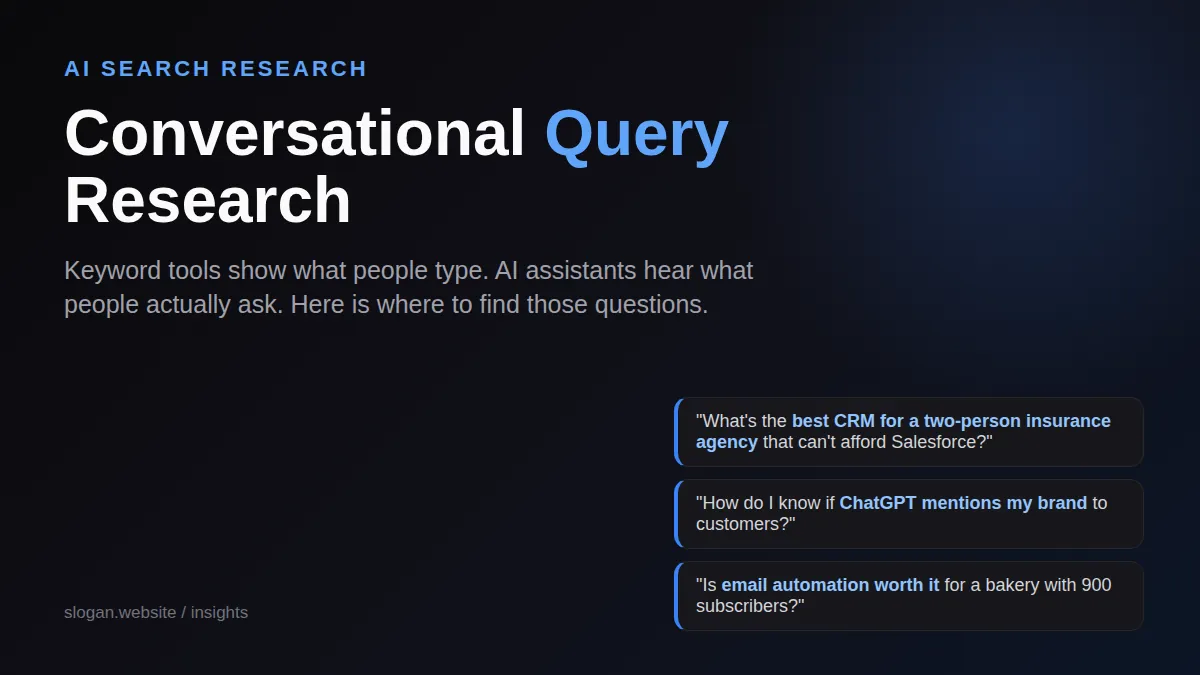
Keyword research tools are built around what people type: two to four words, no context, no situation. AI assistants hear something different. A business owner does not type "CRM small business" into ChatGPT — she asks, "What's the best CRM for a two-person insurance agency that can't afford Salesforce?"
That gap matters because the cited sources in AI answers are usually the pages that resolve the full question, not the pages optimized for the short keyword. Conversational query research is the discipline of finding those full questions before your competitors write the answers.
Why typed keywords and conversational queries diverge
The two query types look similar in a spreadsheet but behave differently in AI search.
| Dimension | Typed keyword | Conversational query |
|---|---|---|
| Shape | "crm insurance agents" | "What's the best CRM for a two-person insurance agency that can't afford Salesforce?" |
| Context | None; intent inferred | Situation, budget, and constraint stated upfront |
| Where it appears | Keyword tools, Search Console | Sales calls, chat logs, forums, AI prompts |
| Winning content | Optimized landing or category page | Answer-first guide with standalone quotable sentences |
| Success metric | Rank, impressions, clicks | Citation or mention inside the AI answer |
Neither replaces the other. The typed keyword still tells you a topic has volume. The conversational query tells you how the buyer actually frames the decision — and that framing is what AI answers match against.
Where to find real conversational queries
You do not need a new subscription for this. The best sources are the words your buyers already use.
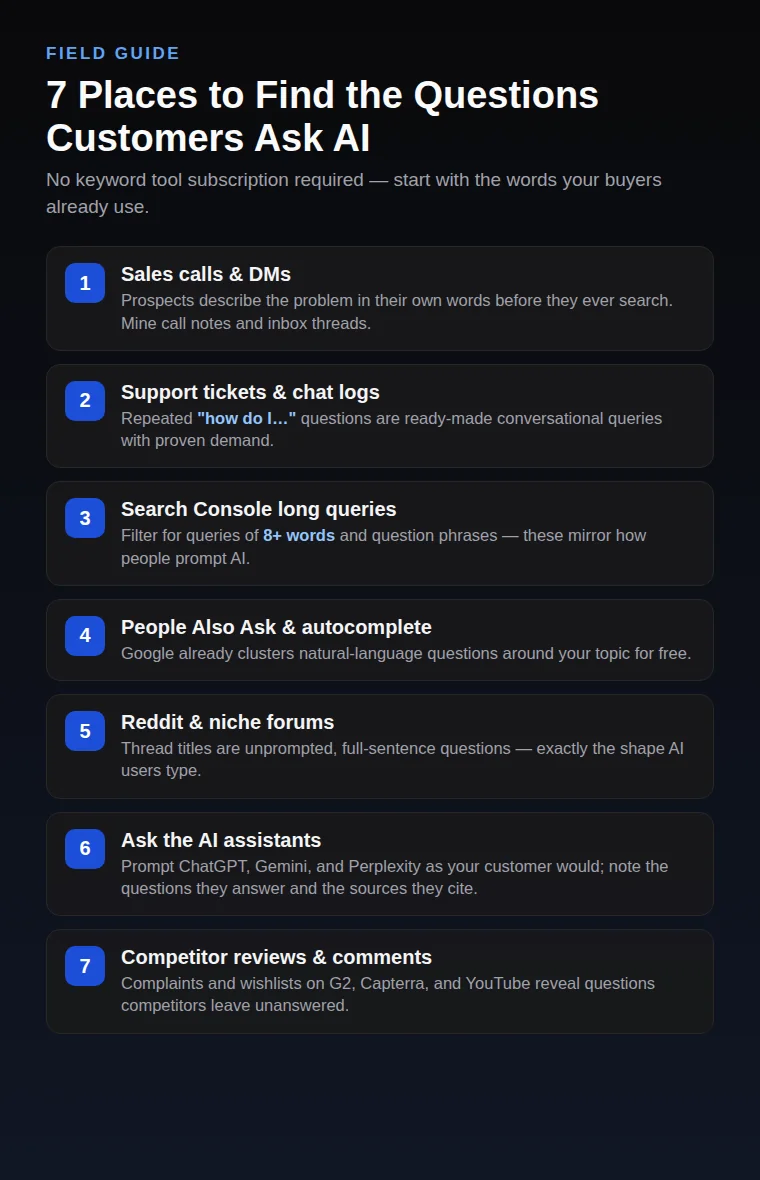
- Sales calls and DMs. Prospects describe the problem in their own words before they ever search. Mine call notes, inbox threads, and WhatsApp conversations.
- Support tickets and chat logs. Repeated "how do I…" questions are proven demand in natural language.
- Search Console long queries. Filter for queries of eight or more words and question phrases. Long typed queries increasingly mirror how people prompt AI.
- People Also Ask and autocomplete. Google already clusters natural-language questions around your topic.
- Reddit and niche forums. Thread titles are unprompted, full-sentence questions — exactly the shape AI users type.
- The AI assistants themselves. Prompt ChatGPT, Gemini, and Perplexity as your customer would. Note which questions they answer confidently and which sources they cite; the citation tracking workflow turns this into a repeatable loop.
- Competitor reviews and comments. Complaints and wishlists on review sites and YouTube reveal questions competitors leave unanswered.
From raw question to citable answer
Collecting questions is the easy half. The value comes from the pipeline that turns them into pages AI engines can quote.
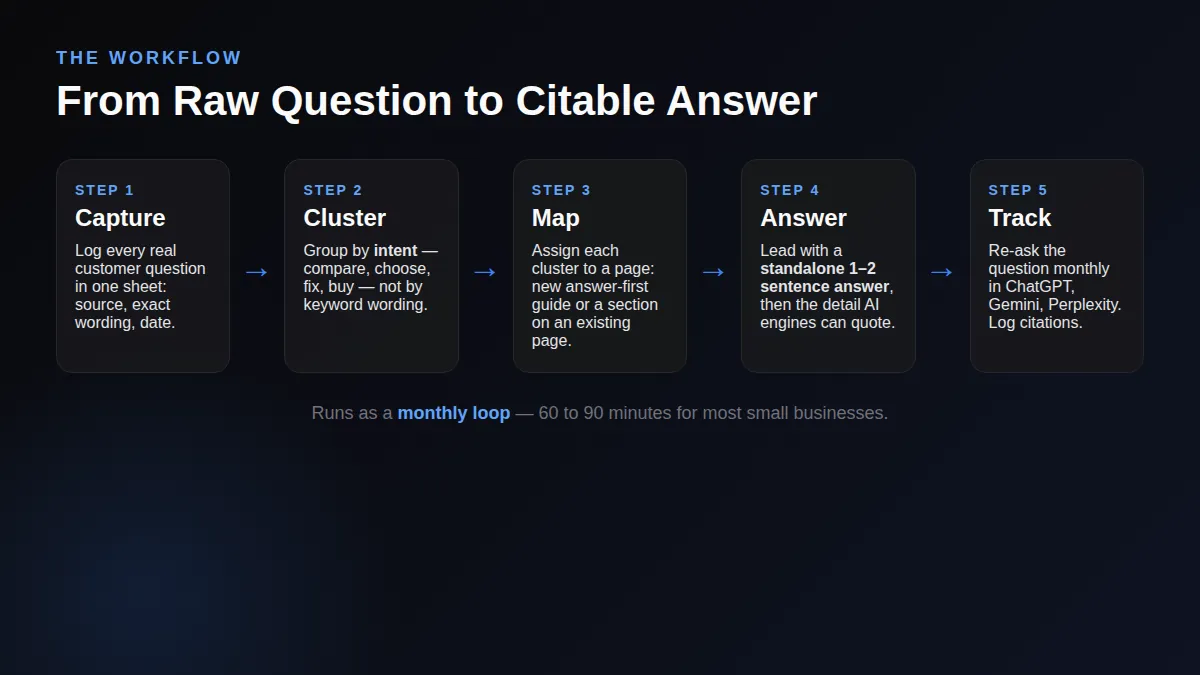
- Capture. Log every real customer question in one sheet: source, exact wording, date.
- Cluster. Group by intent — compare, choose, fix, buy — not by keyword wording. Twenty questions often collapse into five or six clusters.
- Map. Assign each cluster to a page: a new answer-first guide or a new section on an existing page. The buyer journey content map shows how clusters line up with funnel stages.
- Answer. Lead each page or section with a standalone one-to-two-sentence answer, then the supporting detail. The answer extraction writing guide covers the exact passage pattern AI engines quote.
- Track. Re-ask the question monthly in the major assistants and log whether you are cited. Pair this with AI referral tracking in GA4 to connect citations to visits.
A worked example
Say a bakery owner asks an assistant, "Is email automation worth it for a bakery with 900 subscribers?" The typed-keyword version — "email automation small business" — is covered by every major tool vendor. The conversational version is barely covered at all.
A page that opens with "Yes — a bakery with 900 subscribers typically recovers the cost of a basic email automation plan with one extra order per week, and setup takes under two hours with a welcome series and a weekly special" has a real chance of being quoted. That sentence names the situation, the constraint, and the verdict in one breath. The rest of the page earns the click; the opening earns the citation.
Where this fits in the GEO stack
Conversational query research sits at the front of the GEO workflow: it decides what to write before you decide how to optimize it. Run it quarterly, feed the output into your content calendar, and validate coverage with the GEO visibility checklist. If most checklist items pass but citations are thin, the missing layer is usually not technical — it is that nobody wrote the answer to the question buyers are actually asking.
Frequently asked questions
What is conversational query research?
Conversational query research is the process of finding the full, natural-language questions people ask AI assistants and voice tools, instead of the short keyword phrases they type into a search box. The output is a list of real questions, clustered by intent, that you can map to answer-first content.
Do keyword tools work for AI search research?
Partially. Classic keyword tools still show typed demand and search volume, but they underrepresent the long, task-framed questions people ask ChatGPT, Gemini, or Perplexity. Combine keyword data with sales calls, support tickets, Search Console long queries, and direct prompting of the AI assistants themselves.
How many conversational queries does a small business need?
Start with 20 to 30 real questions clustered into 5 to 8 intent groups. That is usually enough to fill a quarter of content work. Refresh the list monthly by re-asking the questions in the AI assistants and noting which sources get cited.
How do I know if my page answers a conversational query well?
Ask the exact question in ChatGPT, Gemini, Perplexity, and Google AI Overviews. If your page is cited or quoted, the answer extraction is working. If a competitor is cited instead, compare their opening sentences, structure, and evidence against yours.