Comparison Pages That AI Answer Engines Cite: A Small Business Guide
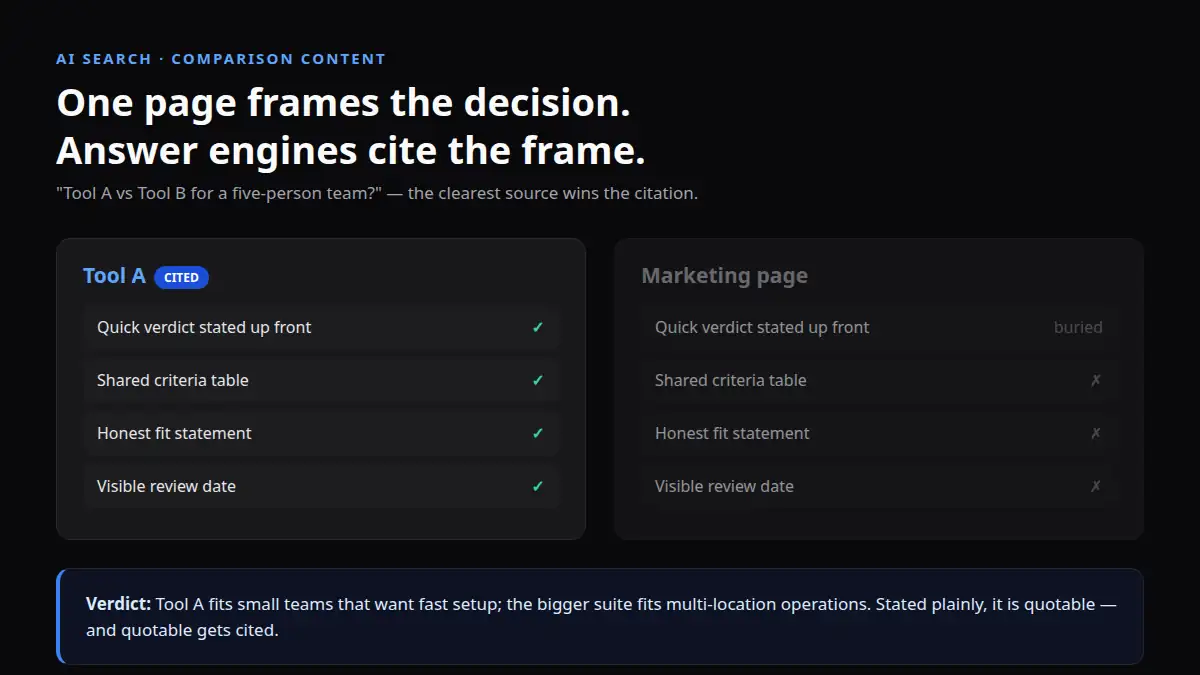
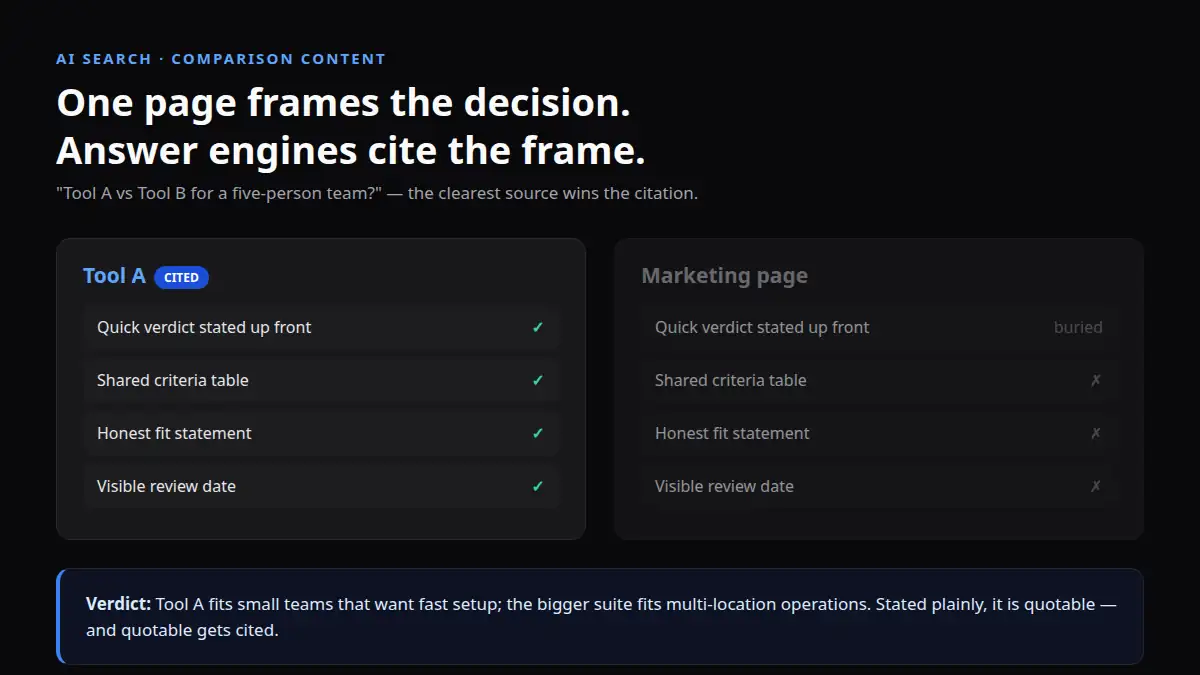
Comparison pages are some of the most-cited content in AI answers. When someone asks ChatGPT, Perplexity, Gemini, or Google's AI Overviews "Which is better, X or Y?", the answer engine needs a source that already frames the decision: both options named, criteria defined, and a clear statement of who each option serves. A well-built comparison page is exactly that source.
For a small business, this is an unusually fair fight. You do not need a large domain or a big content budget to be cited. You need a page that answers the comparison question more clearly and more honestly than the alternatives. This guide explains why answer engines prefer these pages, the structure that earns citations, and the mistakes that get comparison pages ignored.
Why answer engines lean on comparison content
AI search questions are rarely single-word lookups. They sound like the questions customers ask on sales calls: "Is a standalone CRM worth it for a five-person insurance agency?" or "What is the difference between factoring and a line of credit for a small contractor?" These are comparison questions, and the best source for them is a page built as a comparison.
Three properties make comparison pages attractive to answer engines:
- The question is pre-framed. The page already contains the entity pair, the decision context, and the criteria. Extraction is cheap and low-risk for the model.
- The answer is attributable. A page that says "Tool A fits solo operators; Tool B fits teams with dispatchers" gives the engine a sentence it can quote or paraphrase with confidence.
- The evidence is checkable. Pages that cite pricing pages, feature documentation, or their own testing give the engine corroboration it can cross-reference against other sources.
This connects directly to the mechanics in our guide to answer-first writing for AI extraction: the page that states the answer plainly, near the question, wins the citation more often than the page that buries the verdict under marketing copy.
The anatomy of a citable comparison page
A comparison page that earns citations has a consistent skeleton. Each element answers a question the answer engine is implicitly asking.
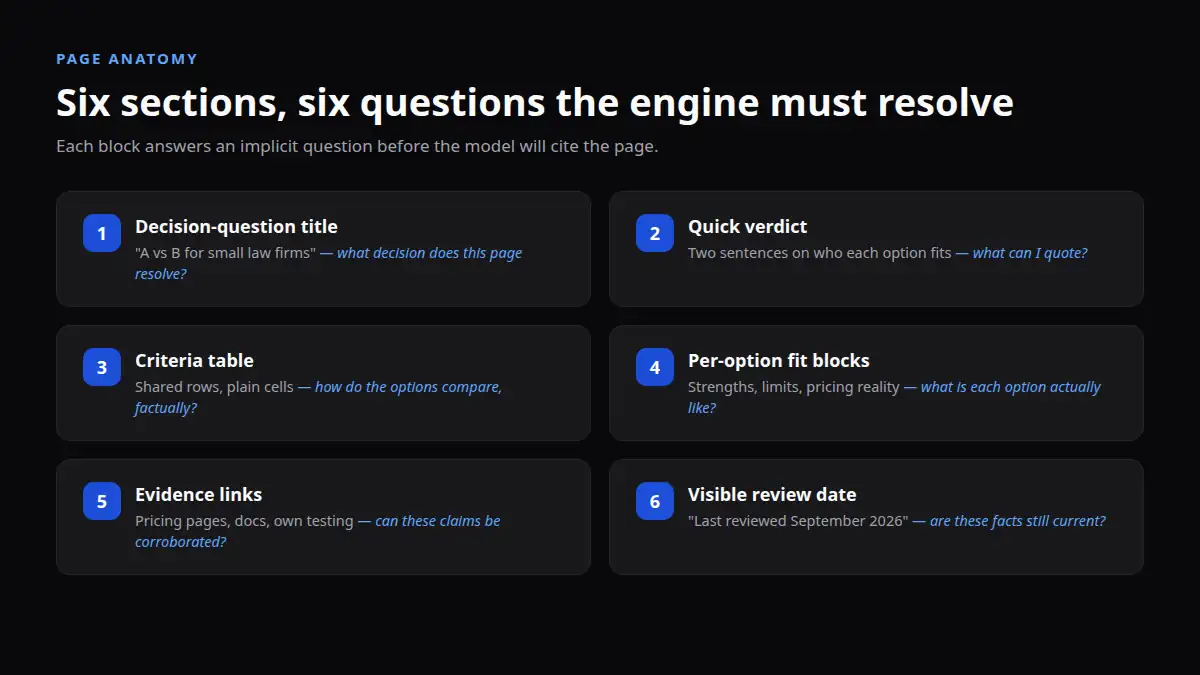
- The decision question as the title. "Tool A vs Tool B for small law firms" is a citation target. "Why our product is the best choice" is not.
- A quick verdict near the top. Two or three sentences that state who each option fits, before any detail. This is the passage most likely to be quoted.
- A criteria table. Shared rows, one column per option, plain-language cells. Tables are easy for machines to parse and hard to misread.
- Per-option fit sections. A short block per option covering strengths, limits, pricing reality, and ideal customer.
- Evidence and dates. Links to primary sources and a visible "last reviewed" date. Freshness signals matter because pricing and features change.
If you want a technical self-check before publishing, run the page through the GEO visibility checklist to catch structural gaps such as missing headings, weak metadata, or absent structured data.
Write criteria that buyers actually use
The criteria table is the heart of the page. Weak pages compare what is easy to measure ("number of features") instead of what decides the purchase. Build criteria from real buying conversations: sales-call notes, support tickets, reviews of both products, and search query data.
| Weak criterion | Strong criterion | Why the strong version gets cited |
|---|---|---|
| Number of features | Time to send a first invoice | Ties the product to a real task a buyer cares about. |
| Price per month | Total monthly cost for a 5-person team with required add-ons | Matches how buyers actually budget; avoids misleading base-price comparisons. |
| Integrations: yes/no | Native integration with the two tools this audience already uses | Specificity makes the answer reusable in a niche query. |
| Customer support | Support channel and response time during the buyer's working hours | Turns a vague claim into a verifiable operational fact. |
| Ease of use | Steps and training time for a non-technical hire | Converts an opinion into a testable process description. |
A good test: if a criterion would look identical on any competitor's comparison page, it is too generic to earn you a citation. The criteria that get quoted are the ones only someone close to the customer would think to include.
Honesty is a ranking signal in AI answers
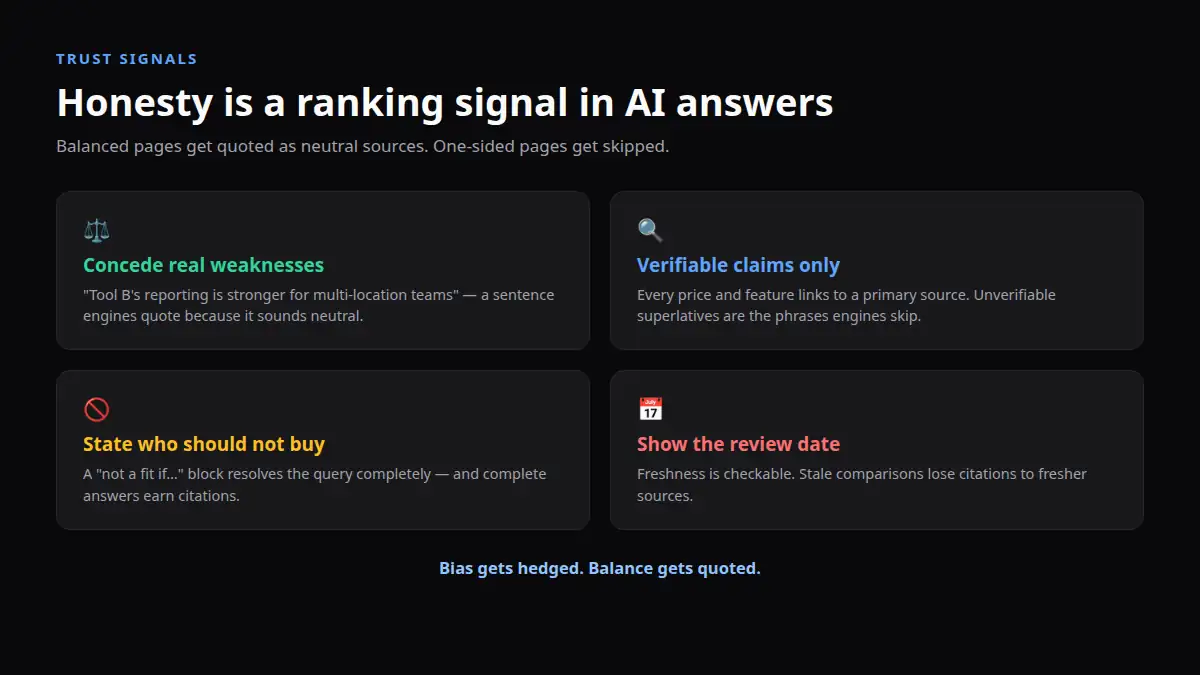
Traditional SEO rewarded pages that argued one side. AI answer engines behave differently. They cross-check your claims against other sources, and pages with obvious bias get discounted or cited only with hedging. Pages that concede real trade-offs get quoted as neutral sources.
That changes the writing rules:
- Name where the competitor wins. "Tool B's reporting is stronger for multi-location businesses" is a citable sentence. It also builds trust with the human reader who already suspected it.
- Avoid unverifiable superlatives. "The best," "the easiest," and "the cheapest" without evidence are the phrases engines skip when choosing sources.
- State who should not buy from you. A short "not a fit if..." block is rare, memorable, and frequently surfaced in answers because it resolves the query completely.
- Show the review date. "Last reviewed September 2026" tells the engine the facts are maintained. Stale comparisons lose citations to fresher ones.
Add structure machines can parse
Content quality gets you considered; structure gets you extracted. Three layers matter:
- Headings that mirror questions. Use H2 and H3 headings phrased as the comparisons buyers ask about: pricing, setup effort, fit by business size. Heading text becomes the map the engine uses to locate passages.
- Semantic HTML tables. Keep criteria in real table markup, not screenshots of tables or loose bullet lists. Machines parse cells; they cannot reliably read text baked into an image.
- Structured data. Mark the page as an Article, include FAQ markup for the short questions at the bottom, and use Product or SoftwareApplication markup where it genuinely applies. Our schema markup guide for AI search walks through the exact types and properties.
If your product or service should appear in shopping-style answers, pair this work with the product visibility workflow for ChatGPT and Perplexity, which covers feed and product-page signals in more depth.
A small-business rollout plan
You do not need twenty comparison pages. You need the three that match real revenue conversations.
| Step | Action | Done when |
|---|---|---|
| 1. Pick the battles | List the competitors named most often in sales calls, lost-deal notes, and search queries containing "vs", "alternative", or "compared to". | You have 2-3 matchups with clear commercial intent. |
| 2. Gather criteria | Pull decision criteria from customer conversations and both products' documentation. Verify prices and features against primary sources. | Every cell in the criteria table has a source you can link. |
| 3. Write the verdict first | Draft the two-sentence quick verdict before the rest of the page. If you cannot state who each option fits, the criteria are not sharp enough yet. | The verdict is specific enough to be quoted on its own. |
| 4. Publish with structure | Ship the page with semantic tables, question-shaped headings, FAQ markup, and a visible review date. | The page passes a structural check such as the GEO visibility checklist. |
| 5. Track citations | Add the comparison questions to your monthly AI citation checks and watch which source the engines prefer. | You can see whether your page, a competitor, or a third party is being cited. |
| 6. Refresh on a schedule | Re-verify pricing and features quarterly, or immediately when either product changes plans. | The review date never lags the facts by more than a quarter. |
Step five is where most small businesses stop too early. Citations are measurable: the AI citation tracking workflow shows how to test your comparison questions monthly and record which page each engine cites. If a third-party review site wins the citation instead of you, that tells you exactly which evidence or structure your page still lacks.
What to avoid
- Fake objectivity. A "comparison" that exists only to funnel readers to your product is obvious to readers and increasingly to models. Include at least one scenario where the competitor is the right choice.
- Comparing against products you have not verified. If you cannot link the competitor's current pricing or feature page, you are not ready to publish the row.
- One page, ten matchups. A single page comparing you against every competitor dilutes the decision framing. One matchup per page keeps the title, headings, and verdict quotable.
- Set-and-forget pricing. Nothing kills citation trust faster than a stale price. The review date is a promise; keep it.
- Hiding the page. Comparison pages should be reachable from navigation, product pages, and related articles. Orphaned pages accumulate neither links nor citations.
The compounding effect
A comparison page is a durable asset in AI search because the question never stops being asked. Buyers will ask "X vs Y" this month, next quarter, and next year, in slightly different words. The page that answers it clearly, honestly, and with current facts keeps earning citations long after publication, and each citation reinforces the next.
Start with the matchup that costs you the most deals today. Write the verdict first, build the criteria table from real conversations, mark the review date, and put the question into your monthly citation checks. That is the whole loop: frame the decision, prove it, keep it fresh, and measure whether the answer engines agree. Audit the page with the GEO visibility checklist before you ship the refresh.
Frequently asked questions
Why do AI answer engines cite comparison pages so often?
Comparison pages match how people ask questions in AI tools. A query like 'Which invoicing tool is better for a freelancer, A or B?' maps directly to a page that already names both options, defines the decision criteria, and states who each option fits. That structure is easy for an answer engine to extract and attribute.
Should a small business compare itself against bigger competitors?
Yes, when the comparison is honest and specific. Answer engines look for balanced criteria, clear fit statements, and evidence. A page that admits where a competitor is stronger is more citable than a page that claims to win every category.
How many comparison pages should a small business publish?
Start with two or three pages against the competitors customers actually mention in sales calls. Quality and accuracy matter more than volume. Each page should have real criteria, current facts, and a stated review date.
Do comparison pages need schema markup to get cited?
Schema is not required for citations, but it helps machines parse the page. Article, FAQ, and product or software-application markup clarify what the page covers. Structure and honest content still do most of the work.