Local Business Visibility in AI Search: How ChatGPT and Perplexity Pick Who to Recommend
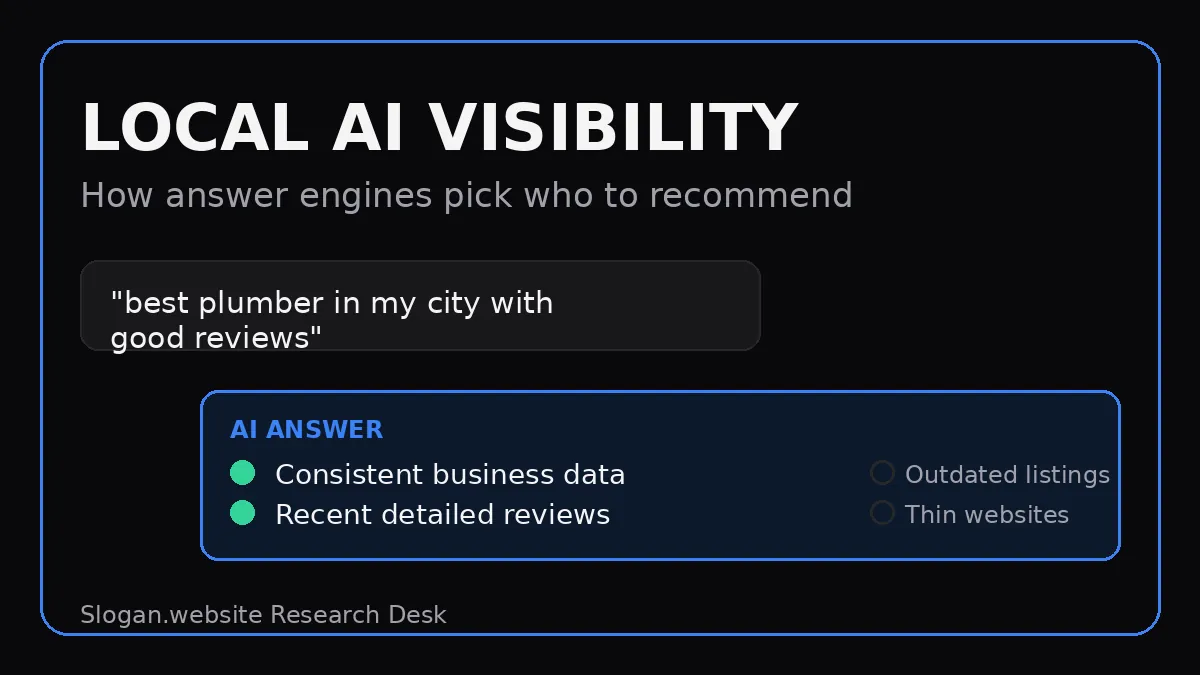
Ask ChatGPT or Perplexity for the best plumber, dentist, or coffee shop in your city and you will get a confident shortlist. That shortlist is not the Google map pack rewritten. It is assembled from a different mix of sources, and many local businesses that rank well in classic search are invisible inside those answers.
Local AI visibility is the practice of making your business the one an answer engine names when a customer asks for a recommendation in your area. The good news: the work is concrete, mostly free, and a focused owner can run a first audit in about an hour.
This guide covers where local AI answers come from, the five signals that decide who gets recommended, and a 60-minute audit you can repeat monthly. If you want a broader framework first, start with our entity SEO for AI search guide, the local SEO checklist, the Google Business Profile checklist, and the GEO visibility checklist.
Where local AI answers actually come from
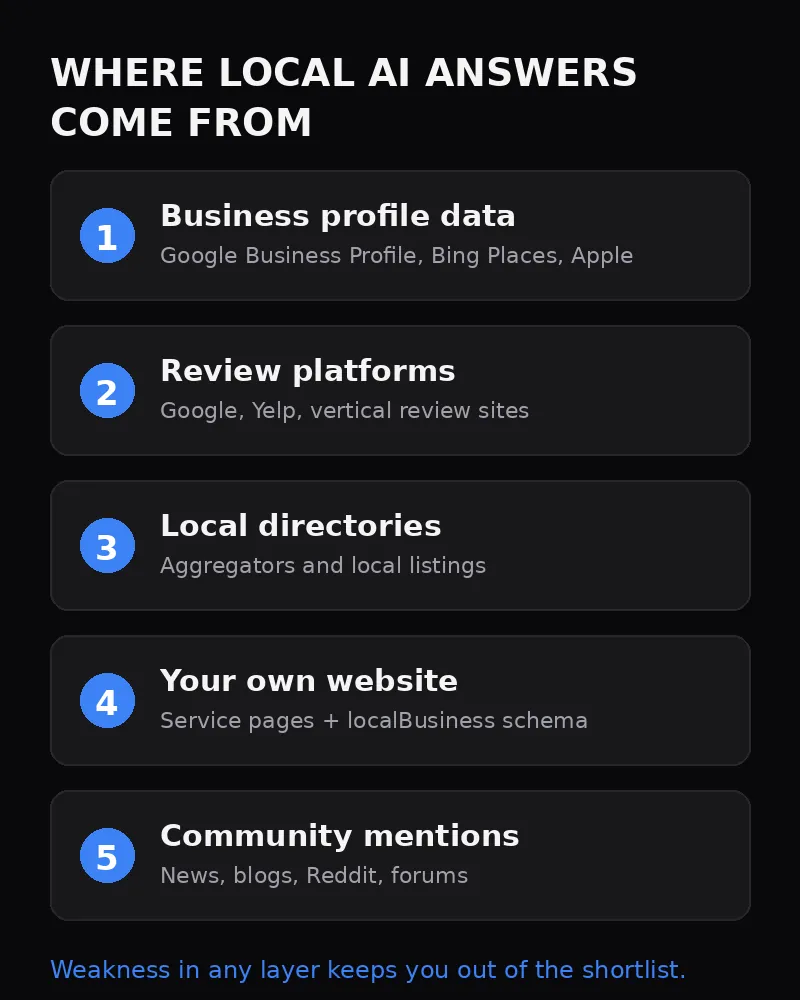
Answer engines do not have a local database of their own. They pull from layers of existing data, roughly in this order of influence for local queries:
- Business profile data. Google Business Profile feeds Google's AI answers directly, and its data (categories, hours, services, attributes) is echoed by many other platforms. Bing Places plays the same role for Copilot.
- Review platforms. Google reviews first, then Yelp, TripAdvisor, Facebook, and vertical platforms such as Healthgrades or Avvo, depending on your category. Review text, not just star counts, is what engines quote when explaining a recommendation.
- Local directories and aggregators. Data aggregators and directories (Apple Maps, Yelp, Yellow Pages, local chamber listings) are used to cross-check that your business is real and consistent.
- Your own website. Service pages, location pages, pricing signals, and localBusiness schema tell engines exactly what you do and where.
- Community mentions. Local news, blogs, Reddit threads, and forum posts often decide the tie between two otherwise similar businesses. An engine that sees real people recommending you has a reason to name you.
The implication is uncomfortable but useful: a beautiful website cannot compensate for a thin review profile, and hundreds of reviews cannot compensate for conflicting address data. Local AI visibility is a consistency game across all five layers.
The five signals that decide who gets recommended
Within those sources, five signals carry most of the weight. The table below summarizes each one, how answer engines use it, and what a small business can realistically control.
| Signal | How AI engines use it | What you control |
|---|---|---|
| Entity consistency | Conflicting names, addresses, phone numbers, or hours make engines distrust the listing and skip it. | One canonical name, address, phone, and hours everywhere, starting with Google Business Profile. |
| Review quantity and recency | A steady stream of recent reviews signals an active, trusted business. Engines rarely recommend businesses whose last review is years old. | A repeatable ask-for-a-review process after every job or visit. |
| Review content | Engines quote specific phrases. Reviews that mention services, neighborhoods, and outcomes give the model material to explain why you were chosen. | Prompting happy customers to mention what they bought and where, without scripting them. |
| Service and location clarity | Pages that clearly state services, service area, and pricing ranges are easier to cite than vague homepages. | One page per core service, a visible service area, and localBusiness schema with accurate fields. |
| Third-party mentions | Mentions in local news, blogs, and forums act as independent confirmation that you are a real, recommended option. | Local partnerships, community involvement, and pitching genuinely newsworthy stories to local outlets. |
Notice what is missing: keyword density and backlink counts. Those still matter for classic rankings, but an answer engine deciding between three roofers leans on whether the data agrees, what reviewers actually said, and whether anyone independent has vouched for the business.
The 60-minute local AI visibility audit
Run this once, then repeat monthly with the same prompts so you can see movement instead of guessing.
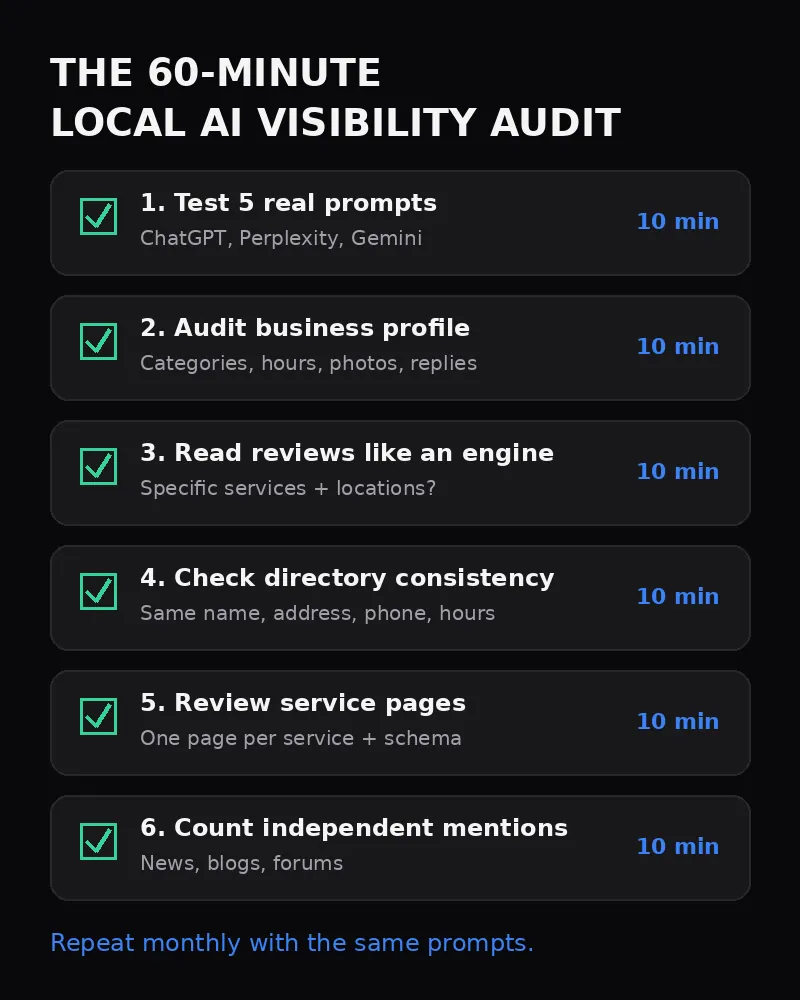
Step 1: test five real prompts (10 minutes)
Write down five questions a customer would genuinely ask, with local intent: "best [service] in [city]", "who should I hire for [job] near [neighborhood]", "affordable [service] in [city] with good reviews", and two variations specific to your trade. Run them in ChatGPT, Perplexity, and Gemini. Record whether you are named, who is named instead, and which sources the engine cites. This is the same benchmarking logic as our AI search competitor gap analysis, narrowed to local intent.
Step 2: audit your business profile (10 minutes)
Check Google Business Profile for correct categories, current hours, a complete services list, recent photos, and owner responses to recent reviews. Use the Google Business Profile checklist to score the listing, then the local SEO checklist for citations and service pages. Check Bing Places and Apple Business Connect. Missing or stale profile data is the cheapest visibility problem to fix.
Step 3: read your reviews like an engine would (10 minutes)
Look at your last 20 Google reviews. Do they mention specific services and locations, or are they generic praise? Note the date of the most recent one. If reviews are old or content-free, your fix is a review process, not a website project.
Step 4: check directory consistency (10 minutes)
Search your business name and compare name, address, phone, and hours across the top directories in your market. Any conflict is a trust penalty. Fix the biggest platforms first; smaller ones often sync from the aggregators.
Step 5: review your service pages (10 minutes)
For each core service, confirm you have a dedicated page that states what you do, where you do it, and what it roughly costs or how pricing works. Add or correct localBusiness schema with the same name, address, and phone as your profiles. Vague pages are invisible pages.
Step 6: count independent mentions (10 minutes)
Search for your business name plus your city and note anything you do not control: news, blogs, event pages, forum threads. Zero mentions means the engines have nothing independent to confirm you with, which is the hardest gap to close but also the most defensible once you do.
Turning the audit into fixes
Prioritize in the order the engines do. Entity consistency and profile completeness come first because they are fast and unlock everything else. A review pipeline comes second because it compounds: five new detailed reviews a month changes what engines can say about you within a quarter. Service-page clarity and schema are a one-week project for most small sites. Independent mentions are the slowest, so start them early and treat them as ongoing outreach rather than a campaign.
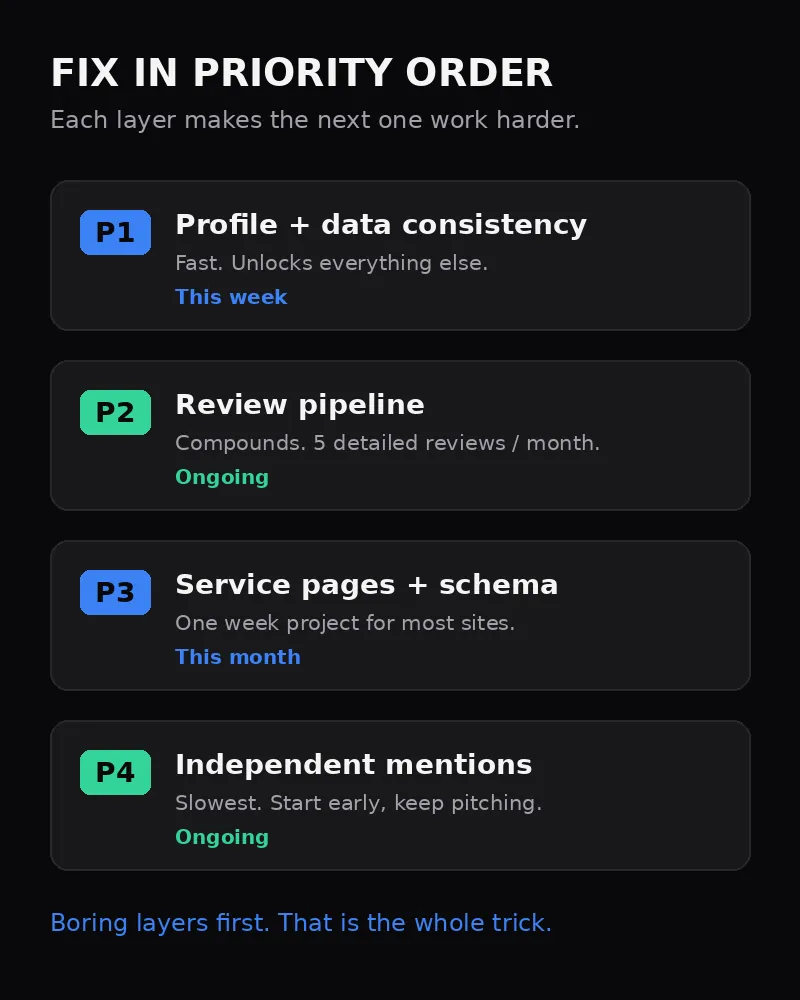
Track results by re-running your five prompts every two to four weeks and logging whether you appear, in what position, and with what explanation. Being named in an answer is the metric; traffic from these engines is a lagging indicator you can measure separately with the workflow in our AI referral traffic tracking guide.
What good looks like
A local business with strong AI visibility has one consistent identity everywhere, a profile that is clearly maintained, a review stream that describes real services in real places, service pages an engine can quote, and at least a handful of independent mentions. None of that requires an agency. It requires an hour a month and the discipline to fix the boring layers first.
The businesses that show up in AI local answers over the next few years will mostly be the ones that treated their data, reviews, and pages as one system. The audit above is the fastest way to find out which layer is holding you back. When you rewrite service-page headlines, draft options in the slogan generator and confirm the page passes the GEO visibility checklist.
Frequently asked questions
Do ChatGPT and Perplexity show local business recommendations?
Yes. When a prompt includes a location or implies local intent, answer engines assemble recommendations from sources such as Google Business Profile data, review platforms, local directories, and pages on your own website. The businesses that appear are usually the ones with consistent, well-structured information across those sources.
Is local AI search different from local SEO?
The foundations overlap, but the output is different. Local SEO competes for a map pack and blue links. Local AI visibility competes to be named inside a generated answer, often with no link at all. That makes review quality, entity consistency, and clear service pages more important than raw keyword rankings.
How long does it take for local AI visibility work to show results?
Review velocity, directory cleanup, and schema changes can influence answers within weeks because answer engines refresh their sources frequently. Expect to re-test prompts every two to four weeks and track whether your business starts being named, not just whether traffic changes.
What is the single highest-impact fix for a local business?
For most small businesses it is entity consistency: the same name, address, phone number, hours, and service description everywhere, paired with an active review pipeline. Answer engines distrust conflicting data, and they lean on reviews to decide which of several similar businesses to name first.