Why AI Search Cites Reddit and Forums — and How Small Businesses Show Up
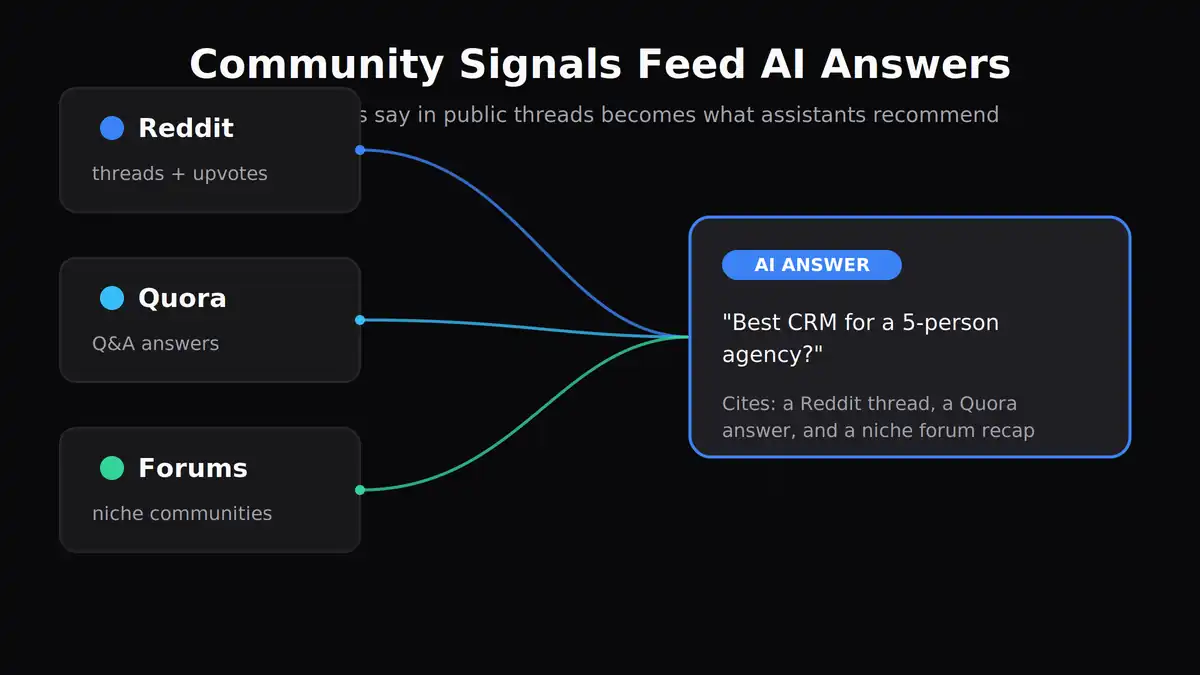
Ask ChatGPT, Perplexity, or Google's AI Overviews "what's the best invoicing app for freelancers" or "is a tankless water heater worth it," and look at the sources. A striking share of the time, the answer is built on Reddit threads, Quora answers, and niche forums — not brand websites.
For small businesses, this is one of the most counterintuitive shifts in AI search: the places you were told to avoid wasting time on are now primary citation sources. This guide explains why AI engines lean on community threads, which platforms matter, and a 30-day workflow for earning visibility there without spamming anyone.
Why AI engines trust community threads over marketing pages
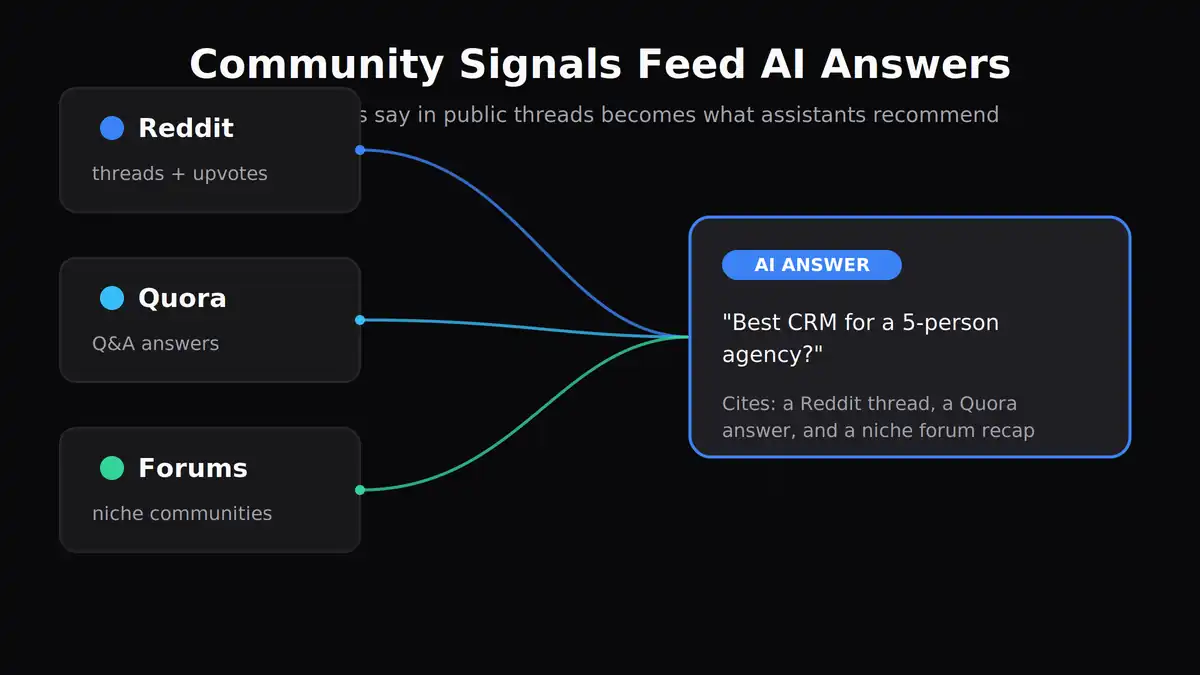
AI search systems have the same problem with your website that skeptical buyers do: everything on it is self-published. Community platforms solve three retrieval problems at once:
- They contain contested, first-hand experience. A thread where twelve people argue about which CRM actually works for a five-person agency is stronger evidence than a vendor's feature page. AI systems are trained and tuned to prefer exactly this kind of consensus-plus-dissent signal.
- The language matches how buyers ask. People on Reddit write "is X worth it for a small shop?" — the same phrasing they later type into ChatGPT. Threads are pre-matched to conversational queries in a way polished marketing copy rarely is.
- Engagement is a visible quality filter. Upvotes, comment depth, and moderator curation give retrieval systems a rough ranking signal before they read a word of the content itself.
This is the same third-party-consensus logic that makes online reviews shape AI recommendations. Community threads are the long-form version: reviews tell AI engines that people rate you, while threads explain why — in language the AI can quote.
The platforms AI engines actually cite
Not all community activity is equal. Citation analyses of AI answers consistently surface a short list of sources:
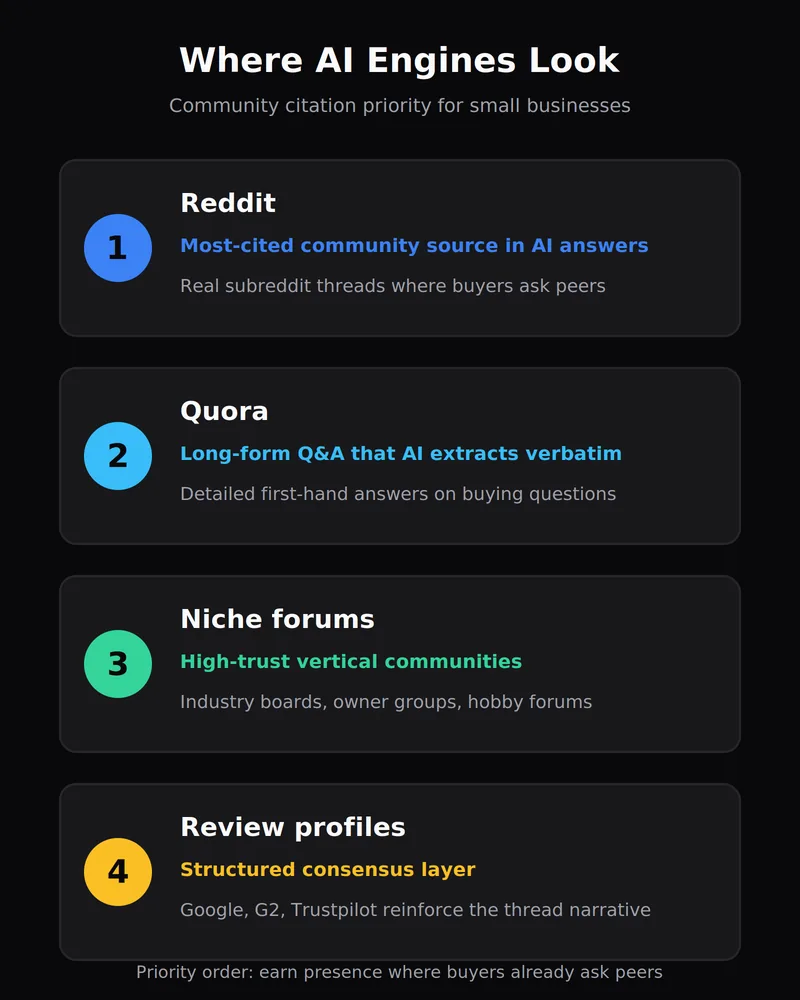
| Platform | Why AI Engines Cite It | How a Small Business Shows Up |
|---|---|---|
| The single most-cited community domain in AI Overviews and Perplexity answers; deal-level access to its corpus | Participate as a named operator in local, trade, and niche subreddits; answer buying questions honestly | |
| Quora | Long-form Q&A formatted almost exactly like AI answers; easy to extract verbatim | Write detailed first-hand answers to the exact questions your buyers ask, with real numbers |
| Niche forums | High-trust vertical communities (contractor boards, owner forums, hobby communities) dominate their categories | Become a regular in the one or two forums your customers treat as the industry's water cooler |
| Review profiles | Structured consensus that reinforces whatever the threads say about you | Keep profiles claimed and consistent so thread sentiment and review sentiment confirm each other |
Two practical consequences follow. First, depth beats breadth: a business that is a genuine regular in two communities earns more AI visibility than one spraying thin posts across ten. Second, the threads don't have to be about you — when AI engines assemble an answer about your category, the sources are usually threads about the problem, and the businesses mentioned inside them are the ones that helped. This mirrors the mechanics in how brand mentions work as a visibility signal.
What a citable community contribution looks like
The difference between participation that earns citations and participation that gets you banned comes down to a few hard rules:
- Identify yourself honestly. "I run a plumbing company in Springfield" builds trust with humans and gives AI systems clean entity context. Fake accounts and sock-puppet praise are a negative signal for both.
- Lead with the answer, not the pitch. The extractable unit is the useful sentence: "For a five-person crew, flat-rate pricing beats hourly because..." If the first line is a link to your site, both moderators and machines discount it.
- Use first-hand specifics. Numbers, timelines, and mistakes you actually made are what get quoted. Generic advice that could come from any blog post adds nothing to the thread and nothing to your visibility.
- Stay in the thread. Follow-up replies are where depth signals come from. An operator who answers three follow-ups over a week creates a far richer citation source than a drive-by comment.
Treat every public answer like the answer-ready copy described in the prompt-ready brand copy workflow: plain facts, concrete specifics, no slogans.
Measuring whether community work moves AI citations
Community participation is an input; citations are the output. Track both sides so you know whether the hours are paying off:
- The input side: log your contributions per week, where they went, and how the community responded (upvotes, replies, moderator removal). A simple spreadsheet is enough.
- The output side: run your fixed buyer prompt set through ChatGPT, Gemini, Perplexity, and AI Overviews monthly, and record which community sources get cited for your category — and whether your business is named inside them. The AI citation tracking workflow has the full prompt-set method, and AI referral tracking in GA4 covers the click side, including traffic from the threads themselves.
For a faster starting point, run the GEO visibility checklist — third-party presence and citation readiness are core areas it scores.
The 30-day community visibility workflow
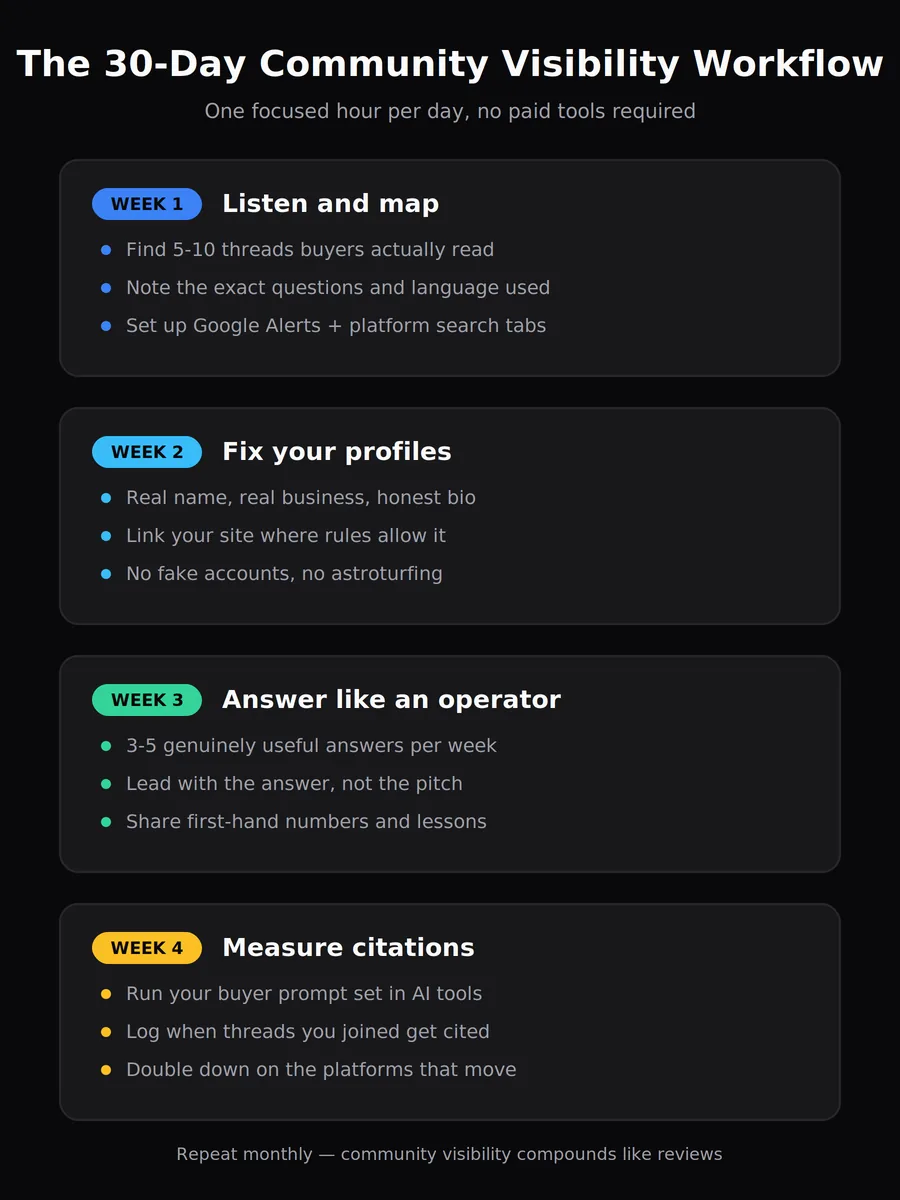
This is the operating rhythm that builds citation-worthy presence without an agency or new software — roughly one focused hour a day:
- Week 1 — Listen and map. Find the 5–10 threads per platform your buyers actually read. Search Reddit, Quora, and your niche forum for the questions you hear in sales calls. Write down the exact language people use — that phrasing is your future answer copy.
- Week 2 — Fix your profiles. Real name, real business, honest bio, link to your site where the rules allow it. Fill in history that makes you a credible operator. Do not create fake accounts, and do not post anything promotional yet.
- Week 3 — Answer like an operator. Post three to five genuinely useful answers per week on the mapped threads and fresh questions. Lead with the answer, include first-hand numbers, mention your business only when it is directly relevant and allowed.
- Week 4 — Measure citations. Run your buyer prompt set, log which community sources AI engines cite in your category, and note whether your threads appear. Identify the platform that moved and shift next month's hours there.
Two hard rules keep this brand-safe and platform-safe: never astroturf (fake reviews, fake accounts, coordinated praise — platforms detect it, users punish it, and the pattern is a negative trust signal for AI systems too), and never treat communities as ad inventory. The businesses earning citations are the ones whose answers would be worth reading even if their company name were removed.
The bottom line
AI search turned community threads from a brand-risk afterthought into a primary citation layer. The good news for small businesses is that this channel rewards exactly what big competitors are worst at: a real operator, answering real questions, with first-hand specifics, over months. Start with Week 1 this week — map the threads your buyers already read — then run the GEO visibility checklist to see how the rest of your AI visibility foundation scores alongside it. Tighten the public-facing line with the tagline generator before you post in those threads.
Frequently asked questions
Why do AI assistants cite Reddit so often?
Because Reddit threads solve the trust problem AI systems have with marketing copy: they contain real people comparing options, describing outcomes, and disagreeing with each other. That first-hand, contested, specific language is exactly what retrieval systems prefer when assembling an answer, and Google, OpenAI, and Perplexity all have direct or indirect access to Reddit's corpus.
Can a small business just post about itself on Reddit?
No — and trying usually backfires. Moderators and users remove obvious self-promotion, and a pattern of astroturfed praise is a negative trust signal for both humans and machines. What works is showing up as a clearly identified operator who answers questions helpfully, whether or not the answer mentions your business.
Which platform should a small business start with?
Start where your buyers already ask peers for recommendations. For most local and service businesses that is Reddit (local and trade subreddits) plus one niche forum or Facebook-style group that has public, indexable threads. B2B software should add Quora and industry Slack-adjacent communities with public archives. Pick two platforms and go deep rather than sprinkling thin posts everywhere.
How long before community activity shows up in AI answers?
Expect weeks to months, not days. Threads need to age, accumulate engagement, and get indexed or absorbed into retrieval corpora. The compounding pattern practitioners see is similar to reviews: steady, genuine participation over 90 days starts moving which sources AI engines associate with your category, and citations follow.