How Online Reviews Shape AI Search Recommendations
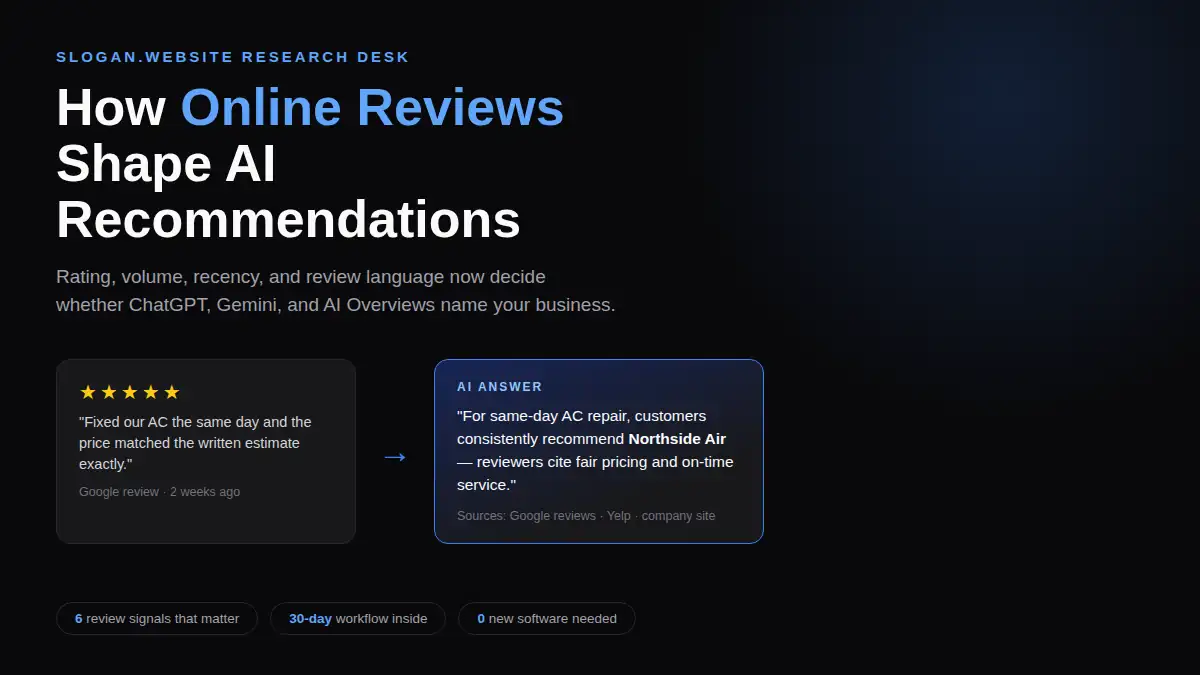
When someone asks ChatGPT, Gemini, Perplexity, or Google's AI Overviews for "the best plumber near me" or "a reliable CRM for a small agency," the answer rarely comes from your website alone. AI engines cross-check what third parties say about you — and the single largest pool of third-party opinion on the internet is online reviews.
For a small business, this changes the job of reputation management. Reviews are no longer just social proof for human visitors. They are a primary input into whether an AI assistant names you, skips you, or recommends a competitor instead. This guide breaks down which review signals matter, which platforms to prioritize, and a 30-day workflow you can run without new software.
Why AI engines lean so hard on reviews
AI search systems have a trust problem to solve: any business can claim anything on its own website, so self-published claims get discounted. Reviews solve that problem for them in three ways:
- They are third-party consensus. A pattern across dozens of independent reviewers is harder to fake than a marketing page, so AI engines treat it as stronger evidence.
- They are structured and comparable. Star ratings, counts, and dates give retrieval systems clean fields to rank and filter businesses before they ever read prose.
- They contain extractable language. When reviewers repeatedly write "fair pricing" or "showed up on time," that exact phrasing becomes raw material an AI can reuse when describing your business.
This is the same citation logic that drives brand mentions as an AI visibility signal. Reviews are simply the highest-volume, most structured form of brand mention most small businesses will ever earn. If you are working through the fundamentals of GEO vs SEO, treat reviews as part of the citation layer, not a separate chore.
The review signals that feed AI answers
Not all review activity is equal. These are the signals that consistently show up when you analyze which businesses AI engines recommend:
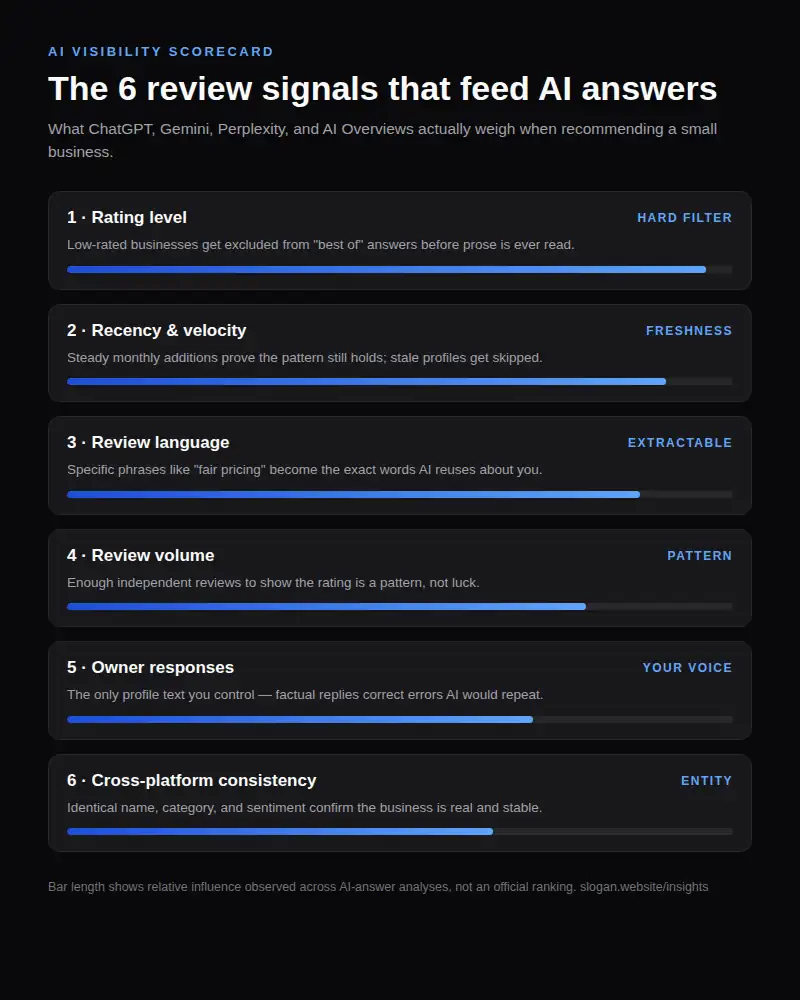
| Signal | Why AI Engines Care | What To Do About It |
|---|---|---|
| Rating level | Used as a hard filter before any prose is read; low-rated businesses get excluded from "best of" answers | Fix service issues first; no workflow compensates for a genuinely weak rating |
| Review volume | Establishes that the rating is a pattern, not luck; thin profiles look unproven | Build a steady ask-every-customer habit instead of occasional campaigns |
| Recency and velocity | Fresh reviews prove the business is active and the pattern still holds; stale profiles get described in past tense or skipped | Aim for consistent monthly additions, even if the number is small |
| Review language and detail | Specific phrases ("fixed our AC same day") become the words AI reuses when recommending you | Prompt customers with questions about the job, speed, and outcome — not "leave us a review" |
| Owner responses | Adds business-authored text that clarifies facts and corrects errors before AI repeats them | Respond to negatives and detailed positives with concrete, factual replies |
| Cross-platform consistency | Matching name, category, and sentiment across platforms confirms the business entity is real and stable | Keep name, address, phone, and categories identical everywhere you are listed |
Two of these deserve extra attention. Velocity matters more than most owners expect: a profile with 80 reviews from three years ago and nothing since often loses AI recommendations to a competitor with 30 reviews and three new ones this month. And review language is the quiet lever — customers who write "they handled our restaurant's payroll and tipped staff correctly" are literally writing your AI sales copy for you.
Which platforms to prioritize
You cannot be strong everywhere, so sequence by where AI engines look for your type of business:
- Local services, restaurants, retail: Google Business Profile first, always. It feeds Google AI Overviews directly, and its review data is disproportionately represented in what AI systems retrieve for local queries. Yelp second for restaurants and home services.
- B2B software and services: G2 and Capterra, plus Google reviews for the entity layer. Comparison content on these platforms is exactly what AI engines cite for "best X for Y" queries — the same pattern covered in comparison pages and AI citations.
- E-commerce and consumer brands: Trustpilot and Google, plus on-site review schema so your own product ratings are machine-readable. Pair this with the schema markup for AI search guide.
- Every business: claim your profiles, correct the categories, and make the business name identical everywhere. Consistency is an entity SEO problem as much as a reviews problem.
Writing review responses AI can quote
Owner responses are the only text on a review profile you fully control, and AI systems do read them. Treat each response as answer-ready copy, in the same spirit as prompt-ready brand copy:
- State facts plainly. "We've served the Northside neighborhood since 2011 and every job includes a written estimate" is extractable. "Thanks for the kind words!!!" is not.
- Correct errors without emotion. If a review misstates pricing or hours, your calm correction becomes the most recent business-authored fact on the page.
- Name the service and location naturally. "Glad the same-day water heater replacement in Springfield worked out" reinforces what you do and where — the two things local AI queries ask about most.
- Keep it short. Two to four sentences. Long defensive replies read badly to humans and extract badly for machines.
Measuring whether reviews move AI visibility
Reviews are an input; citations are the output. To know if the work is paying off, track both sides:
- The input side: review count, average rating, and new reviews per month on your priority platforms. A simple spreadsheet updated monthly is enough.
- The output side: run a fixed set of buyer prompts through ChatGPT, Gemini, Perplexity, and AI Overviews each month and record whether you are named and how you are described. The AI citation tracking workflow has the full prompt-set method, and the AI referral traffic GA4 setup covers the click side.
For a faster starting point, run the GEO visibility checklist — reviews and reputation signals are one of the core areas it scores.
The 30-day review workflow
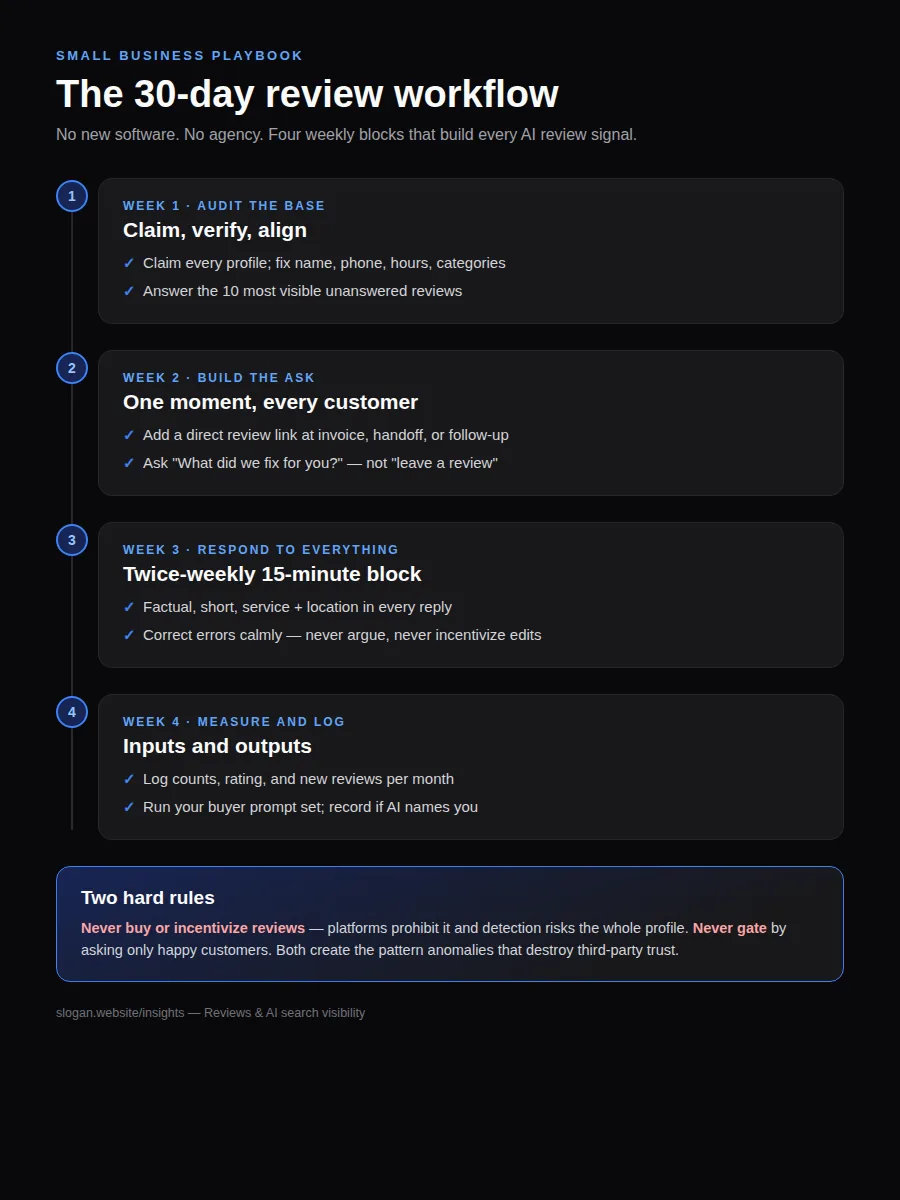
This is the operating rhythm that builds every signal in the table above without software or an agency:
- Week 1 — Audit and fix the base. Claim and verify every profile. Make name, address, phone, hours, and categories identical everywhere. Answer the ten most visible unanswered reviews, prioritizing negatives.
- Week 2 — Build the ask. Pick one moment in your delivery process (invoice, handoff, follow-up email) where every customer gets a direct review link. Prompt with a specific question: "What did we fix for you?" beats "Leave us a review."
- Week 3 — Respond to everything. Set a twice-weekly 15-minute block. Use the factual, short, service-and-location style above. Never argue, never offer incentives for edits.
- Week 4 — Measure and log. Record counts, ratings, and monthly additions. Run your buyer prompt set and log whether AI answers name you. Repeat monthly.
Two hard rules keep this brand-safe and platform-safe: never buy or incentivize reviews (every major platform and Google explicitly prohibit it, and detection puts the whole profile at risk), and never gate reviews by asking only happy customers. Both shortcuts produce exactly the kind of pattern anomaly that erodes the third-party trust AI engines are paying reviews for in the first place.
The bottom line
Reviews were already the highest-leverage reputation asset a small business owns. AI search raised the stakes: the same profiles now decide whether you appear when a buyer asks an assistant instead of a search box. The work is unglamorous — consistent asking, factual responses, identical listings, monthly measurement — but it compounds, and most of your competitors are still not doing it. Start with Google Business Profile this week, then run the GEO visibility checklist to see how the rest of your AI visibility foundation scores.
Frequently asked questions
Do online reviews affect what ChatGPT and Gemini recommend?
Yes. AI assistants and AI Overviews lean on third-party consensus when recommending businesses, and review platforms are the largest structured source of that consensus. Rating level, review volume, recency, and the language customers use in reviews all shape whether a business is named and how it is described.
Which review platform matters most for AI visibility?
For local and service businesses, Google Business Profile reviews carry the most weight because they feed Google AI Overviews directly and are heavily represented in training and retrieval data. After that, prioritize the platform your buyers actually check: Yelp for restaurants and home services, G2 or Capterra for software, Trustpilot for e-commerce.
How many reviews do I need before AI engines notice my business?
There is no official threshold, but practitioners consistently see a credibility floor rather than a magic number: enough recent reviews to establish a pattern. For most local businesses that means double-digit reviews with steady monthly additions, not a one-time burst followed by silence.
Should I respond to every review for AI search purposes?
Respond to as many as you can, especially negative and detailed ones. Responses add fresh, business-authored text that AI systems can extract, they correct factual errors before those errors get repeated in AI answers, and they signal an active, legitimate operation.