Content Refresh for AI Visibility: A Small Business Workflow
Most small business sites already own the raw material for AI visibility: a library of pages that once ranked, earned links, or answered real customer questions. The problem is that those pages age. Prices change, tools change, screenshots go stale, and the answer engines notice. When ChatGPT, Perplexity, Gemini, or Google's AI Overviews cross-check your page against fresher sources, the stale page stops being the one they cite.
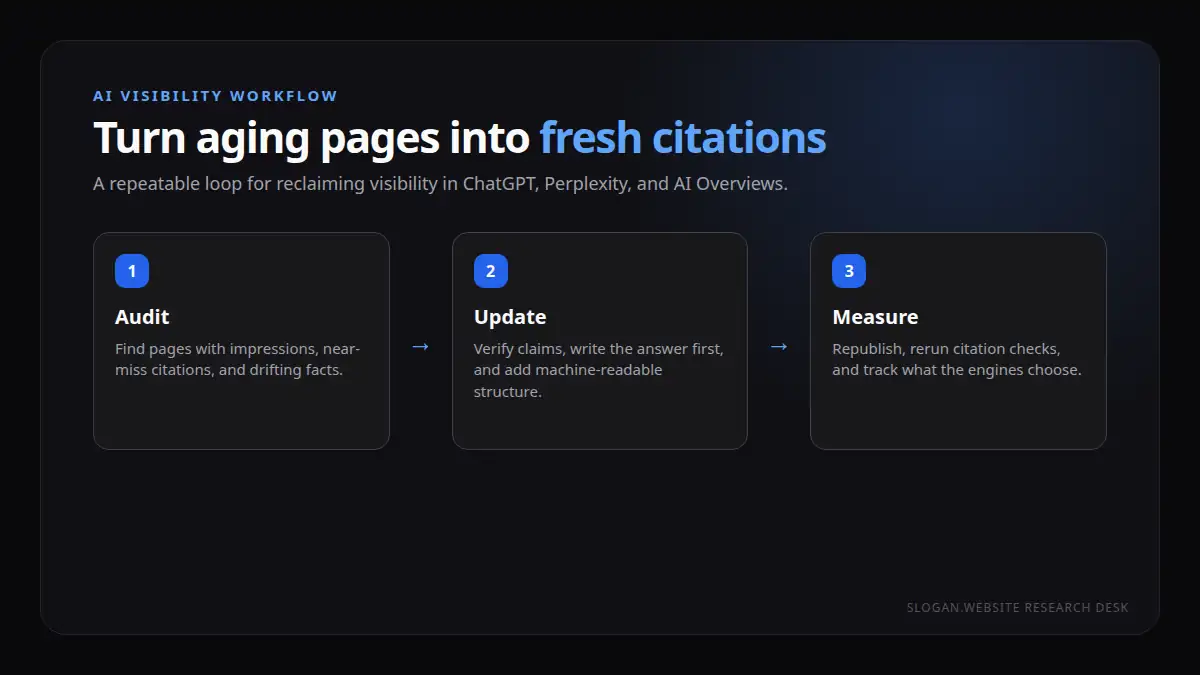
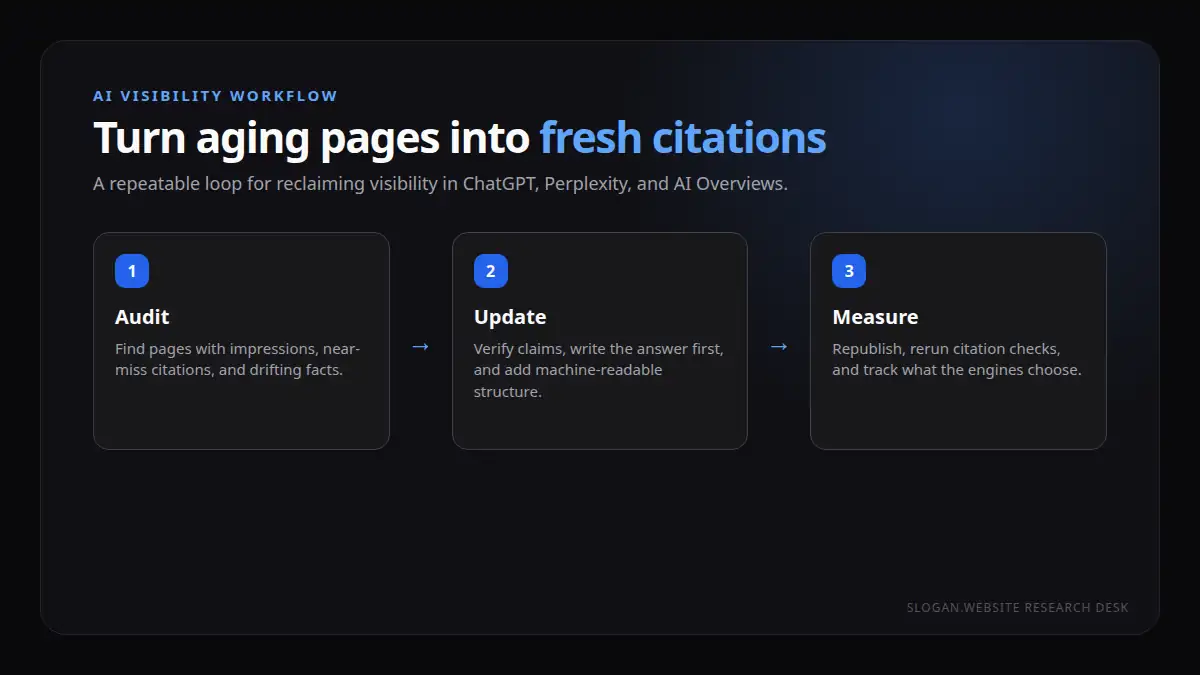
A content refresh workflow fixes that systematically. Instead of publishing new articles and hoping, you identify the pages closest to earning citations, update what the answer engines actually check, and measure whether citations come back. This guide gives you the full loop: picking pages, deciding what to change, shipping the update, and verifying the result.
Why stale pages lose AI citations first
Traditional search tolerated aging content for a long time. A page could hold a ranking for years on the strength of its links even as the details drifted out of date. AI answer engines are less forgiving because they do something classic ranking never did: they repeat your facts, in their own words, to a user who will act on them.
That changes what gets cited. When an answer engine assembles a response, it favors sources whose claims agree with the current consensus across other pages it trusts. A pricing table from two years ago, a feature list for a product that has since changed, or a recommendation built on superseded rules all create disagreement. Disagreement is risk, and the engine resolves risk by citing the fresher source instead.
The practical consequence for a small business: your older pages are not just slowly declining in rankings, they are actively losing a new distribution channel. The good news is that the reverse is also true. A page with existing authority that gets its facts, structure, and dates brought current can regain citations faster than a new page can earn them from zero. This is the same dynamic behind the zero-click search strategy: the citation is the new click, and freshness is part of the price of holding it.
Pick the pages worth refreshing first
You cannot refresh everything, and you should not. The return concentrates in a small set of pages: the ones already close to earning citations. Score every candidate page against a short list of signals before you touch anything.
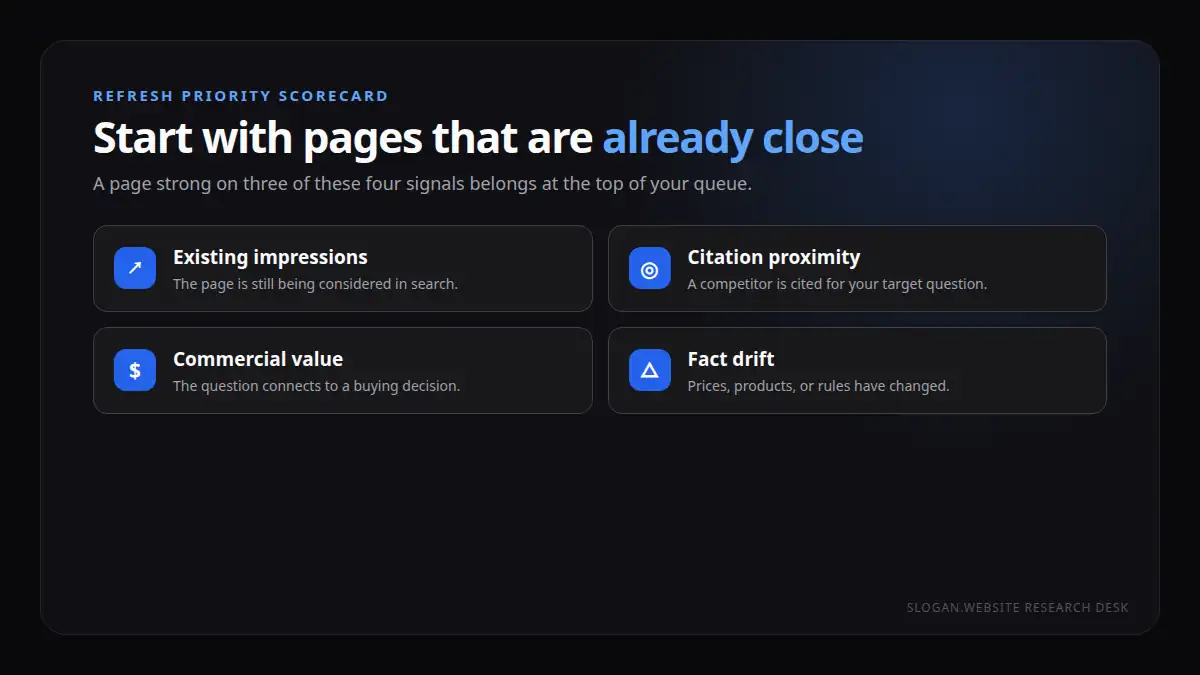
Four signals decide priority:
- Existing impressions. A page that still gets Search Console impressions has not been forgotten. It is being considered and losing. That is a much better starting point than a page with zero visibility.
- Citation proximity. Run the page's target questions through ChatGPT, Perplexity, and AI Overviews. If a competitor or a third-party site is cited where you should be, the page is a near miss. Near misses convert with the least work.
- Commercial value. A page tied to revenue questions — comparisons, pricing, how-to-choose, software and service decisions — outranks a vanity topic even when the vanity topic has more traffic.
- Fact drift. Pages that name prices, versions, dates, regulations, or named competitors decay fastest. A page of timeless principles can wait; a page full of checkable facts cannot.
A simple scoring rule: any page strong on at least three of the four signals goes into the refresh queue. Everything else waits. If you have never run the citation check before, the AI citation tracking workflow shows how to test your questions monthly and record which page each engine cites.
What to actually change on the page
A refresh is not a new date and a tweaked intro. Answer engines re-read the page, so the work is making the page more verifiable, more extractable, and more current. Focus on five upgrades, in this order.
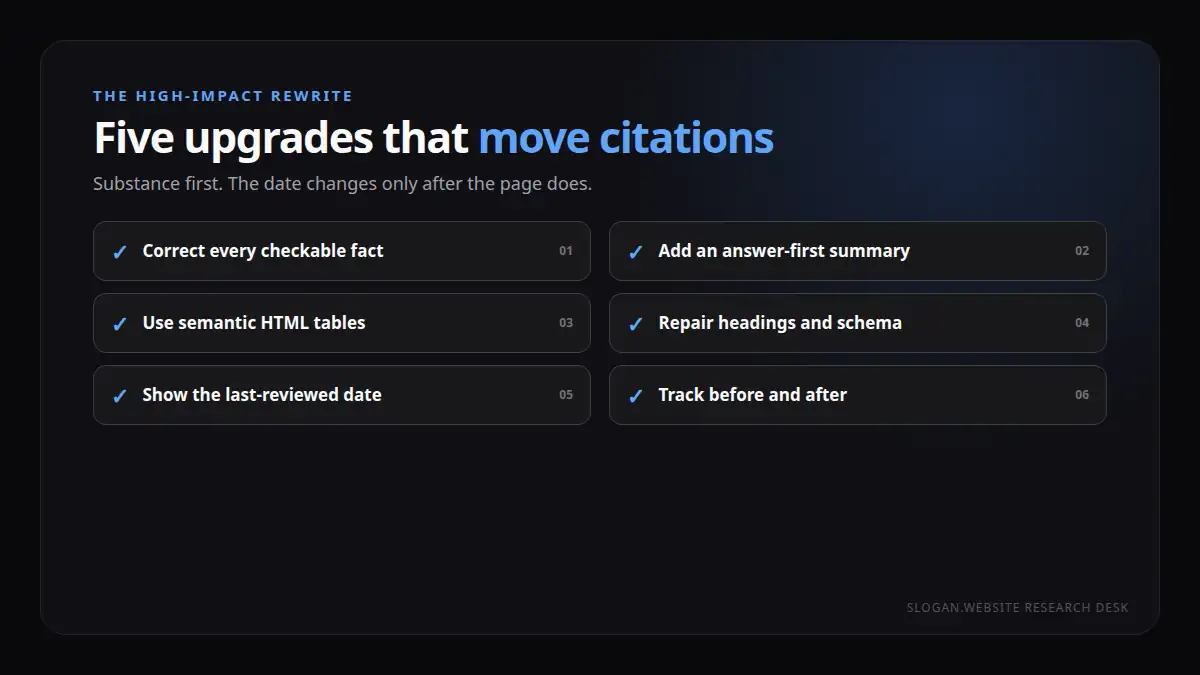
- Correct every checkable fact. Prices, feature names, limits, dates, statistics, and the names of products and competitors. Where you can, link the primary source. A claim with a source is a claim an engine can corroborate.
- Add an answer-first summary. Two or three sentences near the top that state the page's core answer plainly. This is the passage most likely to be extracted and quoted. The mechanics are covered in our guide to answer-first writing for AI extraction.
- Convert loose lists into semantic tables. Decision criteria, feature comparisons, and step plans belong in real table markup. Machines parse cells; they skim past vague bullet clusters.
- Repair the structure. Question-shaped H2 and H3 headings, working internal links, accurate title and description, and Article plus FAQ structured data. The schema markup guide for AI search covers the exact types worth adding.
- Show the review date. A visible "last reviewed" line tells both readers and engines the page is maintained. It is a small element with an outsized trust effect.
Before you republish, run the page through the GEO visibility checklist to catch structural gaps — missing headings, weak metadata, absent structured data — that are easy to overlook after a heavy edit.
A refresh cadence a small team can sustain
The mistake that kills refresh programs is treating them as a one-time cleanup. Facts keep drifting, so the workflow has to repeat. A sustainable cadence for a small team looks like this:
| Step | Action | Done when |
|---|---|---|
| 1. Monthly citation check | Run your tracked questions through the main answer engines and record which source is cited for each. | You can name the pages losing citations to fresher competitors. |
| 2. Score and queue | Score citation-losing pages against impressions, proximity, value, and drift. Pick one or two for this cycle. | The queue has a clear top pick, not a tie between five pages. |
| 3. Verify facts | Re-check every price, feature, date, and named entity against primary sources. Link what you verify. | No claim on the page is older than its source. |
| 4. Restructure | Add or sharpen the answer-first summary, convert key lists to semantic tables, fix headings and structured data. | The page passes the GEO visibility checklist. |
| 5. Republish with the date | Update the visible review date and republish on the same URL. Do not create a new page for the same question. | The live page shows current facts and a current review date. |
| 6. Measure after 30-60 days | Re-run the citation checks and compare impressions and CTR in Search Console and AI referral traffic in GA4. | You can say whether the page regained citations, and why or why not. |
One or two pages per cycle beats a heroic quarterly overhaul. The workflow compounds: each refresh teaches you which upgrades actually moved citations for your topics, and the next refresh gets sharper.
What to avoid
- Date-only refreshes. Changing the date without changing the substance is the oldest trick in SEO, and answer engines are built to detect exactly that kind of disagreement with other sources.
- Refreshing pages nobody asks about. If no tracked question maps to the page and it has no impressions, a refresh is a guess. Spend the cycle on a near miss instead.
- New URLs for old questions. Splitting a refreshed topic onto a new URL abandons whatever authority the old page earned. Update in place unless the old page's angle is genuinely dead.
- Adding length instead of clarity. A longer page is not a more citable page. If the refresh adds words but no new verifiable facts or extractable structure, it will not move citations.
- Skipping the measurement step. Without the before-and-after citation check, you are flying blind and cannot defend the time the refresh program takes.
The compounding effect
A refresh workflow turns your existing content library from a depreciating asset into a maintained one. Every page you bring current is a page that can be cited again, and each regained citation makes the next one easier: engines that already trust your domain for current facts reach for you first when a related question comes up.
Start with the page that loses the most valuable near-miss citation today. Verify its facts against primary sources, add the answer-first summary and the semantic tables, show the review date, and put its questions into your monthly citation checks. That is the whole loop: find the near miss, make the page verifiable again, and measure whether the answer engines come back. Run the GEO visibility checklist on that page before you republish.
Frequently asked questions
How often should a small business refresh content for AI visibility?
Quarterly works for most evergreen pages. Refresh sooner when the underlying facts change: pricing, product features, regulations, or the competitors you name. AI answer engines prefer sources whose facts match what other current sources say, so a page that lags reality loses citations to fresher ones.
Is it better to refresh an old page or publish a new one?
Refresh when the old page already has impressions, links, or citations and the topic is still relevant. Publish new when the old page answers a question nobody asks anymore or the angle has fundamentally changed. A refreshed page with existing authority usually regains visibility faster than a brand-new URL.
What matters most in a refresh: new text, new structure, or a new date?
Substance first. A changed date without changed content does nothing. The highest-impact updates are current facts, an answer-first summary near the top, semantic tables, and structured data. Then update the visible review date so both readers and machines can see the page is maintained.
How do I know if a refresh worked?
Track the page's target questions before and after. Run monthly citation checks in ChatGPT, Perplexity, and Google AI Overviews, watch impressions and CTR in Search Console, and check GA4 for AI referral traffic. A successful refresh shows up as regained citations and improving CTR within one to two months.