Original Research and Statistics: The AI Citation Magnet for Small Businesses
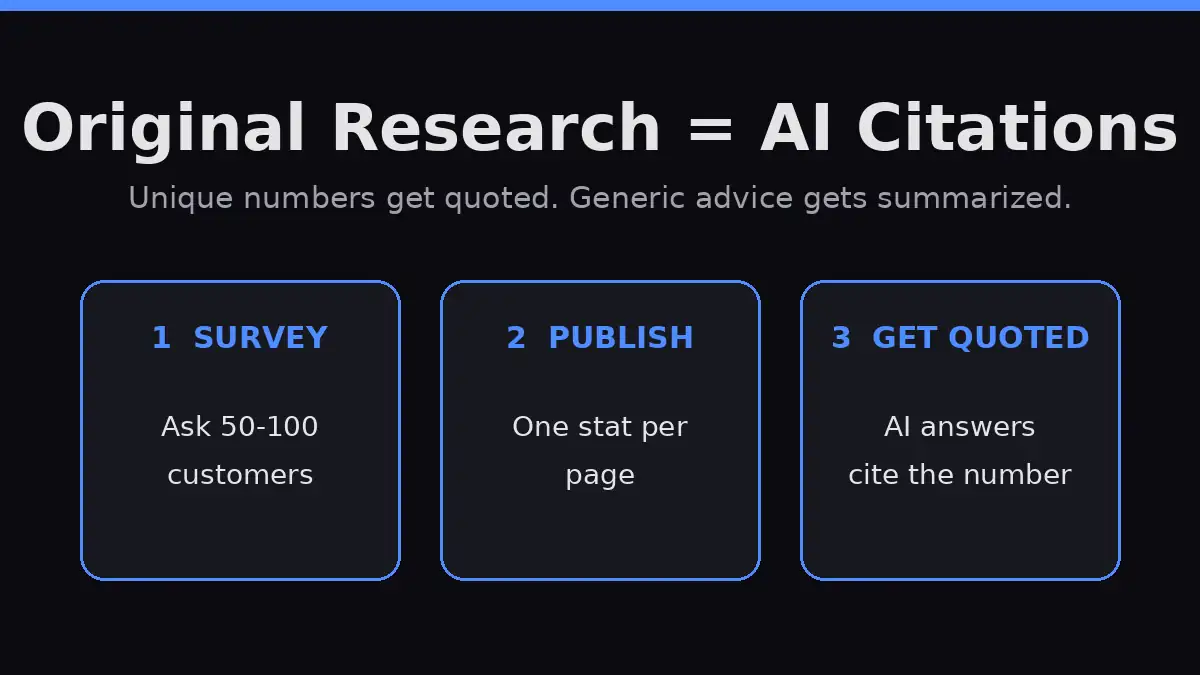
AI answer engines have a visible bias: when they need a number, they cite whoever published one. Advice is interchangeable; data is not. Ten pages can say "email marketing works," but only the page that says "our 212 customers averaged a 34% repeat-purchase rate" gives the answer engine something worth quoting.
That is an opening small businesses can actually win. You do not need a research department — you need a small honest dataset, one quotable number per page, and the packaging that makes it citable. This guide shows the full loop.
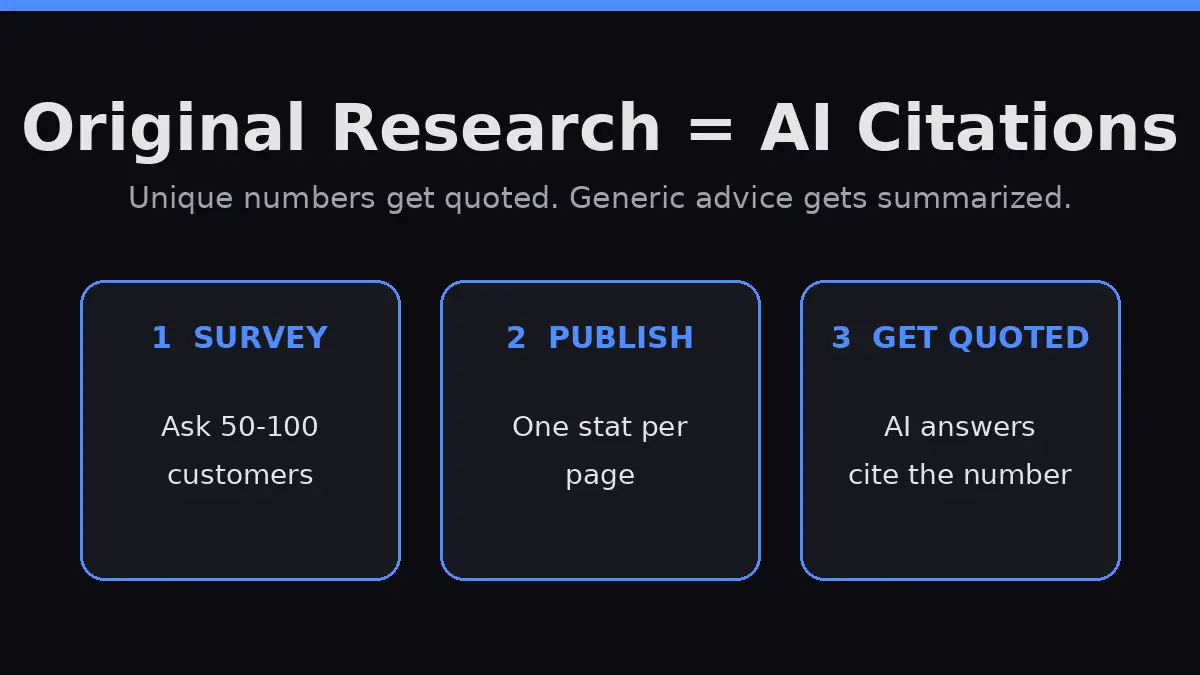
Why numbers beat opinions in AI answers
Answer engines assemble responses from sources that each contribute something distinct. A page of generic tips contributes nothing the model cannot already say, so it gets absorbed without a citation. A page with a specific measurement contributes a fact, and facts travel with source links.
- Specificity is citable. "34% of our customers" is a quote. "Many customers" is filler.
- Recency wins ties. A 2026 survey of 80 buyers beats a 2021 study of 10,000 when the question is what buyers do now.
- Niche data has no competition. Nobody else has numbers on your customers, your jobs, or your local market — so your page is the only possible citation.
- Numbers survive summarization. Paraphrase can strip wording, but a statistic stays intact and keeps pointing back to you.
If you already track where AI answers mention you, add a "data pages" segment: the AI citation tracking workflow shows how to separate citation growth from your data content versus the rest of the site.
Data you already have (no survey needed)
Before running anything new, mine the records sitting in your business today:
- Order and booking history. Average order value, repeat-purchase rate, busiest months, most common requests. Your CRM or order log already holds these — the first-party data guide shows how to turn private records into public-safe numbers.
- Before-and-after measurements. Job duration, cost savings, energy bills, turnaround times. One measured comparison ("average install dropped from 6 days to 4") is a full statistics page.
- Support and sales questions. Tally the 200 most recent inquiries by topic. "41% of callers asked about X" is both a content brief and a quotable stat.
- Reviews and testimonials. Aggregate star distributions, mention frequency, and outcome keywords across your own reviews.
Anonymize and aggregate: report group numbers, never individual customer details.
Running a tiny survey that produces quotable stats
When internal records are not enough, ask. A small survey beats no survey, provided the method is honest.
- One question cluster, five questions max. Ask about a single topic (prices paid, time spent, tools used). Short surveys get finished.
- 50 to 100 responses is enough. State the sample plainly: "Survey of 87 customers, August 2026." Small and disclosed beats big and vague.
- Use your own list first. Email past customers, post-purchase flows, and booked jobs. Response rates from real customers dwarf cold panels.
- Publish the method in two sentences. Who was asked, when, and how many answered. This is what separates citable research from a made-up number — and what keeps the page brand-safe.
- Lead with the single most surprising result. That headline stat becomes the quote that travels.
Packaging: the citation-magnet page format
Data alone does not earn citations; the page format decides whether an answer engine can lift the number cleanly. Write each statistics page so the answer extraction pattern holds: one standalone quotable sentence per fact.
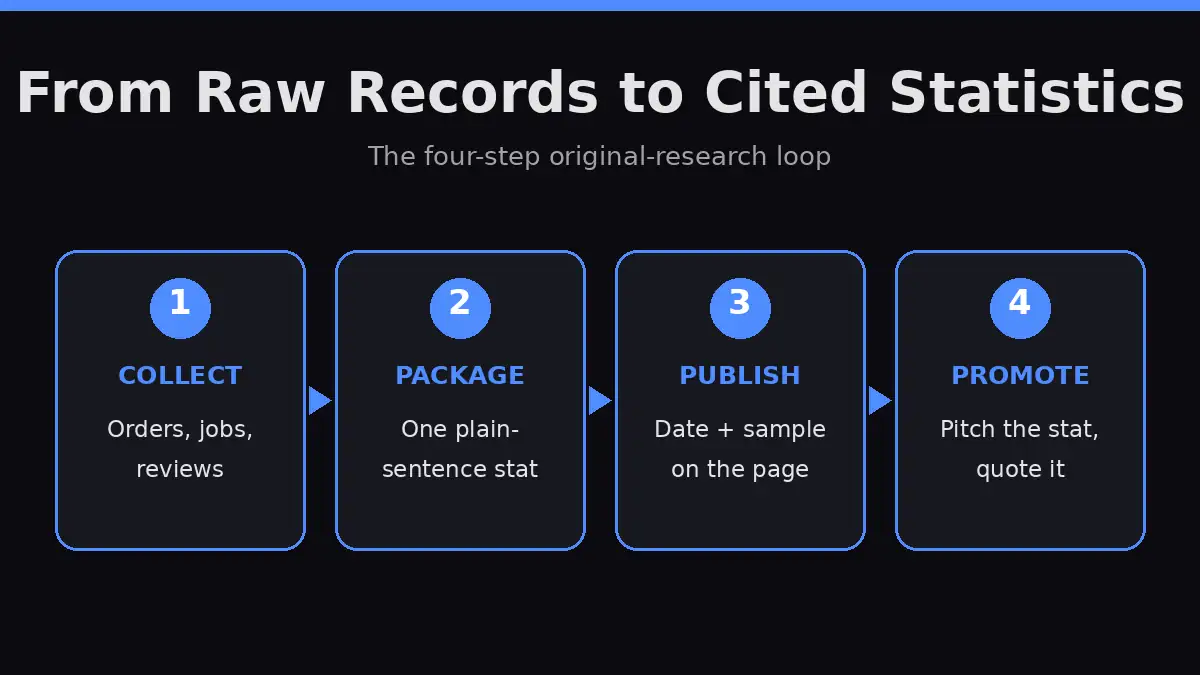
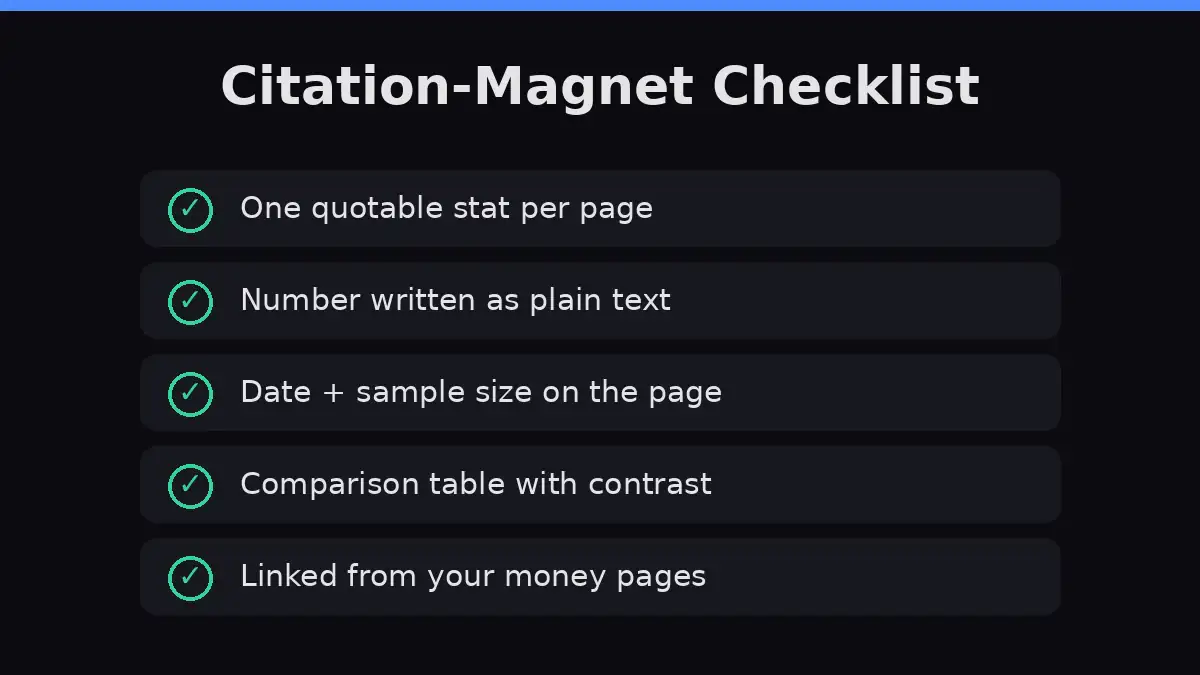
- One stat per page (or per section). A page titled around a single number ranks and gets cited for exactly that query.
- Plain-sentence numbers. "The average invoice was $1,240" beats burying $1,240 in a paragraph or a chart image alone. Keep charts as visuals; keep the number as text.
- Date and sample on the page. "Based on 212 invoices, January–June 2026." Undated numbers look stale to both readers and retrieval systems.
- A comparison table. Put your numbers next to the alternative so the answer engine quotes the contrast, not just your figure:
What to compare your numbers against
| Comparison type | Example | Why it gets cited |
|---|---|---|
| Before vs after | Install time: 6 days before, 4 days after | Shows a measured outcome, not an opinion |
| You vs market average | Your repeat rate 34% vs industry 22% | Gives writers a contrast to quote |
| Segment vs segment | Repeat buyers spend 2.1x more than new buyers | Answers "which is better" questions directly |
| Cost vs outcome | $380 average tune-up prevents $2,100 repairs | Feeds price and ROI questions in AI answers |
| Then vs now | Quotes requested online up from 18% to 57% since 2023 | Signals a trend, which journalists and AI both cite |
Promoting the stat so it gets picked up
Publishing is half the job. Citations compound when other pages reference your number:
- Pitch the stat, not the page. One short email to niche bloggers and local press with the headline number and the method line earns more links than a "check out our study" blast.
- Answer community questions with it. When someone asks your topic on Reddit, Quora, or Facebook groups, the stat plus a link is a genuinely useful answer — and community mentions feed AI visibility.
- Quote it on your own money pages. Your service and comparison pages should cite your own research, so every citation path leads back to an offer.
- Refresh yearly. A "2026 survey" page updated with 2027 numbers keeps its citations; a frozen page slowly loses them to fresher sources.
Where research fits your measurement loop
Original research is a content investment, so measure it like one. Tag data pages in analytics, watch citation and brand mention growth for the headline stats, and compare cost per citation against paid channels in the Marketing ROI Calculator. One well-placed statistic that gets quoted for two years is the cheapest visibility most small businesses will ever buy — and the GEO visibility checklist makes sure AI crawlers can actually reach it.
Frequently asked questions
Why does original research earn AI citations?
AI answer engines prefer sources that add something only they have: a fresh number, a survey result, a measured outcome. A page that states a specific statistic in a plain sentence is easy to quote, so it gets cited while generic advice pages get summarized without credit.
How much data does a small business need to publish?
Far less than you think. A survey of 50 to 100 customers, a before-and-after measurement from your own jobs, or a tally of your last 200 orders is enough. What matters is a clear sample, a date, and one honest number per page — not academic scale.
Where should statistics pages link?
Link each statistics page to the service or product page the number supports, and back: the service page should quote the headline stat. Then run the GEO visibility checklist so AI crawlers can reach the data, and track pickups with the citation tracking workflow.