YouTube Videos That AI Search Cites: A Small-Business Visibility Guide

AI answers do not only read articles. When someone asks how to fix, choose, compare, or price something, answer engines regularly quote YouTube videos — with a timestamp. For a small business that already knows how to do the work, that is a visibility channel hiding in plain sight: the expertise is in your hands, and the camera just needs to capture it in quotable form.
The bar is lower than most owners think. You do not need a studio, an audience, or editing skills. You need one question per video, the answer stated plainly, and packaging that machines can read.

Why video earns citations
Answer engines look for sources that contribute something distinct and verifiable. Video has three structural advantages over yet another blog post:
- Transcripts are quotable text. YouTube auto-transcribes every video, so everything you say becomes readable source material. Say the key sentence cleanly and it can be lifted verbatim.
- Timestamps are evidence. A citation that points to minute 2:14 where you demonstrate the fix carries more weight than a paragraph claiming it. Demonstrations are hard to fake.
- Competition is thinner. Your competitors may all have blog posts on the same topic, but almost none of them have a video answering it. The video is often the only citable source in the niche.
This pairs naturally with written content. The answer-extraction writing pattern — one standalone quotable sentence per fact — works identically for scripts: write the quotable sentence first, then say it on camera.
One question per video
The most common mistake is filming a 20-minute tour of everything you know. Answer engines match sources to specific questions, so each video should own exactly one:
- Steal questions from customers. Your inbox, call log, and quote requests are the brief. "How much does X cost in [city]?" and "Should I repair or replace X?" are citation-grade topics.
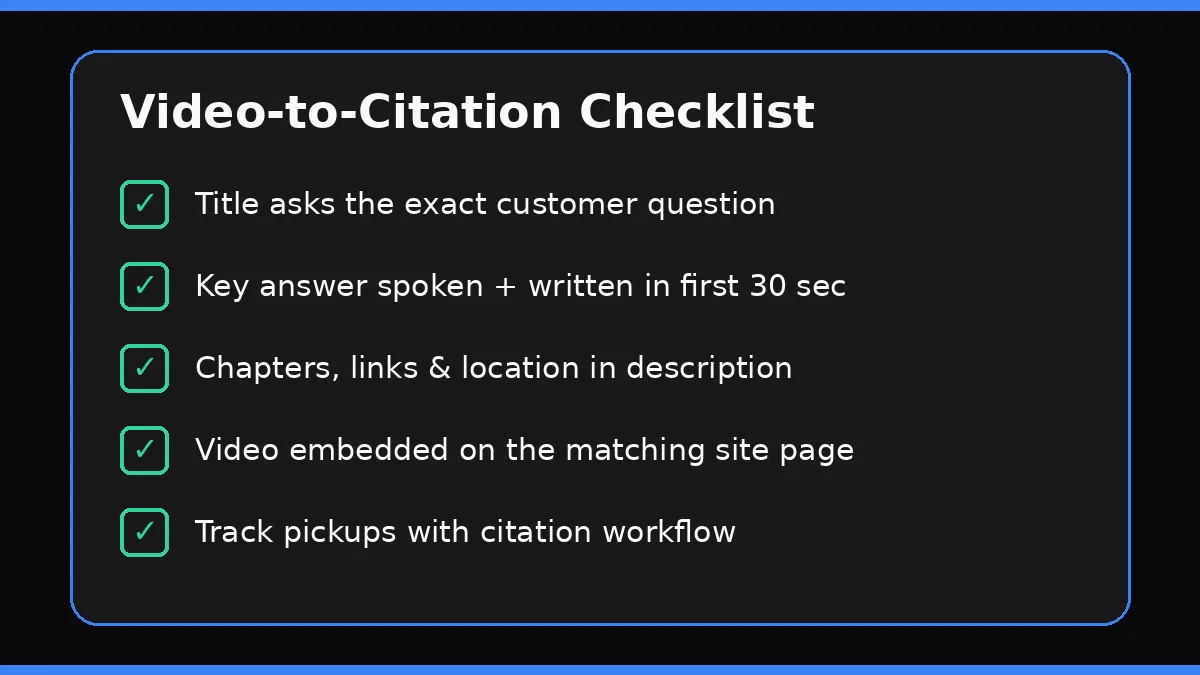
- Put the question in the title, verbatim. "How Much Does a Roof Repair Cost in 2026?" beats "Roofing Talk Ep. 7." Titles that mirror the query get matched to it.
- Answer in the first 30 seconds. State the headline answer immediately, then explain. Viewers stay, and the transcript's opening lines contain the quote.
- Say the key sentence word for word. Write one plain sentence before filming — "The average repair costs $380 and takes half a day" — and speak exactly that. Paraphrase drift kills quotability.
Businesses selling products should apply the same discipline to comparison and demo videos; the product visibility guide covers how answer engines pick which products to mention.
Package the video so machines can read it
What you upload around the video decides whether it gets found and cited. Treat the description as a second script:
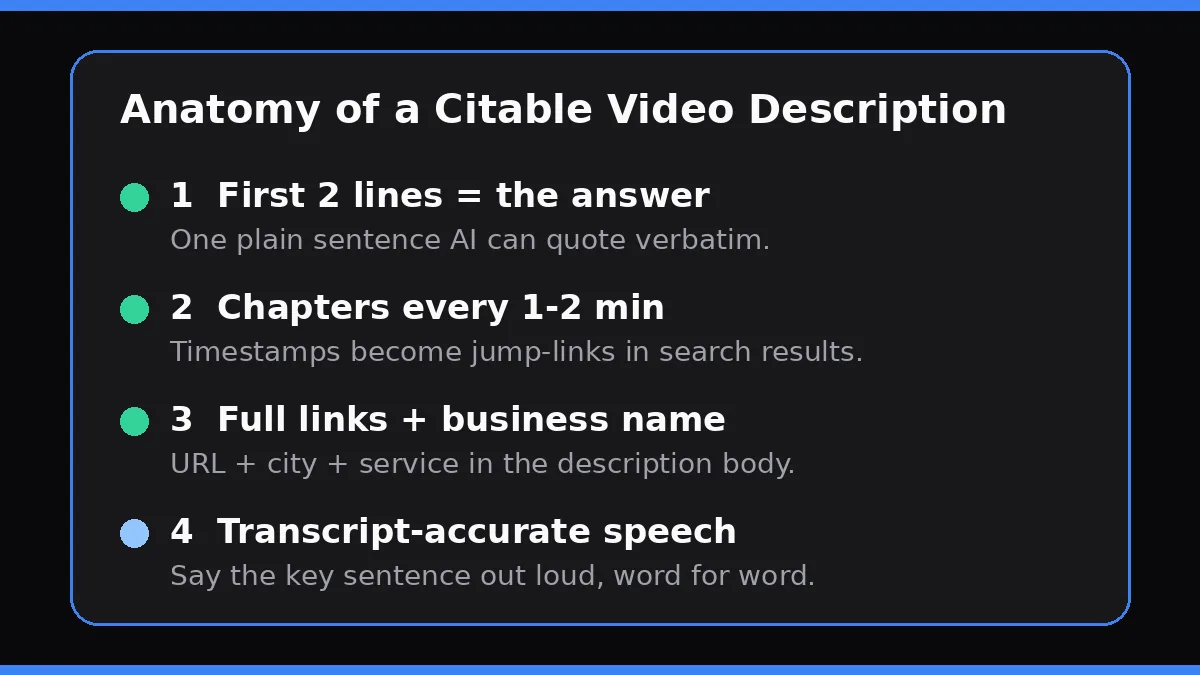
- First two lines carry the answer. Repeat the headline sentence at the top of the description. Many retrieval systems read only the snippet.
- Add chapters every 1–2 minutes. Timestamps in the description become jump-links in search results and give AI answers precise citation points.
- Include full links and location. Your site URL, business name, city, and service in the description body connect the video to your local presence — which also feeds AI Overviews for local queries.
- Upload a clean transcript when it matters. Auto-captions are usually enough, but for your most important videos, correct the captions so the key sentence is exact.
Which videos to film first
Not all video ideas are equal for citations. Prioritize by how directly the video maps to a question buyers ask:
| Video type | Example | Why it gets cited |
|---|---|---|
| Price explainers | "What a water heater install costs and why" | Answers the money question AI responses always include |
| Repair vs replace | "Repair or replace your fence? A 3-minute test" | Decides a binary question with a demonstrable test |
| Mistake warnings | "3 mistakes that ruin epoxy floors" | Lists extract cleanly into quoted bullet answers |
| Before and after | "Kitchen remodel: 6 weeks in 4 minutes" | Measured outcomes are facts, and facts travel with links |
| Local process tours | "How a home inspection works in our county" | Location-specific content has almost no competition |
Film the price explainer first. Cost questions appear in nearly every AI buying answer, and most small businesses refuse to publish prices — so the one who does owns the citation.
Embed every video on your site
YouTube discovery is only half the value. Each video should live on the matching page of your website:
- Embed on the relevant service or product page, next to the written answer. The page and video reinforce each other as one citation unit.
- Quote the key sentence as text beside the embed. Never rely on the video alone to carry the fact — crawlers and readers both need the words on the page.
- Link the video description back to that page. Close the loop so every citation path ends at an offer, not just a channel.
- Collect reviews that mention the video. When customers reference your explanations, that reputation signal compounds the video's authority.
Measure citations, not views
A video with 90 views that gets quoted in AI answers for two years beats a viral video nobody cites. Track accordingly: segment citation and brand-mention growth for queries your videos target, using the AI citation tracking workflow to separate video-driven pickups from the rest of the site.
One video per week, each answering a single real customer question, is a pace any owner can keep. After three months you hold a library of twelve citable demonstrations no competitor bothered to film — and the GEO visibility checklist makes sure AI crawlers can reach both the videos and the pages they live on.
Frequently asked questions
Why do AI answers cite YouTube videos?
Answer engines can read transcripts, chapters, titles, and descriptions. A video that states a clear answer in plain words gives the engine a quotable source with a timestamp, which is exactly the kind of evidence AI answers link to.
Do small businesses need many subscribers to get cited?
No. Citations come from the content of the video, not the channel size. A 40-subscriber channel whose video answers one specific question word-for-word can be quoted while a million-subscriber vlog that never states the answer plainly gets ignored.
Should the video live on YouTube or only on my site?
Both. Publish on YouTube for discovery and transcript indexing, then embed the same video on the matching page of your site so the citation path leads back to your offer. The page and the video should state the same key sentence.