FAQ Pages That AI Search Actually Cites: A Small-Business Guide
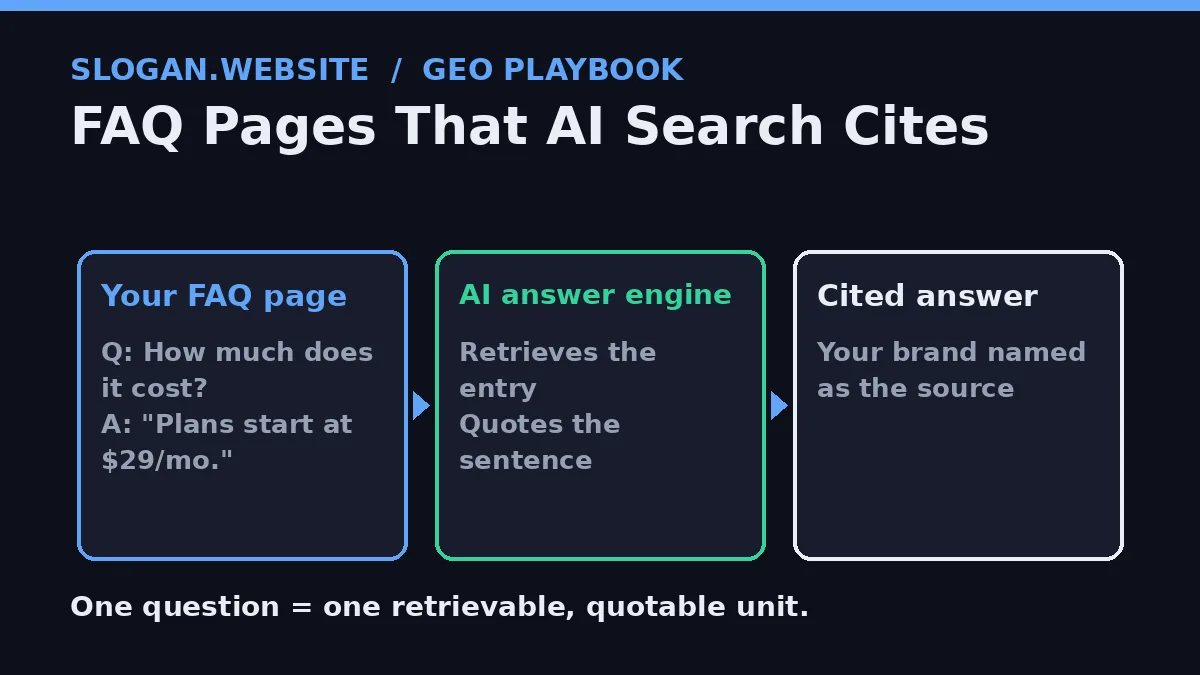
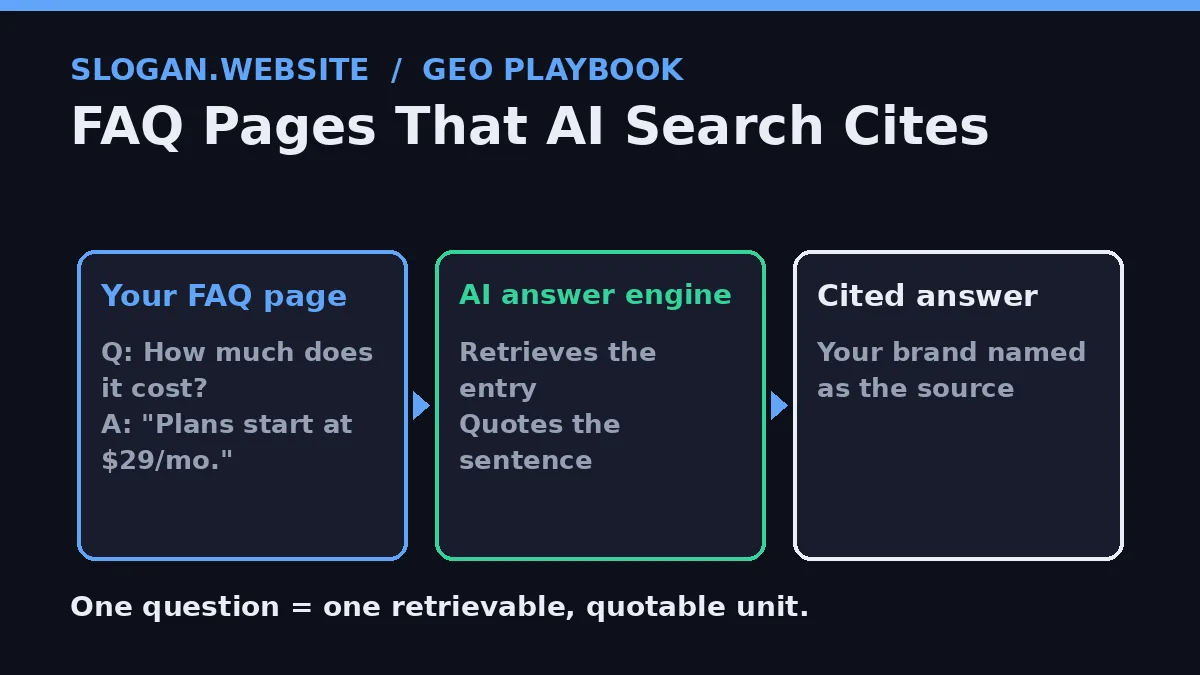
AI answer engines love FAQ pages for a structural reason: a good FAQ is already chunked the way retrieval works. One question, one self-contained answer, no assembly required. When ChatGPT, Perplexity, Gemini, or Google AI Overviews needs a quotable sentence, a clean FAQ entry is the lowest-friction source on your site.
Most small-business FAQ pages waste that advantage. The questions are invented, the answers are vague, and the schema does not match the visible text. This guide fixes all three so your FAQ page becomes a citation source instead of filler.
Why FAQ format matches AI retrieval
Answer engines do not read your page like a visitor does. They split content into passages, score each passage against the user's question, and quote the best match. FAQ pages arrive pre-split.
- One question equals one intent. Each entry targets a single conversational query, which is exactly what conversational query research tells you to map.
- Answers are self-contained. A good FAQ answer restates the context, so the quoted sentence makes sense without the rest of the page. See the answer-extraction writing guide for the sentence pattern.
- Headings are the questions. Verbatim customer phrasing in H3s matches the natural-language queries people ask AI assistants.
- Shorter distance to the quote. No narrative buildup means the extractor finds the fact in the first sentence, not paragraph six.
If your FAQ answers only make sense after reading the whole page, they will not survive extraction. Rewrite each one to stand alone.
The anatomy of a citable FAQ entry
Every entry that earns citations follows the same five-part shape.
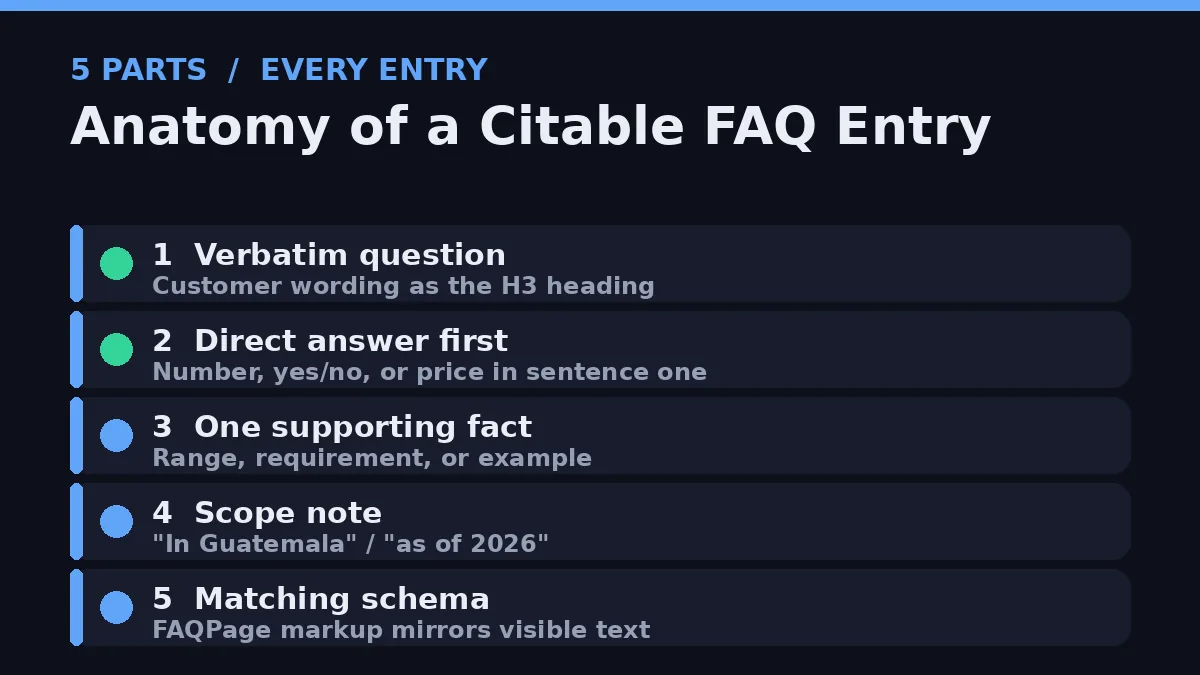
- Verbatim question as the heading. Use the words customers actually type or speak, not your internal terminology. Mine support tickets, sales calls, reviews, and People Also Ask.
- Direct answer in the first sentence. Lead with the number, yes/no, price, timeframe, or definition. Context and caveats come after.
- One supporting fact. A second sentence with a concrete detail (a range, a requirement, an example) gives the extractor a complete quotable block.
- Scope note where it matters. "In Guatemala," "for residential plans," "as of 2026" prevents your quote from being used as a universal claim.
- Matching FAQPage schema. Mark up exactly the visible question and answer text. For the full implementation, follow the schema markup guide for AI search.
An entry missing any of these still renders fine for humans but underperforms for machines. The first sentence carries most of the weight.
Pick questions buyers actually ask
Invented FAQs are easy to spot: generic, overlapping, and oddly confident about things nobody asked. AI systems prefer sources that mirror real query language, so source your questions from evidence.
- Support inbox and sales calls. The last 20 real questions beat any brainstorming session.
- People Also Ask and autocomplete. Copy the phrasing, then answer better than the current winner.
- Reviews and testimonials. Complaints and praise both reveal the questions prospects ask before buying.
- Your own AI referral data. Check which queries already surface your brand in the AI referral tracking workflow and build entries around them.
- Competitor FAQ gaps. If rivals all answer pricing but nobody answers timelines or requirements, that gap is yours.
Group related questions on one page and split unrelated topics. A pricing FAQ, a shipping FAQ, and a requirements FAQ each beat one mega-page, and each can earn its own citations.
Good entries vs citation killers
| Pattern | Citable version | Citation killer |
|---|---|---|
| First sentence | "Plans start at $29/month and include setup." | "That depends on many factors we would love to discuss." |
| Specificity | Names a price, timeframe, or requirement | "Affordable," "fast," "high quality" with no numbers |
| Self-containment | Restates the subject so the quote works alone | "Yes, we do" with the context three paragraphs up |
| Question wording | Customer phrasing from tickets and PAA | Internal jargon nobody searches for |
| Schema | Mirrors the visible text exactly | Hidden markup stuffed with extra keywords |
| Freshness | Prices, dates, and policies current | 2023 answers ranking in 2026 queries |
Keep schema honest and current
FAQPage schema is a citation amplifier, not a ranking trick. Treat it as a mirror of the page, and maintain it like one.
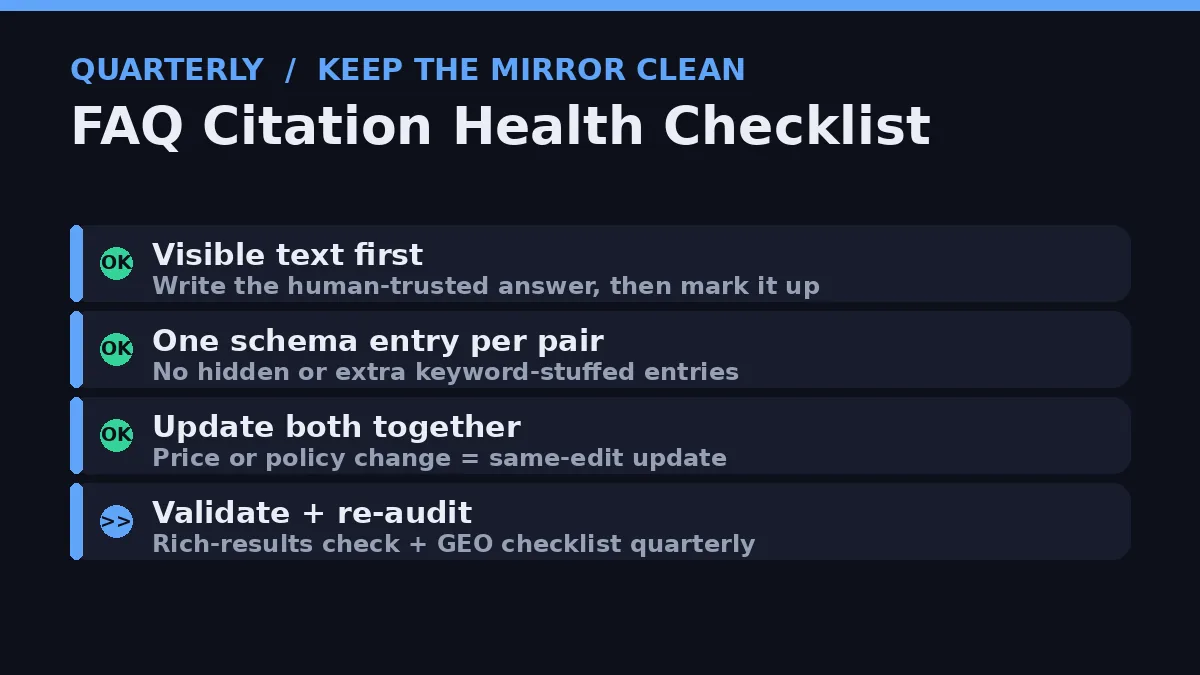
- Visible text first, markup second. Write the answer a human would trust, then encode it. Never the reverse.
- One schema entry per visible Q/A pair. No extra entries for content that is not on the page.
- Update both together. When a price or policy changes, the visible text and the schema change in the same edit. Stale schema plus fresh text (or vice versa) erodes trust with both Google and AI crawlers.
- Validate after every change. Run the page through a rich-results check and re-run the GEO visibility checklist quarterly so crawler access, entity clarity, and structured data stay green together.
Measure whether it works
FAQ work pays off in citations, not just clicks. After publishing, track both sides with the AI citation tracking workflow: check whether your entries appear as quoted sources in ChatGPT, Perplexity, Gemini, and Google AI Overviews for your priority questions, and watch Search Console for FAQ rich-result impressions on the page.
If an entry is indexed but never cited after 6 to 8 weeks, the usual culprits are a vague first sentence, a question nobody asks verbatim, or a stronger competitor entry with concrete numbers. Rewrite the lead sentence with a fact, align the heading with real query phrasing, and re-check. One focused revision round beats adding ten more thin entries.